Chimeric Sequence Contamination in Viromics: Identification, Prevention, and Mitigation Strategies for Researchers
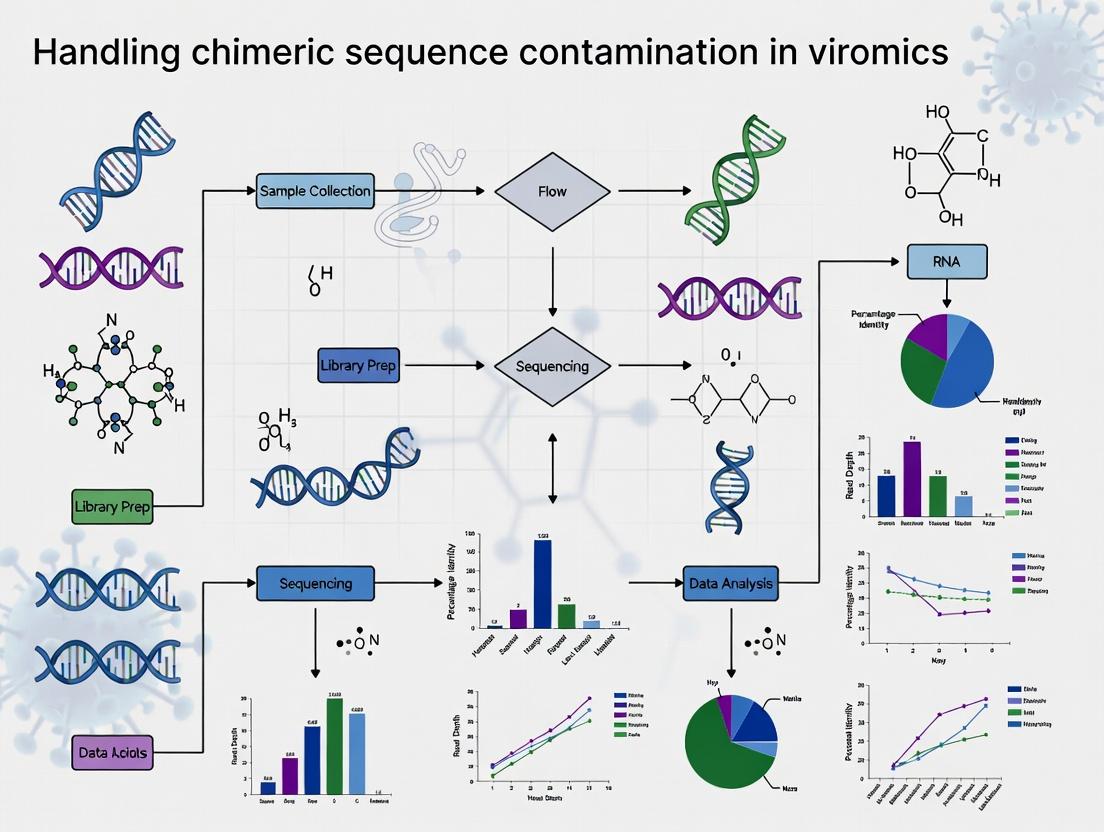
This article provides a comprehensive guide for researchers, scientists, and drug development professionals on handling chimeric sequence contamination in viromic studies.
Chimeric Sequence Contamination in Viromics: Identification, Prevention, and Mitigation Strategies for Researchers
Abstract
This article provides a comprehensive guide for researchers, scientists, and drug development professionals on handling chimeric sequence contamination in viromic studies. It covers the fundamental origins and impact of chimeras, details current methodological approaches for detection and removal, offers troubleshooting and optimization protocols for common issues, and presents validation strategies to ensure data integrity. By synthesizing the latest tools and best practices, this guide aims to enhance the accuracy and reliability of viral metagenomics in biomedical research.
What Are Chimeric Sequences? Understanding the Origins and Impact on Viromics Data
Technical Support Center: Troubleshooting Chimeric Sequences in Viromics
Frequently Asked Questions (FAQs)
Q1: My negative controls (e.g., no-template, extraction blanks) are showing sequence reads. Is this chimeric contamination? A: Yes, this is a primary indicator of chimeric contamination or index-hopping. Sequences in negative controls almost always result from artificial recombination during PCR or from barcode misassignment between samples on a sequencing lane. Proceed to the Troubleshooting Guide below.
Q2: After bioinformatic de novo assembly, I am seeing contigs that combine regions from two different viral families. Is this a novel recombinant virus or a chimera? A: This is a critical distinction. First, you must rigorously rule out an artifact. Key indicators of an artifact include: 1) The breakpoint aligns perfectly with a primer-binding site used in your amplification, 2) The two parent sequences are both present in other samples sequenced on the same run, 3) The chimera is not supported by paired-end reads spanning the entire breakpoint. Validate potential biological recombinants with targeted PCR and Sanger sequencing.
Q3: I am using a high-fidelity polymerase, but I still observe chimeras. Why? A: High-fidelity polymerases reduce point mutations but do not eliminate chimera formation. Chimeras primarily form during later PCR cycles due to incomplete extension. When a polymerase pauses and dissociates, the nascent strand can act as a primer on a heterologous template in a subsequent cycle. This is a function of cycle number and template quality/quantity.
Troubleshooting Guide
| Symptom | Likely Cause | Recommended Action | Validation Method |
|---|---|---|---|
| High chimera rate in all samples | Excessive PCR cycles | Reduce amplification cycles to the minimum required (e.g., ≤35 cycles). | Re-run a subset with 25, 30, and 35 cycles; quantify chimeras via uchime_ref in VSEARCH. |
| Chimeras only in samples with high template concentration | Polymerase incompletion due to complex template | Dilute template input and/or use a polymerase blend optimized for complex templates. | Perform dilution series (e.g., 1:1, 1:10, 1:100 template) and compare chimera rates. |
| Chimeras in multiplexed sequencing runs | Index hopping (crosstalk) | Use unique dual indexing (UDI) and limit sample multiplexing. Apply bioinformatic filtering based on expected index pairs. | Process raw data through deindexer or plexc. |
| Chimeras linking very divergent sequences | Bioinformatic assembly errors | Increase stringency in assembly overlap (e.g., minimum 98% identity over 50 bp). Use hybrid (short-read + long-read) assembly. | Visualize read overlaps in the suspect region using a tool like Consed or Bandage. |
Quantitative Data on Chimera Formation
Table 1: Impact of PCR Cycle Number on Chimera Formation (Simulated Virome Data)
| PCR Cycles | Mean Chimeras Detected (%) | Data Source |
|---|---|---|
| 25 | 1.2 ± 0.5 | (Edgar et al., 2011) Benchmark |
| 30 | 3.5 ± 1.1 | (Edgar et al., 2011) Benchmark |
| 35 | 8.7 ± 2.3 | (Edgar et al., 2011) Benchmark |
| 40 | 15.1 ± 4.0 | (Edgar et al., 2011) Benchmark |
Table 2: Chimera Detection Tool Comparison (Sensitivity/Specificity)
| Tool | Algorithm | Avg. Sensitivity (%) | Avg. Specificity (%) | Best For |
|---|---|---|---|---|
| UCHIME2 (Ref) | Reference-based | 98.5 | 99.8 | When a trusted reference DB exists |
| UCHIME2 (De novo) | Abundance-based | 95.2 | 96.7 | Novel sequences, no reference |
VSEARCH uchime3_denovo |
Abundance-based | 96.8 | 97.5 | Large datasets, speed |
| ChimeraSlayer | Window-based | 92.1 | 94.3 | 16S rRNA gene studies |
Experimental Protocol: In vitro Chimera Formation Assay
Purpose: To empirically determine the chimera formation rate of your specific PCR protocol. Materials: See "Research Reagent Solutions" below. Method:
- Template Preparation: Use two genetically distant, cloned viral target sequences (e.g., Phage ΦX174 and Phage Lambda DNA) at a known, equimolar concentration (e.g., 10⁸ copies/µL each).
- PCR Setup: Set up a single PCR reaction containing both templates using your standard viromics amplification primers (e.g., random hexamers with a linker sequence) and polymerase.
- Amplification: Run for 40 cycles to maximize artifact formation.
- Library Prep & Sequencing: Prepare a sequencing library from the PCR product and sequence on a mid-output flow cell (2x150 bp).
- Bioinformatic Analysis:
a. Reference Mapping: Map reads to a combined reference of the two parent sequences using
bowtie2with very sensitive settings. b. Chimera Calling: Extract reads that map to both references. Require a minimum alignment length of 50 bp to each parent with a clear, sharp breakpoint. c. Quantification: Calculate the chimera rate as:(Number of chimeric reads / Total mapped reads) * 100.
Visualization: Experimental and Computational Workflows
Title: Viromics Workflow with Chimera Generation & Detection Points
Title: PCR Chimera Formation Mechanism
The Scientist's Toolkit: Research Reagent Solutions
Table 3: Essential Reagents for Chimera Management
| Item | Function | Recommendation & Rationale |
|---|---|---|
| High-Fidelity Polymerase Blend | Amplifies nucleic acids with minimal point errors. | Use blends containing a proofreading polymerase and a non-proofreading polymerase (e.g., Phusion High-Fidelity, Q5 Hot Start). The non-proofreading component can complete extension of paused strands, reducing chimera precursors. |
| Unique Dual Index (UDI) Kits | Uniquely labels each sample with two different barcodes. | Critical for multiplexing. Prevents index hopping from being misidentified as chimeric reads. Kits from Illumina (Nextera) or IDT are standard. |
| Clean-room Validated PCR Reagents | Pre-packaged, sterile master mixes and water. | Minimizes contamination from environmental nucleic acids, a common source of "parent" sequences for chimeras in blanks. |
| Magnetic Bead Cleanup Kits | Size-selection and purification of amplicons. | Removes primer-dimers and very short fragments that increase template complexity and promote incomplete PCR extension. |
| Synthetic Spike-in Controls | Non-biological DNA/RNA sequences. | Added to samples pre-extraction. Detects cross-sample contamination and provides an internal standard for chimera rate calculation. |
| Chimera Detection Software | Identifies artificial sequences. | VSEARCH/UCHIME2: For general use. DECIPHER: For high-sensitivity on difficult templates. Must be run in de novo mode for novel viromes. |
Troubleshooting Guides & FAQs
Q1: During amplicon sequencing of viral populations, I am observing a high percentage of chimeric sequences. What is the most likely primary source in my workflow? A: The most likely primary source is PCR-mediated recombination via incomplete extension. During later PCR cycles, partially extended strands from one template can dissociate and act as primers on a different, homologous template, creating a recombinant chimeric sequence. This is exacerbated by high template complexity, excessive cycle numbers, and long extension times.
Q2: How can I distinguish between true biological recombination and PCR-generated chimeras? A: True biological recombinants are typically supported by multiple, independent sequencing reads derived from different PCR reactions (technical replicates). PCR-generated chimeras are stochastic and non-reproducible across replicate amplifications. Implementing a replicate negation protocol, where sequences not found in at least two independent amplifications are filtered out, is a standard control.
Q3: Which polymerase is best for minimizing PCR-mediated recombination? A: Polymerases with high processivity and strand displacement activity increase recombination. For amplicon sequencing of mixed viral templates, use high-fidelity polymerases with 3'→5' exonuclease (proofreading) activity and low strand displacement. Critical parameters are more important than the brand.
| Polymerase Characteristic | Impact on Recombination | Recommended Choice |
|---|---|---|
| Processivity | High processivity reduces dissociation, lowering risk. | High |
| Strand Displacement | High activity increases template switching. | Low/None |
| Proofreading | Minimizes misincorporation but not directly linked to recombination. | Yes (for fidelity) |
| Extension Speed | Faster speed may reduce pausing/dissociation. | Fast |
Q4: What PCR cycle parameters should I optimize to reduce chimera formation? A: Optimize your protocol around the following key parameters:
| Parameter | Problematic Setting | Optimized Setting | Rationale |
|---|---|---|---|
| Cycle Number | >35 cycles | As low as possible (20-30) | Limits substrate for late-cycle template switching. |
| Extension Time | Excessively long | Just sufficient for full-length product | Reduces time for incomplete strands to dissociate. |
| Template Concentration | Very low (<10^3 copies) | Moderate-High (10^3-10^6 copies) | Low copy number increases late-cycle replication of early chimeras. |
| Denaturation Time | Long | Short but complete | Minimizes DNA damage that creates fragmentation. |
Q5: Are there specific library preparation or bioinformatic tools to identify and remove these artifacts? A: Yes. Use unique molecular identifiers (UMIs) to tag original templates before amplification. Bioinformatically, cluster reads by UMI to consensus, eliminating PCR duplicates and chimeras. Post-sequencing, tools like UCHIME2, DADA2, or USEARCH can reference-based or de novo chimera detection.
Q6: Can you provide a detailed protocol to empirically measure chimera formation rate in my specific assay? A: Protocol: Measuring PCR-Mediated Chimera Formation Rate
- Design: Create two artificial template variants (A and B) with high sequence homology (>95%) but distinct, centrally located 10-12 nucleotide "tags."
- Mix: Combine templates A and B at a known ratio (e.g., 1:1) and a total concentration mimicking your experimental samples.
- Amplify: Perform your standard PCR protocol (N=30 cycles) and a second, "high-risk" protocol (N=40 cycles, longer extension).
- Sequence: Perform high-depth amplicon sequencing spanning the tag region.
- Analyze: Classify reads as A-only, B-only, or A-B recombinant (containing both tags). The chimera formation rate is calculated as:
(Number of A-B Recombinant Reads) / (Total Number of Reads) * 100% - Compare: The difference in rates between the two protocols reveals the impact of your cycling parameters.
The Scientist's Toolkit: Research Reagent Solutions
| Item | Function in Mitigating PCR Recombination |
|---|---|
| High-Fidelity, Low-Strand Displacement Polymerase (e.g., Q5, KAPA HiFi) | High processivity and accuracy with minimal strand displacement reduces template switching events. |
| Unique Molecular Identifiers (UMIs) | Short random nucleotide sequences ligated to template DNA before PCR; enables bioinformatic distinction of original molecules from PCR-derived chimeras/duplicates. |
| DMSO or Betaine | Additives that reduce secondary structure, allowing more uniform extension and reducing polymerase pausing/dissociation. |
| Optimized dNTP/Mg2+ Buffers | Balanced cation concentration and dNTPs prevent polymerase stalling, a precursor to template switching. |
| PCR Purification Beads (Solid Phase Reversible Immobilization) | Clean-up post-amplification to remove primers, dimer, and partially extended products that could cause issues in downstream steps. |
Visualizations
(Title: PCR-Mediated Chimera Formation Mechanism)
(Title: Experimental Chimera Mitigation Workflow)
Library Preparation and Sequencing Artifacts as Contributing Factors
Technical Support Center
Troubleshooting Guides & FAQs
Q1: Why do I observe a high percentage of chimeric reads in my virome sequencing data? A: Chimeric sequences in viromics often arise during library preparation, primarily from incomplete PCR extension. In metagenomic samples with highly similar viral sequences, partially extended fragments can act as primers in subsequent cycles, leading to artificial recombinants. A recent study found that using a polymerase with high processivity and fidelity reduced chimera formation from ~15% to ~2% in mock viral communities.
Q2: What specific library prep steps most contribute to index hopping, and how can it be mitigated? A: Index hopping, or index misassignment, is prevalent on patterned flow cell platforms (e.g., Illumina NovaSeq). It occurs when free indexing oligos in the pool hybridize to other library molecules. Key contributing steps are the pooling of libraries before cleanup and over-amplification. Mitigation strategies include using dual-unique index combinations, performing a clean-up post-ligation and post-PCR, and following the manufacturer's recommended pooling protocols. Data indicates that using unique dual indexes (UDIs) can reduce the cross-talk rate from ~2.5% to <0.5%.
Q3: How do I distinguish between a true viral recombination event and a sequencing artifact?
A: True biological recombinants typically have a precise breakpoint, while PCR-mediated chimeras often have ragged junctions. Experimental validation is key. First, re-extract nucleic acids and re-prepare the library using a polymerase mixture with proofreading and high fidelity. Second, use bioinformatic tools like UCHIME2, DADA2, or PEAR with stringent parameters. If the "recombinant" sequence disappears or drastically drops in abundance with modified wet-lab protocols, it is likely an artifact. A 2023 benchmark study showed that combining wet-lab duplication with DADA2 denoising correctly identified 99% of spiked-in artificial chimeras.
Q4: Does nucleic acid extraction method influence artifact generation? A: Yes. Extraction methods that shear DNA (e.g., vigorous bead beating) create shorter fragments that are more prone to forming chimeras during later amplification due to higher sequence similarity across fragments. Furthermore, kits that do not efficiently remove humic acids or inhibitors can lead to partial polymerase stalling, increasing incomplete extensions. Protocols optimized for viral particles (e.g., filtration and DNase treatment of free DNA) yield longer, more intact templates.
Table 1: Impact of Library Preparation Protocols on Artifact Generation
| Protocol Variable | Standard Protocol Artifact Rate (%) | Optimized Protocol Artifact Rate (%) | Key Change |
|---|---|---|---|
| Polymerase Type | 12.5 | 1.8 | Switch from Taq to high-fidelity mix |
| PCR Cycles | 35 cycles: 15.2 | 25 cycles: 3.1 | Reduced amplification |
| Fragment Size | <200 bp: 10.5 | >500 bp: 2.8 | Size selection post-sonication |
| Index Type | Single Index: 2.4 | Unique Dual Index: 0.3 | Implemented UDIs |
| Clean-up Steps | Single post-PCR: 8.7 | Post-ligation & post-PCR: 4.2 | Added bead clean-up |
Table 2: Bioinformatics Tool Efficacy for Chimera Detection (Mock Virome Data)
| Tool | Sensitivity (%) | Specificity (%) | Runtime (min) | Recommended Use Case |
|---|---|---|---|---|
| UCHIME2 | 95.1 | 98.7 | 25 | Reference-based detection |
| DADA2 | 91.3 | 99.5 | 45 | Amplicon data denoising |
| PEAR | 88.7 | 97.2 | 15 | Paired-end read merging |
| de novo UCHIME | 85.4 | 94.8 | 60 | No reference available |
Experimental Protocols
Protocol 1: Optimized Viromics Library Preparation to Minimize Chimeras
- Nucleic Acid Extraction: Use a viral-particle-protected protocol (0.22µm filtration, DNase I treatment of free nucleic acids, followed by QIAamp Viral RNA Mini Kit).
- Fragment Integrity Check: Run extract on Agilent Bioanalyzer (High Sensitivity DNA chip). Do not proceed if the majority of material is <500bp.
- Library Construction:
- Use the NEBNext Ultra II FS DNA Library Prep Kit.
- For amplification, use KAPA HiFi HotStart ReadyMix (or equivalent). Do not exceed 25 PCR cycles.
- Use uniquely dual-indexed adapters (e.g., IDT for Illumina UDIs).
- Double-Sided Size Selection: Perform two rounds of bead-based clean-up (e.g., with AMPure XP beads) – once after adapter ligation (0.8X ratio) and once after final PCR (0.9X ratio) – to remove short fragments.
- Pooling: Quantify libraries by qPCR (e.g., KAPA Library Quantification Kit). Pool equimolar amounts just before loading on the sequencer. Do not store pooled libraries long-term.
Protocol 2: Wet-Lab Validation of Suspected Chimeric Sequences
- Re-amplification from Source: Re-extract nucleic acid from the original sample aliquot (never re-use the same library prep nucleic acid).
- Targeted Re-sequencing: Design primers specific to the flanking regions of the suspected chimeric junction.
- Alternative Polymerase Re-amplification: Perform PCR using a long-range, high-fidelity polymerase system (e.g., PrimeSTAR GXL).
- Clone and Sanger Sequence: Clone the resulting amplicon into a plasmid vector. Sequence 20+ colonies via Sanger sequencing.
- Analysis: If the chimeric junction is absent in all Sanger sequences, the original read is confirmed as a library prep artifact.
Visualizations
Title: Workflow for Minimizing Sequencing Artifacts in Viromics
Title: Decision Logic for Classifying Chimeric Sequences
The Scientist's Toolkit: Research Reagent Solutions
Table 3: Essential Materials for Artifact-Reduced Viromics
| Item | Function | Example Product |
|---|---|---|
| High-Fidelity Polymerase Mix | Reduces misincorporation and incomplete extension errors during PCR, the primary source of chimeras. | KAPA HiFi HotStart ReadyMix, NEBNext Q5U |
| Unique Dual Index (UDI) Adapters | Uniquely labels each molecule on both ends, mitigating index hopping and enabling precise sample demultiplexing. | IDT for Illumina UDIs, Nextera UD Indexes |
| Size Selection Beads | Removes short DNA fragments that increase template switching and improves library uniformity. | AMPure XP Beads, SPRIselect |
| DNase I, RNase-free | Digests unprotected nucleic acids outside viral capsids, enriching for true viral sequences and reducing host background. | Thermo Scientific DNase I |
| Long-Range PCR Kit | For wet-lab validation; amplifies across suspected chimera junctions with high fidelity to confirm structure. | PrimeSTAR GXL DNA Polymerase |
| Nucleic Acid Integrity Assay | Assesses fragment length distribution of input material; poor integrity predicts higher artifact rates. | Agilent High Sensitivity DNA Kit |
| Library Quantification Kit (qPCR-based) | Accurately measures amplifiable library concentration for balanced pooling, preventing over-cycling. | KAPA Library Quantification Kit |
Troubleshooting Guides & FAQs
Q1: Our virome assembly shows an unusually high number of novel viral sequences with low homology to known databases. Could this be due to chimeras, and how can we verify? A1: Yes, chimeric sequences can falsely inflate novelty metrics. Verification Protocol:
- De-novo vs. Reference-based Mapping: Assemble reads de-novo, then map the resulting contigs back to the raw reads using a tool like Bowtie2. Also, map reads directly to a reference database (e.g., RVDB). A significant discrepancy in mapping rates (>15%) suggests chimeras.
- Split-Read Analysis: Use a tool like UMI-aware deduplication (if UMIs were used) or bbduk.sh (from BBMap suite) to identify reads where the 5' and 3' ends map to distinct reference sequences.
- In silico PCR & Primer Matching: Extract contig ends and perform a BLASTn search. Ends mapping to phylogenetically distant hosts/viruses indicate a likely chimera.
Q2: During multiplexed sequencing of multiple samples, we suspect index-hopping or cross-sample chimeras. What is the definitive check? A2: Implement a bioinformatic filter using negative controls and unique dual indices (UDIs).
- Protocol: Include a sterile water control in your sequencing run. Process it identically to samples. Any contig forming in the control that also appears in true samples is a cross-contaminant chimera. Use UDIs and a pipeline like decontam (R package) to statistically identify and remove contaminants based on prevalence in negative controls vs. real samples.
Q3: Our PCR-amplified virome libraries show dominant "phantom" viral families not consistent with the host. What wet-lab steps prevent this? A3: This indicates amplification chimeras formed during library prep.
- Mitigation Protocol:
- Limit PCR Cycles: Keep cycles to an absolute minimum (≤25 cycles).
- Use High-Fidelity Polymerases: Enzymes with 3'→5' exonuclease activity (e.g., Q5, Phusion) reduce mis-priming.
- Non-PCR Methods: Implement transposase-based (Nextera) or ligation-based library prep where feasible.
- Post-PCR Validation: For suspicious contigs, design primers spanning the putative chimera junction and attempt re-amplification from the original, non-amplified nucleic acid extract. Failure to amplify confirms a PCR artifact.
Q4: What is the most effective bioinformatic pipeline for chimera removal in viral metagenomics? A4: A layered, tool-agnostic approach is best. No single tool catches all chimeras.
- Workflow:
- Pre-assembly Filtering: Use Kraken2 against a host genome to remove host reads.
- Chimera-aware Assembly: Use metaSPAdes or IDBA-UD with careful k-mer range selection.
- Post-assembly Screening: Run contigs through UCHIME2 (reference and de-novo modes) and VirFinder.
- Manual Curation: For high-interest contigs, visualize read mapping (in Geneious or IGV) to check for uniform coverage and sharp coverage drops at junctions.
Q5: How do we quantify the rate of chimeric sequence generation in our specific lab protocol? A5: Perform a spike-in control experiment.
- Quantification Protocol:
- Spike a known, low-biomass viral control (e.g., PhiX 174) at a ~1% level into a sterile background.
- Process the sample through your entire extraction, amplification, and sequencing pipeline.
- Assemble the data de-novo and map all contigs to the PhiX genome.
- Identify any contigs where portions map to PhiX and other portions do not map to any known sequence in your databases. The percentage of such contigs relative to total PhiX-mapping contigs is your empirical chimera formation rate.
Research Reagent Solutions Toolkit
| Item | Function & Rationale |
|---|---|
| Unique Dual Indexes (UDIs) | Uniquely labels each sample with two index barcodes, enabling precise bioinformatic identification and removal of index-hopping artifacts. |
| UMI Adapter Kits | Adds Unique Molecular Identifiers to each cDNA fragment before amplification, allowing post-sequencing deduplication and identification of PCR/sequencing duplicates that may be chimeric. |
| High-Fidelity PCR Master Mix | Polymerase with proofreading reduces nucleotide mis-incorporation, a precursor to chimeras, during amplification steps. |
| dsDNA Fragmentase | For generating fragmentation-based libraries without PCR, eliminating PCR-induced chimeras. |
| RNase H & DSN Enzyme | Depletes ribosomal cDNA in RNA viromes, reducing background that can form chimeras with viral sequences. |
| Negative Control RNA/DNA Spike | Synthetic, non-natural sequences (e.g., SIRVs, ERCC) added to samples to empirically track chimera formation and cross-contamination rates. |
Table 1: Chimera Detection Tool Performance Comparison (Simulated Dataset)
| Tool | Sensitivity (%) | Specificity (%) | Run Time (min) | Best Use Case |
|---|---|---|---|---|
| UCHIME2 | 92.1 | 98.7 | 45 | Post-assembly, reference-based |
| VSEARCH | 89.5 | 99.2 | 38 | Clustered OTU data |
| DECONTAM | 95.3 | 99.8 | 5 | Cross-sample contamination |
| Chimeraslayer | 85.7 | 97.9 | 120 | Complex community data |
Table 2: Impact of PCR Cycles on Chimera Formation
| Number of PCR Cycles | % Chimeric Contigs (Mean ± SD) | N50 of Assembly (bp) |
|---|---|---|
| 15 Cycles | 2.1 ± 0.7 | 8,542 |
| 25 Cycles | 8.5 ± 2.3 | 7,891 |
| 35 Cycles | 24.8 ± 5.1 | 5,233 |
Experimental Protocols
Protocol 1: In vitro Chimera Formation Rate Assay Objective: Quantify chimera generation during reverse transcription and PCR. Steps:
- Spike-in Preparation: Combine two distinct, purified RNA viruses (e.g., MS2 and Phi6) at a 1:1 ratio in a nuclease-free buffer.
- Nucleic Acid Extraction: Extract RNA using a column-based kit. Include a no-template control (NTC).
- Reverse Transcription: Use random hexamers and a reverse transcriptase (e.g., SuperScript IV). Split the product: one half proceeds, the other is stored.
- PCR Amplification: Amplify the cDNA using viral-family consensus primers. Create aliquots subjected to 20, 25, 30, and 35 cycles.
- Sequencing & Analysis: Sequence all products on a MiSeq. Map reads to both reference genomes. Chimeras are defined as reads where ≥ 25% of length maps to each virus.
Protocol 2: Bioinformatic Chimera Detection & Curation Workflow Objective: Identify and remove chimeric sequences from a metagenomic assembly. Steps:
- Quality Filtering: Use
fastpto trim adapters and low-quality bases (Q<20). - Host Subtraction: Map reads to the host genome using
Bowtie2(sensitive mode) and retain unmapped reads. - De-novo Assembly: Assemble filtered reads using
metaSPAdeswith k-mer sizes 21, 33, 55. - Chimera Screening: Run all contigs >500bp through
UCHIME2in de-novo mode. Run a parallel screen against a curated viral database (RVDB) in reference mode. - Coverage Validation: For contigs flagged by UCHIME, map raw reads back using
BBMap. Visualize inIGV. Discard contigs with <5x coverage or sharp, unexplained coverage drops.
Visualization
Title: Viromics Workflow with Chimera Detection Points
Title: Chimera Formation Pathways & Impact on Diversity
Distinguishing Chimeras from Natural Recombinants and Quasispecies
Technical Support Center: Troubleshooting Chimeric Sequence Contamination in Viromics
Frequently Asked Questions (FAQs)
Q1: How do I determine if a detected recombinant viral sequence is a true natural recombinant or a PCR/sequencing artifact (chimera)? A1: True natural recombinants are supported by phylogenetic evidence across different genomic regions and are reproducible across independent PCRs and sequencing runs. Chimeric artifacts are often sporadic, appear only in specific amplicons, and show sharp breakpoints that correlate with primer binding sites or low-complexity regions. Implement a wet-lab validation protocol (see below).
Q2: What bioinformatic tools are most reliable for initial chimera detection in high-throughput sequencing data? A2: The consensus is to use a combination of tools, as no single tool is 100% accurate. For Illumina short-read data, use reference-based and de novo approaches in parallel. Key tools and their optimal use cases are summarized in Table 1.
Q3: Our quasispecies reconstruction is showing high levels of putative recombinants. Could these be chimeras from library preparation? A3: Yes, this is a common issue. Template-switching during reverse transcription or PCR amplification in library prep can generate in-vitro recombinants that masquerade as a complex quasispecies. Utilize protocols with high-fidelity, template-switching inhibitors, and conduct dilution experiments to assess chimera formation rates.
Q4: What is the critical negative control experiment to rule out lab-generated chimeras? A4: The essential control is a dilution series experiment. By serially diluting the template RNA/DNA before amplification, you can observe if the frequency of putative recombinant sequences decreases proportionally. Artifactual chimeras often increase in frequency with higher template concentration due to increased template-switching opportunities.
Q5: How can we distinguish a quasispecies from a mixture of chimeric sequences? A5: A true quasispecies will show a continuum of related mutations, with haplotype frequencies that follow a power-law distribution. A chimeric mixture often reveals discrete, poorly supported haplotype clusters with incongruent phylogenetic signals across the genome. Use single-genome amplification (SGA) or linked-read sequencing as a confirmatory method.
Troubleshooting Guides
Issue: High Chimera Flags in Metagenomic Data Post-UCHIME/DADA2.
- Potential Cause: Overly aggressive amplification cycles or poor-quality template DNA with breaks.
- Solution: Re-process samples with a modified PCR protocol: reduce cycle number (e.g., from 35 to 25), increase elongation time, and use a polymerase mix with proofreading and anti-template-switching properties. Re-analyze with both
UCHIME3(reference mode) andDADA2'sremoveBimeraDenovofunction, comparing outputs.
Issue: Putative Recombinants Identified by RDP5 are Not Phylogenetically Plausible.
- Potential Cause: The detected breakpoints may fall within regions of poor sequence alignment or conserved motifs, leading to false recombination signals.
- Solution: Visually inspect alignments at breakpoints using
SimPlotorRDP5. Re-run analysis with trimmed alignments to remove poorly aligned regions. Validate findings withGARD(Genetic Algorithm for Recombination Detection) for a model-based assessment.
Issue: Inconsistent Recombinant Detection Between Different Sequencing Platforms (Illumina vs. Oxford Nanopore).
- Potential Cause: Platform-specific artifacts; PCR artifacts in Illumina vs. consensus errors in Nanopore.
- Solution: For Nanopore, require support from independent reads spanning the entire recombinant junction. For Illumina, require the recombinant pattern to be present in multiple, non-overlapping read pairs. A concordant signal across platforms strongly supports a natural recombinant.
Experimental Protocols
Protocol 1: Dilution Series to Quantify In-vitro Chimera Formation.
- Extract viral RNA/DNA from the sample.
- Prepare a 10-fold serial dilution (e.g., 100 to 10-4) of the template.
- Amplify each dilution in triplicate using your standard diagnostic PCR or RT-PCR assay.
- Clone the amplicons from each dilution (at least 20 clones per dilution) and perform Sanger sequencing.
- Analyze sequences for recombinant/chimeric patterns. Plot the frequency of chimeras against template concentration. A negative correlation suggests the chimeras are lab-generated artifacts.
Protocol 2: Single Genome Amplification (SGA) for Validation.
- Dilute extracted nucleic acid to a concentration estimated to yield PCR positivity in <30% of reactions (e.g., based on digital PCR). This ensures most positive wells contain a single template molecule.
- Distribute the dilution across 96-well PCR plates (e.g., 1 µL per well) with master mix containing outer primers.
- Perform first-round PCR.
- Screen wells for positivity using gel electrophoresis.
- Use 1 µL of positive first-round product as template for a second, nested PCR in a new plate.
- Sequence the nested products directly. Each sequence is derived from a single founding template, eliminating the possibility of in-vitro recombination during PCR.
Data Presentation
Table 1: Comparison of Bioinformatics Tools for Chimera/Recombinant Detection
| Tool Name | Best For | Key Principle | Input Data | Strength | Weakness |
|---|---|---|---|---|---|
| UCHIME3 | Screening metagenomic OTUs | Reference-based & de novo chimera detection | FASTA of OTUs/ASVs | Fast, sensitive to common parents | Requires a curated reference DB for best results |
DADA2 (removeBimeraDenovo) |
Amplicon Sequence Variants (ASVs) | De novo identification of bimera from error-corrected reads | ASV table & seqs | Integrated into ASV pipeline, model-based | Can be conservative; may miss some chimeras |
| RDP5 | Recombinant detection in alignments | Bootscanning, phylogenetic incongruence | Aligned sequences | Comprehensive suite of methods, visual | Can be slow for large datasets; complex output |
| SimPlot | Visualizing recombination | Similarity plotting & bootscanning | Aligned sequences | Excellent visualization, intuitive | Not automated for batch processing |
| GARD | Identifying recombination breakpoints | Model selection based on goodness-of-fit | Aligned sequences | Statistical rigor, identifies breakpoints | Computationally intensive |
Table 2: Research Reagent Solutions Toolkit
| Reagent / Material | Function in Chimera Mitigation | Example Product / Note |
|---|---|---|
| High-Fidelity Polymerase with Proofreading | Reduces misincorporation errors that can confuse quasispecies analysis and lowers template-switching frequency. | Q5 High-Fidelity DNA Polymerase, KAPA HiFi HotStart ReadyMix |
| Reverse Transcriptase with Low Template-Switching Activity | Critical for RNA viruses; minimizes artificial recombination during cDNA synthesis. | SuperScript IV (engineered for lower strand displacement) |
| dNTPs at Balanced Concentration | Prevents polymerase stalling due to depletion of a single dNTP, a cause of incomplete extensions that can lead to chimera formation. | Use standardized, pH-neutral dNTP solutions. |
| PCR Enhancers/Betaine | Reduces secondary structure in GC-rich templates, allowing smoother polymerase progression and reducing recombination-prone pauses. | Betaine, DMSO (optimize concentration). |
| Single-Tube Library Prep Kits | Minimizes handling and cross-contamination between samples, reducing inter-sample chimeras. | Illumina Nextera XT, Nanopore Rapid Barcoding Kit |
| Unique Molecular Identifiers (UMIs) | Tags each original molecule before amplification, allowing bioinformatic collapse of PCR duplicates and identification of chimeric reads post-PCR. | Common in RNA-seq and viromics kits. |
Mandatory Visualizations
Title: Decision Workflow for Classifying Recombinant Sequences
Title: Single Genome Amplification (SGA) Protocol Workflow
A Practical Pipeline: Methods and Tools for Detecting and Removing Chimeras
Technical Support Center
Troubleshooting Guides & FAQs
Q1: During PCR amplification for viromics library prep, I am observing low yield or no product. What are the primary causes and solutions?
A: This is commonly due to PCR inhibition from environmental contaminants or suboptimal reaction conditions.
- Cause: Co-purified inhibitors from sample processing (e.g., humic acids, heparin, salts) or inefficient primer binding due to high genomic complexity.
- Solution:
- Perform a 1:5 and 1:25 dilution of your template to dilute potential inhibitors.
- Increase the amount of polymerase by 10-20% and use a polymerase mix specifically formulated for inhibitor tolerance.
- Implement a touchdown PCR protocol (see Experimental Protocol 1 below) to increase specificity in complex samples.
- Re-quantify template DNA using a fluorometric method; ensure you are using the correct mass for your library prep kit's recommendations.
Q2: I am concerned about chimeric sequence formation during the PCR step of my viromics workflow. How can I minimize this?
A: Chimeras form when an incomplete amplicon acts as a primer on a heterologous template in subsequent cycles. This is a critical source of contamination in viromics.
- Cause: Excessive PCR cycle number, too short extension times, or template reannealing.
- Solution:
- Limit Cycles: Use the minimum number of PCR cycles necessary for adequate yield. Do not exceed 25-30 cycles.
- Optimize Extension Time: Calculate extension time based on polymerase speed (e.g., 15-30 seconds/kb for most polymerases).
- Use Modified Polymerases: Employ "high-fidelity" or "proofreading" polymerases that have lower processivity but higher fidelity, reducing premature dissociation.
- Apply a "Final Extension": A final 5-10 minute extension at the end of cycling ensures all amplicons are fully extended.
- Use Unique Molecular Identifiers (UMIs): Incorporate UMIs during reverse transcription or early PCR cycles to bioinformatically identify and remove chimeras post-sequencing.
Q3: My final NGS library shows high adapter-dimer contamination (~128bp peak). How do I prevent this during library preparation?
A: Adapter-dimer results from ligation or hybridization of free adapters to each other, which then amplify efficiently.
- Cause: Inefficient purification of insert DNA prior to adapter ligation, incorrect adapter:insert ratio, or over-amplification.
- Solution:
- Optimize Cleanup: Use double-sided size selection with SPRI beads (e.g., 0.5X left-side to remove large fragments, then 0.8X right-side to retain insert and remove small fragments).
- Quantify Pre-ligation: Precisely quantify fragmented DNA before adapter ligation to use the recommended adapter molarity (typically a 10:1 adapter:insert molar ratio).
- Dilute Adapters: If dimer persists, dilute the stock adapter mix 1:5.
- Use Quenched Adapters: Employ adapters with a double-strand oligo that must be cleaved by polymerase to become active, preventing adapter-to-adapter ligation.
Q4: My library complexity appears low. What wet-lab steps can improve diversity for viromics samples?
A: Low complexity often stems from over-amplification of a few dominant templates or starting with low input mass.
- Cause: PCR bottlenecking from too few initial molecules.
- Solution:
- Increase Input: Use the maximum recommended input DNA/RNA where possible.
- Reduce Amplification Bias: Switch to PCR enzymes and buffers designed for low-input and high-complexity libraries. Consider isothermal amplification methods for RNA steps.
- Pool Reactions: Perform multiple independent reverse transcription or first-strand synthesis reactions and pool them before amplification to mitigate early-cycle stochasticity.
Experimental Protocols
Protocol 1: Touchdown PCR for Enhanced Specificity in Complex Viromes
- Purpose: To increase primer binding specificity in samples with high genomic diversity and potential off-target host DNA.
- Procedure:
- Set up a standard 50 µL PCR reaction with a high-fidelity polymerase.
- Initial Denaturation: 98°C for 30 seconds.
- Touchdown Cycles (10 cycles): Denature at 98°C for 10 seconds. Anneal starting at 65°C for 20 seconds (decreasing by 0.5°C per cycle). Extend at 72°C for 15-30 seconds/kb.
- Standard Cycles (20 cycles): Denature at 98°C for 10 seconds. Anneal at 60°C for 20 seconds. Extend at 72°C for 15-30 seconds/kb.
- Final Extension: 72°C for 5 minutes.
- Hold at 4°C.
Protocol 2: Double-Sided SPRI Bead Size Selection for Adapter-Dimer Removal
- Purpose: To precisely select DNA fragments in the 300-700 bp range and remove short adapter-dimers (~128 bp).
- Procedure:
- Bring the adapter-ligated DNA product to a 100 µL volume with nuclease-free water.
- Remove Large Fragments: Add 50 µL of well-resuspended SPRI beads (0.5X ratio). Mix thoroughly. Incubate 5 min at RT. Pellet on magnet. Transfer 150 µL supernatant (contains desired small fragments) to a new tube.
- Recover Target Fragments: Add 120 µL of SPRI beads to the supernatant (0.8X ratio). Mix thoroughly. Incubate 5 min at RT. Pellet on magnet. Remove supernatant.
- Wash: With beads on magnet, wash twice with 200 µL of 80% ethanol. Air dry 5 min.
- Elute: Remove from magnet, elute in 25-30 µL of TE or nuclease-free water. Incubate 2 min at RT. Pellet beads and transfer purified library to a new tube.
Data Presentation
Table 1: Impact of PCR Cycle Number on Chimera Formation and Library Diversity
| PCR Cycles | Average Library Yield (nM) | % Chimeric Reads (Bioinformatic) | Estimated Unique Molecules Recovered |
|---|---|---|---|
| 20 | 15.2 | 2.5% | 4.8 x 10^7 |
| 25 | 42.7 | 8.1% | 5.1 x 10^7 |
| 30 | 89.5 | 22.3% | 3.9 x 10^7 |
| 35 | 120.1 | 45.6% | 1.2 x 10^7 |
Table 2: Comparison of High-Fidelity Polymerases for Viromics Library Amplification
| Polymerase | Processivity | Error Rate (mutations/bp) | Recommended Max Cycles | Adapter-Dimer Suppression |
|---|---|---|---|---|
| Polymerase A | High | 2.8 x 10^-6 | 25 | Low |
| Polymerase B | Medium | 1.5 x 10^-6 | 30 | Medium |
| Polymerase C | Low | 3.0 x 10^-7 | 20 | High (with additive) |
Mandatory Visualization
Diagram Title: Mechanism of Chimera Formation in PCR
Diagram Title: Viromics Library Prep Workflow with Risks & Preventative Steps
The Scientist's Toolkit: Research Reagent Solutions
Table 3: Essential Reagents for Chimera-Preventative Viromics Library Prep
| Reagent / Solution | Function in Prevention | Key Consideration |
|---|---|---|
| High-Fidelity DNA Polymerase | Reduces mis-incorporation errors and incomplete extension, a precursor to chimeras. | Check error rate and processivity. Use blends for balance. |
| Unique Molecular Identifiers (UMIs) | Enables bioinformatic identification and removal of chimeric reads post-sequencing. | Must be incorporated pre-amplification (e.g., during adapter ligation). |
| Double-Stranded DNA-Specific Nuclease | Digests linear dsDNA (host genomic) without affecting circular/viral nucleic acids. | Critical for reducing background in uncultured virome samples. |
| SPRI (Solid Phase Reversible Immobilization) Beads | Enables precise size selection to remove primer-dimers and optimize insert size distribution. | Ratios (e.g., 0.5X left-side, 0.8X right-side) are sample and kit-dependent. |
| Quenched or "Staggered" Adapters | Prevent self-ligation of adapters, drastically reducing adapter-dimer formation. | Often part of modern "forks" or "Y"-adapter designs in commercial kits. |
| PCR Inhibitor Removal Beads/Columns | Removes humic acids, polyphenols, and salts from environmental samples that inhibit polymerases. | Essential for soil, plant, or clinical viromics. |
Troubleshooting Guides & FAQs
FAQ 1: My chimera detection pipeline (using VSEARCH) is producing an unexpectedly high rate of chimeric sequences (>50%). What could be the cause and how can I resolve this?
- Answer: An abnormally high chimeric rate often indicates issues upstream of the chimera check, typically during PCR amplification or sequence quality filtering.
- Primary Cause: Excessive PCR cycles during library preparation for viromics. More cycles increase the chance of incomplete extensions, which act as primers in subsequent cycles, generating chimeras in vitro.
- Troubleshooting Steps:
- Review Wet-Lab Protocol: Reduce PCR cycle number to the minimum required for library detection (e.g., 25-30 cycles instead of 40).
- Pre-filter Sequences: Apply stringent quality and length filtering before the chimera check. Remove short reads and reads with ambiguous bases (N's).
- Validate with Reference: Run the algorithm in "reference" mode (
--uchime_refin VSEARCH) against a high-quality, curated viral genome database specific to your sample type. - Algorithm Parameters: Adjust the
--abskewparameter. The default is 2.0 (parent abundance ratio). For complex viromics samples, increasing this value (e.g., to 3.0 or 4.0) can reduce false positives by requiring a greater disparity in abundance between potential parents and the chimera.
FAQ 2: When comparing UCHIME (de novo) and DECIPHER (hierarchical), I get conflicting results. Which algorithm should I trust for my viral metagenomic dataset?
- Answer: Discrepancy is expected as algorithms use different principles. The choice depends on your data and research goal.
- UCHIME/VSEARCH (de novo): Best for novel viromes where reference databases are incomplete. It identifies chimeras by finding better segment matches from more abundant "parent" sequences within the same sample. It may miss chimeras where both parents are at similar, low abundance.
- DECIPHER (ID Search): Uses a hierarchical alignment against a reference database. More reliable when chimeras are formed from evolutionarily distant parents not present in your dataset. Performance is heavily dependent on database comprehensiveness.
- Recommendation: Use a consensus approach. Sequences flagged as chimeric by both algorithms are high-confidence removals. For sequences flagged by only one tool, manually inspect alignments or perform a BLAST search to decide.
FAQ 3: How do I handle chimeric sequences that are "biologically real" (e.g., recombinant viral strains) versus "artificial" (PCR-generated)?
- Answer: In-silico tools cannot distinguish intent; they flag sequences with chimera-like signatures. The interpretation is biological.
- Protocol:
- Detection: Flag all potential chimeras using a conservative algorithm (e.g., DECIPHER in "reference" mode with a broad viral database).
- Curation: For each flagged sequence:
- Extract the reported breakpoint region.
- Perform separate BLASTn/BLASTp on the two segments against NCBI's non-redundant (nr) database.
- If parents are from the same viral family/subfamily and are known to recombine naturally (e.g., different HIV-1 clades, picornaviruses), classify as a potential natural recombinant. Retain for downstream recombination analysis.
- If parents are from taxonomically distant organisms or are unrelated vectors/hosts, classify as likely artificial chimera. Remove from the main dataset but log it.
- Protocol:
FAQ 4: I am processing large-scale, high-throughput viromics data. The chimera checking step in my QIIME2/DADA2 pipeline is the computational bottleneck. How can I optimize this?
- Answer: Performance optimization requires a balance of algorithm choice, parameters, and compute resources.
- Solution Table:
| Issue | Solution | Implementation Example |
|---|---|---|
| Slow de novo checking | Use the --threads parameter to parallelize. Pre-cluster sequences at 99% identity to reduce dataset size for de novo parent search. |
vsearch --uchime_denovo input.fasta --threads 32 --minh 0.3 --nonchimeras output.fasta |
| Large reference database | Use a targeted, smaller database. For viromics, create a custom database from IMG/VR or NCBI Viral RefSeq instead of the entire nr database. | In DECIPHER: FindChimeras(sequenceData, referenceDB = "my_viral_db.fasta") |
| Memory overflow | Split the input FASTA file into batches (e.g., 100,000 reads per batch), run chimera check in parallel, and merge results. | Use a shell script or workflow manager (Nextflow, Snakemake) to split, process, and merge. |
Experimental Protocols
Protocol 1: Standardized Chimera Detection Workflow for Viral Metagenomes
Objective: To identify and remove artificial chimeric sequences from Illumina-derived viral metagenomic amplicon data (e.g., from a conserved region like phage T4 g23).
- Pre-processing: Demultiplex raw reads. Use Trimmomatic or fastp to remove adapters and low-quality bases (Q-score <20).
- Sequence Merging & Filtering: Merge paired-end reads (e.g., with VSEARCH
--fastq_mergepairs). Strictly filter: discard reads with >1 expected error, length outside expected range, or ambiguous bases. - Dereplication: Dereplicate sequences (
--derep_fulllength) to create a non-redundant set for efficiency. - Chimera Detection (Two-Pass Strategy):
- Pass 1 (De novo): Run VSEARCH in
--uchime_denovomode on the dereplicated set. Use parameters:--minh 0.28 --abskew 2.0. Output non-chimeras. - Pass 2 (Reference-based): Run the non-chimeras from Pass 1 through DECIPHER's
FindChimerasfunction in R, using the IMG/VR database as a reference. Use default sensitivity.
- Pass 1 (De novo): Run VSEARCH in
- Final Dataset Creation: Remove any sequence flagged in either pass. The remaining sequences constitute the chimera-filtered dataset for clustering and taxonomy assignment.
Protocol 2: Validation of Chimera Detection Sensitivity & Specificity
Objective: To benchmark algorithm performance using a known synthetic virome community.
- Synthetic Community Design: In silico, generate 1000 unique viral sequence fragments. Spike in 100 known artificial chimeras created by in-silico splicing of random parent pairs from the 1000 fragments.
- Algorithm Testing: Run the synthetic FASTA file through:
- UCHIME (de novo & reference modes)
- VSEARCH (de novo & reference modes)
- DECIPHER (ID method)
- Metrics Calculation: For each algorithm, calculate:
- Sensitivity (Recall): (True Positives) / (All Spiked-in Chimeras)
- Specificity: (True Negatives) / (All Genuine Sequences)
- Precision: (True Positives) / (All Sequences Flagged as Chimeric)
- Result Table:
| Algorithm (Mode) | Sensitivity (%) | Specificity (%) | Precision (%) | Avg. Runtime (s) |
|---|---|---|---|---|
| VSEARCH (de novo) | 92 | 98 | 85 | 45 |
| VSEARCH (ref) | 88 | 99 | 92 | 120 |
| DECIPHER (ID) | 85 | 100 | 100 | 300 |
Data is illustrative. Actual benchmarking must be performed with your specific synthetic community.
The Scientist's Toolkit: Key Research Reagent Solutions
| Item | Function in Chimera Management |
|---|---|
| High-Fidelity DNA Polymerase (e.g., Q5, Phusion) | Reduces PCR-induced base substitution errors and incomplete extensions, the primary source of in-vitro chimeras. |
| Limited Cycle PCR Reagent Kits | Pre-formatted kits with optimized, low-cycle protocols to minimize amplification artifacts in library prep. |
| UltraPure BSA (Bovine Serum Albumin) | Added to PCR to mitigate inhibitors common in environmental virome extracts, enabling cleaner amplification with fewer cycles. |
| Size-Selective Magnetic Beads (SPRI) | For precise post-amplification size selection, removing very short fragments that are often chimeric or primer-dimer. |
| Curated Viral Reference Database (e.g., IMG/VR, NCBI Viral RefSeq) | Essential for reference-based chimera checking. Provides the "ground truth" sequences for identifying anomalous composite reads. |
| Benchmarking Synthetic Mock Community (e.g., ZymoBIOMICS) | Contains known genomic standards to validate the entire bioinformatic pipeline, including chimera detection accuracy. |
Visualizations
Title: Two-Pass Chimera Detection Computational Workflow
Title: Logic Flow for Classifying Flagged Chimeric Sequences
Technical Support Center
Troubleshooting Guides & FAQs
Q1: Our post-assembly contigs show an unusually high percentage of chimeras flagged by tools like UCHIME2 or DECIPHER. What are the most likely causes in the wet-lab workflow? A: This typically points to issues early in sample processing. The primary suspects are:
- Over-amplification during PCR: Excessive PCR cycles increase the chance of incomplete extensions, which act as primers in subsequent cycles, forming chimeras.
- Low DNA template concentration: Sparse starting material forces polymerase to use partial fragments as primers.
- Mixed template communities with high similarity: Common in viromes where related viral strains coexist, facilitating chimera formation between them.
- Fast polymerase elongation rates: Some enzyme formulations speed through extension, increasing mis-priming errors.
Protocol: Optimized PCR to Minimize Chimera Formation
- Template Quality: Use a minimum of 1-10 ng/µL of purified viral DNA. Avoid excessive dilution.
- Polymerase Selection: Use a high-fidelity polymerase (e.g., Q5, Phusion) with 3’→5’ exonuclease proofreading activity.
- Cycle Minimization: Limit PCR cycles to the absolute minimum required for library construction (25-30 cycles is a common target).
- Elongation Time: Ensure extension time is sufficient for the amplicon size (e.g., 30 sec/kb).
- Validation: Run a pilot assay and quantify chimera rate using a control dataset (e.g., a mock community) processed in parallel.
Q2: When should chimera removal be performed in the bioinformatics pipeline—before or after sequence assembly? What is the consensus? A: The consensus is to perform chimera checking both before and after assembly, as they target different artifacts.
- Pre-assembly (on reads): Removes PCR-generated chimeras from the raw data. This provides a cleaner input for assemblers, reducing misassembly.
- Post-assembly (on contigs): Removes in silico chimeras created by the assembler when it incorrectly joins related but distinct sequences.
Table 1: Comparison of Chimera Removal Stages
| Stage | Target | Recommended Tools | Key Advantage | Potential Drawback |
|---|---|---|---|---|
| Pre-Assembly (Reads) | PCR-generated chimeras | UCHIME2, vsearch, DADA2 | Reduces assembler error; more true sequences. | May discard chimeric reads containing valid unique regions. |
| Post-Assembly (Contigs) | Assembly-created chimeras | DECIPHER, UCHIME2, manual BLAST | Catches misassemblies; validates contig integrity. | Relies on assembly quality; may miss chimeras if parental sequences absent. |
Q3: We used a reference-based chimera checker (like UCHIME2 with a viral refdb), but it flagged known, complete viral genomes as chimeric. What went wrong? A: This is often a database completeness issue. The tool identifies a contig as a chimera of two "parent" sequences in the database. If your database lacks the true, complete parental sequence, a genuine genome can be mis-identified as a chimera of its closer relatives present in the database.
- Solution 1: Use a larger, more comprehensive reference database (e.g., NCBI NR, a custom database combining RefSeq, IMG/VR, and your project's contigs).
- Solution 2: Employ a de novo chimera detection mode (available in UCHIME2, vsearch) that uses your own dataset to find parents, independent of a reference db.
- Solution 3: Manually inspect flagged sequences. Align them to the NCBI nr database via BLAST and check if they align to a single contiguous region of a known genome.
Protocol: Hybrid De Novo + Reference-Based Chimera Checking
- Prepare Input: Use quality-filtered, dereplicated reads or contigs.
- De Novo Step: Run
vsearch --uchime_denovo [input] --nonchimeras [output_denovo_nonchimeras]. This uses abundant sequences as parents. - Reference Step: Run
vsearch --uchime_ref [output_denovo_nonchimeras] --db [comprehensive_viral_db] --nonchimeras [final_nonchimeras]. - Curation: Manually validate sequences flagged by the reference step using BLAST and alignment viewers.
Q4: Are there quantitative thresholds for defining a sequence as chimeric? How do we interpret tool outputs like "chimeric score"? A: Yes, but thresholds are tool-specific and should be adjusted for viromics. General guidelines:
Table 2: Interpretation of Chimera Detection Outputs
| Tool | Key Metric | Typical Threshold | Viromics Consideration |
|---|---|---|---|
| UCHIME2 / VSEARCH | Chimera Score | Default: 0.3 to 0.5 (higher=more confident). | Viral sequences are diverse. A more stringent threshold (e.g., 0.8) reduces false positives on novel viruses. |
| DECIPHER | p-value | Default: 1e-50. | Very stringent. Good for final verification. May be too strict for noisy virome data. |
| DADA2 | Bootstrap Score | Default: 0 (low confidence) to 100 (high). | Scores < 50 are often considered ambiguous. Requires training on error rates of your data. |
- Best Practice: Do not rely on a single threshold. Visually inspect alignments for a subset of sequences with scores near your chosen cutoff to calibrate.
The Scientist's Toolkit: Research Reagent Solutions
Table 3: Essential Reagents for Chimera-Aware Viromics Workflows
| Item | Function | Example Product/Kit |
|---|---|---|
| High-Fidelity PCR Master Mix | Minimizes polymerase errors during amplicon generation, reducing wet-lab chimera formation. | Q5 High-Fidelity DNA Polymerase, Phusion Plus PCR Master Mix. |
| Magnetic Bead-Based Cleanup Kits | For precise size selection and cleanup post-amplification, removing primer dimers and fragments that contribute to assembly chimeras. | AMPure XP Beads, SPRIselect. |
| Dual-Indexed Sequencing Adapters | Allows for post-sequencing identification and removal of index-hopping artifacts, which can be misinterpreted as chimeras. | Illumina TruSeq DNA UD Indexes, IDT for Illumina UD Indexes. |
| Mock Viral Community Control | A defined mix of viral genomes to quantitatively track chimera formation rates through your entire wet-lab and computational pipeline. | ATLC Viral Standard (ZeptoMetrix), custom PhiX-MS2 mixture. |
| Negative Extraction Control | Buffer processed alongside samples to identify kitome and environmental contaminant sequences that can form chimeras with true viral reads. | Nuclease-free water taken through extraction. |
| dsDNA Quantitation Kit (Fluorometric) | Accurately measures DNA concentration pre-PCR to avoid low-template conditions that promote chimera formation. | Qubit dsDNA HS Assay, Quant-iT PicoGreen. |
Mandatory Visualizations
Diagram 1: Integrated Chimera Removal Workflow for Viromics
Diagram 2: Decision Tree for Investigating High Chimera Rates
Technical Support Center
Troubleshooting Guides & FAQs
Q1: Our virome assembly yielded several high-abundance contigs that BLAST as chimeras of unrelated viruses. Are these real co-infections or artifacts, and how can we determine this? A: This is a classic symptom of reference database bias or incompleteness. Short, similar sequences from disparate viral genomes can be misassembled if a correct reference is absent. Follow this protocol:
- De-novo Verification: Re-map your raw reads to the suspected chimeric contig using a strict aligner (e.g., BWA-MEM). Inspect the read alignment for even coverage and consistent paired-end distances. A true co-infection will show two distinct coverage peaks.
- Reference Mining: Use each "half" of the chimera as a separate query in a distant homology search (HHblits, PHI-BLAST) against non-redundant protein databases, not just nucleotide.
- In-silico PCR: Design primer pairs specific to each putative parent segment and perform an in-silico PCR on the raw read data using tools like
vimeraorispcr. Lack of amplification suggests an assembly artifact.
Q2: After filtering with a standard viral database, we suspect significant sequence loss. How do we select or construct an optimal database for chimera detection? A: Reliance on a single, static database is a common pitfall. Implement a tiered database strategy:
| Database Tier | Purpose | Example Sources | Risk if Used Alone |
|---|---|---|---|
| Tier 1: Curated & Specific | Primary alignment for known viruses. | NCBI Viral RefSeq, IMG/VR, Virosaurus | High false negatives for novel viruses. |
| Tier 2: Broad & Inclusive | Catch divergent relatives & mobile elements. | NCBI nr/nt (with viral filter), MGV, local isolate collections | High false positives for contamination. |
| Tier 3: De-novo Focused | Detect sequences with no homology. | Use as a negative filter; sequences aligning here (non-viral) are contaminants. | Does not identify chimeras within viral set. |
Protocol for Custom Database Creation:
- Download latest genomes from RefSeq for your target viral families.
- Add all viral sequences from your own lab's historical sequencing projects.
- Use
CD-HIT-EST(parameters: -c 0.95 -n 10) to cluster at 95% identity to reduce redundancy. - Index the final combined database for your aligner (Bowtie2, BWA).
Q3: What computational pipeline steps are mandatory to minimize chimeric artifacts before database alignment? A: Pre-alignment processing is critical. The following workflow must be implemented:
Title: Pre-Alignment Processing Workflow for Chimera Minimization
Detailed Protocol for Step 4 (Host Subtraction):
- Tool:
Bowtie2orBWA. - Reference: A comprehensive host genome (e.g., human GRCh38) plus common contaminants (phiX, lambda, E. coli).
- Command Example:
bowtie2 -x host_db -U input.fastq --un-gz cleaned_reads.fastq.gz -S discarded.sam - Output: The
cleaned_reads.fastq.gzfile proceeds to assembly.
Q4: Which specific metrics in the alignment file (SAM/BAM) are red flags for a chimeric contig? A: Manually inspect alignments of your contig to the reference database. Key metrics are summarized below:
| SAM/BAM Flag | Normal Indicator | Potential Chimera Red Flag |
|---|---|---|
| Mapping Quality (MAPQ) | Uniformly high (e.g., >50) for all segments. | Sharp drop or split (e.g., segment A MAPQ=60, segment B MAPQ=5). |
| Read Pair Orientation & Insert Size | Consistent (FR, RF, etc.) and within expected distribution. | Multiple, discordant orientations linking the two segments. |
| Soft/Hard Clipping | Minimal at contig ends. | Excessive internal clipping at the putative chimera junction. |
| Per-Base Coverage | Smooth gradient across junction. | Sudden, step-change drop/increase at the junction point. |
The Scientist's Toolkit: Research Reagent Solutions
| Item | Function in Chimera Identification |
|---|---|
| Synthetic Spike-in Controls (e.g., Evenimer) | Artificially engineered chimeric standards to quantify false-positive rates of wet-lab and computational workflows. |
| High-Fidelity Polymerase (e.g., Q5, Phusion) | Reduces PCR-induced recombination during amplification, a major wet-lab source of chimeras. |
| Duplex-Specific Nuclease (DSN) | Normalizes cDNA populations pre-sequencing, reducing over-representation that can drive misassembly. |
| Ultra-clean Nucleic Acid Extraction Kits | Minimizes co-purification of foreign DNA/RNA, reducing substrate for inter-molecule chimeras. |
| Unique Molecular Identifiers (UMIs) | Tags individual RNA/DNA molecules pre-amplification, allowing bioinformatic consensus calling and PCR error/chimera correction. |
Q5: Can you illustrate the decision logic for validating a putative chimera post-discovery? A: The following logic tree should be applied:
Title: Decision Logic for Putative Chimera Validation
Technical Support Center: Troubleshooting & FAQs
FAQ 1: After removing suspected chimeric sequences, my alpha diversity (Shannon Index) increased dramatically. Is this expected, or did my analysis pipeline fail? Answer: This is a possible and expected outcome. Chimera removal is a critical quality control step. Chimeras are artificial sequences that inflate operational taxonomic unit (OTU) or amplicon sequence variant (ASV) counts with false, often low-abundance, variants. Their removal can lead to a more accurate community profile.
- If chimeras were abundant and predominantly low-abundance noise: Their removal reduces "rare species" noise, which can paradoxically increase the Shannon Index—a metric that considers both richness (number of species) and evenness (abundance distribution). A cleaner dataset with less spurious rarity can show higher evenness and thus a higher Shannon value.
- Actionable Protocol: Re-run your analysis, comparing pre- and post-removal datasets side-by-side.
- Generate a feature table (OTU/ASV table) before and after chimera removal (using tools like DADA2, USEARCH, or VSEARCH's
--uchime_denovo). - Calculate alpha diversity metrics (Richness, Shannon, Simpson) for all samples in both tables using QIIME 2, phyloseq (R), or Mothur.
- Perform a paired statistical test (e.g., Wilcoxon signed-rank test) to see if the change is significant.
- Generate a feature table (OTU/ASV table) before and after chimera removal (using tools like DADA2, USEARCH, or VSEARCH's
Table 1: Hypothetical Alpha Diversity Changes Post-Chimera Removal
| Sample ID | Pre-Removal Richness | Post-Removal Richness | Pre-Removal Shannon | Post-Removal Shannon | Interpretation |
|---|---|---|---|---|---|
| Virome_01 | 150 | 120 | 2.8 | 3.5 | Noise reduction improved evenness. |
| Virome_02 | 200 | 165 | 3.2 | 3.1 | Minor adjustment, true diversity stable. |
| Virome_03 | 95 | 94 | 1.9 | 2.8 | Removal of a dominant artificial chimera. |
FAQ 2: My beta diversity PCoA plot shows significant sample clustering shifts after chimera removal. Does this invalidate my original group comparisons? Answer: Not necessarily. It underscores the importance of the QC step. Significant shifts indicate that chimeric sequences were non-randomly distributed across your samples, potentially biasing initial observations.
- Troubleshooting Protocol:
- Recalculate Distances: Generate Bray-Curtis or Jaccard distance matrices for both pre- and post-removal datasets.
- Visualize: Create Principal Coordinates Analysis (PCoA) plots for both.
- Statistically Re-assess: Re-run your group significance tests (e.g., PERMANOVA, ANOSIM) on the post-removal distance matrix. If group distinctions (e.g., healthy vs. disease) remain significant with the purified data, your findings are robust. If they disappear, the initial signal may have been artefactual.
- Key Consideration: Always report beta diversity results based on the chimera-filtered dataset. The pre-removal analysis should be considered preliminary.
Diagram Title: Beta Diversity Re-assessment Workflow Post-Chimera Removal
FAQ 3: What are the essential controls and reagents for validating a chimera removal step in viromics? Answer: Validation is crucial. Below are key research reagent solutions and controls.
Table 2: Research Reagent Solutions for Chimera Removal Validation
| Item | Function in Validation |
|---|---|
| Synthetic Mock Community | A defined mix of known viral sequences (e.g., from ATCC). Provides ground truth to calculate chimera detection false positive/negative rates. |
| Spike-in Control Sequences | Non-native viral sequences added to samples pre-extraction. Helps track if chimeras form during PCR and if the removal algorithm identifies them. |
| Negative Extraction Control | Sample-free buffer taken through the entire extraction/amplification process. Identifies lab/environmental contaminants that can be misclassified or form chimeras. |
| Polymerase with Low Error Rate | Enzymes like Q5 High-Fidelity DNA Polymerase. Reduces PCR errors that are precursors to chimeric formation during amplification. |
| Duplication-based Pipelines | Software like DADA2 or USEARCH's -unoise3. Use sequence abundance patterns to denoise and inherently reduce chimera impact, complementing specific removal tools. |
Experimental Protocol: Validating Chimera Removal Efficacy
- Sample Prep: Include a mock community and a negative control in every sequencing run.
- Bioinformatics: Process raw reads through your standard pipeline (e.g., trimming, quality filtering).
- Chimera Detection: Apply two independent chimera check methods (e.g., reference-based
uchime_refand de novouchime_denovoin VSEARCH). - Validation Metrics:
- For the Mock Community: Compare the identified sequences against the known composition. Any sequence not in the original mock that passes filters is a potential chimera or false positive.
- For All Samples: Compare the number and taxonomy of features removed by each method. High concordance increases confidence.
- Assess changes in alpha/beta diversity metrics as detailed in FAQs 1 & 2.
Troubleshooting Chimera Detection: Common Pitfalls and Protocol Optimization
Technical Support Center
Troubleshooting Guide: Diagnosing Chimeric-Artifact Signals in Viromics
FAQ Section
Q1: Our negative controls (e.g., nuclease-treated water) consistently show low-level viral read counts. Is this contamination or a false positive? A: This is a critical red flag. Low-level reads in negative controls are often false positives stemming from:
- Index hopping/misassignment: During multiplexed sequencing, tags can mis-assign, causing reads from positive samples to appear in controls.
- Lab or reagent contamination: Ubiquitous environmental sequences or carryover from high-titer samples.
- In-silico database bias: Overly inclusive reference databases that match non-viral reads.
Immediate Troubleshooting Steps:
- Re-process raw data using strict filter (e.g., DADA2, USEARCH) and chimera removal (e.g., UCHIME2, DECIPHER) tools before host read subtraction.
- Implement a two-step negative control: 1) Extraction blank, 2) Library amplification blank. If both are positive, it's likely index hopping or post-PCR contamination. If only the extraction blank is positive, it's earlier process contamination.
- Apply a quantitative threshold. Discard any Operational Taxonomic Unit (OTU) or Viral Contig where the mean read count in true samples is not >10x the maximum count in negative controls.
Q2: We suspect we are missing known viruses (false negatives) in patient samples that were previously PCR-positive. What are the main causes? A: False negatives in viromics often arise from sample preparation and analysis biases:
- Nucleic Acid Loss: Viral lysis inefficiency or binding losses during silica-column purification, especially for diverse virion structures.
- PCR Inhibition: Residual components in complex samples (e.g., stool, tissue) inhibiting reverse transcription or library amplification.
- Sequence Depletion: Over-aggressive host read subtraction (e.g., using a human genome reference) can inadvertently remove viral reads integrated in the host genome or those with homology to host sequences.
- Database Limitations: The virus is novel or divergent enough not to align to references using standard parameters.
Immediate Troubleshooting Steps:
- Add an exogenous internal control: Spike a known quantity of a non-native virus (e.g., Equine Arteritis Virus for human samples) prior to extraction. Calculate recovery rate to pinpoint loss stage (see Table 1).
- Dilute template nucleic acid 1:10 and re-amplify to check for PCR inhibition.
- Re-map raw reads using a composite host genome (e.g., human + microbiome) and very sensitive alignment settings (low stringency), followed by a more targeted viral identification tool like VirSorter2 or DeepVirFinder.
Q3: How can we systematically calibrate our wet-lab and bioinformatics pipeline to minimize these rates? A: Implement a routine calibration protocol using standardized controls.
- Experimental Protocol: Calibration Run for Viromics Pipeline
- Materials: High-titer positive control (e.g., Phage ΦX174), negative control (nuclease-free water), patient sample, and internal spike-in control.
- Procedure:
- Spike: Add a quantified spike-in control to a split aliquot of the patient sample and to the negative control.
- Co-process: Extract nucleic acid from all samples (Positive, Negative, Patient, Patient+Spike) in the same run.
- Sequence: Pool libraries equimolarly.
- Analyze: Process data through your standard bioinformatics pipeline.
- Calculate Metrics: Determine False Positive Rate (FPR) from the negative control and False Negative Rate (FNR) from spike-in recovery (see Table 1).
Table 1: Key Calibration Metrics from a Simulated Experiment
| Metric | Formula | Target Value | Interpretation of Deviation |
|---|---|---|---|
| False Positive Rate (FPR) | (Viral reads in Neg Control / Total reads in Neg Control) x 100 | < 0.001% | High: Contamination or index hopping. |
| Spike-in Recovery Rate | (Spike reads in Sample / Expected spike reads) x 100 | 50-150% | Low: Extraction inefficiency. High: PCR bias. |
| Limit of Detection (LoD) | Lowest spike-in concentration with >95% detection rate | Defined per pipeline | Increases with higher background noise/loss. |
Research Reagent Solutions Toolkit
| Item | Function in Viromics |
|---|---|
| PhiX174 Control Virus | Process Control: Monitors extraction & amplification efficiency for dsDNA viruses. |
| MS2 Bacteriophage | Process Control: RNA recovery control; added pre-extraction to monitor RT and amplification. |
| Mimivirus DNA/RNA | Inhibition Control: Large genome helps identify mechanical lysis issues & PCR inhibitors. |
| Artificial Metagenome (e.g., Even) | Bioinformatics Control: Validates classification software sensitivity/specificity. |
| Duplex-Specific Nuclease (DSN) | Host Depletion: Selectively degrades abundant dsDNA (e.g., host/mitochondrial) to enrich viral sequences. |
| Nicotine Adenine Dinucleotide (NAD+) / Benzonase | Enrichment: Degrades free bacterial/ host DNA/RNA from lysed cells, intact virions are protected. |
Diagram: Viromics Workflow with Critical Quality Control Checkpoints
Diagram: Decision Logic for Chimeric vs. True Viral Contigs
Dealing with Low-Biomass and High-Host Background Samples
Technical Support Center
Troubleshooting Guides
Issue 1: Inconsistent or No Viral Signal Detected After Sequencing
- Problem: Sequencing results show predominantly host reads with minimal or no viral signatures.
- Diagnosis: This is classic of high-host background overwhelming low viral biomass. Insufficient removal of host nucleic acid during sample prep is the most common cause.
- Solution: Implement a dual nuclease treatment protocol (see below). Re-evaluate input material; consider increasing starting volume if feasible, and ensure all purification steps use carriers to prevent loss of low-concentration target nucleic acids.
Issue 2: High Incidence of Chimeric Sequences in Final Dataset
- Problem: Bioinformatic analysis flags an abnormally high percentage of chimeric reads, confounding true viral signal.
- Diagnosis: Chimeras often form during PCR amplification of low-template samples. Over-cycling and poor polymerase choice are frequent contributors.
- Solution: Optimize amplification by switching to a high-fidelity, low-processivity polymerase and reducing PCR cycle number. Use unique molecular identifiers (UMIs) to bioinformatically identify and collapse duplicates, removing PCR artifacts.
Issue 3: Contamination from Reagents or Cross-Sample Carryover
- Problem: Negative controls show sequences matching common environmental viruses or samples from previous runs.
- Diagnosis: Low-biomass samples are exceptionally vulnerable to contamination from laboratory reagents (e.g., enzymes, water) or amplicon carryover.
- Solution: Meticulously dedicate workspace and equipment for pre-amplification steps. Use UV-irradiated, filtered tips and ultrapure, commercially validated nuclease-free reagents. Include multiple negative controls (extraction and no-template PCR) in every run.
Frequently Asked Questions (FAQs)
Q1: What is the minimum recommended host DNA/RNA depletion for a low-biomass viromics sample? A: Aim for a minimum of 99% host depletion. For DNA viromics, use a combination of DNase treatment (for extracellular host DNA) and selective lysis of mammalian cells followed by nuclease treatment to digest released host nucleic acids. Efficiency should be validated by qPCR for a host housekeeping gene pre- and post-depletion.
Q2: Which is more critical for reducing chimeras: library preparation method or polymerase choice? A: Both are critical, but they address different stages. Polymerase choice (high-fidelity, low-processivity) is primary for preventing chimera formation during amplification. The library prep method (e.g., using UMIs) is essential for the bioinformatic identification and removal of chimeras and other PCR errors that do occur.
Q3: Can I use standard commercial nucleic acid extraction kits for these samples? A: Standard kits often lead to complete loss of signal. You must use kits specifically designed for low-input/cell-free DNA/RNA or modify standard protocols by adding carrier molecules (like glycogen or tRNA) during precipitation steps to improve recovery. See the "Research Reagent Solutions" table below.
Q4: How many negative controls are sufficient? A: At minimum, include: one extraction negative control (all reagents, no sample), one no-template PCR control for each master mix used, and one water control for the library preparation. Their sequencing profiles are essential for defining a contamination background to subtract from your samples.
Experimental Protocols
Protocol 1: Dual Nuclease Treatment for Host Depletion
Objective: To aggressively deplete host nucleic acids from serum or CSF samples.
- Sample Preparation: Clarify 500µL - 1mL of sample by centrifugation at 16,000 x g for 10 min at 4°C.
- Filtration: Pass supernatant through a 0.8µm syringe filter, followed by a 0.45µm filter.
- Nuclease Treatment 1 (Benzonase): To the filtrate, add MgCl₂ to 2mM final concentration and 50 units of Benzonase Nuclease. Incubate at 37°C for 60 min.
- Nuclease Treatment 2 (DNase I/RNase A): Add EDTA to 10mM to chelate Mg²⁺ and halt Benzonase activity. Add 10 units of DNase I and 5µg of RNase A. Incubate at 37°C for 30 min.
- Viral Lysis & Nucleic Acid Isolation: Add viral lysis buffer containing carrier RNA and proceed with a column-based or silica bead-based extraction protocol.
Protocol 2: UMI-Based Library Prep for Chimera Identification
Objective: To generate sequencing libraries that allow post-hoc removal of PCR artifacts.
- First-Strand Synthesis: Use random hexamers with a unique molecular identifier (UMI) sequence (8-12 random bases) at their 5' end for reverse transcription (RNA) or first-strand synthesis (DNA).
- Second-Strand Synthesis: Perform second-strand synthesis with a standard dNTP mix.
- Limited-Cycle Amplification: Amplify the cDNA/dsDNA using a high-fidelity polymerase (e.g., KAPA HiFi) for only 12-18 cycles. Use primers that add partial adapter sequences.
- Library Completion & Purification: Purify the amplicon and perform a final index PCR for 4-8 cycles to add full Illumina adapters. Clean up with size-selection beads.
- Bioinformatic Demultiplexing: Use tools like
umitoolsorfastpto identify reads originating from the same original molecule by their UMI, align them, and consensus-call to remove point errors and chimeras.
Data Presentation
Table 1: Comparison of Host Depletion Methods for Low-Biomass Samples
| Method | Principle | Typical Host Reduction | Risk of Viral Loss | Best For |
|---|---|---|---|---|
| Filtration (0.45µm) | Size exclusion of cells/debris | 10-50% | Low | Removing eukaryotic cells, large debris. |
| Differential Centrifugation | Low-speed pelleting of host cells | 30-70% | Moderate (if virions are aggregated) | Liquid samples with high cellularity. |
| Nuclease Treatment | Enzymatic digestion of free nucleic acids | 90-99% | Low (if virions are intact) | Reducing free host DNA/RNA in filtrates. |
| Commercial Kits (e.g., NEBNext) | Probe-based capture & depletion | >99.9% | Moderate-High (off-target binding) | High-quality, high-volume input DNA. |
Table 2: Impact of PCR Cycle Number on Artifact Generation in Low-Template Samples
| PCR Cycles | Mean Library Yield (nM) | % Duplicate Reads (no UMI) | % Chimeric Reads Identified (with UMI) | Recommended Use Case |
|---|---|---|---|---|
| 15 | 1.5 | 65% | 0.8% | High biomass samples, re-amplification of libraries. |
| 25 | 12.0 | 98% | 5.2% | Standard but suboptimal for low biomass. |
| 35 | 45.0 | 99.9% | 18.7% | Avoid. Extreme artifact generation. |
| 18 + UMI | 4.5 | *N/A (deduplicated) | 1.1% | Optimal for low-biomass viromics. |
Mandatory Visualization
Title: Low-Biomass Viromics Sample Processing Workflow
Title: Chimeric Sequence Causes, Impacts, and Mitigations
The Scientist's Toolkit
Table 3: Research Reagent Solutions for Low-Biomass Viromics
| Item | Function | Example Product/Brand |
|---|---|---|
| Benzonase Nuclease | Degrades all forms of DNA and RNA (linear, circular, supercoiled). Critical for digesting free host nucleic acids post-filtration. | Merck Millipore Benzonase Nuclease |
| Carrier RNA/DNA | Improves recovery of minute amounts of target nucleic acid during alcohol precipitation and silica-column binding by providing a bulk matrix. | Glycogen, tRNA, or commercial carrier solutions from Qiagen or Thermo Fisher. |
| High-Fidelity Polymerase | Polymerase with superior proofreading to reduce substitution errors and low processivity to minimize chimera formation during limited-cycle PCR. | KAPA HiFi HotStart ReadyMix, Q5 High-Fidelity DNA Polymerase. |
| Unique Molecular Identifier (UMI) Kits | Library prep kits that incorporate random nucleotide barcodes onto each original molecule, enabling bioinformatic error correction. | NEBNext Ultra II FS DNA Library Kit, SMARTer smRNA-Seq Kit. |
| Nuclease-Free, Ultrapure Water | Essential for all reagent preparation to prevent contamination from environmental nucleic acids. Must be from a certified, UV-treated source. | Invitrogen UltraPure DNase/RNase-Free Water. |
| Size Selection Beads | Magnetic beads (e.g., SPRI) for precise selection of viral nucleic acid fragments and removal of primer dimers after library amplification. | Beckman Coulter AMPure XP, KAPA Pure Beads. |
Optimizing Parameters for Novel or Undersampled Viral Clades
Troubleshooting Guides & FAQs
Q1: During de novo assembly for an undersampled clade, my contigs are extremely short and fragmented. What parameters should I adjust? A: This is often due to high stringency mismatch penalties that are inappropriate for divergent sequences. Optimize the following in your assembler (e.g., MEGAHIT, SPAdes):
- Reduce the
-k-merminimum count (-min MEGAHIT): Lower from default (e.g., from2to1) to retain more low-coverage, divergent reads. - Adjust mismatch/indel penalties in the aligner stage: If using a pipeline with BWA or Bowtie2, increase allowed mismatches (
-Nflag) and use less stringent seed lengths (-L). - Actionable Protocol: Re-run assembly with this modified MEGAHIT command:
Q2: How do I differentiate between a true novel virus and a chimeric artifact from host co-infection? A: This requires a multi-step validation protocol focused on read mapping and primer confirmation.
- Map raw reads back to the novel contig using a sensitive aligner (BBmap, BWA-MEM). Check for even read coverage across the entire contig. Sharp drops to zero coverage may indicate breakpoints.
- Perform a BLAT/BLASTN search of the contig in segments (e.g., 1kb chunks) against the host genome and NCBI nt. Chimeras often show stark, segmental homology to different sources.
- Experimental Validation Protocol: Design PCR primers from two distinct regions of the putative viral contig (e.g., putative capsid and polymerase). Perform PCR on the original sample extract.
- Successful amplification & Sanger sequencing of a single product spanning these regions strongly supports a genuine, contiguous viral genome.
Q3: When performing reference-based genome finishing for a novel paramyxovirus, mapping fails at the 5' terminal region. What is the issue? A: This is common due to high genetic divergence in non-coding terminal regions of many viral families. The standard global alignment parameters are too strict.
- Solution: Use a local alignment mode or adjust alignment scores. In Geneious or CLC, select the "Local Alignment" algorithm. For command-line tools (MiniMap2):
The
--score-N 0reduces penalty for non-homologous ends.
Q4: My viral discovery pipeline is heavily contaminated with host (e.g., human) sequence. Which preprocessing steps are most critical? A: Implement a tiered host subtraction strategy. The efficiency of common methods is summarized below.
Table 1: Comparative Efficiency of Host Read Subtraction Methods
| Method | Tool Example | Avg. % Host Read Removal | Key Limitation for Undersampled Clades |
|---|---|---|---|
| Standard Genomic Alignment | BWA vs. Host Genome | 99.5%+ | May also subtract viral reads integrated in host genome (e.g., EVEs). |
| Transcriptome Alignment | STAR vs. Host Transcriptome | 98.5% | Less effective for nuclear DNA viruses. |
| K-mer Based Filtering | BBSplit, Kraken2 | 99.0% | Risk of filtering divergent viral reads with host-like k-mer composition. |
| Ococo-based Real-time Filtering | Ococo (ONT) | >99.9% | Platform-specific (Oxford Nanopore). |
Protocol for Conservative K-mer Filtering (using BBSplit):
Research Reagent Solutions Toolkit
Table 2: Essential Reagents for Validating Novel Viral Clades
| Item | Function in Context | Example/Supplier |
|---|---|---|
| Whole Transcriptome Amplification (WTA) Kit | Amplify low-input RNA from novel viruses without sequence-specific primers. | Sigma-Aldrich WTA2, REPLI-g WTA Single Cell Kit (QIAGEN) |
| DNase I, RNase-free | Remove contaminating host nucleic acids prior to viral enrichment. | Roche, Thermo Scientific |
| Random Hexamer Primers | For cDNA synthesis from viral RNA genomes of unknown sequence. | Integrated DNA Technologies (IDT) |
| Long-Amp Taq Polymerase | PCR amplify long, fragmented contigs from metagenomic data for validation. | NEB LongAmp Taq, TaKaRa LA Taq |
| S1 Nuclease | Verify circular genomes (e.g., parvoviruses, anelloviruses) by linearizing prior to PCR. | Thermo Scientific |
| Host rRNA Depletion Probes | Deplete abundant host (human/mouse/bacterial) rRNA to increase viral sequencing depth. | Illumina Ribo-Zero Plus, NEBNext rRNA Depletion |
Workflow & Pathway Diagrams
Diagram 1: Viral Discovery & Chimera Check Workflow
Diagram 2: Chimera vs Co-infection Decision Logic
Evaluating the Trade-off Between Sensitivity and Specificity
Technical Support Center
Topic: Troubleshooting Chimeric Sequence Contamination in Viromics Data Analysis
Frequently Asked Questions (FAQs)
Q1: During my viromics pipeline run, my specificity is high, but my sensitivity is very low. I'm missing known viral reads. What could be the cause? A: This is a classic symptom of overly stringent filtering. The trade-off is tilted too far towards specificity.
- Primary Checkpoints:
- Adapter/Quality Trimming: Check your quality score threshold (e.g., Q20 vs Q30). Over-trimming removes valid viral sequence data.
- Host Depletion: Verify the reference genome used for host read subtraction. If it's too broad or includes related species, it may inadvertently remove your target viral sequences.
- Database Choice: The viral reference database (e.g., NVRL, RefSeq Viral) may lack diversity for your sample type. Consider using a custom database or a more comprehensive one.
- Protocol Adjustment: Re-run the classification step with a less stringent e-value threshold (e.g., switch from 1e-10 to 1e-5) and observe the change in sensitivity.
Q2: I am detecting many novel viral sequences, but upon manual curation, a high proportion appear to be chimeras. How can I increase specificity without destroying sensitivity? A: This indicates chimeric sequences are passing through your filters, inflating sensitivity at the cost of specificity.
- Immediate Action: Integrate a dedicated chimera-checking step before taxonomic classification.
- Recommended Protocol: Use
UCHIME2(de novo mode) orVSEARCH--uchime_denovoon your assembled contigs. For raw reads in amplicon-based viromics, use the reference-based mode against a trusted viral genome collection. - Workflow Integration: The chimera-check must be performed post-assembly but pre-annotation. A secondary check post-classification against a host genome can also remove host-virus chimeras.
Q3: What is the optimal point in the sensitivity-specificity trade-off for drug target discovery? A: For drug development, specificity is often prioritized. False positives (chimeras, contaminants) can lead to costly pursuit of invalid targets.
- Strategic Guidance: Design your bioinformatic pipeline to have high specificity in the final output. You can achieve this by:
- Using multiple, independent classification tools and taking consensus (e.g., BLASTx + Diamond + k-mer analysis).
- Applying rigorous post-classification filters (e.g., requiring >80% genome coverage, presence of hallmark genes).
- Manually validating top candidates via phylogenetic analysis.
Q4: My wet-lab negative control shows viral reads after analysis. Is this contamination or a chimera issue? A: This is likely lab-generated contamination or index-hopping, not a chimera. However, chimeras can form during PCR amplification in controls.
- Troubleshooting Steps:
- Wet-lab: Review reagent purity (especially polymerase), aerosol contamination, and sample-to-sample proximity during library prep.
- Bioinformatic: Apply a strict negative control subtraction. Any read/contig in your sample that is ≥99% identical to a sequence in the control should be removed.
- Experimental Design: Always include multiple negative controls (extraction + library prep) to define this background noise.
Key Quantitative Data on Filter Performance
Table 1: Impact of Common Filters on Sensitivity & Specificity in Viromic Pipelines
| Filter Step | Typical Tool/Setting | Effect on Sensitivity | Effect on Specificity | Primary Risk |
|---|---|---|---|---|
| Quality Trimming | Fastp (q20) | Moderate Decrease | Moderate Increase | Loss of low-quality but valid viral reads. |
| Host Depletion | Bowtie2 vs. Host Genome | Major Decrease | Major Increase | Removal of genuine viral integrates or novel viruses with host homology. |
| Chimera Detection | VSEARCH (de novo) | Minor Decrease | Major Increase | May fragment or remove genuine complex recombinant viruses. |
| Classification Threshold | BLASTx (e-value 1e-5 vs 1e-10) | Major Increase | Moderate Decrease | Inclusion of false positives (chimeras, spurious hits). |
| Read Length Filter | Retain >75bp reads | Minor Decrease | Minor Increase | Loss of information from short viral reads. |
Table 2: Performance of Chimera Check Tools on Simulated Viromic Data
| Tool | Mode | Avg. Sensitivity (Chimera Detection) | Avg. Specificity (Non-chimera Retention) | Computational Demand |
|---|---|---|---|---|
| UCHIME2 | De Novo | 89% | 95% | High |
| VSEARCH | De Novo | 85% | 97% | Medium |
| UCHIME2 | Reference-based | 91% | 99% | Medium (requires ref DB) |
| ChimerSlayer | Reference-based | 88% | 96% | Very High |
Experimental Protocols
Protocol 1: De Novo Chimera Detection for Assembled Viromic Contigs Objective: Identify chimeric sequences formed during assembly.
- Input: Contigs in FASTA format from assembler (e.g., SPAdes, metaSPAdes).
- Tool: VSEARCH (v2.22.1).
- Command:
- Parameters: Default parameters are robust. Adjust
--abskew(default=2.0) if chimeras are from parents of very uneven abundance. - Output: Two FASTA files. Proceed with classification of
contigs_nonchimeric.fasta.
Protocol 2: Reference-Based Negative Control Subtraction Objective: Subtract background contamination present in negative controls.
- Input: Classified viral hits from sample (
sample_viral.fasta) and all reads from the negative control (neg_control.fasta). - Tool: BLASTn (v2.13+).
- Command:
- Critical Parameter:
-perc_identity 99. A strict threshold prevents over-subtraction of true positives that are similar to ubiquitous contaminants.
Visualizations
Diagram Title: Viromics Pipeline with Chimera Check for Optimal Trade-off
Diagram Title: Sensitivity-Specificity Trade-off Relationship
The Scientist's Toolkit: Research Reagent Solutions
Table 3: Essential Reagents & Tools for Minimizing Chimeras & Contamination
| Item | Function & Relevance to Thesis | Example Product/Brand |
|---|---|---|
| High-Fidelity Polymerase | Reduces PCR errors and chimera formation during amplification steps. Critical for amplicon-based viromics. | Q5 Hot Start (NEB), KAPA HiFi |
| UltraPure DNase/RNase-free Water | Baseline reagent for all mixes. Prevents introduction of environmental nucleic acid contaminants. | Invitrogen UltraPure, Millipore Milli-Q |
| Murine RNase Inhibitor | Protects viral RNA during extraction, improving sensitivity for RNA viruses without adding contaminating sequences. | Murine RNase Inhibitor (NEB) |
| Magnetic Beads for Clean-up | Size-selective purification removes primer dimers and short fragments that contribute to spurious assembly/chimeras. | AMPure/SPRIselect (Beckman) |
| Unique Dual Index (UDI) Kits | Drastically reduces index-hopping (crosstalk) between samples, a source of false-positive "contamination". | Illumina UDI Kits, IDT for Illumina |
| Synthetic Spike-in Controls | External viruses added to sample pre-extraction. Quantifies sensitivity loss and controls for extraction efficiency. | MICROBE Viral Spike-in Mix (ZYMO) |
| PhiX Control v3 | Sequencing run control. Helps identify cross-cluster contamination on the flow cell. | Illumina PhiX |
| Pre-processed Negative Control Libraries | Ready-to-sequence libraries from blank extractions. Essential for bioinformatic background subtraction. | In-house preparation is mandatory. |
Best Practices for Iterative Filtering and Manual Curation
Troubleshooting Guides and FAQs
Q1: After iterative filtering, my virome dataset is extremely small. What could be the cause and how can I troubleshoot this? A: Overly stringent filtering is a common cause. First, verify your filtering thresholds. For BLAST-based filtering against host databases, use an E-value cutoff of 1e-5 initially, not 1e-10. Check your sequencing depth; a low-input library will yield fewer post-filter reads. Troubleshoot by re-running the filtering iteration with relaxed parameters and plotting the number of retained reads at each step to identify where the drastic drop occurs.
Q2: How do I distinguish between a true novel virus and a chimeric artifact during manual curation? A: This requires multi-faceted validation. First, map all raw reads back to the candidate sequence. True viruses will have even coverage across the genome, while chimeras often show sharp coverage drops or mis-assembly points. Use multiple de novo assemblers (e.g., SPAdes, MEGAHIT) and compare contigs—true sequences are often recovered by multiple tools. Finally, check for conserved domain architecture (e.g., RdRp for RNA viruses) across the length of the contig using HMMER3 against the Pfam database.
Q3: My negative control samples show sequences after filtering. Is this contamination or a filtering failure?
A: This indicates either index hopping (crosstalk) during sequencing or insufficient wet-lab contamination removal. To troubleshoot, first analyze the read composition in the control. If it mirrors your samples, index hopping is likely; use dual-unique indexing and bioinformatic tools like decontam (prevalence method) in R. If it's a specific, consistent contaminant (e.g., Mycobacterium phage), it may be a lab reagent contaminant; maintain a "kitome" database for subtraction.
Q4: During iterative host subtraction, what is the optimal balance between computational BLAST and k-mer-based tools? A: Use a tiered approach for efficiency and sensitivity. The following table summarizes a recommended protocol:
Table 1: Comparison of Host Subtraction Methods
| Method | Tool Example | Speed | Sensitivity | Best Use Case |
|---|---|---|---|---|
| k-mer-based | BBduk (BBmap), KneadData | Very Fast | Moderate | Initial, rapid subtraction of abundant host genomes. |
| Alignment-based | BWA, Bowtie2 | Fast | High | Secondary subtraction against full host reference. |
| BLAST-based | BLASTN, DIAMOND | Slow | Very High | Final, sensitive curation for divergent regions. |
Protocol: 1) Use BBduk with a k-mer length of 31 to remove >95% of host reads. 2) Map remaining reads with Bowtie2 (--very-sensitive-local) to remove near-exact matches. 3) Use BLASTN as a final check on assembled contigs against host transcripts.
Q5: What are the critical steps for manual curation of viral contigs post-assembly? A: Follow this detailed checklist:
- Length & Coverage: Retain contigs >1.5 kb with mean coverage >5x.
- Coding Potential: Use Prodigal (metagenomic mode
-p meta) to check for open reading frames covering >70% of the contig. - Similarity Search: Perform BLASTX against NCBI NR and a custom viral RefSeq database. Discard contigs with best hit to non-viral kingdoms (E-value < 1e-5).
- Domain Search: Use HMMER3 to search for viral protein domains (e.g., ViralRdRp, Phagecapsid).
- Genomic Context: Check for flanking host genes or adapter sequence at contig ends.
- Validation: PCR amplification with Sanger sequencing across contig gaps or low-coverage regions.
The Scientist's Toolkit
Table 2: Key Research Reagent Solutions for Viromics Contamination Handling
| Item | Function in Iterative Filtering & Curation |
|---|---|
| DNase/RNase Treatment (e.g., Baseline-ZERO) | Digestes unprotected nucleic acids outside viral capsids, reducing background host and free nucleic acid contamination. |
| PhiX Control V3 | Spiked-in during sequencing as a positive control and to improve base calling on low-diversity virome libraries. |
| MonoSpin Virus DNA/RNA Extraction Columns | Size-exclusion columns designed for efficient recovery of viral nucleic acids, minimizing co-precipitation of contaminants. |
| Murine RNase Inhibitor | Preserves viral RNA integrity during extraction, crucial for RNA virome studies. |
| PCR Decontamination Kit (e.g., UNG treatment) | Prevents cross-contamination from PCR amplicons in subsequent experiments. |
| Human Microbiome Project (HMP) Mock Community | Used as a positive control to benchmark host subtraction and viral recovery efficiency. |
Experimental Protocols
Protocol: Iterative Wet-Lab & Dry-Lab Filtering for Chimera Removal Objective: To minimize chimeric sequences from host-virus recombination or PCR artifacts.
- Wet-Lab Step (Pre-sequencing):
- Perform limited-cycle amplification (≤25 PCR cycles).
- Use high-fidelity polymerase (e.g., Q5 Hot Start).
- Include a DMSO or Betaine additive (2-3%) to reduce GC-bias and mis-priming.
- Purify amplicons with size-selection beads (e.g., AMPure XP) to remove short-fragment artifacts.
Dry-Lab Step 1 (Post-sequencing):
- Assemble reads using a chimera-aware assembler:
metaspades.py --meta -k 21,33,55 -o output_dir. - Run standalone chimera check on contigs:
uchime3_denovo --input assembled_contigs.fa --nonchimeras cleaned_contigs.fa.
- Assemble reads using a chimera-aware assembler:
Dry-Lab Step 2 (Manual Inspection):
- Visualize contig coverage with IGV. Flag contigs with sharp, localized coverage spikes.
- Extract the flanking 200 bp of any suspected chimeric breakpoint.
- Perform a targeted BLASTN search of these flanking regions separately.
Protocol: Manual Curation Workflow for Novel Virus Identification
- Initial Filtering: Select all contigs from the assembly that are > 1500 bp.
- Similarity Assessment:
- Run
diamond blastx -d nr -q contigs.fa -o matches.m8 --evalue 1e-3 --max-target-seqs 5. - Parse output. Contigs with no viral hits proceed to Step 3. Contigs with mixed viral/host hits are flagged as potential chimeras.
- Run
- Protein Domain Analysis:
- Predict proteins:
prodigal -i candidate.fa -a candidate_proteins.faa -p meta. - Search against viral HMMs:
hmmsearch --cpu 8 --tblout hits.txt Viral_RdRp.hmm candidate_proteins.faa.
- Predict proteins:
- Genome Completeness: Check for terminal repeats (e.g., Direct Terminal Repeats in poxviruses) using
blastn -task blastn-short -query contig_ends.fa -subject contig_ends.fa. - Final Validation: Design primers for the candidate region and attempt PCR amplification from the original, non-amplified nucleic acid extract.
Visualizations
Title: Iterative Filtering and Curation Workflow for Viromics
Title: Decision Logic for Novel Virus vs. Chimera
Benchmarking Tools and Validating Results: Ensuring Viromics Data Integrity
Comparative Analysis of Popular Chimera Detection Tools
Troubleshooting Guides & FAQs
FAQ 1: Why does the chimera detection tool classify a large proportion of my viromics reads as chimeric, and how can I verify this?
- Answer: High chimeric rates in viromics can stem from low template concentration during PCR or over-amplification. To verify, first, run your raw sequences through a secondary, algorithmically distinct tool (e.g., cross-check UCHIME2 results with DECIPHER's Find Chimeras). Second, perform an in-silico negative control by spiking known, non-chimeric viral sequences from a database into your dataset and re-running the chimera check. If these controls are flagged, the tool's parameters (e.g., parent abundance in UCHIME2) may be too sensitive for your data. Manually inspect a subset of flagged sequences by performing a BLASTn search against the NCBI nt database; true chimeras will show two distinct high-scoring segment pairs (HSPs) on different reference genomes.
FAQ 2: When using VSEARCH's uchime3_denovo mode, what is the optimal minimum divergence fraction for viral metagenomes?
- Answer: The min_div parameter sets the minimum divergence between the query and the more similar "parent" sequence. For highly diverse viral communities, setting this too high (>0.5) can miss real chimeras formed from moderately similar parents. Based on recent benchmarks, a min_div value between 0.2 and 0.3 is recommended for viromics as it balances sensitivity and specificity. Start with 0.25. If subsequent taxonomic analysis shows many sequences with split taxonomic assignments at the family level, consider lowering it to 0.2.
FAQ 3: How should I handle the "borderline" chimera flag from tools like ChimeraSlayer?
- Answer: Borderline chimeras have scores near the significance threshold. In the context of a thesis on contamination handling, we recommend a conservative approach. Create a separate "borderline" sequence file. In your downstream phylogenetic analysis, include these sequences but perform a sensitivity analysis: run the core analysis twice—once with and once without the borderline set. If key tree topologies or community composition metrics do not change significantly, you can consider removing them for clarity. Always report this step in your methodology.
FAQ 4: The reference-based mode of a chimera checker requires a curated database. Which is most suitable for viral research?
- Answer: For broad viral detection, use a comprehensive but non-redundant database like the NCBI Viral RefSeq. However, for reference-based chimera checking, you must first tailor this database. The protocol is: 1) Download the Viral RefSeq genomic FASTA. 2) Use CD-HIT-EST or
seqkit rmdupto cluster sequences at 95-97% identity to reduce redundancy and computational bias. 3) For bacteriophage studies, supplement with the IMG/VR or Gut Phage Database (GPD) in a similarly deduplicated manner. A tool-specific formatted database (e.g., for USEARCH) must then be generated using the tool's commands (makeudb_usearch).
Data Presentation: Tool Comparison Table
| Tool Name | Algorithm Type | Primary Mode | Key Strength for Viromics | Key Limitation | Typical Runtime on 1M reads* |
|---|---|---|---|---|---|
| UCHIME2 (in VSEARCH) | Heuristic, Seed-based | de novo & Reference | Very fast; good for large, diverse viromes. | Less sensitive for chimeras from very similar parents. | ~15 minutes |
| DECIPHER (Find Chimeras) | Statistical, Alignment-based | de novo | High specificity; low false positive rate. | Computationally intensive for large datasets. | ~90 minutes |
| ChimeraSlayer | BLAST-based, Consortia-driven | Reference-based | Integrated within QIIME/MOTHUR pipelines. | Requires a high-quality reference database. | ~45 minutes (plus DB build) |
| USEARCH (unoise3) | Algorithmic, Denoising | de novo | Simultaneously performs error-correction and chimera removal. | Proprietary (licensed). | ~25 minutes |
*Runtime benchmarked on a standard server (16 cores, 32GB RAM) for 2x250bp reads.
Experimental Protocols
Protocol 1: In-Silico Spike-In Control for Chimera Detection Validation
- Obtain Control Sequences: Download 50 complete viral genome sequences from your target family (e.g., Microviridae) from NCBI RefSeq.
- Fragment Simulation: Use
art_illumina(or similar) to simulate 10,000 250bp paired-end reads from these genomes, ensuring no overlapping regions are created that could form in-silico chimeras. - Spike & Merge: Randomly select 5% (e.g., 500 reads) of your experimental viromic data and replace them with an equal number of simulated control reads. Maintain a manifest of which reads are controls.
- Run Chimera Detection: Process the merged file through your standard chimera detection pipeline (e.g., VSEARCH
--uchime_denovo). - Analyze Specificity: Calculate the False Positive Rate (FPR) as: (Number of control reads flagged as chimeric) / (Total number of control reads). A well-tuned pipeline should have an FPR < 1%.
Protocol 2: Two-Tool Consensus Approach for High-Confidence Chimera Identification
- Initial Filtering: Perform quality filtering and dereplication on your viromic sequence data using
fastpand VSEARCH--derep_fulllength. - Parallel Chimera Checking:
- Path A (Heuristic): Run VSEARCH
--uchime_denovowith parameters:--minh 0.3 --mindiv 0.25. - Path B (Alignment): Run the DECIPHER
FindChimeras()function in R using the defaultorientations=option.
- Path A (Heuristic): Run VSEARCH
- Generate Consensus: Compare the outputs. Retain only the sequences flagged as chimeric by both tools for removal. This consensus set is your high-confidence chimera list.
- Generate "Chimera-Free" Dataset: Use
seqtkto remove the high-confidence chimeras from the dereplicated sequence set:seqtk subseq input.fasta chimera_ids.txt > non_chimeric.fasta.
Mandatory Visualization
Title: Two-Tool Consensus Chimera Detection Workflow
Title: PCR-Dependent Chimera Formation Mechanism
The Scientist's Toolkit: Research Reagent Solutions
| Item | Function in Chimera Detection/Prevention |
|---|---|
| High-Fidelity DNA Polymerase | Reduces misincorporation errors during amplification, lowering the probability of generating chimeric artifacts. Essential for library prep. |
| Limited PCR Cycles | The single most effective wet-lab mitigation. Reducing cycles (e.g., to 25-30) directly decreases incomplete extension events, the primary cause of chimeras. |
| Clean Ampure/SPRI Beads | For precise size selection and primer-dimer removal. Clean post-PCR libraries reduce noise before sequencing, improving downstream in-silico analysis. |
| Quant-iT PicoGreen dsDNA Assay | Enables accurate quantification of low-concentration viral DNA libraries without over-amplifying, crucial for maintaining template integrity. |
| PhiX Control v3 | Spiked into sequencing runs for error rate calibration. Its known sequence can help monitor for in-situ chimera formation during the sequencing process itself. |
Validation Using Spiked-In Controls and Synthetic Mock Communities
Troubleshooting Guides and FAQs
Q1: Our viromics sequencing run showed no reads aligning to our spiked-in control phage. What could be wrong? A: This indicates a catastrophic failure in sample processing or sequencing. Follow this troubleshooting protocol:
- Re-extract Control: Repeat the extraction on a fresh aliquot of your spiked-in control (e.g., PhiX-174, MS2) alone to verify its integrity via qPCR.
- Check Spiking Protocol: Confirm the volume and concentration of the spike-in added. Use the formula:
Spike-in Volume (µL) = (Desired Copy Number) / (Stock Concentration (copies/µL)). A common error is miscalculating dilution factors. - Library Prep QC: Run the final library on a Bioanalyzer or Tapestation. If the control is absent, the issue likely occurred during library preparation (e.g., failed adapter ligation, inefficient amplification).
- Sequencing Control: Verify the sequencing run's internal control (e.g., Illumina's PhiX) passed. A failed flow cell can cause total loss.
Q2: The abundance profile of our synthetic mock community (e.g., ZymoBIOMICS D6300) is severely skewed from the expected composition in our virome analysis. How should we proceed? A: Skewed profiles often point to biases in nucleic acid extraction or amplification.
- Quantify Bias: Calculate the Log2 Fold-Change for each member:
Log2(Observed Relative Abundance / Expected Relative Abundance). Members with absolute values >2 indicate significant bias. - Troubleshoot by Stage:
- Extraction Bias: Compare profiles from different extraction kits (e.g., QIAamp Viral RNA Mini Kit vs. PowerViral Environmental Kit). Some kits preferentially lyse certain viral capsids.
- Amplification Bias: If using MDA (Multiple Displacement Amplification) for ssDNA viruses, titrate the reaction time and polymerase. Over-amplification can skew ratios. Consider alternative methods like SISPA for more uniform coverage.
- Bioinformatic Error: Ensure your reference database contains the exact genomes present in the mock community. Even small sequence divergences can cause misalignment.
Q3: We suspect our viromics dataset contains chimeric sequences from spiked-in controls or mock community members. How can we identify and filter them? A: Chimera formation between your target virome and controls is a critical contamination risk. Implement this bioinformatic protocol:
- Identify: Use
vsearch --uchime_denovooruchimein Mothur on your contigs/chimeric sequences, specifying the control genomes as the reference database. - Filter: Remove any read or contig that shows >95% identity to a control sequence but contains a region with high identity to a non-control virus.
- Validate: Post-filtering, re-map reads to the control genomes. The remaining alignments should be perfect, full-length matches. Partial or chimeric alignments should be near zero.
Q4: What is the optimal concentration for spiking a control into a complex environmental sample? A: The optimal spike-in level balances detectability with minimal competition. Follow this guideline:
Table 1: Recommended Spike-In Concentrations for Viromics
| Sample Type | Recommended Spike-In Copy Number | Example Control | Justification |
|---|---|---|---|
| Low-Biomass (e.g., CSF, air) | 10^6 - 10^7 copies per mL | PhiX-174, Mammalian Virus Spikes | Ensures detection without overwhelming signal. |
| Moderate-Biomass (e.g., seawater, stool) | 10^7 - 10^8 copies per mL | MS2, PM2 | Sufficient for normalization amid background. |
| High-Biomass (e.g., sediment, soil slurry) | 10^8 - 10^9 copies per mL | T4, Lambda Phage | Required to track efficiency through challenging matrices. |
- Protocol: Spike the control after any initial filtration or clarification step but before the main extraction begins. This validates the extraction and library prep, not the pre-processing.
Q5: How do we use spike-in data to normalize sequencing depth across samples? A: Use the recovery rate of the spike-in for quantitative normalization.
- Calculate Spike Recovery:
(Observed Spike Reads / Total Sequencing Reads) / (Theoretical Spike Input Proportion). - Apply Normalization Factor: Scale the raw read counts of putative viral taxa in each sample by the sample's Spike Recovery Factor. This corrects for technical variations in extraction and sequencing efficiency.
Experimental Protocols
Protocol 1: Implementing a Spike-In Control for Viromic DNA/RNA Extraction Efficiency
Objective: To quantify and correct for losses during viral nucleic acid extraction. Materials: See "The Scientist's Toolkit" below. Procedure:
- Pre-quantify Control: Titer your phage control (e.g., PhiX-174 dsDNA) via plaque assay or digital PCR to know the exact input copy number (e.g., 1 x 10^8 copies).
- Spike Addition: After filtering your environmental sample (e.g., 0.22µm filter), add the quantified control to the filtrate. Vortex thoroughly.
- Co-extraction: Proceed with your chosen viral nucleic acid extraction kit for the entire sample+spike mixture.
- Quantitative PCR (qPCR): Perform qPCR on the eluted nucleic acids using primers/probe specific to the spike-in phage. Calculate extraction efficiency:
(Copies recovered via qPCR) / (Copies originally spiked) * 100. - Sequencing & Bioinformatic Normalization: Proceed with library prep and sequencing. Use the bioinformatic recovery (see FAQ A5) for cross-sample normalization.
Protocol 2: Validating Chimeric Sequence Detection with a Mock Community Challenge
Objective: To benchmark chimera detection tools using a known community. Materials: ZymoBIOMICS D6300 (or similar defined viral community), sequencing kit, bioinformatics cluster. Procedure:
- Wet-Lab Spike: Spike the defined mock community into a sterile buffer at a known concentration. Process it through your standard viromics pipeline (extraction, library prep, sequencing).
- In-Silico Spike: Download the exact genomic sequences of the mock community members. Use a read simulator (e.g.,
ART,InSilicoSeq) to generate a perfectly accurate, chimera-free sequencing dataset. - Artificial Chimera Generation: Use a tool like
MetaChimaerato introduce known chimeric sequences into the in-silico dataset at a defined rate (e.g., 5%). - Tool Benchmarking: Run both your real (wet-lab) and spiked in-silico datasets through chimeric detection pipelines (e.g., DADA2, UCHIME2, ChimeraSlayer).
- Calculate Metrics: For the in-silico dataset, calculate:
- Sensitivity: True Positives / (True Positives + False Negatives)
- Precision: True Positives / (True Positives + False Positives) The tool with the best balance should be applied to your real experimental data.
Visualizations
Title: Spike-In Control Workflow for Viromics Normalization
Title: Bioinformatic Chimera Check Against Controls
The Scientist's Toolkit: Research Reagent Solutions
Table 2: Essential Materials for Validation in Viromics
| Item | Example Product/Catalog # | Function in Validation Context |
|---|---|---|
| DNA Phage Spike-In | PhiX-174 (ATCC 13706-B1) | dsDNA virus control for extraction efficiency, library quantification, and sequencing run calibration. |
| RNA Phage Spike-In | MS2 Bacteriophage (ATCC 15597-B1) | ssRNA virus control for RNA virome studies, validating RNA extraction and reverse transcription. |
| Synthetic Viral Community | ZymoBIOMICS D6300 | Defined mix of 8 DNA viral genomes. Gold standard for benchmarking bioinformatic pipelines (taxonomic assignment, chimera detection). |
| Internal Amplification Control | TaqMan Exogenous Internal Positive Control (Thermo Fisher 4308323) | Non-competitive control added post-extraction to confirm PCR/inhibition status, distinguishing extraction from amplification failures. |
| Digital PCR System | QIAcuity (Qiagen) / QuantStudio (Thermo Fisher) | Absolute quantification of spike-in controls without standards, crucial for calculating exact copy number recovery. |
| Viral Metagenomics Kit | Nextera XT DNA Library Prep Kit (Illumina) | Used with spike-ins to assess library prep bias and generate sequencing-ready libraries from low-input viral DNA/RNA. |
| Chimera Detection Software | UCHIME2, DADA2, vsearch | Critical bioinformatic tools for identifying artificial chimeric sequences formed between viral targets and control sequences during amplification. |
Troubleshooting Guides & FAQs
FAQ 1: How can I detect chimeric sequences in my viromics dataset?
- A: Chimeras are common in viromics due to PCR amplification of heterogeneous viral templates. Detection methods are primarily bioinformatic.
- Reference-based: Map reads to a trusted reference database (e.g., viral RefSeq) and use tools like
uchime2_ref(in VSEARCH) or chimera detection inbbduk.sh(BBTools suite). - De novo: For novel viruses without references, use algorithms like
uchime3_denovoorchimera.uchimein Mothur, which model error rates from your sequencing data. - Key Indicator: A read is flagged if its left and right segments align best to different parent sequences.
- Reference-based: Map reads to a trusted reference database (e.g., viral RefSeq) and use tools like
FAQ 2: My genome assembly yields many short, fragmented contigs. Could chimeras be the cause?
- A: Yes. Chimeric reads act as "bridges" between unrelated genomic sequences, misleading assembly algorithms. The assembler (e.g., metaSPAdes, MEGAHIT) tries to merge distinct genomes, resulting in misassembly, premature termination, and fragmented contigs for the true genomes.
FAQ 3: Why does my taxonomic assignment show the same contig assigned to multiple, divergent viral families?
- A: This is a classic signature of a chimeric contig. Different regions of the contig have high similarity to different reference sequences. Tools like Kraken2, DIAMOND, or BLAST will report these conflicting assignments based on local alignments. You must inspect the alignment map of the contig.
FAQ 4: What is the concrete impact of chimeras on downstream diversity metrics (like alpha/beta diversity)?
- A: Chimeras artificially inflate perceived viral diversity. Each chimera can be counted as a novel Operational Taxonomic Unit (OTU) or Amplicon Sequence Variant (ASV), skewing alpha diversity (richness, Shannon index) upwards. In beta diversity (between samples), false OTUs reduce the perceived similarity between samples. The quantitative impact depends on chimera rate.
Table 1: Impact of Simulated Chimera Rates on Downstream Metrics
| Chimera Rate in Dataset | Estimated Inflation of OTU Count | Impact on Assembly N50 | False Positive Rate in Taxonomic Bin |
|---|---|---|---|
| 1% | 2-5% | -5% to -10% | 0.5% to 1.5% |
| 5% | 10-25% | -20% to -35% | 3% to 8% |
| 10% | 25-50%+ | -40% to -60% | 10% to 20%+ |
Note: Impacts are simulated estimates based on viromics benchmark studies. Actual impact varies with sample complexity and tool parameters.
Experimental Protocols
Protocol 1: In-silico Chimera Spike-in for Impact Assessment
- Create Clean Dataset: Start with a curated set of viral genomes representing your community of interest.
- Generate Simulated Reads: Use
art_illuminaorinSilicoSeqto generate synthetic paired-end reads from the clean genomes. - Generate Chimeras: Use
emperoror a custom script to create chimeras by splicing reads from different parent genomes. Specify a target chimera rate (e.g., 5%). - Spike-in: Mix the synthetic chimeric reads with the clean simulated reads.
- Downstream Processing: Run the spiked dataset through your standard genome assembly (e.g., metaSPAdes) and taxonomic assignment (e.g., Kaiju) pipelines.
- Benchmarking: Compare outputs (contig counts, N50, taxonomic assignments) against the known, clean ground truth to quantify errors.
Protocol 2: Wet-lab Chimera Minimization during Library Prep
- Polymerase Selection: Use high-fidelity, proofreading DNA polymerases (e.g., Q5, Phusion) during amplification steps to reduce polymerase template-switching errors.
- Limited Cycles: Minimize the number of PCR cycles. Prefer library preparation protocols that require ≤25 cycles.
- Fragmentation Method: Consider using mechanical shearing (e.g., sonication) instead of enzymatic fragmentation, which can produce fragment ends prone to chimera formation.
- Duplex Sequencing: For ultra-high accuracy, adopt duplex sequencing protocols where both strands of the original DNA fragment are sequenced and consensus is required, effectively eliminating PCR-born chimeras.
The Scientist's Toolkit: Research Reagent Solutions
| Item | Function in Viromics / Chimera Handling |
|---|---|
| High-Fidelity PCR Master Mix (e.g., Q5, Phusion) | Reduces polymerase-induced base substitution errors and template switching, a major source of chimeras. |
| Duplex Sequencing Adapters | Enables sequencing of both strands of an original DNA molecule, allowing bioinformatic removal of PCR errors and chimeras. |
| Methylase-assisted DNA Packaging Recovery | Selective enrichment of viral DNA based on packaging, reducing host DNA and subsequent non-viral chimeras. |
| DNase I Treatment Reagents | Used to enrich for encapsidated (virus-like particle) nucleic acids, a critical step to reduce external DNA contamination. |
| Nuclease-free Water & UV-treated Consumables | Prevents cross-sample contamination and ambient DNA/RNA contamination, which are potential chimera sources. |
| Size-selection Beads (SPRI) | Cleanup post-amplification to remove very short fragments and adapter dimers that can interfere with assembly. |
| Internal Control Spike-ins (e.g., PhiX, exogenous viruses) | Monitors sequencing quality and can be used to estimate cross-sample chimera formation rates. |
Visualizations
Diagram 1: Chimera Formation in PCR and Downstream Impact
Diagram 2: Workflow for Chimera Detection & Validation
Technical Support Center: Chimera Management in Viromics
Troubleshooting Guides
Issue 1: Spurious Novel Virus Discovery
- Symptoms: Identification of a virus with high abundance in one sample that disappears upon replication or assembly into an incomplete genome.
- Diagnosis: Likely a PCR/amplification chimera formed between a low-abundance real virus and a highly abundant host or microbial sequence.
- Resolution: Re-process raw reads using a more stringent chimera detection tool (e.g., UCHIME2, DADA2's
removeBimeraDenovo). Compare pre- and post-filtering OTU/contig tables. Validate any novel finding by mapping reads to the suspected chimeric contig and inspecting the read alignment for clear discontinuities.
Issue 2: Inflated Viral Diversity Metrics
- Symptoms: Alpha diversity (Shannon, Richness) is unusually high. Taxonomic assignment yields many low-abundance "species" from the same family.
- Diagnosis: Chimeras are creating artificial sequence variants that are counted as distinct taxonomic units.
- Resolution: Apply a reference-based chimera check against a curated database (e.g., CHIMERA_CHECK with the RVDB). Aggressively cluster post-chimera-removal sequences at a higher identity threshold (e.g., 97% vs. 95%) before diversity analysis.
Issue 3: Failed Phylogenetic Placement or Recombination Analysis
- Symptoms: A sequence occupies an anomalous, unstable position in phylogenetic trees, potentially suggesting recombination where none exists biologically.
- Diagnosis: The sequence is a lab-generated chimera, mimicking a recombinant.
- Resolution: Prior to phylogenetic inference, perform a BLASTn dissection of the contig. If the 5' and 3' halves hit different reference sequences with 100% identity over their respective lengths, it is a strong indicator of a chimera. Remove it from the analysis.
Frequently Asked Questions (FAQs)
Q1: At which stage of my viromics pipeline should I perform chimera removal? A1: The optimal stage is after generating sequence variants (ASVs/OTUs) or contigs, but before taxonomic classification and downstream analysis. Performing it on raw reads can be computationally intensive and less sensitive. Most modern pipelines (QIIME2, mothur, DADA2) have integrated chimera-checking steps post-clustering/denoising.
Q2: What is the difference between reference-based and de novo chimera detection? Which should I use? A2:
- Reference-based: Compares queries against a trusted reference database. More accurate for known groups but misses chimeras derived from novel parents.
- De novo: Identifies chimeras by comparing queries within the sample dataset itself. Catches novel chimeras but requires sufficient sequencing depth and is more prone to false positives.
- Recommendation: Use a combined approach. Run a de novo check first, followed by a reference-based check against the largest available viral database for your study system.
Q3: How do I choose the right parameters for my chimera detection tool? A3: Parameters are tool-specific, but key principles apply:
- Minimal Parent Divergence: Set this to reflect expected evolutionary distances in your data (e.g., ~10-15% for diverse RNA viruses).
- Abundance Skew: Many algorithms assume the "parent" sequences are more abundant than the chimera. Adjust this based on your library prep; PCR cycle number influences this.
- Validation: Always test parameter sets on a positive control (a known chimera-spiked dataset) and a negative control (a simulated clean dataset).
Q4: Can chimeras form during sequencing (e.g., on Illumina NovaSeq), not just PCR?
A4: Yes. Index hopping or cross-talk between multiplexed samples on patterned flow cells can create "sample chimeras." This is managed by using unique dual indices (UDIs) and bioinformatic tools like samtools fastq with the --barcode-dist option or specific pipeline steps to filter reads with discordant indexes.
Data Presentation: Impact of Chimera Filtering Stringency
Table 1: Effect of Chimera Removal on Apparent Viral Diversity in a Marine Virome Study
| Analysis Step | Number of Viral OTUs | Shannon Diversity Index | Predicted Novel Viral Families |
|---|---|---|---|
| Raw Clustered OTUs (99% ID) | 12,547 | 8.91 | 7 |
| After De Novo Chimera Removal | 8,332 | 7.45 | 4 |
| After Reference-Based Removal | 6,119 | 6.88 | 2 |
| Total Reduction | -51.2% | -22.8% | -71.4% |
Table 2: Common Chimera Detection Tools and Their Specifications
| Tool Name | Algorithm Type | Input Format | Key Parameter | Best For |
|---|---|---|---|---|
| UCHIME2 | Reference & De Novo | FASTA, abundance file | minh (score) |
General purpose, well-validated |
| DADA2 | De Novo | Sequence table | minFoldParentOverAbundance |
Amplicon data (ASVs) |
| VSEARCH | Reference & De Novo | FASTA | mindiff, mindiv |
Large datasets, fast |
| CHIMERA_CHECK | Reference-based | FASTA, BLAST db | -a (alignment coverage) |
Viromics (used with RVDB) |
Experimental Protocols
Protocol 1: Integrated Chimera Detection for Viral Metagenomics
- Assembly: Assemble quality-filtered reads into contigs using metaSPAdes or MEGAHIT.
- Initial Screening: Identify viral contigs using VirSorter2, DeepVirFinder, or a minimum-length and database-check approach.
- Chimera Detection:
a. De novo check: Run UCHIME2 in de novo mode on the viral contig set:
uchime2_denovo --input viral_contigs.fa --minh 0.3 --abundance skew. b. Reference check: Run CHIMERA_CHECK using the Reference Viral Database (RVDB) as parent reference:chimera_check -in viral_contigs.fa -db RVDB -out chimeras.txt. - Curation: Merge lists from both steps and remove all flagged contigs from the analysis dataset.
- Validation: Manually inspect alignment (BAM file) of reads back to any borderline contig using a viewer like Geneious or IGV.
Protocol 2: Creating a Positive Control for Chimera Detection
- Select Parent Sequences: Choose two phylogenetically distinct but amplifiable viral genomes (e.g., from different genera).
- Generate In Silico Chimeras: Using a script (e.g., in Python or Biopython), create 50-100 chimeric sequences by splicing the 5' end of Parent A (random length 40-80% of genome) with the 3' end of Parent B.
- Spike into Dataset: Mix these artificial chimeric sequences at varying abundances (0.1%-5%) into a real or simulated metagenomic read set.
- Run Pipeline: Process the spiked dataset through your standard bioinformatics pipeline.
- Calculate Sensitivity: Assess how many of the spiked chimeras your pipeline correctly identifies:
Sensitivity = (True Positives) / (Total Spiked Chimeras).
Visualization: Chimera Detection Workflow
Title: Viromics Chimera Detection Workflow
Title: Distinguishing Lab Chimeras from Biological Recombination
The Scientist's Toolkit: Research Reagent Solutions
| Item | Function in Chimera Management |
|---|---|
| Unique Dual Indexes (UDIs) | Paired indexing primers for Illumina libraries that minimize index hopping, preventing "sample chimeras." |
| High-Fidelity Polymerase (e.g., Q5, KAPA HiFi) | Reduces PCR errors and mis-extension events that are precursors to chimeric sequences during amplification. |
| Low-Cycle PCR Protocols | Limits amplification cycles during library prep, reducing the substrate (later-cycle amplicons) available for chimera formation. |
| Reference Viral Database (RVDB) | A comprehensive, non-redundant database of viral sequences, essential for reference-based chimera checking in viromics. |
| Synthetic Spike-in Controls | Artificially engineered chimeric sequences added to a sample to empirically measure chimera formation rate and detection sensitivity. |
| PCR Decontamination Reagents | (e.g., Uracil-DNA Glycosylase) Used in pre-PCR mix setup to degrade carryover amplicons from previous runs, a potential chimera source. |
Establishing Reporting Standards for Chimera Prevalence in Publications
Technical Support Center
Troubleshooting Guides & FAQs
Q1: During library preparation for viromic sequencing, I observe a sudden drop in sample concentration after PCR. Could chimeras be the cause, and how do I confirm this? A1: Yes, this is a common symptom. PCR-induced chimeras can form during later amplification cycles when truncated amplicons act as primers on heterologous templates. To confirm:
- Run a gel: Look for a smear above your expected band size, indicating heterogeneous chimeric products.
- Use a chimera-check tool in silico: Process a subset of your raw sequences with a tool like UCHIME2 (reference mode) or DADA2's
removeBimeraDenovofunction before any clustering. A preliminary chimera rate >5% is concerning. - Control Experiment: Include a synthetic community with known, non-overlapping sequences. A high chimera rate in this control indicates a protocol issue.
Q2: My viromic analysis pipeline (e.g., Mothur, QIIME2) includes a chimera checking step. Why should I also perform manual checks or use additional tools? A2: Default pipeline parameters may be optimized for 16S rRNA gene studies, not viromics. Viral sequences are more diverse and have fewer conserved regions, reducing the efficacy of reference-based checks. Best Practice Protocol:
- Apply multiple algorithms: Use both de novo (e.g., DADA2) and reference-based (e.g., against the RVDB or NCBI viral refseq) chimera detection.
- Use a consensus approach: Flag a sequence as chimeric only if identified by at least two different algorithms.
- Report comprehensively: For your publication, detail the tools, versions, databases, and parameters used for chimera removal in the Methods section.
Q3: How should I quantitatively report chimera prevalence in my manuscript's Materials and Methods to meet proposed standards? A3: A standardized table is required. Report data for both positive controls (if used) and all samples after quality filtering but before clustering or assembly.
Table 1: Mandatory Reporting Metrics for Chimera Prevalence
| Metric | Description | How to Calculate/Report |
|---|---|---|
| Pre-Filtering Read Count | Total sequences before any chimera check. | Raw output from sequencer. |
| Post-Quality Read Count | Sequences after adapter removal, quality trimming, length filtering. | Output from Trimmomatic, Fastp, etc. |
| Chimera-Check Tool(s) | Software name, version, and algorithm type. | e.g., VSEARCH 2.21.1, de novo mode. |
| Chimeras Identified | Absolute number of sequences flagged as chimeric. | Direct output from tool. |
| Chimera Prevalence Rate | Percentage of input reads identified as chimeric. | (Chimeras Identified / Post-Quality Read Count) * 100. |
| Post-Chimera Removal Read Count | Final sequence count for downstream analysis. | -- |
| Positive Control Chimera Rate | Chimera rate in spike-in control (if applicable). | Essential for protocol validation. |
Q4: What is the most effective wet-lab method to minimize chimera formation during viromic library PCR? A4: Optimize PCR conditions to favor full-length product extension over incomplete priming. Detailed Protocol:
- Reduce PCR Cycles: Use the minimum number of cycles required for sufficient library yield (often 15-20 cycles).
- Increase Elongation Time: Extend the elongation step to 2-3 minutes/kb to allow complete polymerase extension.
- Use High-Fidelity Polymerase: Employ polymerases with high processivity and proofreading ability (e.g., Q5, KAPA HiFi).
- Optimize Template Concentration: Avoid excessive template; high DNA concentrations increase the chance of truncated products priming on wrong templates.
- Employ a "Touchdown" PCR: Start with a higher annealing temperature and gradually decrease it to promote specific primer binding in early cycles.
The Scientist's Toolkit: Research Reagent Solutions for Chimera Mitigation
Table 2: Essential Reagents for Chimera Control in Viromics
| Reagent/Material | Function | Example Product |
|---|---|---|
| High-Fidelity DNA Polymerase | Reduces misincorporation errors and improves extension efficiency, lowering incomplete amplicons that become chimera precursors. | Q5 Hot Start (NEB), KAPA HiFi HotStart ReadyMix (Roche) |
| Ultra-Pure dNTP Mix | Prevents polymerase stalling due to imbalanced or degraded nucleotides, a cause of incomplete extension. | Thermo Scientific dNTPs, PCR Grade |
| Clean-Amplification Ready Primers | HPLC-purified primers minimize truncated primer fragments that can participate in chimera formation. | IDT Ultramer DNA Oligos |
| Synthetic Viral Community Control | Provides known, non-chimeric sequences to benchmark and calculate the experimental chimera formation rate of your protocol. | ZymoBIOMICS Viral Community Standard |
| Magnetic Bead-Based Cleanup | Allows for strict size selection to remove very short fragments that are potent chimera templates. | AMPure XP Beads (Beckman Coulter) |
Visualizations
Diagram 1: Chimera Workflow in Viromics (99 chars)
Diagram 2: Mechanism of PCR Chimera Formation (99 chars)
Conclusion
Effective management of chimeric sequences is not a peripheral step but a central pillar of rigorous viromics. This synthesis underscores that a proactive, multi-layered strategy—combining optimized wet-lab protocols, careful application of computational tools with understood limitations, and thorough validation—is essential for data integrity. Moving forward, the development of standardized controls, benchmarking platforms, and tools tailored for viral genomic complexity will be critical. For biomedical and clinical research, robust chimera handling directly translates to more reliable viral discovery, accurate assessment of viral ecology in disease states, and greater confidence in identifying true therapeutic or diagnostic targets derived from viromic studies.