Measuring the Unseen: Advanced Techniques and Best Practices for Aerosol Transmission Analysis in Biomedical Research
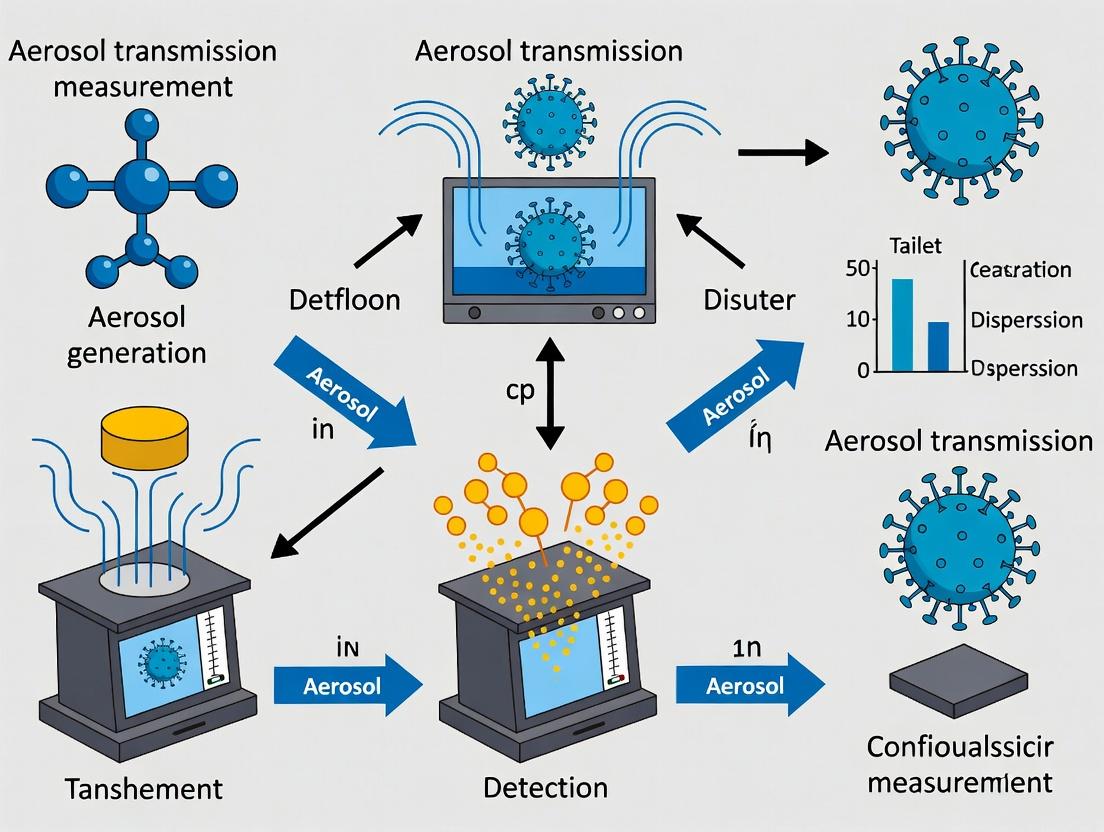
This comprehensive guide for researchers, scientists, and drug development professionals details the evolving landscape of aerosol transmission measurement.
Measuring the Unseen: Advanced Techniques and Best Practices for Aerosol Transmission Analysis in Biomedical Research
Abstract
This comprehensive guide for researchers, scientists, and drug development professionals details the evolving landscape of aerosol transmission measurement. It covers the fundamental principles of aerosol science, explores state-of-the-art methodological approaches and their applications in respiratory drug delivery and infectious disease research, addresses common challenges and optimization strategies, and provides a framework for validating and comparing measurement techniques. The article synthesizes current standards and emerging trends to support robust, reproducible experimental design in both pharmaceutical development and public health studies.
The Fundamentals of Airborne Particles: Core Principles for Aerosol Transmission Research
Within the broader thesis on advancing aerosol transmission measurement techniques, a fundamental requirement is the precise definition of the aerosol itself. An aerosol is a suspension of solid or liquid particles in a gas. Its behavior in transmission, deposition, and biological interaction is governed primarily by its Particle Size Distribution (PSD) and a suite of key physicochemical properties. This document outlines the critical parameters and provides detailed protocols for their characterization, essential for researchers in infectious disease, drug delivery (particularly inhaled therapeutics), and environmental health.
Key Physicochemical Properties & Measurement Techniques
The following properties, beyond size, define aerosol behavior and stability.
Table 1: Key Aerosol Physicochemical Properties and Measurement Methods
| Property | Definition & Impact | Common Measurement Technique(s) |
|---|---|---|
| Mass Concentration | Mass of particulate matter per unit volume of air (e.g., µg/m³). Critical for dosage and exposure assessment. | Filter collection with gravimetric analysis, Tapered Element Oscillating Microbalance (TEOM). |
| Number Concentration | Number of particles per unit volume of air (#/cm³). Key for ultrafine particle and nanoparticle studies. | Condensation Particle Counter (CPC), Optical Particle Counter (OPC). |
| Particle Morphology | Shape, structure, and surface texture (e.g., spherical, fractal, crystalline). Influences drag, coagulation, and dissolution. | Scanning/Transmission Electron Microscopy (SEM/TEM), Atomic Force Microscopy (AFM). |
| Surface Area | Total surface area per unit mass or volume. Critical for surface-mediated reactions and toxicity. | BET Adsorption, Diffusion Charger (e.g., Nanoparticle Surface Area Monitor). |
| Hyroscopicity | Ability to absorb water vapor from the environment, leading to size growth. Dictates deposition in the humid respiratory tract. | Humidified Tandem Differential Mobility Analyzer (H-TDMA). |
| Electrical Charge | Net charge distribution on particles. Affects deposition, coagulation, and sampling efficiency. | Aerodynamic Aerosol Classifier (AAC) or DMA with electrometer. |
| Chemical Composition | Molecular and elemental makeup. Determines biological activity, toxicity, and drug delivery efficacy. | Mass Spectrometry (AMS), Chromatography, X-ray Fluorescence (XRF). |
Particle Size Distribution (PSD): Core Metrics and Data Presentation
PSD is the most critical descriptor. It is typically presented as a number, surface area, or volume/mass distribution.
Table 2: Summary of Key PSD Metrics and Typical Values for Common Aerosols
| Aerosol Type | Dominant Size Mode (Diameter) | Distribution Metric (e.g., MMAD) | Key Measurement Instrument | Notes for Transmission |
|---|---|---|---|---|
| Respiratory Droplets (from coughing) | Bimodal: >5 µm & <5 µm | VMD*: ~10-100 µm for large droplets | High-speed imaging, Aerodynamic Particle Sizer (APS) | Larger droplets settle rapidly; smaller become "droplet nuclei". |
| Droplet Nuclei / Bioaerosols | 0.5 µm - 5 µm | MMAD: 1-3 µm | Differential Mobility Analyzer (DMA), OPC | Remain airborne for extended periods, penetrate deep lung. |
| Pressurized Metered-Dose Inhaler (pMDI) | 1 µm - 5 µm | MMAD: 2-4 µm | Cascade Impactor (ACI/NGI) | Designed for alveolar or bronchial deposition. |
| Dry Powder Inhaler (DPI) | 0.5 µm - 10 µm (often polydisperse) | MMAD: 2-5 µm | Cascade Impactor (ACI/NGI) | Formulation and device critically impact PSD. |
| Ambient Urban Aerosol | Tri-modal: Nuclei (<0.1 µm), Accumulation (0.1-2 µm), Coarse (>2.5 µm) | VMD varies by mode | SMPS, APS | Accumulation mode is most stable in atmosphere. |
VMD: Volume Median Diameter. *MMAD: Mass Median Aerodynamic Diameter.
Detailed Experimental Protocols
Protocol 4.1: Determining Mass-Based PSD using a Next Generation Impactor (NGI)
Objective: To measure the mass-weighted aerodynamic particle size distribution of an inhaled pharmaceutical aerosol.
Materials:
- Next Generation Impactor (NGI)
- Critical flow controller
- Vacuum pump
- Collection cups and seals
- Microbalance (sensitivity ±1 µg)
- Desiccator
- Testing apparatus (e.g., USP/Ph.Eur. induction port, mouthpiece adapter)
- Drug assay equipment (e.g., HPLC)
Procedure:
- Assembly & Preparation: Disassemble the NGI. Apply a thin layer of silicone grease to all seals. Place collection cups in stages 1-7 and the micro-orifice collector (MOC). Weigh each cup individually and record its tare mass (
M_tare). Reassemble the NGI and attach it to the vacuum pump via the critical flow controller. - Calibration: Calibrate the flow rate through the impactor to 60 L/min (or product-specific flow) using the critical flow controller and a calibrated flowmeter.
- Aerosol Generation & Collection: Condition the apparatus at 20±2°C, 45±5% RH for 1 hour. Attach the aerosol source (e.g., inhaler device, nebulizer) to the induction port via an appropriate adapter. Activate the vacuum pump. At the exact moment of achieving stable flow, actuate/activate the aerosol source per its instructions. Collect aerosol for the specified time/doses.
- Sample Recovery: Turn off the pump and disassemble the NGI. Carefully wipe any drug from the induction port, preseparator (if used), and interior surfaces into the respective collection cups. Rinse each cup and stage with an appropriate solvent, pooling rinsates for each stage.
- Quantification: Evaporate the solvent from each cup under a gentle stream of nitrogen. Desiccate the cups for 24 hours. Weigh each cup again to obtain (
M_final). For chemical-specific analysis, use HPLC to quantify drug mass per stage. - Data Analysis: Calculate the emitted mass per stage:
M_stage = M_final - M_tare. Calculate the cumulative mass from the finest stage upward. Plot cumulative % vs. the effective cutoff diameter (ECPD) of each stage on log-probability paper. The MMAD is the diameter at which the line crosses 50%. The Geometric Standard Deviation (GSD) is sqrt(D84%/D16%).
Protocol 4.2: Measuring Number-Based PSD and Hygroscopic Growth using H-TDMA
Objective: To determine the number size distribution and hygroscopic growth factor of sub-micrometer aerosol particles at different relative humidity (RH) conditions.
Materials:
- Differential Mobility Analyzer (DMA) – two units
- Condensation Particle Counter (CPC) – two units
- Aerosol neutralizer (Kr-85 or soft X-ray)
- Humidity conditioners (Nafion membrane tubes)
- Hygrometers
- Particle-free sheath air and aerosol flow systems
- Data acquisition system
Procedure:
- System Setup: Configure the H-TDMA system. The first DMA (DMA1) is set to a specific dry RH (<10%) and selects a monodisperse aerosol population based on electrical mobility (
Dp_dry). The selected particles are then humidified to a target RH (e.g., 90%) in a conditioning chamber. The second DMA (DMA2), operating at the target RH, scans the size of the humidified particles. The CPC counts the particles exiting DMA2. - Calibration: Calibrate the DMAs using certified latex size standards. Calibrate hygrometers using saturated salt solutions.
- Measurement: Generate a stable, dried polydisperse test aerosol (e.g., NaCl, (NH4)2SO4). Set DMA1 to a fixed voltage corresponding to
Dp_dry(e.g., 100 nm). Record the CPC1 count as reference. Set the humidifier to the target RH. Scan DMA2 over a voltage range corresponding to diameters from ~Dp_dryto2.5 * Dp_dry. Record the CPC2 count at each step to obtain the humidified size distribution. - Data Analysis: Invert the DMA2 scan data to determine the growth factor distribution (GF =
Dp_wet / Dp_dry). The mode of the GF distribution for a pure substance corresponds to its hygroscopicity parameter, κ.
Visualization: Methodologies and Property Relationships
Title: Aerosol Characterization Experimental Workflow
Title: Key Aerosol Properties Influence Bio-Outcomes
The Scientist's Toolkit: Essential Research Reagents & Materials
Table 3: Key Reagents and Materials for Aerosol Characterization Experiments
| Item | Function / Application | Example Product/Chemical |
|---|---|---|
| Polystyrene Latex (PSL) Spheres | Monodisperse size standards for calibration of optical and mobility particle sizers. | Thermo Scientific, Duke Standards (e.g., 100 nm, 500 nm, 1 µm). |
| Di-Ethyl Hexyl Sebacate (DEHS) | Liquid aerosol generator material for producing stable, monodisperse droplets via condensation. | Used in aerosol diluters and as a test challenge for filters. |
| Sodium Chloride (NaCl) | Model hygroscopic aerosol for instrument calibration and fundamental studies. | Atomized from aqueous solution to generate solid, cubic particles. |
| Ammonium Sulfate ((NH₄)₂SO₄) | Model hygroscopic and slightly volatile aerosol for atmospheric studies and calibration. | Commonly used in H-TDMA experiments. |
| Oleic Acid | Liquid test aerosol for filter penetration and optical particle counter calibration. | Produces spherical droplets. |
| Silicon Grease (High Vacuum) | Applied to impaction plates and seals in cascade impactors to prevent particle bounce and re-entrainment. | Dow Corning high vacuum grease. |
| Nafion Tubing | Semi-permeable membrane tubing used to precisely humidify or dry aerosol streams in H-TDMA systems. | Perma Pure MD-series dryers/humidifiers. |
| High-Efficiency Particulate Air (HEPA) Filter | Used to generate particle-free sheath air for classifiers and as a final filter on exhausts. | Typically rated 99.97% efficiency at 0.3 µm. |
| Kr-85 or Soft X-Ray Aerosol Neutralizer | Brings aerosol particles to a known Boltzmann charge equilibrium required for DMA classification. | TSI Model 3077A (Kr-85), Model 3088 (X-ray). |
| Microbalance Calibration Weights | Essential for accurate gravimetric analysis of filter and impactor samples. | USP Class 1 or equivalent, traceable to NIST. |
Precise measurement of aerosol and droplet characteristics is foundational for advancing both respiratory drug delivery and understanding pathogen transmission. This field, central to aerosol transmission measurement techniques research, requires standardized methodologies to quantify parameters such as particle size distribution, concentration, velocity, and viral/bioactive load. Accurate data enables the optimization of inhaled therapeutics and the development of evidence-based interventions for airborne infectious diseases.
Table 1: Critical Aerosol/Droplet Characteristics for Drug Delivery vs. Transmission Studies
| Parameter | Ideal Range for Drug Delivery (Therapeutic) | Typical Range for Respiratory Emissions (Pathogen) | Primary Measurement Technique |
|---|---|---|---|
| Aerodynamic Diameter (µm) | 1 - 5 (Lower lung deposition) | 0.1 - 100 (Droplets & droplet nuclei) | Aerodynamic Particle Sizer (APS) |
| Mass Median Aerodynamic Diameter (MMAD) | 2 - 3 µm (Fine particle fraction >70%) | 1 - 10 µm (Varies with expiratory activity) | Cascade Impactor (e.g., NGI) |
| Particle Number Concentration (#/cm³) | 10² - 10⁴ (Nebulizers/DPIs) | 10² - 10⁹ (Cough, speech, breath) | Optical Particle Counter (OPC) |
| Viable Pathogen Load (PFU/mL or TCID₅₀/mL) | Not Applicable (Sterile product) | 10¹ - 10⁸ (In exhaled breath of infected hosts) | Viral Plaque Assay / PCR on sampler fluid |
| Fine Particle Fraction (% <5µm) | >70% (Efficient delivery) | Highly variable; critical for "airborne" risk | Inertial Impaction (NGI/ACI) |
| Velocity (m/s) | Low (Soft mist inhalers ~0.5 m/s) | High (Cough: 10-15 m/s; Breath: ~1 m/s) | Phase Doppler Anemometry (PDA) |
Table 2: Comparison of Common Aerosol Generation & Sampling Techniques
| Technique | Primary Use | Key Advantage | Key Limitation | Typical Particle Size Range |
|---|---|---|---|---|
| Collison Nebulizer | Generating bioaerosols / drug solutions | Consistent output, can handle suspensions | May damage sensitive biologics | 1 - 5 µm (MMAD) |
| Vibrating Mesh Nebulizer | Drug delivery, gentle aerosolization | High efficiency, low residual volume, portable | Potential for clogging | 3 - 6 µm (MMAD) |
| Andersen Cascade Impactor | Size-fractionated sampling/drug testing | Pharmacopeia standard, aerodynamic sizing | Not real-time, complex analysis | 0.4 - 10 µm (Stages) |
| BioSampler (SKC) | Viable bioaerosol collection | Maintains viability, liquid collection | Collection efficiency drops <1µm | Optimized for ~0.3-10 µm |
| Condensation Particle Counter (CPC) | Ultrafine particle counting | Counts down to nanometer scale (e.g., 2.5 nm) | No size discrimination, total count only | 0.0025 - 3 µm |
Experimental Protocols
Protocol 1: Measuring Aerosol Output from a Pressurized Metered-Dose Inhaler (pMDI) Using a Next Generation Impactor (NGI)
Objective: To determine the emitted dose, fine particle dose, and MMAD of a drug from a pMDI. Materials: pMDI (canister + actuator), NGI apparatus, vacuum pump & flow controller, dosing adapter, analytical balance, validated HPLC system, suitable solvent. Procedure:
- Apparatus Setup: Assemble the NGI with collection plates. Attach to a vacuum pump set to draw 30.0 ± 0.3 L/min. Ensure all seals are airtight.
- Conditioning: Place the assembled NGI in a temperature-controlled environment (20-25°C) for at least 1 hour prior to testing.
- Actuator Preparation: Rinse and dry the pMDI actuator. Prime the pMDI by firing 3 shots to waste according to manufacturer instructions.
- Sample Collection: Load a pre-weighed collection plate into each stage. Attach the pMDI to the induction port via the adapter. Fire a single, actuated shot into the apparatus. Repeat for a total of n shots (typically 10), with a 30-second interval between shots to simulate use.
- Sample Recovery: Disassemble the NGI. Rinse the induction port, preseparator (if used), each stage, and the micro-orifice collector (MOC) thoroughly with a known volume of a suitable solvent (e.g., methanol/water mix) into volumetric flasks.
- Analysis: Quantify the drug mass in each fraction using HPLC-UV. Weigh the actuator before and after firing to determine total emitted mass.
- Data Analysis: Calculate cumulative mass distribution. Determine MMAD and geometric standard deviation (GSD). Calculate the Fine Particle Fraction (FPF) as the percentage of the total emitted mass contained in particles <5µm.
Protocol 2: Sampling Viable Viral Aerosols from a Simulated Cough Using a BioSampler
Objective: To collect and quantify infectious virus particles in aerosols generated by a simulated cough. Materials: Collison nebulizer, 3-jet BioSampler (SKC), virus suspension in appropriate medium, culture media, vacuum pump & critical orifice (12.5 L/min), aerosol chamber (e.g., glove box), viral plaque assay reagents (cells, agarose, stain). Procedure:
- Aerosol Generation: Load 10 mL of virus suspension (e.g., Influenza A virus at ~10⁶ PFU/mL) into a sterile Collison nebulizer. Place nebulizer inside the sealed aerosol chamber.
- Sampler Preparation: Fill each of the three BioSampler vessels with 20 mL of ice-cold collection medium (e.g., minimum essential media with 0.5% bovine serum albumin). Attach to a pump drawing 12.5 L/min.
- Experimental Run: Start the BioSampler pump. Immediately start the Collison nebulizer, operating it with clean, dry air at 20 psi for 5 minutes to generate a stable aerosol cloud within the chamber.
- Sample Collection: After 5 minutes, turn off the nebulizer. Continue sampling for an additional 2 minutes to clear chamber lines. Turn off the pump.
- Sample Recovery: Aseptically combine the liquid from the three BioSampler vessels (total ~15 mL post-evaporation). Record final volume. Keep sample on ice.
- Viability Quantification: Perform serial dilutions of the collected liquid. Use a standard viral plaque assay (or TCID₅₀ assay) on appropriate cell monolayers (e.g., MDCK cells for influenza) to determine the Plaque-Forming Units per mL of collection fluid (PFU/mL).
- Calculation: Apply the sampled air volume (12.5 L/min * 7 min = 87.5 L) and collection fluid volume to calculate the airborne viable virus concentration (PFU/m³ of air).
Visualizations
Title: pMDI Aerosol Characterization Workflow
Title: Viable Bioaerosol Sampling & Assay
The Scientist's Toolkit: Essential Research Reagent Solutions
Table 3: Key Materials for Aerosol Measurement Research
| Item | Primary Function | Application Notes |
|---|---|---|
| Next Generation Impactor (NGI) | Gold-standard inertial impaction for aerodynamic particle size distribution. | Used per pharmacopeial methods (USP <601>) for OINDP testing. Requires specific flow rates (e.g., 30, 60, 100 L/min). |
| Andersen Cascade Impactor (ACI) | Multi-stage impactor for size-fractionated collection of viable and non-viable aerosols. | Often used in bioaerosol studies; plates can be filled with agar for viable culturing. |
| 3-Jet BioSampler (SKC) | Collects bioaerosols into a liquid medium while maintaining microbial/viral viability. | Operates optimally at 12.5 L/min. Liquid volume decreases during sampling; critical for concentration calculations. |
| Optical Particle Counter (OPC) | Provides real-time number concentration and size distribution (non-viable). | Essential for chamber mixing uniformity checks and rapid profiling of aerosol sources. |
| Aerodynamic Particle Sizer (APS) | Measures aerodynamic diameter and concentration in real-time via time-of-flight. | Excellent for measuring fast-moving aerosols (e.g., from coughs, puffers). |
| Lactose Carrier (Inhalation Grade) | Common excipient carrier for Dry Powder Inhaler (DPI) formulation studies. | Used in blend uniformity and aerosol performance testing. MMAD typically 60-90 µm. |
| Sodium Fluoride (NaF) Tracer | Chemically inert, water-soluble tracer for aerosol recovery studies. | Quantified via ion-selective electrode; used to validate sampling efficiency without analyte loss. |
| Validated Cell Line (e.g., MDCK, Vero E6) | Host cells for plaque assays to quantify infectious viral load in collected samples. | Choice depends on pathogen (e.g., MDCK for influenza, Vero E6 for SARS-CoV-2). |
| Critical Flow Controller/Orifice | Maintains a constant, calibrated volumetric flow rate for samplers. | Absolute necessity for quantitative aerosol science; requires regular calibration. |
| Particle Image Velocimetry (PIV) System | Non-intrusive measurement of aerosol velocity fields via laser sheet imaging. | Used in advanced studies of expiratory jet dynamics and inhaler spray characterization. |
This application note details advanced methodologies for characterizing aerosolized particles, a critical focus within the broader thesis on advancing metrological techniques for aerosol transmission research. Accurate measurement of particle concentration, viability, and deposition dynamics is fundamental for understanding respiratory disease transmission, evaluating inhaled drug delivery systems, and assessing environmental exposures. The protocols herein are designed for researchers, scientists, and drug development professionals requiring robust, reproducible data.
Table 1: Key Metrics and Measurement Technologies
| Metric | Definition | Typical Range (Respiratory Aerosols) | Primary Measurement Instrument(s) | Key Challenge |
|---|---|---|---|---|
| Particle Concentration | Number of particles per unit volume of air (#/cm³) | 10⁰ - 10⁶ #/cm³ | Optical Particle Counter (OPC), Condensation Particle Counter (CPC), Aerodynamic Particle Sizer (APS) | Coincidence error at high concentrations; distinguishing particles from background. |
| Viability | Fraction of biological particles (e.g., viruses, bacteria) that remain culturable/infectious post-aerosolization. | 0.1% - 100% (highly variable) | Viable Cascade Impactor, BioSampler, Culture/Plague Assay, PCR (with viability markers) | Loss of viability due to shear stress, evaporation, and oxidative damage during aerosolization and sampling. |
| Deposition Dynamics | Spatial pattern and efficiency of particle deposition in a system (e.g., respiratory tract, air sampler). | Depends on particle size and flow. | In vitro anatomical airway models, staged impactors, computational fluid dynamics (CFD) simulations. | Mimicking realistic physiological conditions (humidity, temperature, flow patterns). |
Table 2: Comparative Performance of Common Aerosol Samplers
| Sampler Type | Principle | Optimal Particle Size Range | Viability Preservation | Typical Flow Rate (L/min) |
|---|---|---|---|---|
| Andersen Cascade Impactor | Inertial impaction on stages by size. | 0.4 - 10 µm (aerodynamic) | Low-Moderate (desiccation stress) | 28.3 |
| SKC BioSampler | Liquid impingement with gentle vortex. | 0.3 - 10 µm | High (particles captured in liquid) | 12.5 |
| Coriolis μ Cyclonic Sampler | Cyclonic separation into liquid. | 0.5 - 10 µm | High | 50 - 400 |
| Filter Sampler | Physical filtration onto substrate. | < 0.1 µm upwards | Low (desiccation, shear stress) | 1 - 20 |
Experimental Protocols
Protocol 1: Integrated Measurement of Concentration and Viability for Bioaerosols
Objective: To concurrently determine the total and viable concentration of aerosolized microorganisms (e.g., P. fluorescens as a surrogate) from a nebulizer source.
Materials: Collison nebulizer, SKC BioSampler, Condensation Particle Counter (CPC), Phosphate Buffered Saline (PBS), Tryptic Soy Agar (TSA) plates, Dilution tubes, Incubator, Air pump with flow control, Timer.
Methodology:
- Aerosol Generation: Load 10 mL of bacterial suspension (~10⁸ CFU/mL in PBS) into a sterilized Collison nebulizer. Operate at 20 psi with a clean, dry air supply.
- Dilution & Sampling Setup: Direct the nebulizer output into a 1 m³ sealed chamber with mixing fan. Use a splitter to simultaneously draw air samples to:
- A CPC (measures total particle concentration >10nm).
- An SKC BioSampler filled with 20 mL of sterile PBS (operating at 12.5 L/min for 10 minutes).
- Sample Collection: After the sampling period, aseptically recover the liquid from the BioSampler. Perform serial 10-fold dilutions in PBS.
- Viability Assay: Spread plate 100 µL of appropriate dilutions onto TSA plates in triplicate. Incubate plates at 30°C for 24-48 hours.
- Calculations:
- Total Concentration: Record as #/cm³ from CPC.
- Viable Concentration: Count colonies, calculate CFU/mL in sampler liquid, then apply sampling flow rate and time to derive airborne CFU/m³.
- Percent Viability: (Viable Concentration / Total Concentration) * 100. Note: CPC counts all particles; this ratio is an estimate.
Protocol 2: Deposition Dynamics in a Static Plate System
Objective: To quantify the size-resolved deposition pattern of non-viable particles onto surfaces using a Next Generation Impactor (NGI).
Materials: Spray dryer or dry powder disperser, NGI, High-performance liquid chromatography (HPLC) grade water, USP induction port, Flow controller (60 L/min), Analytical balance (µg sensitivity), Drug substance (e.g., lactose carrier with API).
Methodology:
- Impactor Preparation: Assemble the NGI with collection plates. Ensure it is clean and dry. Weigh each collection plate individually to the nearest 0.001 mg and record as tare weight.
- System Calibration: Calibrate the flow rate through the NGI to 60 L/min ± 5% using a calibrated flow meter.
- Aerosol Generation & Deposition: Load a known mass (e.g., 20 mg) of powder into the disperser. Connect the disperser output to the USP throat/induction port attached to the NGI. Activate the disperser for a set duration (e.g., 2 seconds).
- Mass Recovery: After the run, carefully disassemble the NGI. Allow plates to settle in a desiccator for 30 minutes. Re-weigh each collection plate.
- Data Analysis:
- Calculate the deposited mass on each stage (final - tare weight).
- Determine the Emitted Dose (mass exiting the induction port).
- Calculate the Fine Particle Fraction (FPF) , typically the mass of particles with an aerodynamic diameter < 5µm divided by the Emitted Dose.
- Plot deposition vs. aerodynamic cut-off diameter (provided by manufacturer for each stage at 60 L/min).
The Scientist's Toolkit: Key Research Reagent Solutions
Table 3: Essential Materials for Aerosol Characterization Experiments
| Item | Function & Explanation |
|---|---|
| Polystyrene Latex Spheres (PSL) | Monodisperse, inert particles of known size (e.g., 0.1µm, 1µm, 3µm). Used for precise calibration of optical and aerodynamic particle sizing instruments. |
| Di-Ethyl-Hexyl-Sebacate (DEHS) | A high-boiling point, low-volatility oil. Used to generate stable, non-evaporating test aerosols for instrument calibration and system integrity checks. |
| Tryptic Soy Broth (TSB) / Agar (TSA) | General-purpose culture media for growing and enumerating a wide range of bacteria. Essential for viability assays of bacterial bioaerosols. |
| Phosphate Buffered Saline (PBS) | An isotonic, non-toxic buffer. Used for suspending biological agents before aerosolization and as a collection fluid in impingers to maintain osmotic balance and preserve viability. |
| Lactose Monohydrate | A common inert carrier excipient in dry powder inhaler (DPI) formulations. Used in deposition studies as a model powder or carrier for active pharmaceutical ingredients (APIs). |
| Dimethyl Sulfoxide (DMSO) | A cryoprotectant and solvent. Often added to viral or bacterial stocks before aerosolization to help stabilize the agents and improve survivability during the aerosol stress. |
| Gelatin Filters | Soluble filter membranes. Used for air sampling of bioaerosols; the filter can be dissolved in a warm, mild buffer to recover microorganisms with minimal additional stress. |
Experimental Workflow and Relationship Diagrams
Title: Integrated Aerosol Metrics Measurement Workflow
Title: Core Metrics Link Thesis to Applications
Regulatory and Standardization Frameworks (e.g., USP, Ph. Eur.) Guiding Aerosol Measurement
Within the context of advancing research on aerosol transmission measurement techniques, robust and standardized methodologies are paramount. Regulatory pharmacopeial chapters, primarily from the United States Pharmacopeia (USP) and the European Pharmacopoeia (Ph. Eur.), provide the critical frameworks ensuring the validity, reproducibility, and relevance of in vitro aerosol performance data for inhalation products. These standardized tests are essential for drug development, quality control, and regulatory submission, forming the basis for correlating in vitro data with in vivo deposition.
Key Pharmacopeial Chapters and Specifications
The core methodologies are detailed in specific chapters, which are periodically updated. The following table summarizes the current key chapters, their focus, and primary metrics.
Table 1: Core Pharmacopeial Chapters for Aerosol Measurement
| Pharmacopeia | Chapter Number & Title | Primary Focus | Key Metrics Measured | Apparatus Specified |
|---|---|---|---|---|
| USP | <601> Inhalation and Nasal Drug Products: Aerosols, Sprays, and Powders |
Performance of metered-dose inhalers (MDIs), dry powder inhalers (DPIs), nasal sprays. | Emitted Dose (ED), Fine Particle Dose (FPD), Fine Particle Fraction (FPF), Impactor Stage Mass Distribution. | Next-Generation Impactor (NGI), Andersen Cascade Impactor (ACI), Apparatus with induction port. |
| USP | <1601> Products for Nebulization |
Characterization of nebulizer output. | Total Delivered Dose, Particle/droplet size distribution, Output Rate. | Next-Generation Impactor (NGI), Laser Diffraction. |
| Ph. Eur. | 2.9.18 Preparations for Inhalation: Aerodynamic Assessment of Fine Particles |
Aerodynamic particle size distribution of the delivered dose from DPIs and MDIs. | Mass Median Aerodynamic Diameter (MMAD), Geometric Standard Deviation (GSD), Fine Particle Fraction (FPF). | Next-Generation Impactor (NGI), Andersen Cascade Impactor (ACI). |
| Ph. Eur. | 2.9.44 Preparations for Nebulisation |
Characterization of nebulized preparations. | Particle/droplet size distribution, Deliverable dose. | Cascade Impactor, Laser Diffraction. |
Table 2: Typical Acceptance Criteria for Aerodynamic Particle Size Distribution (APSD)
| Parameter | Definition | Typical Target Range (for quality control) |
|---|---|---|
| MMAD | Mass Median Aerodynamic Diameter: The diameter at which 50% of the aerosol mass is in larger and 50% in smaller particles. | 1-5 µm for lung deposition. |
| GSD | Geometric Standard Deviation: Measure of the dispersity of the particle size distribution. GSD = √(D84.1/D15.9). | ≤ 3.0 (indicative of a log-normal distribution). |
| FPF (<5 µm) | Fine Particle Fraction: Percentage of the emitted dose with an aerodynamic diameter less than 5 µm. | Product-specific; often >30-50%. |
Detailed Experimental Protocol: APSD Measurement for a DPI using a Next-Generation Impactor (NGI) per USP<601>
This protocol outlines the critical steps for characterizing the aerosol performance of a dry powder inhaler.
1. Principle: The emitted dose from the inhaler is drawn through a multi-stage cascade impactor. Particles are segregated by their aerodynamic diameter onto specific stages. Quantification of the active pharmaceutical ingredient (API) on each stage allows for the calculation of APSD parameters.
2. Apparatus & Materials:
- Next-Generation Impactor (NGI) with preseparator
- Critical flow controller (e.g., a calibrated vacuum pump and flow meter)
- USP/Ph. Eur. compliant induction port
- Analytical balance (±0.01 mg sensitivity)
- HPLC or UV-Vis spectrophotometer for API assay
- Suitable dissolution solvents
- Temperature and humidity-controlled environment (as specified in monograph, typically 40-50% RH)
3. Preparation:
- Condition the NGI components, inhaler device, and testing environment to the specified temperature and humidity for ≥24 hours.
- Apply a suitable coating (e.g., silicone oil) to each NGI collection cup and micro-orifice collector to minimize particle bounce and re-entrainment.
- Accurately weigh all collection cups (including the preseparator cup) before assembly.
- Assemble the NGI with the induction port according to the pharmacopeial diagram. Ensure all seals are tight.
4. Testing Procedure:
- Prime or prepare the DPI according to its patient instructions.
- Insert the device into the mouthpiece adapter attached to the induction port.
- Activate the vacuum pump to achieve and maintain the specified flow rate (e.g., 60 L/min or 100 L/min for DPIs) ±5%.
- Fire or actuate the DPI according to its instructions.
- Continue drawing air for the specified time (typically to achieve a total volume of 4 L for the NGI).
- Repeat the actuation until the required number of doses (typically n=10) have been delivered.
- Disassemble the impactor carefully.
5. Sample Analysis:
- Wash the API from the induction port, preseparator, each impactor stage (cup and walls), and the device mouthpiece adapter using a known volume of a suitable solvent.
- Quantify the amount of API in each wash solution using a validated analytical method (e.g., HPLC).
- Weigh the collection cups post-wash (after drying) to determine the total recovered mass if required.
6. Data Analysis & Reporting:
- Calculate the mass of API on each component.
- Determine the Emitted Dose (ED): Sum of API mass from induction port, preseparator, and all impactor stages.
- Construct the cumulative mass undersize distribution versus the cutoff diameter of each stage.
- Determine the MMAD and GSD from the log-probability plot.
- Calculate the Fine Particle Dose (FPD) as the sum of API mass on stages with a cutoff diameter <5 µm.
- Calculate the Fine Particle Fraction (FPF) as (FPD / ED) x 100%.
Visualization of the Aerosol Characterization Workflow
Aerosol Performance Testing Workflow
The Scientist's Toolkit: Key Research Reagent Solutions
Table 3: Essential Materials for Pharmacopeial Aerosol Testing
| Item | Function/Description |
|---|---|
| Calibrated Critical Flow Controller | Precisely controls and maintains the airflow through the impactor (e.g., 15, 30, 60, 100 L/min) as mandated by the pharmacopeia and product monograph. |
| USP/Ph. Eur. Induction Port | Standardized throat model that simulates the upper airway. Its dimensions are exactly specified to ensure inter-laboratory reproducibility. |
| Coating Agent (e.g., Silicone Oil) | Applied to impactor stages to create a sticky surface, preventing particle bounce and re-entrainment, which is critical for accurate size segregation. |
| High-Purity Solvents (HPLC Grade) | Used for quantitative recovery of API from complex impactor surfaces for subsequent chemical assay. |
| Standardized Reference Inhaler | Used for apparatus qualification (e.g., system suitability tests) to verify the entire setup operates within defined parameters before testing unknowns. |
| Humidity & Temperature Control Chamber | Essential for conditioning devices and apparatus as DPIs and some MDIs are highly sensitive to moisture. |
Logical Framework of Pharmacopeial Guidance in Aerosol Research
From Research Need to Standardized Data
From Theory to Bench: A Guide to Current Aerosol Measurement Methodologies and Their Applications
Within the broader thesis on aerosol transmission measurement techniques, the accurate characterization of aerosol particle size distribution (PSD) and viable pathogen concentration is paramount. Impaction-based cascade impactors (e.g., Next Generation Impactor (NGI), Andersen Cascade Impactor (ACI)) and liquid impingers are foundational tools. They enable the quantitation of aerodynamic diameter metrics, such as mass median aerodynamic diameter (MMAD) and fine particle fraction (FPF), and the collection of viable aerosols for microbiological analysis, respectively. This application note details their protocols and applications in pharmaceutical aerosol science and bioaerosol research.
Table 1: Comparison of Key Cascade Impactor Specifications
| Parameter | Next Generation Impactor (NGI) | Andersen Cascade Impactor (ACI, 8-Stage) | Typical Liquid Impinger (e.g., AGI-30) |
|---|---|---|---|
| Number of Stages | 7 (+ Micro-Orifice Collector, MOC) | 8 (+ Final Filter) | Single-stage (multi-stage variants exist) |
| Flow Rate Range (L/min) | 30 - 100 (USP-compliant: 15, 30, 60, 100) | 28.3 (1 ACFM) | 12.5 (standard for AGI-30) |
| Cut-off Diameter (D₅₀) Range | ~0.24 - 11.7 µm @ 30 L/min | 0.4 - 9.0 µm @ 28.3 L/min | Typically samples < 5 µm efficiently |
| Collection Substrate | Coated cups or wells | Solid plates (petri dishes) | Liquid medium (e.g., PBS, growth broth) |
| Primary Application | OINDP (pMDI, DPI) PSD testing | Environmental & OINDP testing, bioaerosols | Viable aerosol sampling (bacteria, virus) |
| Key Standard | USP <601>, Ph. Eur. 2.9.18, ISO 20072 | USP <601>, EPA Methods | NIOSH/EPA bioaerosol methods |
Table 2: Typical Performance Metrics from Recent Studies (2023-2024)
| Study Focus | Instrument | Key Measured Output | Typical Value/Result |
|---|---|---|---|
| DPI Formulation (Budesonide) | NGI (60 L/min) | FPF (<5 µm) of emitted dose | 45-65% |
| pMDI Spray Pattern | ACI (28.3 L/min) | MMAD (with actuator variations) | 2.1 - 3.5 µm |
| Viable SARS-CoV-2 Aerosol Recovery | SKC BioSampler (similar to AGI) | Collection efficiency in viral transport medium | 10-35% (highly variable based on humidity) |
| Ambient Bioaerosol | Coriolis μ Liquid Sampler | Concentration (CFU/m³) | 10² - 10⁴ CFU/m³ |
Experimental Protocols
Protocol: Determination of Aerodynamic Particle Size Distribution (APSD) using the NGI (USP <601>)
Objective: To determine the APSD of an orally inhaled product (e.g., Dry Powder Inhaler) by mass.
Materials:
- Next Generation Impactor (NGI)
- Vacuum pump & flow controller (calibrated to 60 L/min ± 5%)
- Induction port (USP throat)
- Pre-separator (if formulation contains high lactose)
- Collection cups (stages 1-7, MOC)
- Cup coating solution (e.g., 1% w/v Brij-35 in ethanol or silicone oil)
- Analytical balance (0.001 mg sensitivity)
- DPI testing apparatus (discharge volume: 4 L, timer)
- Solvent for extraction (appropriate to API, e.g., methanol/water)
Procedure:
- Assembly & Coating: Apply a thin, uniform coating to each collection cup and the MOC filter to prevent particle bounce and re-entrainment. Allow solvent to evaporate completely.
- Weighing: Weigh each coated cup and MOC filter individually to obtain initial mass (W_initial). Record.
- Impactor Setup: Assemble the NGI in the following order from top to bottom: induction port, pre-separator (if used), stages 1-7, and MOC. Ensure all seals are tight.
- Calibration: Connect the vacuum hose to the outlet of the MOC. Using a calibrated flow meter, adjust the flow controller to achieve a pressure drop corresponding to 60 L/min through the entire assembled system (including induction port and DPI device in place). Mark this controller setting.
- Sampling: a. Insert the DPI into its holder/adapter. b. Activate the vacuum pump to establish the 60 L/min flow. c. Discharge the DPI dose into the apparatus using the standardized discharge volume and flow profile. d. Repeat for a minimum of 10 doses (or number sufficient for quantitation) to the same set of cups. Do not disassemble between doses.
- Extraction & Final Weighing: Disassemble the NGI. Carefully wipe the induction port and any interior surfaces, adding the washings to the respective cup or MOC. Extract the API from each cup using a known volume of solvent. Alternatively, for gravimetric analysis, allow cups to equilibrate in the weighing environment for at least 1 hour before obtaining the final mass (W_final).
- Calculation: Calculate the mass of API on each stage (Mstage = Wfinal - W_initial, or via HPLC analysis of extract). Plot cumulative mass versus the logarithmic stage cut-off diameter. Determine MMAD (50th percentile) and geometric standard deviation (GSD). Calculate FPF as (Mass < 5µm / Total Recovered Mass) x 100%.
Protocol: Collection of Viable Airborne Virus using a Liquid Impinger (AGI-30)
Objective: To actively sample air for infectious virus particles in a controlled laboratory setting.
Materials:
- AGI-30 All Glass Impinger (or equivalent)
- Vacuum pump with critical orifice calibrated to 12.5 L/min
- Viral Transport Medium (VTM) or appropriate collection fluid (e.g., PBS+0.1% BSA)
- Ice bath or chilling unit
- Sterile tubing and connectors
- Biosafety Cabinet (BSC)
- Tissue culture equipment for plaque assay or TCID₅₀
Procedure:
- Preparation: In a BSC, aseptically add 20 mL of cold (4°C) collection fluid to the impinger flask.
- Assembly: Connect the impinger inlet to the sampling point (e.g., chamber outlet) using sterile tubing. Connect the impinger outlet to the vacuum pump via a trap and a HEPA filter to protect the pump.
- Chilling: Place the impinger flask in an ice bath for the duration of sampling to maintain viability.
- Sampling: Activate the pump. Sample air at 12.5 L/min for a defined period (e.g., 10-30 minutes). Do not allow the collection fluid to evaporate to dryness; if necessary, sample for shorter intervals.
- Recovery: After sampling, turn off the pump. In the BSC, carefully disconnect the impinger. Gently swirl the liquid to resuspend any material. Using a sterile pipette, recover the collection fluid. Rinse the inner jet and flask with a small volume of fresh medium and pool.
- Analysis: Process the sample immediately or store at -80°C. Determine infectious virus titer by plaque assay, TCID₅₀, or equivalent cell culture-based method. Calculate the airborne concentration (PFU/m³ or TCID₅₀/m³) considering sampled air volume.
Visualizations
Diagram 1: APSD Workflow via NGI (74 chars)
Diagram 2: Bioaerosol Viability Sampling (80 chars)
The Scientist's Toolkit
Table 3: Essential Research Reagents & Materials
| Item/Reagent | Function & Brief Explanation |
|---|---|
| Brij-35 Solution (1% in Ethanol) | Anti-static and adhesive coating for NGI/ACI collection surfaces. Reduces particle bounce, ensuring accurate size-fractionation. |
| Silicone Oil (e.g., Dow Corning 200) | Alternative viscous coating for impactor stages, particularly effective for large or sticky particles. |
| High-Purity HPLC Grade Solvents (Methanol, Acetonitrile, Water) | For quantitative extraction of Active Pharmaceutical Ingredients (APIs) from impactor stages for chromatographic analysis. |
| Viral Transport Medium (VTM) | Stabilizes virus integrity during and after liquid impinger sampling. Typically contains proteins, buffers, and antibiotics to maintain viability and prevent bacterial overgrowth. |
| Phosphate Buffered Saline (PBS) with 0.1% Bovine Serum Albumin (BSA) | Common collection fluid for general bioaerosol sampling. BSA helps protect sensitive microorganisms from shear and osmotic stress during impingement. |
| Calibrated Critical Orifice | Provides a constant, known sampling flow rate for impingers (e.g., 12.5 L/min for AGI-30) independent of pump fluctuations, essential for quantitative concentration calculations. |
| Micro-Orifice Collector (MOC) | The final "stage" of an NGI. Captures sub-micron particles that pass all impactor stages, allowing for complete mass balance. |
| USP/Ph. Eur. Induction Port (Throat) | Standardized entry simulating the human oropharynx. It is the first component in the setup, ensuring reproducible initial particle deposition before size classification. |
This document serves as a detailed technical annex to a doctoral thesis investigating advanced aerosol transmission measurement techniques. The accurate characterization of aerosol particle size, velocity, and spatial distribution is paramount for modeling transmission dynamics of respiratory pathogens, evaluating drug delivery efficacy via inhaled pharmaceuticals, and assessing mitigation strategies. Optical and laser-based methods provide non-intrusive, high-resolution data critical for these applications. This note details three cornerstone techniques: Laser Diffraction (LD) for ensemble size distribution, Phase Doppler Anemometry (PDA) for simultaneous size and velocity of individual particles, and Particle Image Velocimetry (PIV) for planar velocity field mapping.
Laser Diffraction (LD) for Aerosol Size Distribution
Application Notes
Laser Diffraction is a widely used ensemble technique based on Fraunhofer diffraction or Mie scattering theory. As an aerosol cloud passes through a collimated laser beam, particles scatter light at angles inversely proportional to their size. A multi-element detector measures the angular intensity distribution, which is inverted via an appropriate optical model to yield a volume-based size distribution. It is ideal for rapid, stable sprays and polydisperse aerosols (e.g., from nebulizers or pressurised metered-dose inhalers) but provides no velocity data and assumes spherical particles.
Table 1: Typical LD Performance Specifications for Aerosol Analysis
| Parameter | Typical Range/Value | Notes |
|---|---|---|
| Size Range | 0.1 µm – 10,000 µm | Lower limit depends on detector sensitivity and laser power. |
| Dynamic Range | Up to 1:2500 | Ability to measure widely different sizes simultaneously. |
| Measurement Rate | Up to 10 kHz | Fast snapshot of instantaneous distribution. |
| Accuracy | ±1-2% of median | Depends on optical model alignment and refractive index. |
| Reproducibility | ±0.5% of median | High repeatability for stable aerosols. |
| Concentration Limit | Up to 10⁵ particles/cm³ | Multiple scattering must be avoided. |
Experimental Protocol: Characterizing Nebulizer Output
Aim: To determine the droplet size distribution (DSD) of a jet nebulizer generating a model aerosol. Materials: See "Research Reagent Solutions" below. Procedure:
- System Setup & Alignment: Position the nebulizer reservoir according to manufacturer instructions. Fill with test fluid (e.g., water or saline). Align the nebulizer outlet so the generated aerosol plume passes directly through the centre of the LD instrument's measurement volume. Ensure the laser beam is unobstructed by reservoir walls or fittings.
- Background Measurement: With the laser active and nebulizer off, acquire a background measurement for 30 seconds to account for stray light and ambient particulate.
- Data Acquisition: Activate the nebulizer. Allow 30 seconds for output stabilization. Initiate measurement, acquiring data at 1 Hz for 60 seconds. The instrument software automatically inverts the scatter pattern using the Mie theory model (input correct refractive index: ~1.33 for water).
- Data Analysis: Software outputs key metrics: Dv10, Dv50 (Volume Median Diameter, VMD), Dv90, and Span ( (Dv90 - Dv10)/Dv50 ). Export the full volumetric distribution for further analysis within the thesis framework.
- Cleaning: Flush the nebulizer with purified water and air-dry between samples to prevent cross-contamination or clogging.
Diagram 1: LD Nebulizer Characterization Workflow
Phase Doppler Anemometry (PDA) for Size-Velocity Correlations
Application Notes
PDA extends Laser Doppler Velocimetry by using multiple detector positions to measure the phase shift of scattered light, which is linearly related to particle diameter. It provides simultaneous, real-time measurement of the size and velocity of individual particles passing through an intersection of two laser beams (probe volume). This is critical for thesis research analyzing particle dynamics (acceleration, deceleration) in expelled aerosols (e.g., coughs, sneezes) and validating computational fluid dynamics (CFD) models.
Table 2: Typical PDA Performance Specifications for Aerosols
| Parameter | Typical Range/Value | Notes |
|---|---|---|
| Sizing Range | 0.5 µm – 10,000 µm | Configurable via transmitter optics. |
| Velocity Range | 0.1 m/s – 1000 m/s | Depends on photomultiplier tube (PMT) bandwidth. |
| Sizing Accuracy | ±0.5% to ±2% | Highest for optimal signal-to-noise ratio (SNR). |
| Velocity Accuracy | ±0.2% of reading | High precision for dynamics studies. |
| Temporal Resolution | > 1 MHz | Particle-by-particle measurement. |
| Spherical Assumption | Mandatory | Non-spherical particles cause significant error. |
| Data Rate | Up to 100k particles/s | Limited by particle concentration & data system. |
Experimental Protocol: Mapping a Simulated Cough Jet
Aim: To obtain correlated size and velocity statistics of particles in a transient aerosol jet. Materials: See "Research Reagent Solutions" below. Procedure:
- System Configuration: Install a 2D-PDA transmitter (e.g., Argon-Ion laser, λ=514.5 nm) and receiver at a 30°-70° off-axis scattering angle. Use a transmitting lens to create beam intersection (probe volume, ~0.5 x 0.5 x 2 mm). Precisely align the receiver optics for maximum signal on the PMTs.
- Calibration: Use a mono-disperse aerosol generator (e.g., vibrating orifice) to produce certified 10 µm and 50 µm droplets. Traverse the stream through the probe volume to validate size measurement. Use a rotating graticule or linear stage for velocity calibration.
- Jet Generation: Connect a solenoid-valve-controlled nozzle to a pressurized reservoir containing a seeding fluid (e.g., DEHS/H₂O mixture). Position the nozzle 10 cm from the PDA probe volume. Program the valve to open for 500 ms to simulate a cough pulse.
- Triggered Data Acquisition: Synchronize the PDA data acquisition system with the valve trigger. Set high sampling rates (>50k samples/s) to capture the transient event. Record for 2 seconds to capture the entire jet and trailing particles.
- Post-Processing: Use PDA software to validate signals (spherical validation, SNR filtering). Export time-resolved lists of particle diameter and 2D/3D velocity components. Calculate correlations (e.g., mean velocity per size bin, flux) for thesis analysis.
Diagram 2: PDA Signal Processing Chain
Particle Image Velocimetry (PIV) for Flow Field Mapping
Application Notes
PIV measures instantaneous velocity fields in a planar cross-section (2D-PIV) or volume (3D Tomo-PIV). The fluid is seeded with tracer particles, illuminated by a pulsed laser sheet, and recorded by one or more high-speed cameras. Cross-correlation of particle patterns between consecutive images yields a displacement vector map, dividing the flow field. Within the thesis, PIV is essential for visualizing the complex vortex structures and entrainment in aerosol clouds, such as those from ventilation interactions or human exhalation.
Table 3: Typical PIV System Specifications for Aerosol Flows
| Parameter | Typical Specification | Notes |
|---|---|---|
| Seeding Particle Size | 0.5 – 5 µm (oil/Di-Ethyl-Hexyl-Sebacat), 1 – 10 µm (solid) | Must follow flow faithfully (Stokes No. <<1). |
| Laser Energy/Pulse | 10 – 500 mJ @ 532 nm (Nd:YAG) | Depends on measurement area and speed. |
| Camera Resolution | 1 – 16 MP (sCMOS/CCD) | Higher resolution allows smaller interrogation areas. |
| Pulse Separation (Δt) | 1 µs – 100 ms | Adjusted based on maximum expected velocity. |
| Measurement Plane | < 1 mm thickness | Defined by laser sheet optics. |
| Vector Grid Density | 32x32 to 1024x1024 vectors | Dependent on interrogation window size and overlap. |
| Velocity Accuracy | ~0.1 – 1% of full scale | Depends on calibration, seeding, and processing. |
Experimental Protocol: 2D-PIV of Exhaled Breath in a Stagnant Environment
Aim: To capture the velocity field of a steady, exhaled breath analogue in quiescent air. Materials: See "Research Reagent Solutions" below. Procedure:
- Seeding & Chamber Preparation: Generate a stable, dense aerosol of DEHS or similar PIV seeding fluid using a Laskin nozzle or aerosol generator. Fill a transparent test chamber (approx. 0.5 x 0.5 x 1 m) with the seeded air. Allow flow to settle to quiescence.
- Breath Simulator & Timing: Connect a calibrated syringe pump or breathing simulator to a manikin head or simple round nozzle (diameter ~2 cm). Program a steady exhalation flow rate (~10 L/min, 2-second duration).
- Optical Setup: Position a dual-pulse Nd:YAG laser (532 nm) with cylindrical lens assembly to form a thin (<1 mm) vertical light sheet through the chamber centreline, aligned with the exhalation axis. Place a sCMOS camera perpendicular to the light sheet, equipped with a 532 nm narrow-bandpass filter.
- Synchronization & Calibration: Use a programmable timing unit to synchronize the laser pulses, camera exposure, and breath simulator trigger. Perform a 2D spatial calibration using a target plate with known grid spacing placed in the light sheet plane.
- Image Acquisition: Initiate the sequence: start breath simulator, trigger PIV system to acquire 10-20 image pairs at a suitable Δt (e.g., 200 µs) during the steady exhalation phase.
- Image Processing: Use standard PIV software (e.g., LaVision DaVis, OpenPIV). Apply pre-processing (subtract minimum, intensity normalization). Perform multi-pass cross-correlation with decreasing interrogation window size (e.g., 64x64 to 16x16 pixels with 50% overlap). Apply vector validation (median filter, signal-to-noise ratio). Calculate derived quantities like vorticity and streamlines for thesis analysis.
Diagram 3: 2D-PIV Experimental Procedure
The Scientist's Toolkit: Research Reagent Solutions & Essential Materials
Table 4: Key Materials for Optical Aerosol Experiments
| Item | Function & Application | Example/Notes |
|---|---|---|
| Di-Ethyl-Hexyl-Sebacat (DEHS) | High-purity, non-toxic, non-volatile liquid for aerosol seeding in PIV & PDA. Produces stable, spherical droplets. | Commonly used in bio-aerosol simulant studies due to safety. |
| Polystyrene Latex Spheres (PSL) | Monodisperse, spherical solid particles for system calibration and as model aerosols. | Available in NIST-traceable sizes from 0.1 µm to 100 µm. |
| Sodium Chloride (NaCl) Solution | Used in nebulizers and aerosol generators to produce hygroscopic particles, mimicking respiratory droplets. | Concentration tailored to achieve target dried particle size. |
| Optical Table with Vibration Isolation | Provides a stable platform for precise alignment of lasers, optics, and detectors over long periods. | Critical for PIV and PDA to prevent motion blur and misalignment. |
| Synchronized Timing Unit (e.g., PTU) | Precisely controls the sequence and timing of lasers, cameras, valves, and other peripherals. | Essential for capturing transient events (coughs) and PIV. |
| Index Matching Fluid/Gel | Reduces refraction errors at chamber/container walls during PIV measurements. | Ensures laser sheet and camera view are not distorted. |
| High-Efficiency Particulate Air (HEPA) Filter | Integrated into experimental setups to safely contain and remove bio-aerosols or hazardous materials. | Mandatory for research with actual pathogens. |
| Precision Aerosol Generator (e.g., Vibrating Orifice) | Produces highly monodisperse droplets for calibration and controlled experiments. | Key for PDA calibration and foundational size-velocity studies. |
The study of aerosol transmission mechanisms, particularly for infectious diseases and drug delivery systems, requires precise, real-time characterization of particle size distributions. Aerodynamic Particle Sizers (APS) and Scanning Mobility Particle Sizers (SMPS) are cornerstone instruments in this field. Within a thesis on aerosol transmission measurement techniques, these instruments provide complementary data: the APS measures the aerodynamic diameter relevant for deposition behavior, while the SMPS measures the electrical mobility diameter, critical for understanding particle diffusion and surface area. Their combined use offers a holistic view of aerosol dynamics essential for modeling transmission risks and optimizing inhalable therapeutics.
Instrument Principles & Comparative Data
Core Operating Principles
- APS (Aerodynamic Particle Sizer): Accelerates particles through a nozzle. Their aerodynamic diameter is determined by measuring the time-of-flight between two lasers. Larger, denser particles lag behind smaller, less dense ones.
- SMPS (Scanning Mobility Particle Sizer): Classifies particles based on electrical mobility. Particles are charged, then separated in a differential mobility analyzer (DMA) according to their ability to traverse an electric field. A condensation particle counter (CPC) then sizes and counts them.
Quantitative Comparison Table
Table 1: Technical Specifications and Performance Parameters of APS vs. SMPS
| Parameter | Aerodynamic Particle Sizer (APS) | Scanning Mobility Particle Sizer (SMPS) |
|---|---|---|
| Primary Measured Diameter | Aerodynamic Diameter (Dae) | Electrical Mobility Diameter (Dm) |
| Typical Size Range | 0.5 to 20 µm | 1 nm to 1 µm (system dependent) |
| Key Physical Principle | Time-of-Flight (TOF) | Electrical Mobility Analysis (DMA + CPC) |
| Measurement Time (per scan) | ~1 second (real-time) | ~1 to 5 minutes (scanning) |
| Output Resolution | High time-resolution, lower size resolution | High size-resolution (up to 64+ channels/decade) |
| Critical for Modeling | Respiratory tract deposition (impaction, sedimentation) | Particle diffusion, coagulation, surface area |
| Sample Flow Rate | 1.0 or 5.0 L/min (common) | 0.3 to 1.5 L/min (common, sheath-to-aerosol ratio dependent) |
| Key Assumption/Limitation | Spherical particles of unit density. Shape and density affect accuracy. | Particle charging efficiency (known distribution). Multiple charges on large particles. |
| Primary Application in Transmission Studies | Modeling droplet/nuclei behavior in upper & lower airways. | Modeling fine & ultrafine particle behavior and evaporation in air. |
Application Notes & Experimental Protocols
Protocol: Integrated APS-SMPS Analysis for Aerosolized Pharmaceutical Formulations
Objective: To comprehensively characterize the particle size distribution of a metered-dose inhaler (MDI) or dry powder inhaler (DPI) formulation, linking size to deposition potential.
Materials & Setup:
- APS (e.g., TSI Model 3321) and SMPS (e.g., TSI Model 3938 with DMA 3082 & CPC 3750/3772).
- Inhalation cell or mixing chamber.
- Critical orifice or flow splitter.
- Dilution system (e.g., rotating disc diluter).
- Drying tube (e.g., Nafion dryer) for SMPS inlet.
- Data acquisition software (e.g., Aerosol Instrument Manager).
Detailed Methodology:
- Calibration: Perform size calibration for both instruments using NIST-traceable monodisperse latex spheres (e.g., 0.5, 1, 3 µm for APS; 100 nm for SMPS).
- System Configuration: Connect the aerosol output of the inhalation cell to a flow splitter. Direct one stream to the APS at its specified operating flow rate (e.g., 1 L/min). Direct the second stream through a drying tube and then to the SMPS.
- Dilution: For high-concentration formulations, employ a dilution system upstream of the splitter to prevent instrument saturation and coincidence errors.
- Data Synchronization: Start simultaneous data collection on both instruments. Actuate the inhaler device into the chamber according to pharmacopeial standards (e.g., USP Chapter <601>).
- Acquisition: Allow the APS to collect continuous, 1-second data. Run the SMPS in a scanning mode over the size range of 10 nm to 1000 nm, with a scan time of 60-120 seconds.
- Data Reconciliation: Align data sets by timestamp. Convert SMPS mobility diameter (Dm) to aerodynamic diameter (Dae) for comparison using the formula: Dae = Dm * √(ρp * χ / ρ0), where ρp is particle density, ρ0 is unit density (1 g/cm³), and χ is the dynamic shape factor.
Protocol: Monitoring Aerosol Stability & Evaporation in Transmission Studies
Objective: To track the dynamic size change of exhaled bioaerosol simulants (e.g., surrogate respiratory particles) in real-time to model evaporation and lifetime.
Detailed Methodology:
- Generate Simulant Aerosol: Use a vibrating mesh nebulizer to produce droplets from a saline or artificial saliva solution.
- Initial Characterization: Direct the fresh aerosol first to the SMPS to obtain a high-resolution baseline size distribution of the droplet nuclei.
- Real-Time Aging Study: Route the aerosol through a sealed, temperature- and humidity-controlled aging chamber (residence time: 0-30 minutes).
- Dual Monitoring: Sample continuously from the chamber outlet using the APS (for larger, evaporating droplets) and the SMPS (for stabilized residual nuclei) in parallel.
- Analysis: Plot particle count median diameters (CMD) from both instruments against residence time. The APS data will show a rapid decrease in size as water evaporates, eventually plateauing. The SMPS data will reveal the stable, residual particle core distribution.
Visualizations: Workflows and Relationships
Title: Integrated APS-SMPS Workflow for Deposition Modeling
Title: Decision Logic for APS vs. SMPS in Transmission Studies
The Scientist's Toolkit: Essential Research Reagents & Materials
Table 2: Key Reagents and Materials for APS & SMPS Experiments in Aerosol Transmission Research
| Item Name | Category | Primary Function in Protocol |
|---|---|---|
| NIST-Traceable Polystyrene Latex (PSL) Spheres | Calibration Standard | Provides absolute size calibration for both APS and SMPS instruments across a range of diameters (e.g., 0.1 µm, 0.5 µm, 2 µm). |
| Ammonium Sulfate ((NH₄)₂SO₄) or Sodium Chloride (NaCl) | Aerosol Simulant | Generates stable, non-hygroscopic test aerosols for instrument validation and system performance checks. |
| Di-Ethyl-Hexyl-Sebacate (DEHS) or Dioctyl Sebacate (DOS) Oil | Neutralizer Challenge Aerosol | Used to test the efficiency of aerosol neutralizers (e.g., Kr-85, soft X-ray) within SMPS systems. |
| Diffusion Dryers (e.g., Nafion Tubing) | Sample Conditioning | Removes water vapor from humid aerosol streams before SMPS analysis to prevent sizing artifacts and DMA sheath air contamination. |
| HEPA Filtered Dry, Particle-Free Air Supply | Carrier/Dilution Gas | Provides sheath air for the SMPS DMA and dilution air for high-concentration samples. Critical for reducing background noise. |
| Aerosol Neutralizer (Kr-85 or Soft X-ray) | Charge Conditioning | Brings polydisperse aerosols to a known, stable charge distribution (Boltzmann equilibrium) required for accurate SMPS classification. |
| Rotating Disc or Vortex Diluter | Dilution System | Precisely dilutes high-concentration aerosols (e.g., from coughs or inhalers) to within the optimal counting range of the APS and SMPS, preventing coincidence loss. |
| Zero-Count Filter (ULPA/HEPA) | System Blank | Installed upstream during background measurements to verify the particle-free status of the carrier air and instrument internal background. |
Application Notes
Bioaerosol monitoring is critical in pharmaceutical cleanrooms, hospital infection control, and public health research on airborne pathogen transmission. The selection of technique depends on the target analyte (viable cells, total nucleic acid, specific taxa), required limit of detection, and environmental context.
Viable Cascade Impaction is the regulatory standard for viable airborne particle counts in ISO-classified environments like aseptic filling suites. It provides size-resolved, culture-based data critical for assessing compliance with EU GMP Annex 1 and similar regulations. Recent advancements integrate particle counters with impactors for real-time sizing prior to culture.
Microbiological Air Samplers (e.g., slit-to-agar, centrifugal) offer active, volumetric sampling for occupational exposure assessment in biotechnology and fermentation. They are portable and suitable for both long-term and short-term grab sampling in diverse settings.
PCR-Based Detection, particularly quantitative PCR (qPCR) and digital PCR (dPCR), has revolutionized sensitivity and specificity for detecting non-culturable or fastidious pathogens (e.g., Mycobacterium tuberculosis, SARS-CoV-2). Metagenomic sequencing extends this to broad-spectrum surveillance. These molecular methods are now integral to outbreak investigations and transmission dynamics studies within aerosol science theses.
Protocols
Protocol: Six-Stage Viable Cascade Impactor Operation for Cleanroom Monitoring
Objective: To collect and quantify viable, colony-forming units (CFUs) of airborne particles in six size ranges (≥7.0 µm, 4.7–7.0 µm, 3.3–4.7 µm, 2.1–3.3 µm, 1.1–2.1 µm, and 0.65–1.1 µm) from a cleanroom environment.
Materials:
- Six-stage viable cascade impactor (e.g., Andersen MK6)
- Prepared agar plates (TSA, SDA, or other suitable media) for each stage
- Vacuum pump with calibrated flow meter (28.3 L/min)
- Timer
- Incubators (20–25°C for fungi; 30–35°C for bacteria)
Procedure:
- Preparation: In a lab adjacent to the cleanroom, label agar plates. Aseptically load one plate onto each of the six stages. Assemble the impactor stack, ensuring the gaskets seal properly.
- Sampling Point Selection: Place the impactor at a representative location per cleanroom classification guidelines, at a height of ~1 meter.
- Sampling: Connect to the vacuum pump. Start the pump and timer simultaneously. Sample for the prescribed duration (e.g., 10-60 min) at a constant flow rate of 28.3 L/min (1 CFM).
- Termination: Stop the pump and timer. Carefully disassemble the impactor in a laminar flow hood.
- Incubation: Seal plates with parafilm. Invert and incubate under appropriate conditions for 2-7 days.
- Enumeration & Sizing: Count colonies on each plate. Apply positive hole correction factors per manufacturer's table. Calculate CFU/m³ for each aerodynamic diameter stage.
Protocol: Volumetric Air Sampling with a Slit-to-Agar Sampler
Objective: To actively sample a known volume of air for total viable airborne microorganisms.
Materials:
- Slit-to-agar sampler (e.g., SAS Super 180)
- Prepared contact agar strips or standard Petri dishes
- Calibrated pump
- Ethanol (70%) for decontamination
Procedure:
- Setup: Load a prepared agar plate onto the rotating stage. Set the desired air volume (e.g., 100–1000 L) and sampling time on the controller.
- Decontamination: Wipe the inlet slit with 70% ethanol.
- Sampling: Place the sampler at the breathing zone. Start the unit. Air is drawn at 180 L/min through a narrow slit, impacting particles directly onto the rotating agar surface.
- Collection: After automatic termination, retrieve the plate, seal, and incubate as required.
- Calculation: Count CFUs and calculate concentration: CFU/m³ = (CFU count × 1000) / (Flow rate (L/min) × Time (min)).
Protocol: qPCR Detection of Airborne SARS-CoV-2 RNA from Impinger Samples
Objective: To concentrate and detect viral RNA from air samples using liquid impingement followed by reverse-transcription quantitative PCR.
Materials:
- SKC BioSampler or similar liquid impinger
- Viral transport medium (VTM) or PBS + 0.1% BSA as collection fluid
- High-volume pump (≥ 12.5 L/min)
- RNA extraction kit (e.g., QIAamp Viral RNA Mini Kit)
- One-step RT-qPCR master mix
- Primer/probe sets for SARS-CoV-2 (e.g., CDC N1, N2)
Procedure:
- Sample Collection: Add 20 mL of chilled collection fluid to the impinger. Connect to pump. Sample air at 12.5 L/min for 30-60 minutes in the area of interest. Keep impinger on ice during sampling.
- Concentration: Post-sampling, recover liquid. Centrifuge at high speed or use ultrafiltration to concentrate to ≤ 200 µL.
- RNA Extraction: Extract RNA from the concentrate following kit protocol. Include positive and negative extraction controls.
- RT-qPCR Setup: Prepare reactions with 5 µL RNA template, primers/probes, and one-step master mix.
- Amplification: Run on a real-time cycler: 50°C for 15 min (RT), 95°C for 2 min; then 45 cycles of 95°C for 15 sec and 55–60°C for 30 sec.
- Analysis: Determine cycle threshold (Ct). Quantify using a standard curve of known RNA copies. Report as RNA copies/m³ of air.
Data Tables
Table 1: Performance Comparison of Common Bioaerosol Samplers
| Sampler Type | Example Model | Principle | Flow Rate (L/min) | Culturable? | Size Sorting? | Typical Application |
|---|---|---|---|---|---|---|
| Viable Cascade Impactor | Andersen MK6 | Multi-stage impaction | 28.3 | Yes | Yes (6 stages) | Cleanroom classification, size-distribution studies |
| Slit-to-Agar | SAS Super 180 | Impaction onto rotating agar | 180 | Yes | No | General microbial air monitoring in occupied spaces |
| Centrifugal | RCS Air Sampler | Centrifugal impaction | 40 - 100 | Yes | No | Rapid, portable occupational exposure checks |
| Liquid Impinger | SKC BioSampler | Impingement into liquid | 12.5 | Optionally | No | Collection of fragile pathogens for molecular analysis |
| Gelatin Filter | Sartorius MD8 | Filtration onto gelatin membrane | 10 - 50 | Yes | No | Long-duration sampling with high recovery efficiency |
Table 2: Example qPCR Results for Airborne SARS-CoV-2 in Hospital Settings (Hypothetical Data)
| Location | Sampling Method | Air Volume (L) | Mean Ct Value (N1 gene) | Estimated RNA Copies/m³ | Sample Positivity Rate |
|---|---|---|---|---|---|
| Patient Room (Vent On) | BioSampler | 750 | 36.5 | 15 | 4/10 |
| Corridor | BioSampler | 750 | Undetected | 0 | 0/10 |
| Staff Break Room | Gelatin Filter | 1000 | 38.2 | 5 | 1/10 |
Visualization Diagrams
Title: Bioaerosol Analysis Technique Workflow
Title: Techniques Role in Aerosol Transmission Thesis
The Scientist's Toolkit: Key Research Reagent Solutions
Table 3: Essential Materials for Bioaerosol Research
| Item/Category | Example Product/Specification | Function in Bioaerosol Research |
|---|---|---|
| Collection Media for Viable Sampling | Tryptic Soy Agar (TSA), Sabouraud Dextrose Agar (SDA), Malt Extract Agar | Supports growth of bacteria or fungi from impacted particles for colony counting and identification. |
| Collection Fluid for Molecular Sampling | Phosphate Buffered Saline (PBS) with 0.1% Bovine Serum Albumin (BSA) or Gelatin | Protects fragile viral and bacterial nucleic acids during impingement, reducing desiccation stress. |
| Nucleic Acid Preservation Reagent | RNA/DNA Shield, DNA/RNA Shield Collection Tubes | Immediately stabilizes nucleic acids in field samples, preventing degradation prior to extraction. |
| High-Efficiency Nucleic Acid Extraction Kit | QIAamp Viral RNA Mini Kit, MagMAX Viral/Pathogen Nucleic Acid Isolation Kit | Purifies high-quality, inhibitor-free DNA/RNA from complex air sample matrices (liquid or filter). |
| One-Step RT-qPCR Master Mix | TaqMan Fast Virus 1-Step Master Mix, Luna Universal Probe One-Step RT-qPCR Kit | Enables sensitive, single-tube reverse transcription and quantitative PCR for target pathogen detection. |
| Broad-Range Primers for Metagenomics | 16S rRNA V3-V4 primers (341F/805R), ITS1/ITS2 fungal primers | Amplifies conserved regions for bacterial or fungal community profiling via next-generation sequencing. |
| Positive Control Material | Heat-inactivated whole virus particles, gBlocks Gene Fragments | Provides a non-infectious control for validating sampling efficiency, extraction, and amplification. |
| Size Calibration Standards | Polystyrene Latex Spheres (PSL) of certified diameters (e.g., 0.5, 1, 3 µm) | Calibrates and verifies the size-selective performance of inertial impactors and optical sizers. |
Within a broader thesis on aerosol transmission measurement techniques, the precise quantification of delivered dose and aerodynamic particle size distribution (APSD) from inhalation devices is a cornerstone of pulmonary drug development. This application note details standardized protocols for measuring output from nebulizers, pressurized metered-dose inhalers (pMDIs), and dry powder inhalers (DPIs). These protocols are critical for establishing bioequivalence, ensuring batch-to-batch consistency, and fulfilling regulatory requirements (e.g., FDA, EMA).
Performance is primarily evaluated through two key metrics: Emitted Dose (also known as Delivered Dose) and Aerodynamic Particle Size Distribution (APSD), characterized by metrics like the Mass Median Aerodynamic Diameter (MMAD) and Fine Particle Fraction (FPF).
Table 1: Key Performance Metrics for Inhalation Devices
| Metric | Definition | Typical Range/Value (Device-Dependent) | Significance in Development |
|---|---|---|---|
| Emitted/Delivered Dose | Mass of drug delivered from the device mouthpiece. | 1-100 µg (DPIs/pMDIs); 0.1-5 mg (Nebulizers) | Ensures accurate and reproducible dosing. |
| Mass Median Aerodynamic Diameter (MMAD) | Diameter at which 50% of particles are larger/smaller by mass. | Target: 1-5 µm for lung deposition. | Predicts site of deposition in the respiratory tract. |
| Geometric Standard Deviation (GSD) | Measure of particle size dispersity. | < 3.0 indicates a monodisperse aerosol. | Affects uniformity of lung deposition. |
| Fine Particle Fraction (FPF) | % of emitted dose with aerodynamic diameter < 5 µm. | 20-60% of label claim. | Correlates with the respirable (therapeutically active) dose. |
| Fine Particle Mass (FPM) | Absolute mass of drug in particles < 5 µm. | Calculated from FPF and Emitted Dose. | Key for dose-response and pharmacokinetic studies. |
Standardized Experimental Protocols
Protocol 1: Delivered Dose Uniformity (DDU) Testing for pMDIs and DPIs
This test assesses the consistency of the dose delivered through the mouthpiece across the life of the device.
1. Objective: To determine the mass of API delivered from the device actuator/mouthpiece at the beginning, middle, and end of its labeled number of doses.
2. Apparatus:
- USP/Ph.Eur. Delivered Dose Unit (Apparatus A, DDU apparatus).
- Critical flow controller.
- Vacuum source and timer.
- Analytical balance (±0.001 mg sensitivity).
- Volumetric flasks and solvent (e.g., ethanol/water mix).
3. Methodology: a. Apparatus Setup: Assemble the DDU apparatus per pharmacopeial specifications. Set the flow rate to 28.3 L/min (or device-specific flow, e.g., 55-90 L/min for DPIs) using a calibrated flow meter and critical flow controller. b. Priming: Prime or waste shots per manufacturer instructions. c. Dose Collection: Fire a single dose into the apparatus, drawing air for the specified time (e.g., 4-6 seconds). d. Sample Recovery: Rinse the apparatus interior and filter with appropriate solvent into a volumetric flask. e. Quantification: Analyze the solution using validated HPLC-UV or equivalent assay. Calculate the delivered mass per dose. f. Sampling Schedule: Test at least 10 doses, typically at shots #1-3, #n/2, and #N-2, #N-1, #N (where N is total number of doses).
Protocol 2: Aerodynamic Particle Size Distribution (APSD) via Next Generation Impactor (NGI)
The NGI is the standard apparatus for determining APSD of orally inhaled products.
1. Objective: To fractionate the aerosol cloud by aerodynamic diameter and quantify the API mass in each stage to calculate MMAD, GSD, and FPF.
2. Apparatus:
- Next Generation Impactor (NGI) with induction port and pre-separator (if needed).
- High-capacity vacuum pump and flow controller.
- USP/Ph.Eur. accessory bath for coating impaction stages (to prevent particle bounce).
- Stage coating solution (e.g., 1% w/v glycerol in ethanol or silicone oil).
3. Methodology: a. Impactor Preparation: Apply a thin coating to each collection stage and micro-orifice collector (MOC) to prevent particle bounce and re-entrainment. b. Calibration: Calibrate the flow system at the critical orifice pressure drop to achieve the target flow rate (e.g., 30, 60, or 90 L/min). c. Dose Collection: Assemble NGI. Fire a minimum of 10 doses into the induction port at the target flow rate. Ensure dose collection time meets requirements for steady-state flow. d. Sample Recovery: Disassemble NGI. Rinse each stage, the induction port, and the mouthpiece adapter/mouthpiece individually with solvent. e. Quantification: Analyze each fraction via HPLC. Determine the mass of API on each stage. f. Data Analysis: Plot cumulative % mass less than the cut-off diameter vs. effective cut-off diameter (ECD) on log-probability paper or use specialized software (e.g., CITDAS) to calculate MMAD, GSD, and FPF (<5µm).
Diagram: APSD Measurement Workflow with NGI
Diagram Title: Workflow for Aerodynamic Particle Size Measurement
The Scientist's Toolkit: Essential Research Reagent Solutions
Table 2: Key Materials for Inhalation Output Testing
| Item | Function & Specification |
|---|---|
| Next Generation Impactor (NGI) | Standard cascade impactor for APSD determination across 8 stages (0.24 to 11.7 µm cutpoints). |
| USP/Ph.Eur. Delivered Dose Unit | Apparatus designed for consistent collection and measurement of the dose delivered from the device mouthpiece. |
| Critical Flow Controller | Maintains a constant, calibrated volumetric flow rate through the sampling apparatus independent of vacuum fluctuations. |
| High-Performance Liquid Chromatography (HPLC) System | Primary analytical method for quantifying active pharmaceutical ingredient (API) mass in collected samples. |
| Stage Coating Solution (e.g., 1% Glycerol in Ethanol) | Applied to impaction stages to eliminate particle bounce, ensuring accurate size fractionation. |
| Synthetic Air Supply & Vacuum Pump | Provides clean, dry air for device actuation (DPIs) and creates the necessary flow through the collection apparatus. |
| Inhalation Testing Automation Systems (e.g., Copley, MSP) | Robotic systems for precise, reproducible device actuation, dose collection, and timing, minimizing human variability. |
Advanced Context: Pathway from Device Output to Therapeutic Effect
Understanding the link between in vitro measurements and in vivo performance is central to aerosol research.
Diagram: Linking In Vitro Metrics to Therapeutic Outcome
Diagram Title: From Device Output to Clinical Effect Pathway
Robust, standardized protocols for measuring nebulizer, pMDI, and DPI output are non-negotiable in modern drug development. The data generated—encapsulated in parameters like FPF and MMAD—serve as critical predictive bridges between product design, preclinical assessment, and clinical performance. As the thesis on aerosol transmission techniques evolves, these application notes provide the foundational in vitro framework essential for advancing targeted pulmonary therapeutics and ensuring patient safety and efficacy.
The study of respiratory emissions is a cornerstone in understanding the transmission dynamics of airborne pathogens. Within the broader thesis on aerosol measurement techniques, this application note focuses on standardized methods to simulate and quantify the aerosol particles and droplets generated by coughs, sneezes, and normal breathing. These simulations form the critical experimental basis for evaluating transmission risks, testing mitigation strategies (e.g., masks, air filtration), and modeling the spread of respiratory diseases in controlled environments.
Live search data indicates a reliance on mechanical simulators, human subject studies, and advanced particle measurement technologies. Key metrics include particle size distribution, concentration, ejection velocity, and dispersion distance.
Table 1: Characteristics of Simulated Respiratory Emissions
| Emission Type | Typical Particle Size Range | Initial Velocity (m/s) | Volume/Volume of Aerosol (mL) | Primary Measurement Technique |
|---|---|---|---|---|
| Cough | 0.1 µm - 1000 µm (Bimodal: <5µm & >100µm) | 10 - 25 (peak) | 1 - 2 L (gas), ~0.1-1 mL (liquid) | High-speed imaging, Laser diffraction (APS, OPS) |
| Sneeze | 0.1 µm - 1000 µm (Wide distribution) | 20 - 50 (peak) | ~2 - 5 L (gas), ~0.1-2 mL (liquid) | Phase Doppler Interferometry, Shadowgraphy |
| Breath (Tidal) | 0.1 µm - 1 µm (Submicron) | 1 - 5 | 0.5 L (gas), Minimal liquid | Condensation Particle Counter (CPC), SMPS |
| Speech | 0.1 µm - 10 µm | 1 - 10 (modulated) | Variable | Optical Particle Spectrometer (OPS) |
Table 2: Common Aerosol Measurement Instrumentation Comparison
| Instrument | Size Range | Measured Parameter | Principle | Best For |
|---|---|---|---|---|
| Scanning Mobility Particle Sizer (SMPS) | 0.0025 µm - 1 µm | Number concentration & size distribution | Electrical mobility | Breath, speech (fine aerosols) |
| Aerodynamic Particle Sizer (APS) | 0.5 µm - 20 µm | Aerodynamic diameter & concentration | Time-of-flight | Cough, sneeze (larger droplets) |
| Optical Particle Sizer (OPS) | 0.3 µm - 10 µm | Optical diameter & concentration | Light scattering | Real-time cough/sneeze simulation |
| Condensation Particle Counter (CPC) | >0.0025 µm | Total particle concentration | Condensation & optical detection | Total emission count |
| High-Speed Camera | N/A | Droplet velocity, trajectory, breakup | Imaging (1000+ fps) | Visualizing plume dynamics |
Detailed Experimental Protocols
Protocol 1: Mechanically Simulated Cough/Sneeze using a Pressurized Headform
Objective: To generate a reproducible and bio-safe simulation of a cough or sneeze for testing PPE efficacy and studying plume dispersion.
Materials:
- Anatomical headform (manikin) with oral/nasal openings.
- Precision syringe pump or pressurized reservoir.
- Particle-laden test fluid (e.g., 0.1% fluorescein or synthetic saliva with 1-3 µm polystyrene latex spheres as tracers).
- Solenoid valve with programmable controller for rapid release.
- Aerosol measurement suite (e.g., OPS/APS array, laser sheet).
- High-speed camera with backlighting.
Methodology:
- Setup: Position the headform in a controlled environment (climate chamber optional). Arrange measurement instruments at specified distances (e.g., 10 cm, 50 cm, 1 m) and angles from the emission source.
- Fluid Preparation: Prepare a test fluid containing tracer particles. For visualization, add a non-toxic dye.
- System Calibration: Calibrate the release mechanism. Program the solenoid valve to open for 100-300 ms to mimic cough duration. Set the driving pressure (e.g., 5-15 psi for cough, 15-30+ psi for sneeze) to achieve target exit velocities.
- Emission & Measurement: Trigger the simulated cough/sneeze. Simultaneously initiate high-speed video recording (≥2000 fps) and all aerosol instruments.
- Data Collection: Record time-resolved particle concentration and size data at each measurement point. Capture plume geometry and droplet trajectories from video.
- Analysis: Integrate data to calculate total emitted particle count, size distribution over time, and plume propagation speed. For PPE tests, compare concentrations upstream and downstream of the material/device.
Protocol 2: Direct Measurement of Human Respiratory Emissions
Objective: To capture the authentic size distribution and concentration of aerosols from voluntary coughs, speech, and tidal breathing in human volunteers.
Materials:
- Funnel or collection cone connected to a mixing/dilution chamber.
- Critical orifice or low-flow pump to isokinetically sample from the chamber.
- Exhalation filter holder (for pathogen collection, if applicable).
- SMPS, CPC, OPS.
- Spirometer for volume calibration.
- Bioethical approval and participant screening forms.
Methodology:
- Participant Preparation: The participant is seated and fitted with a mouthpiece or soft-seal mask attached to the collection funnel.
- Background Measurement: Record background aerosol levels in the chamber for 1 minute.
- Emission Task:
- Tidal Breathing: Participant breathes normally through the mouth for 2 minutes.
- Cough: Participant performs 3-5 voluntary coughs into the system.
- Speech: Participant recites a standardized text (e.g., "Rainbow Passage") for 1 minute.
- Tasks are separated by clean air purges.
- Sampling: Aerosols are immediately and continuously drawn from the mixing chamber via a critical orifice, diluted if necessary (to prevent coincidence error), and directed to the SMPS/CPC/OPS.
- Data Processing: Subtract background. Calculate emission rates (particles per second or per liter of exhaled air) and size distributions for each activity.
Visualizations
Title: Workflow for Mechanical Respiratory Emission Simulation
Title: Direct Human Respiratory Aerosol Measurement Setup
The Scientist's Toolkit: Research Reagent Solutions & Essential Materials
Table 3: Key Reagents and Materials for Emission Simulation Studies
| Item | Function / Purpose | Example/Notes |
|---|---|---|
| Polystyrene Latex (PSL) Spheres | Inert, monodisperse tracer particles for instrument calibration and quantifying transport. | Sizes: 0.1 µm, 0.5 µm, 1 µm, 3 µm, 10 µm. |
| Synthetic Lung Fluid/Saliva | Physiologically representative test fluid for simulating the physical properties (viscosity, surface tension) of respiratory secretions. | Recipe: Mucomyst, salts, proteins, surfactants. |
| Fluorescein Sodium Dye | Water-soluble tracer for visualizing droplet impact patterns and for quantitative analysis via fluorometry. | Used in filtration and mask efficacy studies. |
| Agar Plates / Cell Culture Media | For collecting viable microorganisms in cough/sneeze simulations to study bioaerosol infectivity and reduction. | Placed at distances to measure colony-forming units (CFUs). |
| Phase Change Materials (e.g., Glycerol-Water) | To mimic the rapid evaporation dynamics of respiratory droplets and study the resulting aerosol nuclei. | Adjustable hygroscopicity. |
| High-Efficiency Particulate Air (HEPA) Filtered Air Supply | Provides clean background air for dilution and prevents contamination in human studies. | Critical for low-concentration measurements. |
| Programmable Solenoid Valve System | Enables precise, repeatable control over the duration and onset of simulated respiratory expirations. | Typical opening times: 100-500 ms. |
| Isokinetic Sampling Probe | Ensures aerosol is sampled from an airstream without distorting its size distribution due to inertial effects. | Matches sampling flow velocity to ambient flow velocity. |
Overcoming Measurement Challenges: Troubleshooting and Optimizing Aerosol Assay Performance
Within the context of advancing aerosol transmission measurement techniques for respiratory pathogens and drug delivery systems, accurate sampling is paramount. This application note details four critical physical artifacts—particle bounce, coagulation, evaporation, and wall losses—that can significantly bias the measured size distribution and concentration, leading to erroneous conclusions in research and development. Mitigating these pitfalls is essential for robust experimental design and data interpretation.
Table 1: Characteristics and Impact of Key Sampling Pitfalls
| Pitfall | Primary Influencing Factors | Typical Particle Size Range Most Affected | Potential Concentration Error | Typical Sampling Flow Rate Range |
|---|---|---|---|---|
| Particle Bounce | High inertia, low stickiness, dry surfaces, impactor geometry. | >1 µm (coarse mode) | Up to 50-80% loss for large particles on dry surfaces | 1-30 L/min |
| Coagulation | High concentration, long residence time, small particle size. | <0.1 µm (ultrafine/nucleation mode) | Can exceed 10%/minute at >10⁵ particles/cm³ | <5 L/min (for long tubing) |
| Evaporation | Low volatility, temperature, relative humidity, residence time. | <1 µm (esp. droplets, semi-volatile organics) | Up to 100% loss for volatile components | N/A |
| Wall Losses | Diffusion, sedimentation, electrostatic attraction, tubing material/length. | Diffusion: <0.1 µm; Sedimentation: >1 µm | 5-90% depending on geometry and conditions | All, but lower flows increase residence time |
Table 2: Mitigation Strategies and Their Trade-offs
| Mitigation Strategy | Target Pitfall | Effectiveness | Potential Drawback |
|---|---|---|---|
| Greased or Wetted Substrates | Bounce | High | Possible contamination, alters chemistry |
| Short, Wide, Conductive Tubing | Losses, Coagulation | Medium-High | May complicate system integration |
| Dilution (Active or Passive) | Coagulation, Evaporation | High | Lowers concentration, adds complexity |
| Humidification/ Conditioned Air | Evaporation | Medium | May promote hygroscopic growth |
| Minimized Residence Time | All | High | May require high flow, impacting other instruments |
Experimental Protocols for Artifact Assessment
Protocol 3.1: Assessing Wall Losses via Tandem Measurement
Objective: Quantify particle loss in a sampling line as a function of particle size. Materials: Monodisperse aerosol generator (e.g., atomizer with DMA), test sampling line, two identical condensation particle counters (CPC1, CPC2), flow meters. Procedure:
- Generate stable monodisperse aerosol at desired sizes (e.g., 20 nm, 50 nm, 100 nm, 500 nm, 1 µm).
- Split the aerosol flow into two identical streams using a low-loss manifold.
- Direct Stream A (reference) directly to CPC1. Direct Stream B through the test sampling line to CPC2.
- Pre-condition the system (electrostatic neutralizer, humidity control if needed).
- Measure particle concentration (Cref and Cline) simultaneously for at least 2 minutes per size.
- Calculate loss fraction: L(dp) = 1 - (Cline / C_ref).
- Repeat for various flow rates and tubing orientations (straight, coiled).
Protocol 3.2: Evaluating Particle Bounce in Impaction Devices
Objective: Determine the bounce efficiency of non-sticky particles for an impactor stage. Materials: Solid, non-spherical test aerosol (e.g., ammonium sulfate, Arizona Road Dust), multi-stage cascade impactor, greased (e.g., Apiezon) and ungreased collection substrates, microbalance or chemical analysis setup. Procedure:
- Generate dry, solid test aerosol. Size-select using a pre-classifier if necessary.
- Run the impactor with a standard ungreased substrate for a known sampling period and flow rate.
- Quantify mass collected on the target stage and on all downstream stages (indicating bounce).
- Repeat experiment with identical parameters using a substrate coated with a thin layer of high-vacuum grease.
- Calculate bounce fraction: BF = (Mass on downstream stages with dry substrate) / (Mass on target stage with greased substrate).
- Vary aerosol dryness and impaction velocity (via flow rate) to characterize conditions.
Protocol 3.3: Quantifying Evaporative Losses
Objective: Measure the change in size and concentration of volatile or semi-volatile droplets. Materials: Collison atomizer generating droplets from a solution of known volatility (e.g., dioctyl sebacate in alcohol), differential mobility analyzer (DMA), CPC, humidity and temperature sensors, drying column. Procedure:
- Generate droplets. Measure initial size distribution (DMA+CPC) and concentration (CPC) immediately after generation (Point A).
- Route aerosol through a controlled aging chamber (laminar flow tube) with set temperature and relative humidity.
- Measure size distribution and concentration at the outlet of the aging chamber (Point B) after a known, controlled residence time.
- Calculate the change in count median diameter (CMD) and total concentration.
- Repeat at different residence times, temperatures, and relative humidities to model evaporation kinetics.
Diagrams of Relationships and Workflows
Title: Sampling Pitfalls and Their Mitigation Pathways
Title: Wall Loss Assessment Experimental Workflow
The Scientist's Toolkit: Essential Research Reagents & Materials
Table 3: Key Reagents and Materials for Aerosol Sampling Integrity Studies
| Item | Function & Explanation |
|---|---|
| Apiezon H or L Vacuum Grease | A low-volatility hydrocarbon grease used to coat impaction substrates to eliminate particle bounce by providing a sticky surface. |
| Di-Ethyl-Hexyl-Sebacate (DEHS) / Dioctyl Sebacate | A common, low-volatility liquid used to generate stable, non-evaporating liquid test aerosols for instrument calibration and loss studies. |
| Polydisperse / Monodisperse Aerosol Generators | Devices (e.g., Collison atomizer, vibrating orifice generator) to produce test aerosols of known, reproducible properties. |
| Differential Mobility Analyzer (DMA) | Classifies charged particles by electrical mobility, providing monodisperse aerosol for size-specific artifact testing. |
| Condensation Particle Counter (CPC) | Detects and counts ultrafine and fine particles by optical scattering, essential for concentration loss measurements. |
| Conductive Silicone or Copper Tubing | Minimizes electrostatic wall losses by dissipating particle charge and reducing image charge attraction. |
| Diffusion Dryer (e.g., silica gel) | Removes excess moisture from aerosol streams to create stable, dry test conditions or study evaporation. |
| Neutralizer (e.g., Kr-85, soft X-ray) | Brings aerosol to a known Boltzmann charge equilibrium, crucial for repeatable DMA classification and electrostatic loss assessment. |
| Humidity & Temperature Probe | Monitors and controls aerosol stream conditions, critical for studying hygroscopic growth and evaporative losses. |
| Inertial Impactors (e.g., cascade) | Standard tools for aerodynamic size classification; used as test platforms for bounce and loss studies. |
Within the broader thesis on aerosol transmission measurement techniques, the accuracy of quantitative data hinges on the fundamental principles of sampler inlet design and operation. Incorrect flow rate selection, neglect of dilution effects, and non-isokinetic sampling introduce significant biases in particle size distribution and concentration measurements, compromising the validity of downstream analysis for infectious disease transmission studies and inhaled drug development. This document provides application notes and protocols to optimize these critical parameters.
Isokinetic Sampling Principle
Isokinetic sampling requires that the air velocity at the sampler inlet equals the velocity of the undisturbed air stream. Deviation causes anisokinetic conditions, leading to particle enrichment or depletion.
Table 1: Anisokinetic Sampling Bias (U0 = Freestream Velocity, Us = Inlet Velocity)
| Condition | Ratio (Us/U0) | Effect on Sampled Aerosol | Typical Error for 10 µm particles at 1 m/s |
|---|---|---|---|
| Isokinetic | 1.0 | Representative sampling | < 5% |
| Sub-isokinetic | < 1.0 | Over-sampling of large particles | Up to +200% |
| Super-isokinetic | > 1.0 | Under-sampling of large particles | Up to -70% |
Flow Rate Selection & Dilution Considerations
Flow rate (Q) determines the sampling volume and the cut-point diameter (d50) for impactors and cyclones. Dilution is often required to prevent coincidence errors in optical particle counters (OPCs) and saturate condensation particle counters (CPCs).
Table 2: Recommended Sampling Flow Rates for Common Aerosol Instruments
| Instrument Type | Typical Flow Rate Range (L/min) | Purpose / Key Consideration |
|---|---|---|
| Optical Particle Sizer (OPS) | 1.0 - 5.0 | Coincidence error < 5% at ~10⁴ particles/cm³ |
| Scanning Mobility Particle Sizer (SMPS) | 0.3 - 1.5 | Sheath-to-aerosol flow ratio critical for resolution |
| Microbiological Impinger (e.g., SKC BioSampler) | 8.5 - 12.5 | Optimized for viable collection into liquid |
| Cascade Impactor (e.g., Andersen) | 28.3 (1 ACFM) | Defined by stage cut-point design |
| Condensation Particle Counter (CPC) | 0.3 - 3.0 | Higher flows for low-concentration environments |
Table 3: Dilution System Selection Guide
| Dilution Method | Typical Dilution Ratio | Primary Application | Key Limitation |
|---|---|---|---|
| Active (Ejector) Diluter | 10:1 to 100:1 | Continuous, real-time sampling for OPCs/CPCs | Potential particle loss in diluter |
| Rotating Disc Diluter | 100:1 to 10,000:1 | High-ratio, precise dilution for calibration | Not for continuous, fluctuating sources |
| Filtered Air Dilution | 2:1 to 100:1 | In-situ, simple setup for high concentrations | Requires clean, dry dilution air supply |
Experimental Protocols
Protocol 1: Establishing Isokinetic Sampling Conditions
Objective: To configure a sampling probe for isokinetic sampling from a duct or wind tunnel. Materials: Sampling probe with known inlet diameter (D), calibrated flow meter, adjustable vacuum pump, anemometer or pitot tube. Procedure:
- Characterize Freestream Velocity (U0): Measure the undisturbed air velocity at the sampling point using an anemometer. Take multiple readings to ensure uniformity.
- Calculate Required Sampler Flow Rate (Q): Using the probe inlet area (A = π(D/2)²) and target U0, calculate Qisokinetic = U0 * A. Ensure units are consistent (e.g., m/s * m² = m³/s, convert to L/min).
- Configure Sampling System: Connect the probe to the sampling train (e.g., impactor, filter) and vacuum pump via a flow meter and control valve.
- Set and Verify Flow: Adjust the control valve while drawing air through the system until the flow meter reads Qisokinetic. Allow the system to stabilize.
- Align Probe: Position the probe inlet directly facing the airflow, with its axis parallel to the flow direction. Validation: For critical applications, use an in-situ method like the isokinetic ratio test with a particle size spectrometer upstream and downstream of the probe.
Protocol 2: Implementing and Calibrating a Dilution System
Objective: To accurately dilute a high-concentration aerosol for analysis by an OPC. Materials: Primary aerosol source, ejector diluter, HEPA-filtered dry air source, flow meters (MFCs), OPC, aerosol neutralizer. Procedure:
- Setup: Connect the aerosol source to the diluter's sample inlet. Supply HEPA-filtered air to the diluter's dilution inlet at the pressure specified by the manufacturer. Connect the diluter outlet to an aerosol neutralizer and then to the OPC.
- Determine Nominal Dilution Ratio (DR): The manufacturer provides a nominal DR based on specific pressure and flow settings. Record these.
- Empirical Calibration of DR: a. Generate a stable, non-volatile aerosol (e.g., NaCl, DOS) of known, moderate concentration (Craw) measurable directly by the OPC. b. Measure concentration directly (Craw) with the OPC. c. Insert the dilution system and measure the diluted concentration (Cdil). d. Calculate actual DR = Craw / C_dil. Perform this at multiple concentrations to check linearity.
- Operational Use: For sampling, apply the calibrated DR to all OPC-measured concentrations (Cmeasured) to obtain the true ambient concentration: Ctrue = C_measured * DR.
Visualization of Workflows
Title: Aerosol Sampling Setup Optimization Workflow
Title: Isokinetic vs. Anisokinetic Sampling Effects
The Scientist's Toolkit: Research Reagent Solutions & Essential Materials
Table 4: Essential Materials for Optimized Aerosol Sampling
| Item | Function & Rationale |
|---|---|
| Isokinetic Sampling Probe | A thin-walled, bevelled inlet tube designed to minimize airflow disturbance and allow for precise alignment with the airflow vector. Critical for representative sampling from ducts or wind tunnels. |
| Mass Flow Controller (MFC) | Electronically controls and maintains a precise, user-set sampling flow rate. Essential for maintaining isokinetic conditions and ensuring instrument cut-point stability. |
| Ejector Diluter | Uses filtered compressed air to actively dilute a sample stream by a known factor. Enables measurement of high-concentration aerosols (e.g., from coughs, nebulizers) without instrument saturation. |
| Aerosol Neutralizer (e.g., Kr-85 or Soft X-ray) | Brings aerosols to a known charge equilibrium (Boltzmann distribution). Required before size classification in SMPS or electrical mobility-based instruments to eliminate charge-dependent bias. |
| HEPA-Filtered Dry Air Supply | Provides particle-free, low-humidity air for dilution systems and as sheath air for instruments like SMPS. Prevents contamination and humidity-induced particle growth. |
| Optical Particle Counter (OPC) | Provides real-time, size-resolved particle concentration. Used to validate dilution ratios, check for coincidence errors, and monitor source stability. |
| Condensation Particle Counter (CPC) | Measures total particle number concentration (>3 nm). Used for ultra-fine aerosol studies and as a reference for dilution system calibration. |
| Scanning Mobility Particle Sizer (SMPS) | The gold standard for measuring sub-micrometer particle size distributions (e.g., exhaled aerosols, nebulizer outputs). Requires precise, stable flows and neutralized aerosol. |
| Micro-Orifice Uniform Deposit Impactor (MOUDI) | Cascade impactor for high-resolution size-segregated sampling of aerosols onto substrates for chemical, morphological, or microbiological analysis. Flow must be precisely maintained at design specification (e.g., 30 L/min). |
1. Introduction and Thesis Context
Within the broader thesis on advancing aerosol transmission measurement techniques, the accurate characterization of particle populations is paramount. A significant methodological challenge arises when sampling hygroscopic particles (which absorb water) and volatile particles (which evaporate). These dynamic physical transformations, driven by ambient environmental conditions, introduce critical biases in measured particle size distribution, concentration, and composition. This document presents application notes and protocols for environmental control and methodological adaptation to preserve the intrinsic properties of such labile aerosols from generation to analysis, ensuring data fidelity in transmission studies.
2. Core Principles and Quantitative Data Summary
The core challenge is managing the saturation ratio (S) for water vapor and the partial pressure for volatile components. The following table summarizes key environmental parameters and their impact.
Table 1: Critical Environmental Parameters & Particle Response
| Parameter | Target for Hygroscopic Particles | Target for Volatile Particles | Typical Impact if Uncontrolled |
|---|---|---|---|
| Relative Humidity (RH) | Stabilize at ≤20% (Dry) OR at a fixed, measured value (e.g., 90%) | Minimize (≤20%) to reduce co-condensation of water. | Growth (Hygroscopic) or Shrinkage (Volatile due to evaporative cooling). |
| Temperature | Stabilize (±0.5°C) across the entire system. | Stabilize (±0.5°C); often elevated to match particle gen. temp. | Condensation/Evaporation driven by thermal gradients. |
| Residence Time | Minimize in transfer lines. | Minimize aggressively (<1 sec ideal). | Time for phase change or mass transfer. |
| Dilution Air | Dry, temperature-controlled. | Dry, temperature-controlled, potentially saturated with vapor to suppress evaporation. | Primary driver of evaporative loss for volatiles. |
| Particle Composition | Deliquescence Relative Humidity (DRH) is key. | Vapor Pressure and Enthalpy of Vaporization are key. | Defines susceptibility to environmental conditions. |
Table 2: Common Method Adaptations & Performance Metrics
| Adaptation Technique | Primary Application | Key Performance Consideration | Typical Efficiency/Outcome |
|---|---|---|---|
| Diffusion Drier | RH reduction for all particles. | Loss of small particles via diffusion to walls. | Can reduce RH to <10%; >50% loss for sub-10nm particles. |
| Thermodenuder (TD) | Volatile mass removal (for non-volatile core). | Determines Volatile/Non-Volatile fraction. | Volatile stripping efficiency >95% at optimized T. |
| Conditioning Train | RH/T stabilization before measurement. | Achieves equilibrium size. | Can add 5-30 sec residence time. |
| Electrostatic Precipitation | Low-stress collection for off-line analysis. | Minimal thermal or shear stress. | Collection efficiency >70% for viable sampling. |
| Direct On-line MS | Minimizes time-to-analysis. | Avoids artifacts from collection. | Detection limits in pptv-ppbv range for components. |
3. Experimental Protocols
Protocol 1: Measuring Size-Resolved Hygroscopic Growth Factors
- Objective: To determine the growth factor (GF = Dp,wet/Dp,dry) of particles as a function of RH.
- Materials: See "Scientist's Toolkit" (Section 5).
- Method:
- Generate monodisperse particles from the sample of interest (e.g., via atomization and DMA selection).
- Split the aerosol flow into two pathways.
- Dry Pathway: Direct one stream through a high-efficiency diffusion dryer (RH<10%).
- Humidified Pathway: Direct the second stream through a temperature-controlled humidification column (e.g., Gore-Tex tubing in a water bath) to achieve a target RH (e.g., 90%).
- Precisely measure the RH and Temperature in both streams immediately before sizing.
- Measure the particle size in each stream using a Scanning Mobility Particle Sizer (SMPS).
- Calculate the GF as the ratio of the modal diameter at high RH to the modal diameter at dry conditions.
- Repeat for multiple dry particle sizes and RH setpoints.
Protocol 2: Determining Volatile Fraction via Thermodenuder
- Objective: To quantify the volume fraction of material that evaporates at a defined temperature.
- Materials: Thermodenuder, SMPS, diffusion dryer.
- Method:
- Generate polydisperse or size-selected aerosol.
- Measure the baseline size distribution (Dp,baseline) using an SMPS.
- Direct the aerosol through a thermodenuder set to a specific operating temperature (e.g., 150°C - 300°C) and a controlled cooling/adsorption section.
- Measure the post-TD size distribution (Dp,TD).
- For each mobility diameter, calculate the volume fraction remaining (VFR) = (Dp,TD³ / Dp,baseline³).
- The volatile fraction is 1 - VFR.
- Perform a temperature scan to generate a volatility profile.
4. Visualization of Workflows
Diagram Title: Hygroscopic Growth Measurement Workflow
Diagram Title: Volatility Measurement with Thermodenuder
5. The Scientist's Toolkit
Table 3: Essential Research Reagent Solutions & Materials
| Item | Function & Rationale |
|---|---|
| Differential Mobility Analyzer (DMA) | Classifies particles by electrical mobility diameter, providing monodisperse aerosols for controlled studies. |
| Condensation Particle Counter (CPC) | Detects and counts ultrafine particles by condensing vapor onto them to grow to detectable sizes. |
| Nafion Dryer | Permeation dryer that uses a water vapor partial pressure gradient to gently dry aerosol streams with minimal particle loss. |
| Thermodenuder (TD) | Heats aerosol to desorb volatile/semi-volatile components, then removes vapors via diffusion to activated carbon. |
| Scanning Mobility Particle Sizer (SMPS) | Integrated system (DMA + CPC) that measures full particle size distributions. |
| Electrostatic Precipitator (ESP) | Collects particles onto a substrate using an electric field for subsequent chemical or biological analysis. |
| High-Efficiency Particulate Air (HEPA) Filtered Dilution Air | Provides ultra-clean, particle-free air for dilution to prevent contamination and unwanted nucleation. |
| Silica Gel Diffusion Dryer | Simple, low-cost method to reduce RH in aerosol lines using a desiccant. |
| Temperature-Humidity Sensor | Precisely monitors ambient conditions at critical points in the experimental setup. |
| Synthetic Air or Nitrogen Canisters | Provide consistent, dry, and CO2-free carrier gas for aerosol generation and handling. |
Accurate measurement of aerosol transmission is foundational to understanding respiratory disease dynamics and evaluating pharmaceutical interventions. A core challenge in this field is the preservation of pathogen viability throughout the sampling process. This document details the primary stressors encountered during bioaerosol sampling and provides validated protocols to mitigate their impact, thereby ensuring that viability measurements reflect true environmental and clinical infectivity.
Key Stressors and Quantitative Impact on Pathogen Viability
The following table summarizes the major stressors, their mechanisms of action, and typical viability loss documented in recent literature.
Table 1: Primary Stressors in Bioaerosol Sampling and Their Impact
| Stressor Category | Specific Stressor | Mechanism of Viability Loss | Typical Viability Reduction (%)* | Most Affected Pathogen Types |
|---|---|---|---|---|
| Hydration Stress | Evaporative Drying | Damage to lipid membranes and protein denaturation. | 60 - 95 | Enveloped viruses (e.g., Influenza, SARS-CoV-2), vegetative bacteria. |
| Shear & Impaction Force | Inertial Impaction (High flow) | Physical rupture of cell walls or viral capsids. | 30 - 70 | Gram-negative bacteria, large viruses. |
| Liquid Impingement (Bubbling) | Osmotic shock and bubble bursting at air-liquid interface. | 20 - 50 | All, especially fragile structures. | |
| Thermal Stress | Heat from Pump Motors | Denaturation of essential proteins and nucleic acids. | 10 - 40 | All, proportional to temperature rise. |
| Oxidative Stress | Reactive Oxygen Species (ROS) Generation | Oxidation of lipids, proteins, and genetic material. | 15 - 35 | Anaerobic bacteria, enveloped viruses. |
| Sampling Media | Improper Osmolarity/pH | Osmotic imbalance and enzyme function disruption. | 25 - 60 | Bacteria, Legionella spp. |
| Lack of Protective Additives | Absence of scavengers for ROS or organic matter. | +20 to +40 | All. |
Reduction compared to nebulized stock, varies widely by sampler and organism. *Potential improvement in recovery when added.
Detailed Experimental Protocols
Protocol: Comparative Viability Assessment of Common Samplers
Objective: To quantitatively compare the culturability/infectivity recovery efficiency of different bioaerosol samplers while controlling for environmental parameters.
Materials:
- Pathogen suspension (e.g., E. coli WG5, MS2 coliphage, influenza A/H1N1).
- Collison nebulizer (6-jet) and aerosolization chamber.
- Test samplers (e.g., SKC BioSampler, Coriolis μ, NIOSH BC-251, gelatin filter).
- Controlled environment chamber (RH ~50%, T ~22°C).
- Appropriate culture media/plaque assay components.
- Airflow calibrator.
Procedure:
- Aerosol Generation: Load Collison nebulizer with a pathogen suspension of known concentration (e.g., 10^8 CFU/mL or PFU/mL). Generate aerosol into the mixing chamber for 15 min to achieve steady-state concentration.
- Sampler Setup: Connect all test samplers to the chamber ports. Ensure each sampler's flow rate is calibrated immediately prior to the run.
- Sampling: Activate samplers simultaneously for a standard period (e.g., 10-20 min). For liquid-based samplers, pre-load with appropriate collection fluid (see Protocol 3.2).
- Sample Recovery: According to sampler type:
- Impingers/Cyclones: Serially dilute the collection fluid and plate/assay.
- Filters: Elute filter in 5-10 mL of recovery medium with gentle agitation for 30 min.
- Control: Determine the initial nebulizer fluid concentration post-experiment.
- Analysis: Calculate recovery efficiency: (Concentration in sampler / Theoretical air concentration) x 100. Theoretical concentration = (Nebulizer output concentration x time).
Protocol: Formulation of Stabilizing Collection Media
Objective: To prepare and validate a collection medium that mitigates hydration, osmotic, and oxidative stress.
Materials:
- Sterile phosphate-buffered saline (PBS), 1X.
- Bovine Serum Albumin (BSA) or gelatin (from bovine skin).
- Sucrose or trehalose.
- Catalase (from bovine liver).
- Potassium phosphate (mono and dibasic).
- 0.1 μm syringe filter.
Procedure:
- Base Solution: Prepare 0.1 M potassium phosphate buffer, pH 7.4.
- Additives: To 100 mL of buffer, add and dissolve:
- Osmoprotectant: 1.0 g Sucrose (final ~0.03M).
- Organic Stabilizer: 0.5 g BSA (final 0.5% w/v).
- Antioxidant: 5,000 units of Catalase.
- Sterilization: Filter sterilize the solution using a 0.1 μm syringe filter. Do not autoclave.
- Validation: Use in Protocol 3.1 comparing recovery against plain PBS or deionized water. Assess viability at 0, 1, and 4 hours post-collection to evaluate sustained stability.
Visualization of Stress Pathways and Mitigation
Title: Bioaerosol Sampling Stressors & Mitigation Pathways
Title: Experimental Workflow for Viability Assessment
The Scientist's Toolkit: Essential Research Reagents & Materials
Table 2: Key Reagent Solutions for Viability Maintenance
| Item | Function & Rationale | Example Formulation/Product |
|---|---|---|
| Osmoprotectants | Reduce osmotic shock during rehydration and stabilize membranes by forming a protective glassy matrix. | 0.3M Sucrose or Trehalose in PBS. |
| Organic Protein Stabilizers | Competes for air-liquid interface, preventing protein denaturation and adsorption to surfaces. | 0.5-1.0% (w/v) Bovine Serum Albumin (BSA) or 1-3% Gelatin. |
| Antioxidants | Scavenges Reactive Oxygen Species (ROS) generated during aerosolization and sampling. | 0.01-0.1% Sodium Pyruvate or 100-1000 U/mL Catalase. |
| Viability-Preserving Broths | Provides nutrients and a stabilizing environment immediately upon collection. | Tryptic Soy Broth (for bacteria), Viral Transport Media (e.g., with SPG). |
| Gelatin Filters | Dissolves at low temperature (≈37°C), offering gentle recovery and inherent humidity control. | 3% Gelatin filter (e.g., Sartorius). |
| PMA or EMA Dyes | (For molecular methods) Distinguishes viable from non-viable by penetrating compromised membranes. | Propidium Monoazide (PMA) for subsequent qPCR. |
| Collison Nebulizer | Standardized aerosol generator for producing reproducible bioaerosol challenges. | 3-jet or 6-jet model, operated at 10-20 psi. |
| SKC BioSampler | Liquid impinger with low shear design; collects into liquid medium, enabling immediate hydration. | Operated at 12.5 L/min standard flow rate. |
1. Introduction Within aerosol transmission measurement research, robust data integrity is paramount for validating models of airborne pathogen spread, inhalable drug delivery, and environmental contaminant flow. This application note details critical protocols for calibration, system suitability testing (SST), and noise minimization, framed within a thesis on advancing quantitative aerobiology.
2. Calibration Protocols for Aerosol Measurement Systems
2.1 Primary Aerosol Generator and Detector Calibration Objective: To establish traceable quantification of aerosol particle number, mass, and size distribution. Protocol:
- Neutralizer Calibration: Pass generated aerosols through a bipolar Kr-85 or soft X-ray neutralizer to achieve a known charge equilibrium (Boltzmann distribution) prior to sizing.
- Size Calibration: Use monodisperse polystyrene latex (PSL) spheres of certified size (e.g., 100 nm, 300 nm, 1 µm) with a particle counter (e.g., Condensation Particle Counter - CPC) or optical particle sizer (OPS). Generate aerosols from a suspension nebulizer.
- Procedure: a. Generate aerosol from PSL standard. b. Direct output through neutralizer into sizing instrument. c. Record the mean detected peak. Adjust instrument sizing algorithm until output matches certified PSL diameter within ±3%. d. Repeat for at least three distinct sizes spanning the instrument's range.
- Flow Calibration: Use a primary flow meter (e.g., bubble flowmeter) to calibrate the volumetric flow rate of sampling pumps. Perform pre- and post-experiment verification.
Table 1: Calibration Standards and Tolerances
| Parameter | Primary Standard | Acceptance Criterion | Frequency |
|---|---|---|---|
| Particle Size | PSL Spheres (NIST-traceable) | Mean diameter ±3% of standard | Quarterly |
| Number Concentration | CPC with Aerosol Electrometer (Faraday Cup) | Concentration within ±5% | Semi-Annually |
| Mass Concentration | Microbalance (for filter gravimetric analysis) | Filter weight ±1 µg | Per experiment |
| Flow Rate | Primary Bubble Flowmeter | Measured flow ±2% | Monthly |
2.2 Environmental Sensor Calibration For parameters influencing aerosol stability (temperature, relative humidity, pressure), calibrate sensors against NIST-traceable references prior to each measurement campaign.
3. System Suitability Tests (SST) for Experimental Runs
SSTs verify the entire measurement system's performance under actual experimental conditions prior to data collection.
3.1 SST for a Virus- or Particle-Laden Aerosol Generation System Protocol:
- Generation Consistency Test: Generate an aerosol using an inert surrogate (e.g., fluorescent microspheres, NaCl) at a target concentration and size for 15 minutes.
- Sample at the experimental sampling port using a time-resolved counter. Calculate the geometric mean concentration (GMC) and geometric standard deviation (GSD).
- Acceptance Criteria: GSD of time-series data ≤1.25 over the 15-minute period. GMC must be within 10% of the historical baseline established during method qualification.
- Background Check: Measure particle count in the chamber or duct with clean, HEPA-filtered air flowing. Accept if count is <5% of the target experimental concentration or <10 particles/L for low-concentration studies.
Table 2: Example System Suitability Test Results
| Test Article | Metric | Result | Acceptance Criterion | Pass/Fail |
|---|---|---|---|---|
| NaCl Aerosol (0.5 µm) | GSD (15-min) | 1.18 | ≤1.25 | Pass |
| GMC (particles/cm³) | 12,500 | 11,250 - 13,750 | Pass | |
| Chamber Background | Mean Count (particles/cm³) | 2 | ≤50 | Pass |
4. Minimizing and Characterizing Background Noise
4.1 Sources of Noise in Aerosol Measurements
- Electrical Noise: in CPCs or electrometers.
- Optical Noise: stray light in laser-based detectors.
- Particulate Background: ambient particles, system shedding.
- Biological Background: ambient environmental DNA/RNA in viability studies.
4.2 Protocol for Noise Baseline Characterization and Subtraction
- Establish a Clean State: Purge the system with HEPA/ULPA-filtered air for a minimum of 30 minutes.
- Execute a Blank Run: Perform the experimental workflow using the exact same parameters (flow rates, timers, culture media if applicable) but with no test article (e.g., sterile buffer nebulization).
- Data Collection: Record signals from all detectors (particle count, fluorescence, nucleic acid concentration from air samples) throughout the blank run duration.
- Define Noise Threshold: Calculate the mean (µ) and standard deviation (σ) of the blank signal. Set the Limit of Detection (LOD) as µ + 3σ.
- Experimental Data Correction: During experimental runs, subtract the mean blank signal (µ) from the raw experimental data. Any signal below the LOD is reported as not detected (ND).
5. The Scientist's Toolkit: Essential Research Reagent Solutions
Table 3: Key Reagents and Materials for Aerosol Integrity Studies
| Item | Function & Rationale |
|---|---|
| NIST-Traceable PSL Spheres | Absolute size calibration standards for optical and aerodynamic particle sizers. |
| Potassium Sodium Tartrate Tetrahydrate | Used in non-volatile residue testing to clean nebulizers and ensure mass calibration. |
| Di-Ethyl-Hexyl-Sebacate (DEHS) | Neutral, non-volatile liquid for generating monodisperse aerosols via condensation generators for filter and instrument testing. |
| Fluorescent Microspheres (e.g., Polystyrene) | Biologically inert surrogates for tracking particle transport, recovery, and as system suitability test articles. |
| RNase/DNase Inactivation Reagents (e.g., TRIzol LS) | Critical for 'stopping' biological activity in air samples to preserve accurate nucleic acid quantification and prevent false positives. |
| Aerosol Grade Solvents (e.g., Ethanol, IPA) | High-purity, low-residue solvents for cleaning aerosolization components to prevent particulate background. |
| Certified Virus/Bacterial Stocks (e.g., MS2, ΦX174, B. atrophaeus) | Non-pathogenic, quantifiable surrogates for validating bioaerosol sampling efficiency and culturability assays. |
6. Experimental Workflow and Data Integrity Gatekeeping
Diagram Title: Aerosol Experiment Data Integrity Workflow
7. Signaling Pathway for Data Integrity Assurance
Diagram Title: Data Integrity Assurance Signaling Pathway
Ensuring Rigor: Validation Strategies and Comparative Analysis of Aerosol Measurement Platforms
Within a doctoral thesis investigating novel aerosol transmission measurement techniques, the rigorous validation of any new analytical method is paramount. Establishing the performance parameters—accuracy, precision, sensitivity, and robustness—provides the empirical foundation required to assure the reliability of data generated in studies of airborne pathogen viability, drug delivery via inhalables, or environmental pollutant dispersion. This document outlines standardized application notes and protocols for validating such methods, ensuring they produce trustworthy results for critical decision-making in public health and pharmaceutical development.
Core Validation Parameters: Definitions and Quantitative Targets
Accuracy: The closeness of agreement between a measured value and an accepted reference value. In aerosol studies, this often involves spiking known quantities of a surrogate analyte (e.g., fluorescent tracer, non-pathogenic virus) into a collection medium or aerosol stream. Precision: The closeness of agreement among a series of measurements obtained from multiple sampling of the same homogeneous sample under prescribed conditions. It is expressed as repeatability (intra-assay) and intermediate precision (inter-day, inter-operator). Sensitivity: Defined by the Limit of Detection (LoD) and Limit of Quantification (LoQ). For aerosol measurement, LoD is the smallest number of viable particles or lowest mass concentration that can be detected, but not necessarily quantified. Robustness: A measure of the method's capacity to remain unaffected by small, deliberate variations in methodological parameters (e.g., flow rate ±5%, extraction time variance, analyst change), indicating its reliability during normal usage.
Table 1: Target Acceptance Criteria for Validation Parameters in Aerosol Assays
| Parameter | Sub-Parameter | Recommended Acceptance Criterion | Typical Measurement in Aerosol Research |
|---|---|---|---|
| Accuracy | Recovery (%) | 80-120% (for biological tracers) | Recovery of viable virus from an aerosol sampler. |
| Precision | Repeatability (RSD%) | ≤15% | Replicate aerosol samples from a controlled chamber. |
| Precision | Intermediate Precision (RSD%) | ≤20% | Day-to-day variation in particle count analysis. |
| Sensitivity | Limit of Detection (LoD) | Signal-to-Noise Ratio ≥ 3 | Minimum detectable genome copies per liter of air. |
| Sensitivity | Limit of Quantification (LoQ) | Signal-to--noise Ratio ≥ 10 & RSD ≤20% | Minimum quantifiable fluorescent particle count. |
| Robustness | Parameter Variation | Result remains within precision limits | Varying relative humidity in the aerosol generation. |
Detailed Experimental Protocols
Protocol 3.1: Determining Accuracy (Recovery) for a Viral Aerosol Sampler
Objective: To assess the percentage recovery of a known concentration of viral particles spiked directly into the sampler's collection fluid. Materials: Viral stock (e.g., MS2 bacteriophage), sampler collection fluid, plaque assay reagents, positive displacement pipettes. Procedure:
- Prepare three concentrations of viral stock (high, medium, low) in duplicate.
- Directly add 100 µL of each spike solution into 5 mL of collection fluid contained in a clean sampler collection vessel. Prepare two unspiked controls.
- Process the fluid through the standard viral plaque assay protocol.
- Calculate the recovered titer (PFU/mL) for each spike.
- Calculate % Recovery:
(Measured Concentration in Spiked Sample – Measured Concentration in Unspiked Control) / Theoretical Spike Concentration * 100. - Acceptance: Mean recovery across all concentrations should be within 80-120%.
Protocol 3.2: Establishing Precision (Repeatability & Intermediate Precision) for Particle Count Analysis
Objective: To determine the variance in particle count measurements using an optical particle sizer under repeatable and intermediate conditions. Materials: Polystyrene latex sphere (PSL) aerosol generator, optical particle sizer, aerosol chamber, calibration standards. Procedure:
- Repeatability: Generate a stable, monodisperse PSL aerosol (e.g., 1 µm) in a chamber. Perform ten consecutive 1-minute sample measurements using the same instrument, operator, and conditions within a 2-hour period.
- Intermediate Precision: Repeat the above experiment on three different days, with two different operators.
- For each data set, calculate the mean particle count (particles/L) and the Relative Standard Deviation (RSD%).
- Acceptance: Repeatability RSD ≤15%; Intermediate Precision RSD ≤20%.
Protocol 3.3: Determining Sensitivity (LoD/LoQ) for a qPCR-based Aerosol Detection Method
Objective: To statistically determine the lowest number of target genome copies detectable and quantifiable from an air sample. Materials: Aerosol sampler, nucleic acid extraction kit, qPCR system, synthetic DNA standard. Procedure:
- Generate a dilution series of the DNA standard (e.g., 10^6 to 10^0 copies/µL) in the matrix matching the extracted sample.
- Run qPCR in decuplicate for each dilution, including no-template controls (NTCs).
- Plot Cycle Threshold (Ct) vs. log10(concentration) to create a standard curve.
- LoD: Calculate the standard deviation (SD) of the NTC Ct (if detectable) or the low-concentration sample. LoD = Mean(NTC) + 3*SD, converted to copies via the standard curve.
- LoQ: The lowest concentration on the standard curve that can be quantified with an RSD ≤20% and accuracy of 80-120%.
Protocol 3.4: Testing Robustness via Deliberate Variation in Critical Method Parameters
Objective: To evaluate the impact of small, intentional changes to a defined aerosol sampling method. Materials: Aerosol generation and sampling system, analytical instrument (e.g., spectrophotometer). Design: A Plackett-Burman or fractional factorial design is efficient. Example variations for an impinger-based sampler:
- Factor A: Collection fluid volume (±10%)
- Factor B: Sampling flow rate (±5%)
- Factor C: Post-sampling hold time on ice (±30 minutes)
- Factor D: Extraction time (±10%) Procedure:
- Execute the experimental runs as per the design matrix.
- Analyze all samples using the standard analytical finish.
- Use statistical analysis (e.g., ANOVA, Pareto chart of effects) to identify which factors cause a statistically significant variation in the result.
- Acceptance: No single, small variation should cause the result to fall outside the pre-established precision limits.
Visualization of Method Validation Workflow
Diagram 1: Method Validation Workflow
The Scientist's Toolkit: Key Research Reagent Solutions
Table 2: Essential Materials for Aerosol Method Validation Studies
| Item / Reagent Solution | Function in Validation | Example Product / Note |
|---|---|---|
| Polystyrene Latex (PSL) Spheres | Precision & Instrument Calibration. Monodisperse particles of known size for generating standardized aerosol challenges. | Thermo Fisher Scientific Duke Standards; 0.1 µm to 20 µm sizes. |
| Non-pathogenic Surrogate Viruses (e.g., MS2, Phi6) | Safety testing of Accuracy & Sensitivity for bioaerosol methods. Mimic the behavior of pathogenic viruses without BSL-2+ requirements. | ATCC 15597-B1 (MS2), used for sampler efficiency studies. |
| Fluorescent Tracers (e.g., Sodium Fluorescein) | Accuracy & Recovery determination for liquid-based samplers. Allows for simple, quantitative spectrophotometric analysis. | Sigma-Aldrich Fluorescein sodium salt; highly soluble, stable. |
| Nucleic Acid Extraction Kits (qPCR-based) | Critical for Sensitivity (LoD) determination of molecular aerosol assays. Ensures efficient, reproducible recovery of DNA/RNA from complex matrices. | Qiagen QIAamp Viral RNA Mini Kit, MagMAX for air samples. |
| Synthetic DNA/RNA Standards | Establishing the standard curve for LoD/LoQ calculations in qPCR/ddPCR. Provides exact copy number for absolute quantification. | Twist Synthetic SARS-CoV-2 RNA Control; gBlock gene fragments. |
| Viable Particle Count Agar Plates | Gold standard for culturalbility assays. Used to determine recovery of viable bacteria/fungi from air samples. | Tryptic Soy Agar (TSA), Malt Extract Agar (MEA). |
| Aerosol Chamber Calibration Standard | Validates the entire experimental setup. Known concentration of aerosol in a controlled environment. | Generated using a condensation monodisperse aerosol generator. |
| Stable Isotope-labeled Internal Standards | Enhances Accuracy & Precision in mass spectrometry-based aerosol analysis. Corrects for sample loss and matrix effects. | Cambridge Isotope Laboratories labeled amino acids or toxins. |
This application note, framed within a broader thesis on aerosol transmission measurement techniques research, provides a comparative analysis of three core methodologies for aerosol particle characterization: inertial, optical, and microscopic techniques. Accurate measurement of aerosol size, concentration, and composition is critical for research in airborne pathogen transmission, drug delivery via inhalation, and environmental monitoring. Each technique operates on distinct physical principles, offering complementary strengths and inherent limitations that guide their application in scientific and industrial settings.
Technical Summaries & Comparative Data
Inertial Techniques (e.g., Cascade Impactors)
Principle: Particles are accelerated through nozzles and directed onto collection stages. Their inertia causes them to deviate from the air streamlines and impact onto substrates, separated by aerodynamic diameter.
- Primary Strength: Direct, physical collection enabling post-hoc chemical, biological, or microscopic analysis (e.g., PCR, culturing, mass spectrometry).
- Key Limitation: Provides time-integrated, not real-time, data. Size resolution is defined by discrete stages.
Optical Techniques (e.g., Optical Particle Counters, Phase Doppler Anemometry)
Principle: Particles pass through a light beam (laser), scattering light. The scattered signal's intensity, phase, or shift is used to infer particle size, velocity, and sometimes concentration.
- Primary Strength: High-resolution, real-time measurement of size distribution and concentration. Non-intrusive.
- Key Limitation: Indirect measurement; relies on Mie scattering theory and assumed particle refractive index, which can introduce error for non-spherical or complex-composition particles.
Microscopic Techniques (e.g., SEM, TEM, AFM)
Principle: Direct imaging of particles collected on a substrate using electron beams (SEM/TEM) or a physical probe (AFM).
- Primary Strength: Highest spatial resolution; provides definitive morphological and elemental composition data (with EDX).
- Key Limitation: Labor-intensive, low statistical sampling, requires high vacuum for EM (potentially altering volatile components).
Table 1: Quantitative Comparison of Core Aerosol Measurement Techniques
| Parameter | Inertial (Cascade Impactor) | Optical (OPC) | Microscopic (SEM) |
|---|---|---|---|
| Size Range | 0.05 µm – 20 µm | 0.1 µm – 10 µm (standard) | 0.001 µm – 100 µm+ |
| Size Resolution | Discrete stages (e.g., 8-10) | High (up to 256 channels) | Atomic to nm scale |
| Output | Mass/Number vs. Aerodynamic Dia. | Real-time Number vs. Optical Size | Image, Morphology, Composition |
| Sampling Rate | Minutes to Hours (integrated) | Milliseconds (real-time, >1 Hz) | Minutes per field of view |
| Key Measurable | Aerodynamic Diameter | Optical Diameter, Concentration | Morphology, Crystallinity, Elemental Map |
| Primary Limitation | Time-integrated only | Refractive index assumption | Sample prep, Statistics, Cost |
Table 2: Suitability for Specific Research Applications
| Research Context | Inertial | Optical | Microscopic | Recommended Approach |
|---|---|---|---|---|
| Viral Aerosol Stability Kinetics | Medium | High | Low | OPC for real-time decay; Impactor for infectivity assay. |
| DPI Formulation Particle Engineering | High | Medium | High | SEM for shape/surface; Impactor for aerodynamic performance. |
| Indoor Airborne Particle Counting | Low | High | Low | OPC for continuous monitoring. |
| Nanoparticle Agglomeration State | Low | Medium | High | TEM for primary particle size and aggregation. |
Detailed Experimental Protocols
Protocol 3.1: Inertial Sizing and Bioaerosol Collection using a Cascade Impactor
Objective: To determine the aerodynamic size distribution of an aerosolized suspension (e.g., virus, protein, drug powder) and collect fractionated samples for subsequent analysis. Materials: Next-generation pharmaceutical cascade impactor (e.g., Andersen, MSLI), compatible substrates (agar plates, filters, polycarbonate membranes), aerosol generation system (nebulizer, dry powder inhaler), flow meter, vacuum pump. Procedure:
- Assembly & Calibration: Sterilize impactor stages and assemble according to manufacturer guidelines. Calibrate the operating flow rate (e.g., 60 L/min for an 8-stage impactor) using a certified flow meter.
- Substrate Preparation: Load appropriate collection substrates onto each stage. For viable collection, use nutrient agar; for chemical analysis, use aluminum foil or filters.
- Aerosol Generation: Connect the aerosol source (e.g., nebulizer containing virus in a stabilizing buffer) to the impactor inlet. Generate aerosol at a steady rate.
- Sampling: Activate the vacuum pump to draw aerosol through the impactor for a predetermined time (e.g., 2-10 minutes). Record precise sampling duration and flow rate.
- Sample Recovery: Carefully disassemble impactor. Collect substrate from each stage using sterile technique. Process immediately (e.g., incubate agar, elute filters for PCR).
- Data Analysis: Calculate the collected mass or number of colony-forming units (CFU) per stage. Plot cumulative distribution vs. stage cut-off diameter to determine aerodynamic size distribution.
Protocol 3.2: Real-Time Size Distribution Measurement using an Optical Particle Sizer
Objective: To monitor the transient size and concentration of aerosols generated in an exposure chamber or from a device. Materials: Laser-based optical particle sizer (OPS) or spectrometer, aerosol chamber or sampling manifold, dilution system (if needed), data acquisition software. Procedure:
- Instrument Setup: Power on OPS and allow for laser warm-up (typically 15-30 min). Initialize software and set sampling interval (e.g., 1-second readings).
- Background Measurement: Sample HEPA-filtered air to establish a zero-particle background. Subtract this baseline from subsequent measurements.
- Isokinetic Sampling: Connect the instrument inlet to the sampling port of the chamber or device outlet using conductive tubing. Ensure sampling flow does not disturb the aerosol cloud.
- Data Acquisition: Initiate aerosol generation (e.g., actuate inhaler, start aerosolizer). Simultaneously begin recording particle number concentration in pre-set size bins.
- Dilution (if necessary): For high-concentration aerosols (e.g., >10^6 particles/cm³), employ a calibrated diluter to avoid coincidence error.
- Analysis: Export time-series data. Calculate key metrics: total number concentration, mass concentration (using assumed density), and median volumetric diameter.
Protocol 3.3: Morphological Analysis of Collected Aerosols via Scanning Electron Microscopy
Objective: To obtain high-resolution images and elemental composition of individual aerosol particles collected on a substrate. Materials: SEM with Energy Dispersive X-ray Spectroscopy (EDX), conductive substrate (e.g., silicon wafer, aluminum stub with conductive tape), sputter coater (gold/palladium), desiccator. Procedure:
- Sample Collection: Collect particles directly onto a SEM-compatible substrate using an electrostatic precipitator or a micro-orifice impactor. Alternatively, gently transfer particles from an inertial impactor stage.
- Sample Preparation: Mount the substrate on an SEM stub using conductive carbon tape. Desiccate samples for >24 hours to remove moisture.
- Coating: Sputter-coat the sample with a 5-10 nm layer of Au/Pd to render it conductive and prevent charging under the electron beam.
- SEM Imaging: Insert the stub into the SEM chamber. After achieving high vacuum, navigate to areas of interest at low magnification (e.g., 500X). Increase magnification (e.g., 10,000X – 100,000X) to resolve fine particle features. Use both secondary electron (SE) and backscattered electron (BSE) detectors.
- EDX Analysis (Optional): For elemental composition, select individual particles or areas, and perform an EDX point-and-shoot or mapping analysis.
- Image Analysis: Use software to measure particle Feret diameter, aspect ratio, and other morphological descriptors from acquired images.
Visualized Workflows & Relationships
Diagram 1: Workflow of three aerosol analysis techniques.
Diagram 2: Thesis framework integrating comparative technique analysis.
The Scientist's Toolkit: Key Research Reagent Solutions
Table 3: Essential Materials for Aerosol Measurement Experiments
| Item/Category | Example Product/Specification | Primary Function in Aerosol Research |
|---|---|---|
| Cascade Impactor | Next-Generation Pharmaceutical Impactor (NGI), Andersen 8-Stage | Standardized aerodynamic size fractionation for inhalable particles. |
| Optical Particle Sizer | TSI Optical Particle Sizer (OPS) 3330; Palas Welas Digital 2300 | High-frequency, real-time measurement of particle size distribution. |
| Scanning Electron Microscope | Thermo Scientific Phenom XL; Zeiss Sigma VP | High-resolution imaging and elemental analysis of particle morphology. |
| Aerosol Generation | Collison Nebulizer; Dry Powder Insufflator; Vibrating Orifice Aerosol Generator (VOAG) | Produces stable, reproducible aerosol clouds from liquid or powder suspensions. |
| Collection Substrates | Polycarbonate membrane filters (0.4 µm pore); Agar plates (for viable collection) | Captures particles for subsequent off-line analysis (microscopy, PCR, culture). |
| Size Calibration Standards | Polystyrene Latex Spheres (PSL), NIST-traceable (e.g., 0.1 µm, 0.5 µm, 3 µm) | Validates and calibrates the sizing accuracy of optical and inertial instruments. |
| Conductive Coating System | Gold/Palladium Sputter Coater (e.g., Quorum Q150R S) | Prepares non-conductive samples for SEM analysis to prevent charging. |
| Data Acquisition Software | TSI Aerosol Instrument Manager; Custom LabVIEW routines | Controls instruments, logs time-series data, and performs initial analysis. |
This application note, framed within a broader thesis on aerosol transmission measurement techniques research, details a systematic methodology for correlating in vitro aerodynamic particle size distribution data with in vivo lung deposition patterns and in silico computational fluid dynamics (CFD) models. The objective is to establish a predictive framework for optimizing inhaled therapeutic aerosols, reducing reliance on complex and costly clinical deposition studies.
Key Experimental Protocols
Protocol: In Vitro Aerodynamic Particle Size Distribution (APSD) Measurement
Principle: To characterize the aerosol cloud generated by an inhaler using Next-Generation Impaction (NGI) according to current regulatory standards.
Materials:
- Next-Generation Impactor (Copley or equivalent)
- Critical flow controller
- USP/Ph.Eur. Induction Port
- Pre-separator (for formulations containing carrier)
- Solvent for chemical assay (e.g., HPLC-grade methanol/water)
- High-performance liquid chromatography (HPLC) system
Procedure:
- Apparatus Setup: Assemble the NGI with stages cooled to a defined temperature (e.g., 5°C ± 3°C) to minimize particle bounce and re-entrainment.
- Flow Rate Calibration: Connect the critical flow controller to the NGI outlet and calibrate the pump to achieve a pressure drop of 4 kPa, establishing a flow rate of 60 L/min (for dry powder inhalers) or 30 L/min (for pressurized metered-dose inhalers).
- Sampling: Actuate the inhaler into the USP induction port at the beginning of a 4-second simulated inhalation. Collect the aerosol for a defined number of doses.
- Sample Recovery: Wash each stage, the induction port, and the device mouthpiece/throat separately with a known volume of suitable solvent.
- Quantification: Analyze the drug mass in each wash via validated HPLC-UV method.
- Data Analysis: Calculate the mass of drug per stage. Compute the mass median aerodynamic diameter (MMAD), geometric standard deviation (GSD), fine particle fraction (FPF; % of particles <5 µm), and emitted dose (ED).
Protocol: In Silico Deposition Modeling Using MPPD
Principle: To predict total and regional lung deposition using the Multiple-Path Particle Dosimetry (MPPD) model, based on in vitro APSD data and patient breathing parameters.
Materials:
- MPPD software (v3.04 or later)
- In vitro APSD data (MMAD, GSD, density)
- Subject-specific or population-average breathing patterns (e.g., tidal volume, breathing frequency, functional residual capacity)
Procedure:
- Input Particle Characteristics: Define the aerosol input as a lognormal distribution. Enter the experimentally derived MMAD and GSD. Specify the particle density (e.g., 1.0 g/cm³ for solution aerosols, measured true density for powders).
- Define Lung Anatomy: Select an appropriate airway model (e.g., Stochastic Lung Model, Aerosol Dosimetry-2017).
- Set Breathing Parameters: Input representative breathing parameters (e.g., slow, deep: 500 mL tidal volume, 15 breaths/min; rapid, shallow: 250 mL, 30 breaths/min).
- Run Simulation: Execute the model to compute total lung deposition fraction and regional deposition (oropharyngeal, tracheobronchial, alveolar).
- Sensitivity Analysis: Vary input parameters (MMAD, GSD, flow rate) to assess their impact on predicted deposition.
Protocol: In Vivo Gamma Scintigraphy Deposition Study
Principle: To quantitatively image and measure the regional deposition of a radiolabeled aerosol in human subjects.
Materials:
- Technetium-99m (99mTc) as radiolabel (e.g., 99mTc-DTPA)
- Gamma camera (single or dual-head)
- Inhaler device and formulation for radiolabeling
- Dose calibrator
- Standardized lung outlines from a transmission scan
Procedure:
- Radiolabeling: Incorporate 99mTc into the formulation using a validated method that ensures the label acts as a true surrogate for the drug particles.
- Dose Calibration: Measure the radioactivity of the dose to be administered immediately before inhalation.
- Administration: Instruct the subject to inhale the radiolabeled aerosol from the device in a controlled manner, typically in a seated position.
- Imaging: Acquire planar anterior and posterior gamma scintigraphy images immediately after inhalation. A transmission scan with a 99mTc flood source may be used to define lung margins.
- Image Analysis: Use geometric mean analysis of anterior/posterior counts to correct for tissue attenuation. Define regions of interest (ROIs) for the oropharynx, lungs, and stomach. Calculate the percentage of the emitted dose deposited in each region.
Data Presentation
Table 1: Case Study Correlation Data for a Model Dry Powder Inhaler Formulation
| Parameter | In Vitro NGI Result | In Silico MPPD Prediction (Slow/Deep Breath) | In Vivo Scintigraphy Result (Mean ± SD, n=12) |
|---|---|---|---|
| Emitted Dose (%) | 92.5 ± 3.1 | N/A | 91.8 ± 4.2 |
| MMAD (µm) | 2.8 ± 0.2 | Input: 2.8 | N/A |
| FPF (<5 µm, %) | 68.4 ± 4.5 | N/A | N/A |
| Oropharyngeal Deposition (%) | N/A | 15.2 | 18.3 ± 5.1 |
| Lung Deposition (%) | N/A | 52.7 | 49.6 ± 6.8 |
| Alveolar Deposition Fraction (%) | N/A | 38.1 (of total lung) | 35.2 ± 7.4 (of total lung) |
Table 2: Key Research Reagent Solutions & Materials
| Item | Function/Application |
|---|---|
| Next-Generation Impactor (NGI) | Gold-standard apparatus for aerodynamic particle size distribution measurement of inhaled products. |
| USP/Ph.Eur. Induction Port | Standardized throat model connecting the inhaler to the impactor, simulating the human oropharynx. |
| Critical Flow Controller | Maintains a constant and reproducible flow rate through the impactor, critical for APSD measurement. |
| MPPD Software | Computational dosimetry model for predicting aerosol deposition in human and rodent lungs. |
| Technetium-99m (99mTc) | Gamma-emitting radioisotope with ideal imaging properties (140 keV) for scintigraphic deposition studies. |
| HPLC-UV System | Used for quantitative chemical analysis of drug mass recovered from impactor stages and device components. |
Visualization Diagrams
Title: Integrated Framework for Predictive Aerosol Deposition Modeling
Title: In Vitro APSD Measurement Protocol Workflow
Benchmarking Against Reference Methods and Gold Standards in the Literature
Within the broader thesis on aerosol transmission measurement techniques, rigorous benchmarking against established reference methods and gold standards is a cornerstone of methodological validation. This protocol details the application notes for comparing novel aerosol sampling and analytical techniques against such benchmarks, ensuring data reliability for researchers, scientists, and drug development professionals working on inhaled therapeutics and pathogen transmission.
Research Reagent Solutions & Essential Materials
| Item | Function |
|---|---|
| Andersen Cascade Impactor (ACI) | Gold-standard inertial impaction sampler for aerodynamic particle size distribution (APSD). |
| Next-Generation Impactor (NGI) | Reference impactor for APSD of orally inhaled products (OIPs), with defined calibration standards. |
| Vibrating Orifice Aerosol Generator (VOAG) | Generates monodisperse aerosols of known size for sampler calibration. |
| Polystyrene Latex Spheres (PSL) | Monodisperse particles of certified size, used as a calibration standard. |
| Sodium Fluoride (NaF) | Tracer salt used in filter-based collection efficiency studies. |
| Gamma-irradiated Microbial Cultures (e.g., B. subtilis var. niger) | Biological simulant (surrogate) for pathogenic aerosols in containment studies. |
| High-Efficiency Particulate Air (HEPA) Filter | Reference standard (99.97% efficiency at 0.3 µm) for filter-based sampler validation. |
| Condensation Particle Counter (CPC) | Provides ground-truth number concentration for ultrafine aerosol validation. |
Experimental Protocols
Protocol 1: Benchmarking APSD Against Cascade Impaction
Objective: To validate the particle size distribution performance of a novel aerosol sampler against the reference NGI.
- Calibration: Generate a polydisperse dry powder aerosol (e.g., lactose with API blend) using a standard dry powder inhaler (DPI) testing apparatus.
- Reference Method: Collect aerosol sample using an NGI operated at 15 L/min for 4.0 seconds (as per pharmacopeial guidelines). Analyze each stage gravimetrically or chemically.
- Test Method: In parallel, direct the aerosol cloud to the novel sampler under test, following its operational protocol.
- Data Analysis: Calculate the Mass Median Aerodynamic Diameter (MMAD) and Geometric Standard Deviation (GSD) from both methods. Compute the difference in recovered fine particle fraction (FPF; <5 µm).
Protocol 2: Biological Aerosol Collection Efficiency vs. Reference Filter
Objective: To determine the collection efficiency of a novel bioaerosol sampler against a reference HEPA filter in a contained system.
- Aerosol Generation: Generate an aerosol containing gamma-irradiated B. subtilis spores using a Collison nebulizer within a Class III biological safety cabinet.
- Reference Line: Draw aerosol through a validated, sealed HEPA filter holder at 28.3 L/min (1 CFM) for 10 minutes. Quantify spores via culture or quantitative PCR (qPCR).
- Test Line: In a parallel, identical setup, draw aerosol through the novel sampler.
- Analysis: Calculate collection efficiency as (Count in Test Sampler / Count on Reference HEPA Filter) * 100%.
Data Presentation
Table 1: Benchmarking Data for a Novel Electrostatic Precipitator vs. NGI for APSD
| Metric | Reference NGI (Mean ± SD) | Novel Sampler (Mean ± SD) | % Difference | Acceptability Threshold |
|---|---|---|---|---|
| MMAD (µm) | 2.3 ± 0.2 | 2.5 ± 0.3 | +8.7% | ≤15% |
| GSD | 2.1 ± 0.1 | 2.3 ± 0.2 | +9.5% | ≤20% |
| FPF (<5 µm) | 78.5% ± 2.1% | 75.2% ± 3.4% | -4.2% | ≤10% |
Table 2: Collection Efficiency for Biological Surrogate
| Sampler Type | Flow Rate (L/min) | Mean Recovery (CFU/mL) | Efficiency vs. HEPA Filter | Statistical Significance (p-value) |
|---|---|---|---|---|
| Reference HEPA Filter | 28.3 | 1.0 x 10⁶ ± 1.2 x 10⁵ | 100% (Reference) | N/A |
| Novel Wet Cyclone | 28.3 | 9.4 x 10⁵ ± 8.9 x 10⁴ | 94.0% ± 8.9% | p > 0.05 (NS) |
| Standard Impinger | 12.5 | 6.8 x 10⁵ ± 9.5 x 10⁴ | 68.0% ± 9.5% | p < 0.01 |
Visualizations
Title: Aerosol Method Benchmarking Workflow
Title: Core Benchmarking Validation Parameters
Application Note 1: Real-Time Aerosolized Pathogen Detection via Raman Spectroscopy
Thesis Context: This protocol details a method for the direct, culture-free identification of aerosolized microorganisms, a critical advancement for quantifying viable pathogens in transmission studies.
Experimental Protocol: Raman-Activated Cell Sorting and Identification
- Aerosol Collection: Sample bioaerosols directly into a sterile phosphate-buffered saline (PBS) solution using a Coriolis μ wet cyclone sampler (Bertin Technologies) at a flow rate of 300 L/min for 10 minutes.
- Sample Preparation: Centrifuge the collection liquid at 5,000 x g for 10 minutes. Resuspend the pellet in 1 mL of filtered, deionized water.
- Microfluidic Chip Loading: Inject the sample into a commercial Raman-activated cell sorting (RACS) microfluidic chip (e.g., RiverD International).
- Spectral Acquisition: Trap single cells optically. Acquire Raman spectra using a 785 nm laser at 30 mW power with a 10-second integration time. Perform for 100-500 individual cells per sample.
- Data Analysis: Process raw spectra with baseline correction (adaptive iteratively reweighted Penalized Least Squares) and vector normalization. Compare processed spectra to a validated spectral library (e.g., BU Raman Spectral Library for Microbes) using a principal component analysis-linear discriminant analysis (PCA-LDA) model for classification.
Table 1: Performance Metrics for Raman Identification of Select Aerosolized Pathogens
| Pathogen | Identification Accuracy (%) | Time-to-Result | Limit of Detection (cells/mL in suspension) |
|---|---|---|---|
| Staphylococcus aureus | 98.2 | < 5 minutes | 1 x 10³ |
| Escherichia coli | 97.5 | < 5 minutes | 1 x 10³ |
| Pseudomonas aeruginosa | 96.8 | < 5 minutes | 5 x 10³ |
| Bacillus subtilis (spores) | 99.1 | < 5 minutes | 1 x 10² |
Title: Raman Spectroscopy Pathogen ID Workflow
Application Note 2: High-Resolution Mass Spectrometric Profiling of Aerosol Composition
Thesis Context: This protocol enables the untargeted metabolomic/lipidomic analysis of sub-micron aerosol particles to correlate chemical signatures with microbial viability and infectivity.
Experimental Protocol: LC-HRMS/MS Analysis of Collected Aerosol Filters
- Aerosol Collection: Draw air through a 37mm PTFE filter (0.2 μm pore) at 10 L/min for 24 hours. Aseptically transfer the filter to a 15 mL glass vial.
- Metabolite Extraction: Add 5 mL of cold 80:20 methanol:water (v/v) with 0.1% formic acid. Sonicate for 30 minutes in an ice bath. Filter extract through a 0.22 μm PVDF syringe filter. Dry under a gentle nitrogen stream.
- Sample Reconstitution: Reconstitute the dried extract in 100 μL of 10% acetonitrile in water for LC-MS analysis.
- LC-HRMS/MS Analysis:
- Column: HSS T3 (2.1 x 100 mm, 1.8 μm).
- Gradient: 1% B to 99% B over 18 min (A= water + 0.1% FA, B= acetonitrile + 0.1% FA).
- MS: Operate in data-dependent acquisition (DDA) mode. Full MS scan (m/z 70-1050) at 120,000 resolution. Top 10 precursors selected for fragmentation (HCD, 30 eV).
- Data Processing: Process raw files with software (e.g., Compound Discoverer 3.3). Perform feature detection, alignment, and identification against online databases (mzCloud, GNPS).
Table 2: Key Lipid Biomarkers Detected in Aerosols Containing Mycobacterium tuberculosis
| Lipid Class | Exact Mass (m/z) | Observed [M+H]+ | Proposed Identification | Role in Aerosol Viability |
|---|---|---|---|---|
| Phosphatidylinositol dimannoside | 951.559 | 952.5663 | PDIM (variant) | Cell envelope integrity, stress resistance |
| Triacylglycerol | 902.786 | 903.7935 | TAG(54:3) | Energy reserve in non-replicating state |
| Sulfolipid-1 | 1,397.875 | 1,398.8822 | SL-1 | Potential immunomodulator in droplets |
Title: Untargeted LC-HRMS/MS Aerosol Analysis
Application Note 3: Viability-Coupled Rapid Enumeration via Solid-Phase Cytometry
Thesis Context: This protocol provides a rapid, culture-independent count of viable aerosolized bacteria, essential for determining precise transmission probabilities.
Experimental Protocol: Solid-Phase Cytometry with Fluorescent Vital Staining
- Aerosol Collection: Sample air directly onto a black, polycarbonate membrane filter (0.2 μm pore) using a portable air sampler.
- Vital Staining: Place filter on a pad saturated with 1 mL of staining solution containing:
- ChemChrome V6 (2 μM): Fluorescent esterase substrate (labels viable cells green).
- Propidium Iodide (10 μg/mL): Membrane integrity dye (labels dead cells red).
- Incubate in the dark at 30°C for 15 minutes.
- Membrane Scanning: Transfer the filter to a solid-phase cytometer (e.g., ChemScan RDI). Scan the entire membrane surface with a 488 nm laser.
- Detection & Enumeration: The instrument detects fluorescent events. Apply discrimination algorithms to differentiate viable (green), dead (red), and auto-fluorescent particles. Results are expressed as viable cells per cubic meter of air (CFU-e/m³).
Table 3: Comparison of Rapid Viability Methods for Aerosol Samples
| Method | Principle | Time-to-Result | Viability Indicator | Key Limitation |
|---|---|---|---|---|
| Solid-Phase Cytometry | Enzymatic activity + membrane integrity | 60-90 minutes | Esterase activity | Potential dye uptake in stressed cells |
| Flow Cytometry (after elution) | Multi-parameter fluorescence | 2-3 hours | Membrane potential, enzyme activity | Requires particle elution from collection medium |
| EMA/Propidium Monoazide qPCR | DNA intercalation + PCR inhibition | 4-5 hours | Membrane integrity (DNA accessibility) | DNA from intact dead cells may persist |
Title: Solid Phase Cytometry Viability Assay
The Scientist's Toolkit: Key Research Reagent Solutions
| Item | Function in Aerosol Transmission Research |
|---|---|
| Coriolis μ Cyclonic Sampler | High-volume (up to 300 L/min) wet aerosol collection into a liquid matrix, preserving viability for downstream culture and molecular assays. |
| PTFE Membrane Filters (0.2 μm) | Inert, efficient collection of sub-micron aerosol particles for subsequent chemical (MS, spectroscopy) or molecular extraction. |
| ChemChrome V6 / Propidium Iodide Stain | Two-parameter viability stain differentiating metabolically active (esterase+) from membrane-compromised cells in rapid assays. |
| Raman Spectral Library for Microbes | Curated database of reference spectra from known bacterial species and strains, enabling rapid identification via spectral matching algorithms. |
| HSS T3 LC Column | Reverse-phase chromatography column designed for retention of polar metabolites, crucial for capturing the broad metabolome of aerosol samples. |
| mzCloud / GNPS Databases | Cloud-based mass spectral libraries for untargeted identification of small molecules and lipids detected in complex aerosol samples. |
Conclusion
Accurate measurement of aerosol transmission is a critical, multidisciplinary endeavor underpinning advances in targeted pulmonary drug delivery and the understanding of airborne disease spread. This article has synthesized the journey from foundational principles through applied methodologies, optimization, and rigorous validation. For researchers and drug developers, the key takeaway is the necessity of a fit-for-purpose approach, where the measurement technique is carefully matched to the scientific question—be it characterizing a novel inhalable formulation or quantifying the infectious potential of a respiratory pathogen. Future directions will be driven by the integration of real-time, high-resolution analytical technologies with advanced computational fluid dynamics (CFD) models, enabling more predictive and physiologically relevant assessments. Standardizing these evolving techniques across laboratories remains a paramount challenge, requiring continued collaboration between academia, industry, and regulatory bodies to translate precise aerosol science into tangible clinical and public health outcomes.