The Quest for Pan-Viral Defenses: Unraveling the Scientific Hurdles in Broad-Spectrum Antiviral Drug Development
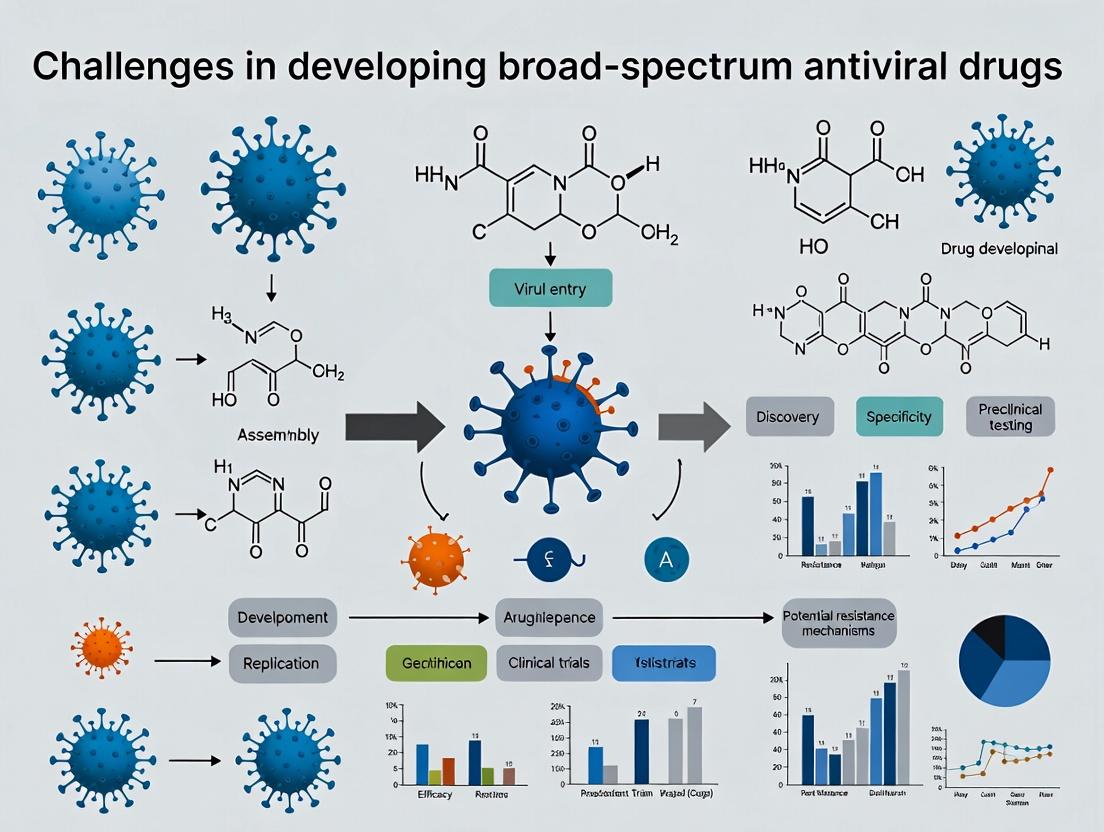
This article provides a comprehensive analysis for researchers and drug development professionals on the formidable challenges impeding the creation of effective broad-spectrum antiviral drugs.
The Quest for Pan-Viral Defenses: Unraveling the Scientific Hurdles in Broad-Spectrum Antiviral Drug Development
Abstract
This article provides a comprehensive analysis for researchers and drug development professionals on the formidable challenges impeding the creation of effective broad-spectrum antiviral drugs. It explores the foundational biological hurdles posed by viral diversity, examines current methodological strategies targeting common viral mechanisms, troubleshoots critical issues in drug specificity and resistance, and validates progress through comparative analysis of leading candidate platforms. The synthesis offers a roadmap for overcoming these barriers to achieve the paradigm-shifting goal of pan-viral therapeutics.
Viral Diversity vs. Drug Specificity: The Core Biological Conflict
Technical Support Center: Troubleshooting Broad-Spectrum Antiviral Research
FAQs & Troubleshooting Guides
Q1: My high-throughput screen for broad-spectrum viral polymerase inhibitors yielded a high hit rate but subsequent validation shows poor specificity and high cytotoxicity. What went wrong? A: This is a common issue. The initial assay may lack counter-screens. Implement these protocols immediately:
- Primary Assay: Cell-based viability assay (e.g., CellTiter-Glo) with a panel of RNA/DNA viruses (e.g., Influenza, HCV, Coxsackievirus). Use MOI=0.1.
- Essential Counter-Screens:
- Cytotoxicity: Treat uninfected cells with compound series. Calculate CC50.
- Host Polymerase Inhibition: Use a commercially available mammalian DNA Pol α/β or RNA Pol II biochemical assay kit.
- Interferon Induction Artifact: Include a reporter cell line (e.g., A549-ISRE-luc) to rule out non-specific antiviral activity via innate immune activation.
- Troubleshooting: A high primary hit rate (>5%) often indicates assay interference. Re-optimize library concentration to start screening at 10µM. Use Z' factor >0.5 as a quality control metric for each plate.
Q2: When testing a novel capsid inhibitor, I observe rapid resistance development in serial passage experiments. How can I characterize the fitness cost of these mutations? A: You must quantify the evolutionary trade-off. Follow this competitive fitness assay:
- Protocol: Co-infect cells at a 1:1 ratio of mutant virus (from passage) and wild-type (WT) virus, in the absence of drug. Use a total MOI of 0.01 to avoid superinfection.
- Harvest progeny virus at 48-72 hours post-infection.
- Genotype: Perform deep sequencing (minimum 10,000x coverage) of the capsid region or use a quantitative PCR assay with allele-specific probes to determine the ratio of mutant to WT.
- Passage: Repeat for 10 serial passages without drug pressure.
- Analysis: A declining mutant/WT ratio indicates a high fitness cost. Plot the log ratio over passages; a steep negative slope suggests the mutation is unlikely to persist in nature, informing drug durability.
Q3: My host-directed antiviral (targeting a cellular entry factor) works in vitro but shows no efficacy in the animal model. What are potential reasons? A: This typically points to pharmacokinetic (PK) or pathway redundancy issues.
- Checklist:
- Target Engagement: Did you verify the target is inhibited in vivo? Use a PD biomarker (e.g., phosphorylation status of a downstream protein) from treated animal tissues.
- Drug Exposure: Measure plasma and target organ (e.g., lung) concentration of the compound at your dosing regimen. Ensure it remains above the in vitro IC90 for >12 hours.
- Redundancy: The virus may use an alternate receptor in vivo. Perform a CRISPR knockout of your target gene in an animal model cell line and re-test infection. If infection proceeds, an alternate pathway exists.
- Recommended Experiment: Repeat animal study with a more frequent dosing schedule. If efficacy improves, the issue is PK. If no change, the issue is likely biological redundancy.
Q4: How can I accurately quantify viral mutation rates to assess the "moving target" problem for my drug candidate? A: Use a fluctuation test (Luria-Delbrück assay) adapted for viruses.
- Protocol:
- Infect a large number of parallel, low-density cell cultures (e.g., 100 wells of a 96-well plate, 10^4 cells/well) with a low MOI (~0.001) to ensure independent replication events.
- Allow replication for a set number of generations (e.g., 5-7 replication cycles).
- Add a high concentration of your drug (10x IC99) to each well to select for pre-existing resistant mutants.
- Use TCID50 or plaque assay to titer the resistant virus in each well.
- Calculation: The variance in the number of resistant mutants across wells is used to calculate the mutation rate using the Ma-Sandri-Sarkar maximum likelihood estimator (available in tools like FALCOR).
- Critical Control: Include a nucleoside analog (e.g., ribavirin) as a positive control to increase mutation rate and validate your assay sensitivity.
Quantitative Data Summary
Table 1: Comparative Mutation Rates of Selected Viruses
| Virus Family | Genome Type | Mutation Rate (per base per replication cycle) | Key Polymerase Fidelity Feature |
|---|---|---|---|
| Picornavirus | (+)ssRNA | ~10^-4 to 10^-5 | RNA-dependent RNA polymerase (RdRp) lacks proofreading |
| Influenza | (-)ssRNA | ~3 x 10^-5 | RdRp complex has low fidelity |
| Coronavirus | (+)ssRNA | ~3 x 10^-6 | nsp14-ExoN provides some proofreading |
| HIV-1 | ssRNA-RT | ~3 x 10^-5 | Error-prone reverse transcriptase |
| Herpesvirus | dsDNA | ~2 x 10^-7 | DNA polymerase with proofreading exonuclease |
Table 2: Common Causes of Failed Broad-Spectrum Antiviral Screens
| Issue | Frequency in HTS (%) | Primary Root Cause | Recommended Solution |
|---|---|---|---|
| Cytotoxicity Mimicking Efficacy | 15-25 | Non-specific host cell pathway inhibition | Implement real-time cell health monitoring (e.g., impedance). |
| Assay Interference (Fluorescence) | 10-20 | Compound auto-fluorescence or quenching | Switch to luminescent or colorimetric readout. |
| Innate Immune Activators | 5-15 | Non-specific ISG induction masking direct effect | Use knockout cell lines (e.g., MAVS-/-, STING-/-) for validation. |
| Viral Strain Specificity | 30-40 | Target site not conserved across clades | Screen against minimum 3 diverse strains from initial hit stage. |
Experimental Protocol: Serial Passage for Resistance Mutant Selection
Objective: To force the development of antiviral resistance in vitro and identify associated mutations. Materials: Relevant cell line, wild-type virus stock, antiviral compound, cell culture media. Method:
- Infect cells in a T-25 flask at an MOI of 0.1 in the presence of a low concentration of compound (e.g., 2x IC50).
- Incubate until significant cytopathic effect (CPE) is observed (~80% cell death).
- Harvest supernatant, clarify by centrifugation (2000 x g, 10 min).
- Titer the harvested virus (plaque assay).
- Use a portion of the harvested virus to infect a new cell monolayer, increasing the compound concentration by 1.5-2x.
- Repeat steps 2-5 for 15-20 passages.
- At passages 0, 5, 10, 15, and 20, extract viral RNA/DNA for whole-genome sequencing to identify fixed mutations. Controls: Parallel passage of the same virus in the absence of any compound.
Visualizations
Diagram Title: Viral Resistance Evolution Under Drug Pressure
Diagram Title: Antiviral Drug Candidate Screening Workflow
The Scientist's Toolkit: Research Reagent Solutions
| Item | Function & Application | Key Consideration |
|---|---|---|
| Polymerase Error Rate Assay Kits (e.g., for RdRp) | Quantify nucleotide misincorporation rates to assess viral mutation potential and drug pressure effects. | Use with purified viral polymerase and natural NTPs; include a fidelity-enhanced mutant control. |
| Human Primary Cell Models (e.g., PBMCs, HAE cells) | Provide physiologically relevant host factors and innate immune responses for in vitro testing. | Donor variability is high; use pooled donors or minimum n=3 for significant results. |
| Replicon Systems & Reporter Viruses | Enable safe, high-throughput study of viral replication mechanisms for BSL-2 agents (e.g., HCV, SARS-CoV-2 ΔN). | Ensure the replicon contains all relevant cis-acting elements for authentic replication. |
| Deep Sequencing Services (Viral amplicon-seq) | Identify low-frequency resistance variants (<1%) in a viral population pre- and post-treatment. | Require high coverage depth (>10,000x) and include a no-template control for contamination. |
| Pseudotyped Virus Particles | Study entry inhibitors for high-containment viruses (e.g., Ebola, NiV) safely at BSL-2. | Validate that the pseudotype accurately reflects the glycoprotein function of the wild-type virus. |
| Metabolomic Profiling Kits | Identify host metabolic pathways hijacked by viruses, potential targets for host-directed therapy. | Use isotopically labeled tracers (e.g., 13C-glucose) to track flux changes upon infection/drug treatment. |
Genetic & Structural Heterogeneity Across Viral Families
Technical Support Center
Troubleshooting Guide & FAQ
Q1: Our high-throughput sequencing of a clinical isolate reveals a highly divergent genome that does not align well to reference strains. How do we determine if this is a novel variant or a recombinant strain, and what are the implications for our broad-spectrum antiviral candidate targeting a conserved polymerase domain?
A1: This is a common issue stemming from viral genetic heterogeneity. Follow this protocol to characterize the isolate.
- Assembly & Annotation: Use a de novo assembler (e.g., SPAdes, IVA) followed by reference-guided mapping. Annotate using VAPiD or VICTOR.
- Phylogenetic Analysis: Perform separate phylogenetic reconstructions for different genomic regions (e.g., structural vs. non-structural genes). Use MAFFT for alignment and IQ-TREE for maximum-likelihood trees.
- Recombination Detection: Run sequences through RDP4 or SimPlot to identify potential recombination breakpoints.
- Structural Modeling: If the antiviral target is a polymerase, model the mutant protein's structure using AlphaFold2 and dock your candidate drug.
Implication: A recombinant or highly divergent strain may have altered the local protein environment of your target site, affecting drug binding. Quantitative data from recent studies on mutation rates is below:
Table 1: Viral Polymerase Fidelity and Mutation Rates
| Virus Family | Polymerase Type | Error Rate (per bp per replication) | Key Broad-Spectrum Target |
|---|---|---|---|
| Coronaviridae | RNA-dependent RNA polymerase (RdRp) | ~10⁻⁶ | Conserved active site (nsp12) |
| Orthomyxoviridae | RdRp (complex) | ~10⁻⁵ | Cap-snatching endonuclease (PA) |
| Picornaviridae | RdRp | ~10⁻⁴ | Conserved hydrophobic pocket in VP1 |
| Herpesviridae | DNA polymerase | ~10⁻⁷ | Exonuclease domain (UL30) |
| Retroviridae | Reverse Transcriptase | ~10⁻⁵ | Non-nucleoside binding pocket |
Workflow for Characterizing Divergent Viral Isolates
Q2: Our cryo-EM reconstruction of a potential broad-spectrum antiviral bound to the target capsid protein shows poor density for the drug in one major viral family despite high sequence conservation. What are the likely structural causes and how can we validate them?
A2: Poor density indicates weak or heterogeneous binding. Structural heterogeneity, not captured in sequence alignments, is likely the cause.
Experimental Protocol to Identify Causes:
- 3D Variability Analysis: Use cryoSPARC's 3D Variability Display or RELION to analyze continuous conformational heterogeneity in your cryo-EM data.
- Focused Classification: Perform focused 3D classification with a mask around the drug-binding pocket to isolate subpopulations with/without bound drug.
- Molecular Dynamics (MD) Simulation: Run all-atom MD simulations of the drug bound to the high-resolution structures from different viral families. Calculate binding free energies (MM/GBSA).
- Mutagenesis Validation: Introduce key divergent residues from the non-binding family into a permissive viral backbone (e.g., using reverse genetics). Test drug efficacy via plaque reduction assay.
Table 2: Common Sources of Structural Heterogeneity Affecting Drug Binding
| Source | Description | Experimental Validation Method |
|---|---|---|
| Conformational Dynamics | Target protein exists in multiple states. | 3D Variability Analysis (cryo-EM), Hydrogen-Deuterium Exchange MS |
| Allosteric Modulation | Binding at a distal site alters target site. | Double Electron-Electron Resonance (DEER) Spectroscopy |
| Quinary Structure | Differences in solvent ions/cosolute interactions. | Isothermal Titration Calorimetry (ITC) with varied buffers |
| Glycan Shield | Differential glycosylation blocking access. | Glycan deletion mutants (CRISPR), Lectin Blot |
| Capsid Breathing | Transient opening of the capsid. | Time-Resolved Limited Proteolysis |
Diagnosing Cryo-EM Drug Density Problems
Q3: In our cell-based antiviral assay, the lead compound shows potent activity against Filoviruses but no activity against Paramyxoviruses, despite targeting a homologous class I fusion protein. What mechanistic troubleshooting steps should we take?
A3: This highlights functional heterogeneity within a conserved structural fold. The issue likely lies in the kinetic or allosteric mechanisms of fusion inhibition.
Detailed Mechanistic Protocol:
- Cell-Cell Fusion Assay: Quantify inhibition of syncytia formation for both viruses using a luciferase reporter gene (e.g., dual split protein assay). Test at different pH levels to probe for pH-dependent activation differences.
- Surface Plasmon Resonance (SPR): Measure the binding kinetics (ka, kd, KD) of your compound to the purified recombinant fusion protein ectodomains from both families.
- Pre- & Post- Treatment: Add the compound at various time points relative to viral attachment and low-pH trigger (using temperature blocks or pH pulses). This identifies which step (e.g., pre-hairpin formation, six-helix bundle completion) is blocked.
- Resistance Selection: Generate compound-resistant mutants for the sensitive virus. Sequence to identify mutations; engineer these into the resistant virus to see if they confer sensitivity.
The Scientist's Toolkit: Research Reagent Solutions
| Item | Function in This Context | Example/Supplier |
|---|---|---|
| Dual Split Protein (DSP) Assay Kit | Quantifies cell-cell fusion in real-time via luciferase complementation. | Promega, or clone DSP1-7 & DSP8-11. |
| Biotinylated Viral Glycoprotein Ectodomains | For immobilization on SPR chips to measure direct drug binding kinetics. | IBT Bioservices, Sino Biological. |
| Site-Directed Mutagenesis Kit | For introducing resistance mutations into viral glycoprotein expression plasmids. | Agilent QuikChange, NEB Q5. |
| pH-Sensitive Dyes (e.g., pHrodo) | To precisely monitor and control endosomal pH during time-of-addition assays. | Thermo Fisher Scientific. |
| Pseudotyped Viral Particles | Safe, BSL-2 systems expressing heterologous fusion proteins for neutralization assays. | Integral Molecular, Systems Biosciences. |
Troubleshooting Fusion Inhibitor Specificity
Troubleshooting Guide & FAQ for Antiviral Drug Development Research
This support center addresses common experimental challenges encountered in broad-spectrum antiviral (BSA) drug development, framed within the overarching thesis: "The principal challenge in BSA drug development lies in optimizing the balance between a compound's spectrum width (the diversity of viruses it can inhibit) and its therapeutic efficacy (potency and selectivity at the target site)."
Frequently Asked Questions (FAQs)
Q1: In our high-throughput screening (HTS) assay, we are seeing high hit rates against a viral panel, but subsequent secondary assays show no efficacy. What could be the cause? A: This is a classic artifact often due to assay interference. Primary HTS for BSAs often uses biochemical (e.g., enzyme inhibition) or cell-based phenotypic (e.g., cytopathic effect reduction) assays. Hits with broad activity may be non-specific aggregators, fluorescent compound interferers, or promiscuous inhibitors that disrupt general cell viability.
- Troubleshooting Steps:
- Run counter-screens: Implement a parallel HTS against an unrelated target to identify promiscuous inhibitors.
- Test for aggregation: Use detergents (e.g., 0.01% Triton X-100) in the assay buffer. True inhibitors are usually detergent-insensitive, while aggregators lose activity.
- Assess cell toxicity early: Perform a cell viability assay (e.g., ATP-based luminescence) concurrently with the antiviral assay to calculate a selectivity index (SI = CC₅₀ / EC₅₀). A low SI (<10) suggests general cytotoxicity, not specific antiviral action.
- Verify chemical stability: Use LC-MS to confirm the compound is stable under assay conditions and not degrading into a non-specific toxic byproduct.
Q2: Our nucleoside analog shows excellent in vitro breadth against several viruses in the same family, but fails in animal models for one of them. How should we investigate this? A: This discrepancy often stems from host metabolism differences impacting prodrug activation or nucleotide triphosphate (NTP) formation.
- Troubleshooting Protocol:
- Quantify active metabolite in target tissue:
- Method: Administer the prodrug to infected animal models. Harvest target organ tissue (e.g., lung for respiratory viruses).
- Extraction: Homogenize tissue in 70% methanol.
- Analysis: Use LC-MS/MS to quantify the levels of the active triphosphate (NTP) form. Compare levels between the successful and failing virus models.
- Check for host kinase expression: The conversion often relies on host kinases. Perform qPCR or western blot on tissue lysates to compare expression levels of key activating kinases (e.g., UMP-CMP kinase, nucleoside diphosphate kinase).
- Test alternative prodrug forms: If activation is low, design and synthesize phosphoramidate (ProTide) or other prodrug forms to bypass rate-limiting kinase steps.
- Quantify active metabolite in target tissue:
Q3: We are developing a host-targeting antiviral. While it shows a broad spectrum, we observe significant variability in EC₅₀ values across different cell lines for the same virus. How can we standardize our assays? A: Variability in host-targeting agents is expected due to differences in host gene expression, cell cycle, and metabolic states across lines.
- Standardization Workflow:
- Characterize your cell lines: Profile the expression level of your host target (e.g., receptor, kinase, protease) in all standard lab lines (e.g., Vero E6, A549, Huh-7, primary cells) using western blot.
- Use an internal reference virus: Include a standard, well-characterized virus (e.g., a lab-adapted influenza A strain) in all experiments as a control for cell line permissiveness and compound performance.
- Normalize data: Report EC₅₀ values relative to the target protein expression level or the internal reference virus's EC₅₀ to contextualize potency.
Table 1: Comparison of Representative Broad-Spectrum Antiviral Drug Candidates (Illustrative Data)
| Candidate Name | Target / Mechanism | Spectrum Width (Virus Families) | Avg. EC₅₀ (µM) in vitro | Selectivity Index (Avg.) | Current Status |
|---|---|---|---|---|---|
| Remdesivir (GS-5734) | RNA-dependent RNA polymerase (Viral) | Filoviridae, Coronaviridae, Paramyxoviridae | 0.01 - 0.1 | >100 (in dividing cells) | Approved (COVID-19) |
| Favipiravir (T-705) | RNA-dependent RNA polymerase (Viral) | Orthomyxoviridae, Arenaviridae, Bunyaviridae, Flaviviridae | 1 - 10 | ~10 - 100 | Approved (Influenza, Japan) |
| EIDD-2801 (Molnupiravir) | RNA-dependent RNA polymerase (Viral - induces error catastrophe) | Coronaviridae, Alphaviridae | 0.1 - 1 | >100 (in some models) | Approved (COVID-19) |
| Nitazoxanide | Host regulator (PKR, INK) & viral HA maturation | Coronaviridae, Orthomyxoviridae, Flaviviridae, Reoviridae | 0.1 - 5 | ~5 - 20 | Phase 2/3 for various |
| Umifenovir (Arbidol) | Host cell membrane / viral fusion inhibition | Orthomyxoviridae, Coronaviridae | 1 - 10 | >10 | Approved (RU/CN for influenza) |
Detailed Experimental Protocols
Protocol 1: Time-of-Addition Assay to Determine Mechanism Stage Objective: To pinpoint whether a host-targeting BSA candidate acts on early (entry) or late (replication/assembly) stages of the viral life cycle.
- Seed susceptible cells (e.g., Vero E6) in a 96-well plate.
- Infect cells at a low MOI (e.g., 0.1). Add the compound at different time points post-infection (e.g., -1, 0, 2, 4, 6, 8 hours relative to infection).
- Include Controls: A known entry inhibitor (e.g., heparin for some viruses) added at time 0, a known replication inhibitor (e.g., remdesivir) added at 2h p.i., and a DMSO vehicle control.
- Harvest supernatant/cells at 24h p.i.
- Quantify viral yield by plaque assay or qRT-PCR.
- Analysis: A compound that loses efficacy when added late acts on early stages. One that retains efficacy when added late acts on post-entry stages.
Protocol 2: Cell-Based Viral Polymerase Activity Assay (Minireplicon) Objective: To confirm direct antiviral activity against viral replication machinery, excluding entry/fusion effects.
- Transfect cells with a plasmid system expressing:
- A reporter (e.g., luciferase) gene flanked by viral UTRs.
- Viral polymerase complex proteins (e.g., RdRp, co-factors L, P, N for NNS viruses).
- Treat with your BSA candidate at a range of concentrations (e.g., 0.1 µM to 50 µM) immediately after transfection.
- Incubate for 24-48 hours.
- Lyse cells and measure reporter activity (e.g., luminescence).
- Normalize data to cell viability (from a parallel MTS assay) and calculate EC₅₀ for replication inhibition specifically.
Visualizations
Title: BSA Drug Targeting Strategies and Their Trade-offs
Title: BSA Drug Discovery and Validation Workflow
The Scientist's Toolkit: Research Reagent Solutions
Table 2: Essential Reagents for BSA Mechanism and Efficacy Studies
| Reagent / Material | Function in BSA Research | Key Consideration |
|---|---|---|
| Plaque Assay Reagents (Agarose, Crystal Violet) | Gold-standard for quantifying infectious viral titer and calculating EC₅₀/CC₅₀. | Optimize overlay viscosity and cell type for clear plaque morphology. |
| qRT-PCR Master Mix & Viral Primers/Probes | Quantifies viral genomic RNA/DNA load; faster than plaque assays but measures genome copies, not infectivity. | Design primers against conserved regions for broad detection within a family. |
| Cell Viability Assay Kits (MTS, CCK-8, ATP-based) | Measures compound cytotoxicity to calculate the critical Selectivity Index (SI). | Run in parallel with antiviral assays on the same cell plate for accurate SI. |
| Minireplicon System Plasmids | Enables study of viral replication/transcription isolated from entry/fusion processes. | Requires species-specific polymerase components; transfection efficiency is key. |
| CRISPR Knockout Library (e.g., GeCKO) | Genome-wide screen to identify essential host factors for viral replication (host-target discovery). | Requires deep sequencing and bioinformatics analysis of guide RNA abundance. |
| Recombinant Viral Proteins (e.g., RdRp, Protease) | For biochemical screening and characterizing direct inhibition mechanisms (Ki, IC₅₀). | Ensure proteins are enzymatically active; use positive control inhibitors. |
| Primary Human Cell Cultures (e.g., PBMCs, HAE, hepatocytes) | Provides physiologically relevant models to test efficacy and toxicity beyond immortalized lines. | Donor variability; more expensive and difficult to culture than cell lines. |
| Pharmacokinetic (PK) Assay Kits (LC-MS/MS compatible) | Quantifies drug and metabolite levels in vivo to link exposure (PK) to effect (PD). | Critical for understanding why an in vitro active compound fails in vivo. |
Troubleshooting Guides & FAQs
FAQ: Understanding Core Concepts
Q1: What is the fundamental "targeting dilemma" in broad-spectrum antiviral development? A1: The dilemma is the conflict between targeting a highly conserved, host-dependent factor essential for multiple viruses (high efficacy, but risk of host toxicity) versus targeting a highly specific, virus-encoded factor (lower toxicity, but narrow spectrum and higher risk of viral resistance).
Q2: Why are host dependency factors (HDFs) attractive yet problematic targets? A2: HDFs, such as the endosomal Rab GTPases or the ER-associated protein folding machinery, are hijacked by multiple virus families. Targeting them can block a wide range of pathogens. However, as these are cellular proteins, inhibition can disrupt vital host cell functions, leading to off-target toxicity, which is a major hurdle in drug development.
Q3: What are common experimental pitfalls when validating host-targeted antivirals in vitro? A3: Common issues include:
- Misinterpreting Cytotoxicity: A compound may reduce viral titer purely due to host cell death. It's critical to calculate a Selectivity Index (SI = CC50 / EC50).
- Lack of Orthogonal Validation: Relying on a single assay (e.g., only a luciferase reporter) without secondary validation (e.g., plaque assay, qPCR) can lead to false positives from assay-specific artifacts.
- Poor Model Translation: An HDF may be essential in a cancer-derived cell line but redundant in primary human cells, leading to overestimation of therapeutic window.
Troubleshooting Guide: Key Assays
Issue: High Cytotoxicity (Low CC50) obscuring antiviral activity in a host-targeted compound screen.
- Step 1: Verify cytotoxicity assay timing. Ensure the CC50 is measured over the same duration as the antiviral assay (e.g., 72h post-infection).
- Step 2: Switch to a more physiologically relevant cell model. If using HeLa or HEK293 cells, repeat in primary cell types (e.g., human bronchial epithelial cells, PBMCs). Toxicity is often cell-type dependent.
- Step 3: Titrate the compound addition time. For some HDFs (like those involved in viral entry), a short "pulse" treatment may be sufficient for antiviral effect, reducing cumulative toxicity.
Issue: Inconsistent broad-spectrum activity of an HDF inhibitor across different virus families.
- Step 1: Check the conservation of the HDF's role. Use siRNA/gene knockout to confirm the factor is equally required for all tested viruses in your specific cell model.
- Step 2: Assess viral entry pathways. An inhibitor of cathepsin L will block pH-dependent enveloped viruses (e.g., Ebola) but not pH-independent ones (e.g., Lassa).
- Step 3: Evaluate the stage of the viral life cycle. Use time-of-addition assays to pinpoint if the inhibitor acts early (entry) or late (assembly). An inconsistent pattern may indicate off-target effects.
Issue: Emergence of viral resistance during in vitro passage with a host-targeted inhibitor.
- Step 1: Sequence the viral genome. Resistance to bona fide HDF inhibitors is rare but possible through mutations that allow viral usage of an alternative host factor (viral adaptation).
- Step 2: Validate the host target engagement. Use a cellular thermal shift assay (CETSA) or drug affinity responsive target stability (DARTS) to confirm the compound still binds its intended protein in the resistant population.
- Step 3: Consider combination therapy. Pair the HDF inhibitor with a direct-acting antiviral (DAA) to create a higher genetic barrier to resistance.
Data Presentation
Table 1: Comparison of Antiviral Targeting Strategies
| Target Class | Example Target | Pros | Cons | Quantitative Risk Metric (Typical Range) |
|---|---|---|---|---|
| Virus-Specific | Viral Polymerase (e.g., HCV NS5B) | High specificity; Low host toxicity | Narrow spectrum; High resistance risk | Selectivity Index (SI): >1000 |
| Host Dependency Factor (HDF) | Cellular Protease (e.g., TMPRSS2) | Broad-spectrum potential; Lower resistance risk | Potential host toxicity; Side effects | Therapeutic Index (TI): Often <100 |
| Proviral Host Factor | Restriction Factor Antagonist (e.g., HIV Vif targeting APOBEC3G) | High barrier to resistance; Potentially broad | Difficult drug design; Mechanism complexity | Resistance Frequency: <10^-8 |
Table 2: Key In Vitro Assay Parameters for Validating Host-Targeted Antivirals
| Assay | Primary Readout | Critical Controls | Typical Z'-Factor (Quality Metric) | Key Reagent (See Toolkit) |
|---|---|---|---|---|
| Cell Viability (CC50) | Luminescence (ATP) / Fluorescence | DMSO vehicle; Staurosporine (pos. control) | >0.5 | CellTiter-Glo 2.0 |
| Antiviral Efficacy (EC50) | Plaque Reduction / Viral Genome Copy (qPCR) | Infection-only; Untreated infected cells | >0.4 | Virus-specific qPCR probe/primer set |
| Time-of-Addition | % Inhibition vs. Time of Compound Add. | Entry inhibitor (e.g., Chloroquine) as early control | N/A | Synchronized viral stock |
| Selectivity Index (SI) | SI = CC50 / EC50 | Must use same cell type & duration | N/A | Calculated from CC50 & EC50 data |
Experimental Protocols
Protocol 1: Determining Selectivity Index (SI) for a Putative Broad-Spectrum Compound
Objective: To quantify the window between cytotoxicity and antiviral activity.
Materials: Candidate compound, appropriate cell line (e.g., Vero E6, A549), virus stock(s), cell viability assay kit (e.g., CellTiter-Glo), viral load assay (e.g., plaque assay or RT-qPCR reagents), 96-well plates.
Methodology:
- Cytotoxicity (CC50) Assay:
- Seed cells in a 96-well plate at 80-90% confluence.
- After 24h, treat with serial dilutions (e.g., 100 µM to 0.1 µM) of the compound (n=4 wells per dilution).
- Incubate for 72 hours.
- Lyse cells and measure ATP content per manufacturer's protocol. CC50 is the concentration that reduces cell viability by 50%.
Antiviral Efficacy (EC50) Assay:
- Seed cells as above.
- Infect cells at a low MOI (e.g., 0.01) after pre-treating with the same serial dilutions of compound for 1h.
- Incubate for 48-72h (one viral replication cycle).
- Harvest supernatant for plaque assay or cell lysate for viral RNA/DNA quantification. EC50 is the concentration that reduces viral output by 50%.
Calculation: SI = CC50 / EC50. An SI >10 is typically considered promising for further development.
Protocol 2: Time-of-Addition Assay to Determine Mechanism Stage
Objective: To identify whether a host-targeted compound inhibits early (entry/post-entry) or late (replication/assembly) stages of the viral life cycle.
Materials: Compound, cells, virus, neutralization antibody (late control), entry inhibitor (early control, e.g., Bafilomycin A1).
Methodology:
- Design a plate with the following conditions per time point: (-) Uninfected, (+) Infected/Untreated, (+) Infected/Entry Inhibitor, (+) Infected/Late Inhibitor, (+) Infected/Test Compound.
- Synchronize infection by adsorbing virus to cells at 4°C for 1h.
- Shift to 37°C to initiate synchronous entry. This is Time = 0.
- Add the test compound at different time points post-infection (e.g., -1h, 0h, +2h, +4h, +8h).
- At 24h post-infection, harvest all samples and quantify viral load (e.g., by plaque assay).
- Analysis: Plot % inhibition against time of addition. Inhibition that drops sharply after ~2-4h suggests an early (entry) mechanism. Sustained inhibition at later times suggests a post-entry or late-stage mechanism.
The Scientist's Toolkit: Research Reagent Solutions
| Item Name | Vendor Example (for reference) | Function in Research |
|---|---|---|
| siRNA/CRISPR Libraries (Human Geome-Wide) | Horizon Discovery, Sigma-Aldrich | Systematic knockdown/knockout to identify novel Host Dependency Factors (HDFs). |
| Cell Viability Assay Kit (Luminescence) | Promega (CellTiter-Glo 2.0) | Quantifies ATP as a marker of metabolically active cells for CC50 determination. |
| Protease Inhibitor (TMPRSS2 inhibitor: Camostat mesylate) | Tocris Bioscience | Tool compound to validate the role of the host protease TMPRSS2 in viral entry (e.g., SARS-CoV-2, influenza). |
| Endosomal Acidification Inhibitor (Bafilomycin A1) | Cayman Chemical | Standard control for blocking pH-dependent viral entry; used in time-of-addition assays. |
| Live-Cell Dye for Viral Entry Imaging (e.g., DiD/DiO) | Thermo Fisher Scientific | Lipophilic fluorescent dyes to label viral envelopes and track entry kinetics via microscopy. |
| Cellular Thermal Shift Assay (CETSA) Kit | Thermo Fisher Scientific | Validates direct engagement of a small molecule with its putative host protein target in cells. |
| Broad-Spectrum Virus Panel (e.g., FLUAV, RSV, hCoV-OC43) | ATCC, Zeptometrix | Essential for empirically testing the broad-spectrum claim of an HDF-targeting compound. |
Diagrams
Diagram 1: HDF vs Viral Target Drug Development Pathway
Diagram 2: Host Factor Involvement in Viral Life Cycle
This technical support center provides troubleshooting guidance for common challenges encountered in broad-spectrum antiviral (BSA) drug research, framed by historical lessons from failed clinical candidates.
Troubleshooting Guides & FAQs
Q1: During high-throughput screening (HTS) of compound libraries against a conserved viral target, we encounter an unacceptably high rate of false-positive hits due to assay interference (e.g., aggregation, fluorescence quenching). How can we mitigate this?
A: This is a common historical pitfall. Implement a multi-tiered counter-screening protocol.
- Initial Triage: Immediately subject primary HTS hits to the following orthogonal assays:
- DLS/MLS: Use Dynamic or Multi-angle Light Scattering to detect promiscuous colloidal aggregates.
- Redox Assay: Test for compound-mediated reduction or oxidation, which can mimic inhibition.
- Dose-Response in Alternate Assay Format: Confirm activity in a non-fluorescent, label-free format (e.g., SPR, enzymatic assay with different readout).
- Protocol - Aggregation Testing via DLS:
- Prepare hit compounds at 10x and 50x their observed IC50 in assay buffer.
- Filter samples through a 0.22 µm filter.
- Load into a DLS instrument and measure particle size distribution.
- Interpretation: A population of particles in the 100-1000 nm range indicates aggregation. True hits should show only molecular-sized particles (<5 nm).
Q2: Our lead compound shows excellent in vitro potency against a panel of viruses from one family, but demonstrates rapid loss of efficacy in serial passage resistance experiments. What are the next steps?
A: This indicates a low genetic barrier to resistance—a frequent cause of failure. Your workflow must now focus on mechanistic validation and combination strategy.
- Protocol - Serial Passage Resistance Selection:
- Infect cell culture with virus at low MOI (e.g., 0.01).
- Treat with compound at a concentration near its IC50 or IC90.
- Harvest virus when CPE is extensive, and use this supernatant to infect new, treated cells.
- Repeat for 15-20 passages. Include a DMSO/no-drug control passage.
- Sequence viral genomes (e.g., whole genome sequencing) from passages 5, 10, 15, and the endpoint. Identify conserved vs. divergent mutations.
- Action: If mutations consistently map to the compound's presumed binding pocket, it confirms target engagement but predicts clinical resistance risk. Consider developing a backup compound with activity against the common mutant or initiate combination studies with a compound having a non-overlapping resistance profile.
Q3: We have a candidate that targets a host dependency factor. It shows broad-spectrum activity in vitro, but in animal models, we see unacceptable toxicity or narrow therapeutic index (TI). How do we troubleshoot?
A: Targeting host factors is historically high-risk for toxicity. A systematic de-risking plan is required.
- Confirm On-Target vs. Off-Target Toxicity:
- Protocol - CRISPR Knockdown/Rescue: In your primary cell assay, use CRISPRi to knock down the host target gene and confirm it phenocopies the antiviral effect. Then, express a drug-resistant version (e.g., silent mutations in the binding site) of the target protein. If the compound loses efficacy in the rescued cells, the antiviral effect is on-target. Correlate cell viability in this system with toxicity markers.
- Tissue-Specific Expression Analysis: Quantify target protein expression in key organs (e.g., liver, kidney, bone marrow) vs. primary infection sites. High expression in vital organs predicts toxicity.
- Explore Alternative Dosing Regimens: In animal models, test pulsed dosing versus continuous dosing to see if antiviral efficacy can be maintained while reducing cumulative exposure and toxicity.
Key Data from Historical Failures
Table 1: Analysis of Selected Failed Broad-Spectrum Antiviral Candidates
| Candidate Name / Class | Target / Proposed Mechanism | Phase of Failure | Primary Reason for Failure | Key Quantitative Data (e.g., TI, Resistance Rate) |
|---|---|---|---|---|
| Umifenovir (Arbidol) | Hemagglutinin fusion inhibitor (broad-spectrum claimed) | Preclinical/Phase III (equivocal results) | Lack of robust, reproducible efficacy in rigorous RCTs; unclear mechanism. | Meta-analysis (2020): Pooled RR for influenza = 0.95 (0.83-1.09); No significant reduction in viral titer vs. placebo. |
| Nitazoxanide (Host-directed) | Regulates host cell pathways (PKR, eIF2α) | Phase III (for influenza) | Failed to meet primary endpoint (time to symptom alleviation) in adult outpatient studies. | Phase III Trial (2014): Median time to symptom resolution: 72.5h (drug) vs 81.5h (placebo), p=0.41. |
| Favipiravir (Polymerase inhibitor) | RNA-dependent RNA polymerase (RdRp) | Limited approval (Japan); failed some trials | Teratogenicity risk; modest efficacy in later-stage trials; raises uric acid levels. | Phase III (PREVAIL II, 2020): No significant difference in time to clinical improvement in mild COVID-19. |
| Various Polymerase Inhibitors (e.g., Balapiravir) | HCV RdRp | Phase II | Host toxicity (mitochondrial toxicity, bone marrow suppression) leading to narrow TI. | Balapiravir: Associated with significant anemia and neutropenia, leading to trial termination. |
Experimental Protocol: Core Assessment for BSA Leads
Protocol: Three-Pillar In Vitro Profiling for BSA Candidates Objective: To comprehensively evaluate the breadth, selectivity, and resistance potential of a novel BSA candidate. Pillar I: Breadth and Potency Panel.
- Method: Perform standard plaque reduction or yield reduction assays.
- Viruses: Include minimum 3 distinct species from at least 2 different genera within the target viral family. Use clinical isolates where possible.
- Output: Determine EC50/EC90 for each virus. Success Criterion: EC50 < 1 µM across panel.
Pillar II: Cytotoxicity and Therapeutic Index (TI).
- Method: Conduct parallel assays in relevant, metabolically active host cells (e.g., primary cells, hepatocytes, PBMCs).
- Assays: MTT/XTT (metabolism), LDH release (membrane integrity), and cell count (proliferation). Run for 72-96 hours.
- Output: Calculate CC50. Determine Selectivity Index (SI) = CC50 / EC50. Target Criterion: SI > 100 for advancement.
Pillar III: Barrier to Resistance.
- Method: Serial passage experiment as detailed in FAQ #2.
- Output: Genotype and phenotype (fold-change in EC50) of escape mutants. Target: No high-fitness escape mutants emerging before passage 10.
Pathway & Workflow Visualizations
Title: BSA Candidate Progression & Critical Checkpoints
Title: Broad-Spectrum Antiviral Drug Target Landscape
The Scientist's Toolkit: Research Reagent Solutions
Table 2: Essential Reagents for BSA Resistance & Toxicity Studies
| Reagent / Material | Function / Application | Key Consideration |
|---|---|---|
| Pseudotyped Viral Particle Systems (VSV, HIV, MLV core with heterologous glycoproteins) | Safely measure entry inhibition breadth against high-consequence viruses (e.g., Ebola, NiV, SARS-CoV-2) in BSL-2. | Validate correlation with authentic virus infection for your target. |
| Recombinant Viral Polymerase Complexes (RdRp, RT) | Screen for direct enzyme inhibition and perform mechanistic kinetics (e.g., NTP incorporation, template binding). | Co-expression with essential co-factors (e.g., NiRAN, cap-snatching subunits) is often needed for relevant activity. |
| Primary Human Cell Models (HUVEC, PBMCs, hepatocytes, bronchial epithelia) | Assess cytotoxicity and antiviral activity in physiologically relevant, non-transformed cells. Critical for accurate TI calculation. | Donor variability is a factor; use pooled or multiple donors. |
| CRISPR Knockout/Knockdown Cell Pools (for host factor targets) | Conclusively link antiviral effect to the intended host target and rule of off-target effects. | Use inducible or stable knockdown systems to avoid compensatory adaptations. |
| Dual-Luciferase Reporter Assays (e.g., Renilla/Firefly) | Counter-screen for non-specific inhibition of gene expression (transcription/translation) which can cause false positives. | Standard part of the triage workflow post-HTS. |
| Metabolite Profiling Kits (e.g., for ATP, Lactate, Uric Acid) | Monitor specific off-target metabolic toxicities observed historically (mitochondrial dysfunction, purine metabolism disruption). | Integrate into repeat-dose in vitro toxicity screening. |
Strategic Blueprints: Current Approaches to Pan-Viral Drug Design
Technical Support Center
Troubleshooting Guides & FAQs
Q1: Our high-throughput screen for HDT candidates targeting endosomal pathways shows high cytotoxicity at non-inhibitory concentrations. What are the primary control points to check? A: High cytotoxicity often indicates off-target effects on essential cellular machinery. Follow this protocol:
- Dose-Response Validation: Re-run cytotoxicity (e.g., MTT, LDH) and antiviral (e.g., plaque reduction) assays in parallel across a minimum of 10 concentrations, with 8 replicates each. Calculate Selectivity Index (SI = CC50 / EC50). An SI < 3 suggests a narrow therapeutic window.
- Cell Cycle Analysis: Perform flow cytometry with propidium iodide staining. A significant arrest in G1/S phase may indicate unintended disruption of cell cycle regulators like cyclin-dependent kinases.
- Off-Target Kinase Profiling: Utilize a commercial kinase profiling panel (e.g., Eurofins KinaseProfiler) at 1 µM and 10 µM of your compound. A hit rate >5% of the kinome suggests promiscuous binding.
- Pathway-Specific Rescue: Co-treat with a known pathway activator (e.g., for ER stress, use Salubrinal; for autophagy, use rapamycin). If cytotoxicity is reversed, it confirms on-pathway but excessive modulation.
Q2: During validation of a host kinase inhibitor, we observe potent antiviral activity in cell lines but no efficacy in a primary human airway epithelial (HAE) model. What is the systematic troubleshooting approach? A: Discrepancy between cell lines and physiologically relevant models is a key challenge in broad-spectrum antiviral development.
- Check Metabolic Stability: Primary HAE cells express higher levels of cytochrome P450 enzymes. Perform an LC-MS/MS assay to measure parent compound concentration in the apical wash of HAE cultures over 24 hours. A half-life < 2 hours indicates rapid metabolism.
- Assess Protein Binding: Use equilibrium dialysis to determine compound binding to media components (e.g., albumin) present in the HAE culture system. >95% binding significantly reduces free compound concentration.
- Verify Target Expression: Perform qRT-PCR and western blot on lysates from your HAE model versus the cell line. Key Data Table:
| Target Kinase | Cell Line (mRNA Level) | HAE Model (mRNA Level) | Cell Line (Protein Level) | HAE Model (Protein Level) |
|---|---|---|---|---|
| Target A | 1.0 (ref) | 0.2 ± 0.05 | High | Undetectable |
| Compensatory Kinase B | 0.1 ± 0.02 | 1.5 ± 0.3 | Low | High |
- Test Combination Therapy: If the single agent fails, combine with a low-dose, direct-acting antiviral (DAA) in the HAE model. Synergy (calculated via Bliss Independence or Loewe Additivity models) can rescue efficacy and lower the HDT dose, mitigating potential host toxicity.
Q3: We are developing an HDT that modulates the interferon (IFN) response. How do we quantitatively distinguish between broad-spectrum activity and general hyper-inflammation? A: This is critical for safety. Implement a dual-reporter assay system and cytokine profiling.
- Dual-Reporter Assay:
- Protocol: Transfect cells with two plasmids: 1) An ISRE (Interferon-Stimulated Response Element) promoter driving firefly luciferase. 2) An NF-κB promoter driving Renilla luciferase. Treat with your HDT, then infect with two unrelated viruses (e.g., Influenza A and human coronavirus 229E).
- Expected Result for Safe Broad-Spectrum Activity: ISRE luminescence increases >5-fold over mock-infected controls for both viruses, while NF-κB luminescence increases <2-fold.
- Red Flag Result: Both ISRE and NF-κB increase >5-fold, indicating a general inflammatory response.
- Multiplex Cytokine Panel:
- Protocol: Collect supernatant 24h post-treatment/infection and analyze using a 30-plex Luminex panel (e.g., including IFN-α, IFN-β, IL-6, TNF-α, IP-10).
- Data Analysis Table:
| Cytokine Class | Desired Profile (Safe HDT) | Risk Profile (Hyper-inflammatory) |
|---|---|---|
| Type I/III IFN | Early, significant increase (e.g., IFN-β >500 pg/mL) | Sustained, excessive increase (>2000 pg/mL) |
| ISG-derived Chemokines | Moderate increase (IP-10, RANTES) | Extreme increase (IP-10 >10,000 pg/mL) |
| Pro-inflammatory (IL-6, TNF-α) | Minimal change (<2x mock) | Significant increase (>10x mock) |
Q4: Our HDT candidate works in vitro but shows rapid clearance and low bioavailability in murine pharmacokinetic studies. What formulation strategies are most viable for preclinical advancement? A: Reformulation is often required. Prioritize strategies based on your compound's properties:
| Property (Assay) | Issue | Recommended Formulation | Key Excipient/Approach |
|---|---|---|---|
| Aqueous Solubility (<10 µg/mL) | Poor absorption | Nano-crystallization or Liposomal Encapsulation | Polyvinylpyrrolidone (PVP) or HSPC/Cholesterol/DSPE-PEG2000 |
| P-gp Substrate (Caco-2 Efflux Ratio >3) | Intestinal efflux | Co-administration with P-gp inhibitor | Oral co-dosing of low-dose cyclosporine A |
| First-Pass Metabolism (Hepatic Microsomal t1/2 <5 min) | Hepatic clearance | Phospholipid Complex or Prodrug | Phosphatidylcholine complex; Ester derivatization |
| Plasma Protein Binding (>99%) | Low free fraction | Albumin Nanoparticle Conjugation | Maleimide-mediated linkage to endogenous albumin |
Protocol for Liposomal Formulation Assessment:
- Prepare a thin lipid film (HSPC:Cholesterol:DSPE-PEG2000 at 55:40:5 molar ratio).
- Hydrate with ammonium sulfate buffer (pH 6.5) and extrude through 100nm polycarbonate membranes.
- Perform remote loading of your compound.
- Test in vivo: Compare IV pharmacokinetics of free drug vs. liposomal drug in BALB/c mice (n=6). Target: Increase in AUC(0-24h) by a minimum of 5-fold.
The Scientist's Toolkit: Research Reagent Solutions
| Item | Function in HDT Research | Example Product/Catalog # |
|---|---|---|
| ISRE-Luciferase Reporter Plasmid | Quantifies activation of the broad antiviral interferon-stimulated gene pathway. | pISRE-TA-luc (Clontech, #631913) |
| CRISPR/Cas9 Knockout Pool (Host Target) | Enables genome-wide or targeted loss-of-function screens to identify host factors essential for viral replication but dispensable for cell viability. | Human Protein Kinase KO Pool (Horizon Discovery, #HSD-005) |
| Primary Human Airway Epithelial (HAE) Cultures | Physiologically relevant model for respiratory virus research; maintains differentiated mucociliary morphology. | MatTek Corporation, EpiAirway (AIR-100) |
| Cytotoxicity Assay, Multiplexed | Allows simultaneous measurement of cell viability (e.g., resazurin) and caspase-3/7 activity (apoptosis) in the same well. | CellTiter-Glo 2.0 & Caspase-Glo 3/7 (Promega, #G9241 & #G8091) |
| Phospho-Kinase Array | Multiplexed immunoblotting to profile the activation status of 40+ key host kinases simultaneously upon HDT treatment. | Proteome Profiler Human Phospho-Kinase Array (R&D Systems, #ARY003B) |
| Poly(I:C) HMW | A synthetic double-stranded RNA analog used to mimic viral infection and stimulate MDA5/TLR3 pathways in validation experiments. | InvivoGen, tlrl-picw-250 |
Visualizations
Diagram 1: HDT Screening & Validation Workflow
Diagram 2: Key Host Pathways for Broad-Spectrum HDTs
Technical Support Center: Troubleshooting Antiviral Target Research
FAQ 1: My cell-based viral entry inhibition assay shows high background signal and low signal-to-noise ratio. How can I improve specificity?
- Answer: High background is commonly due to non-specific binding of detection reagents or high basal fluorescence/ luminescence in your cell line. Use the following checklist:
- Optimize Wash Stringency: Increase the number of post-infection and post-antibody washes. Include a gentle detergent (e.g., 0.05% Tween-20) in your PBS wash buffer to reduce non-specific adhesion.
- Validate Antibody Specificity: Perform a no-primary-antibody control and an isotype control. Titrate your detection antibody to find the optimal concentration that minimizes background.
- Use Appropriate Controls: Include a well-treated with a known entry inhibitor (e.g., T-20 for HIV, Heparin for HSV) as a positive control for inhibition and a virus-only well as a negative control. Normalize all readings to these controls.
- Cell Health: Ensure cells are not over-confluent or stressed at the time of infection, as this can increase autofluorescence and non-specific uptake.
FAQ 2: I am screening polymerase inhibitors and observing high cytotoxicity in my Vero E6 cells, confounding my antiviral readout. What steps should I take?
- Answer: Cytotoxicity masking antiviral effect is a major hurdle. Implement a parallel cytotoxicity assay.
- Protocol - Parallel Cell Viability Assay:
- Seed identical assay plates for antiviral effect (plaque reduction or CPE) and cell viability (e.g., MTT, CellTiter-Glo).
- Treat both plates with the same compound dilutions but do not infect the viability plate.
- Run the viability assay at the same timepoint as your antiviral endpoint.
- Calculate the Selectivity Index (SI) as CC50 (cytotoxic concentration 50%) / EC50 (effective concentration 50%). An SI > 10 is typically required for a promising lead.
- Alternative: Use a reporter virus that expresses a quantifiable protein (e.g., luciferase, GFP) to measure antiviral activity in live cells, allowing you to subsequently stain the same well for viability.
- Protocol - Parallel Cell Viability Assay:
FAQ 3: My FRET-based protease assay demonstrates poor cleavage efficiency and low dynamic range with the recombinant viral protease. What could be wrong?
- Answer: This often relates to substrate or reaction condition optimization.
- Verify Substrate Specificity: Confirm the peptide sequence between the donor (e.g., EDANS) and acceptor (e.g., DABCYL) fluorophores matches the exact consensus cleavage site for your target protease (e.g., for SARS-CoV-2 Mpro: AVLQSGFR).
- Optimize Reaction Buffer: Protease activity is highly sensitive to pH, ionic strength, and reducing agents. For example, many viral proteases require a reducing environment (1-5 mM DTT). Perform a buffer screen.
- Check Enzyme Quality: Run an SDS-PAGE gel to confirm protease purity and lack of degradation. Use a positive control inhibitor (e.g., GC376 for coronavirus 3CLpro) to confirm specific activity loss.
- Instrument Settings: Ensure the excitation/emission wavelengths are correct for your FRET pair and that you are using a black, low-binding microplate to minimize background.
FAQ 4: My surface plasmon resonance (SPR) analysis for an entry inhibitor shows non-specific binding to the control flow cell, skewing kinetics data.
- Answer: Non-specific binding to the sensor chip matrix must be addressed.
- Include Robust Controls: Immobilize a irrelevant protein (e.g., BSA) at similar density to your target receptor (e.g., ACE2) in the reference flow cell.
- Optimize Running Buffer: Add a non-ionic detergent (0.005% P20) and a carrier protein (0.1% BSA) to the running buffer to block non-specific sites. Include a low concentration of DMSO (e.g., 1%) if your compound is stored in DMSO to match conditions.
- Regeneration Scouting: Perform a regeneration scout to find a condition (e.g., mild acid, 10 mM Glycine pH 2.0; or high salt) that removes bound compound without damaging the immobilized receptor. This ensures the surface can be re-used for multiple cycles.
Table 1: Efficacy Parameters of Representative Broad-Spectrum Antiviral Inhibitors
| Target Class | Prototype Inhibitor | Primary Viral Spectrum | EC50 (nM) Range | CC50 (μM) Range | Reported Selectivity Index (SI) |
|---|---|---|---|---|---|
| RNA Polymerase | Remdesivir (Nuc) | Coronaviruses, Filoviruses | 10 - 750 | >10 | >13 - >1000 |
| Protease | PF-00835231 (Mpro Inh.) | Coronaviruses (SARS-CoV-2) | 7 - 70 | >50 | >700 |
| Viral Entry | Arbidol (Umifenovir) | Influenza, SARS-CoV-2 (disputed) | 2200 - 10000 (In vitro) | >50 | >5 |
| Polymerase | Favipiravir (Nuc) | Influenza, Ebola, Arenaviruses | 5000 - 40000 | >1000 | >25 |
Detailed Experimental Protocol: Viral Polymerase Inhibition Assay (Biochemical)
Objective: To measure the half-maximal inhibitory concentration (IC50) of a compound against a purified viral RNA-dependent RNA polymerase (RdRp) using an elongation assay.
Materials:
- Purified viral RdRp complex (e.g., SARS-CoV-2 nsp7/nsp8/nsp12).
- Synthetic RNA template and primer.
- NTP mix (ATP, GTP, CTP) + [³H]-UTP (radiolabeled) or UTP+ fluorescent label.
- Test compounds and positive control (e.g., Remdesivir-TP).
- Reaction buffer (typically 50 mM Tris-HCl pH 7.5, 5 mM MgCl2, 1 mM DTT, 50 mM KCl).
- Stop solution (50 mM EDTA).
- Equipment: Liquid scintillation counter or fluorescent plate reader, 37°C incubator.
Methodology:
- Prepare Reaction Mix: In a master mix, combine reaction buffer, RNA template/primer duplex, and RdRp enzyme.
- Dilute Compounds: Serially dilute test compounds in DMSO, ensuring the final DMSO concentration is ≤1% in all reactions.
- Initiate Reaction: Aliquot the master mix into tubes/wells containing compound or vehicle control. Pre-incubate for 10 minutes at 25°C. Start the polymerization reaction by adding the NTP mix containing the labeled UTP.
- Incubate: Allow the reaction to proceed for 30-60 minutes at 30°C or 37°C.
- Stop Reaction: Add an excess of EDTA stop solution to chelate Mg2+ and halt polymerization.
- Quantify Incorporation:
- For radiolabel: Transfer reaction product to filter membranes, wash extensively to remove unincorporated NTPs, and measure retained radioactivity via scintillation counting.
- For fluorescent label: Measure signal directly or after a purification step using a plate reader.
- Data Analysis: Calculate percent inhibition relative to no-inhibitor control. Fit dose-response data to a sigmoidal curve to determine IC50.
Visualization: Antiviral Target Screening Workflow
Title: Antiviral Lead Identification & Validation Workflow
The Scientist's Toolkit: Key Research Reagent Solutions
| Reagent / Material | Function in Conserved Target Research | Example Product / Note |
|---|---|---|
| Recombinant Viral Polymerase | Target protein for biochemical inhibition assays (IC50 determination). | SARS-CoV-2 RdRp (nsp7/nsp8/nsp12 complex), purified from insect cells. |
| Cell Line with Viral Receptor | Essential for entry inhibition and replicon/reporter assays. | Vero E6 (ACE2+ for many viruses), Huh-7 (liver tropic viruses), A549 (airway tropic viruses). |
| Reporter Virus or Replicon | Enables safe, high-throughput quantification of viral replication inhibition. | NanoLuc-expressing SARS-CoV-2 replicon (BSL-2); GFP-expressing influenza virus. |
| Fluorescent Peptide Substrate | Key for continuous, real-time kinetic assays of viral protease activity. | Dabcyl-KTSAVLQSGFRKME-Edans (for coronavirus Mpro). |
| Positive Control Inhibitor | Critical for validating assay performance and as a benchmark for novel compounds. | Remdesivir (polymerase), GC376 (protease), Heparin (entry blocker). |
| Cell Viability Assay Kit | To deconvolute antiviral effect from cytotoxicity (SI calculation). | MTT, CellTiter-Glo (luminescence), or AlamarBlue (fluorescence). |
The Promise of Innate Immune Stimulators and Broadly Neutralizing Antibodies
Technical Support Center: Troubleshooting & FAQs
Context: This support content addresses common experimental challenges in the research of broad-spectrum antiviral strategies, framed within the thesis on "Challenges in developing broad-spectrum antiviral drugs."
FAQs & Troubleshooting Guides
Q1: In our in vitro screening assay, we observe high cytotoxicity when testing novel STING (Stimulator of Interferon Genes) agonists. What are the primary controls and optimization steps? A: High cytotoxicity is a common hurdle. Implement this troubleshooting protocol:
- Dose-Response Validation: Re-run assay with a broader dilution series (e.g., 0.1 nM to 100 µM) to establish a true CC50 (cytotoxic concentration 50%).
- Control Check:
- Positive Cytotoxicity Control: Use a known cytotoxic agent (e.g., digitonin).
- Agonist-Specific Control: Include a canonical STING agonist (e.g., cGAMP) to benchmark expected cell health.
- Vehicle Control: Ensure DMSO concentration is ≤0.1%.
- Timing Optimization: Innate immune activation can induce apoptosis over time. Measure cytokine output (IFN-β) at earlier time points (e.g., 6h, 12h, 24h) post-treatment to find the peak response before significant cell death.
Q2: Our pseudotyped virus neutralization assay for bNAbs (broadly neutralizing antibodies) shows inconsistent neutralization curves (poor Hill slopes) between replicates. What could be the cause? A: Inconsistent curves often point to variability in viral stock or assay conditions.
- Pseudovirus Stock QC: Titrate your stock anew on the target cell line to determine precise infectious units (IU/mL). Avoid using passage number >5.
- Cell Passage & Viability: Ensure target cells (e.g., HEK293T-ACE2) are in log-phase growth and >90% viability. Do not use cells beyond passage 25.
- Incubation Time Standardization: Pre-incubate antibody and virus at a constant temperature (37°C) for a fixed time (e.g., 1h) before adding to cells. Use a timer.
- Plate Edge Effect: Avoid using outer wells for critical data points; fill them with PBS. Use sealed, humidified boxes during incubation.
Q3: When assessing combinatorial therapy (Innate Stimulator + bNAb) in a murine model, how do we differentiate the antiviral contribution of each component? A: A rigorous experimental design with multiple arms is required.
- Required Study Arms: Include: a) Untreated infected, b) bNAb monotherapy, c) Innate stimulator monotherapy, d) Combination therapy, e) Isotype control antibody, f) Innate stimulator vehicle control.
- Endpoint Triangulation: Measure viral load (qRT-PCR), serum cytokine levels (e.g., multiplex IFN-I, IL-6), and bNAb pharmacokinetics (ELISA for human IgG) from the same animals at matched time points.
- Statistical Interaction Analysis: Use a two-way ANOVA to test for a statistically significant synergistic or additive interaction between the two treatments, rather than just comparing each to control.
Q4: What are the critical steps to validate the specificity of a RIG-I agonist in priming an antiviral state? A:
- Genetic Knockdown/Knockout Control: Perform the experiment in parallel with RIG-I knockdown (siRNA/shRNA) or CRISPR-KO cell lines. The agonist's effect should be abrogated.
- Pathway-Specific Reporter Assay: Use a dual-luciferase reporter plasmid (e.g., IFN-β promoter-firefly luciferase). Co-transfect with a Renilla control for normalization.
- Downstream Signaling Validation: Confirm phosphorylation of IRF3 and NF-κB via western blot, not just cytokine output.
Experimental Protocols
Protocol 1: Standardized In Vitro Screening of Innate Immune Agonist Potency and Cytotoxicity Objective: To determine the EC50 (half-maximal effective concentration) and CC50 of a novel agonist. Materials: See "Research Reagent Solutions" table. Method:
- Seed 5x10³ target cells (e.g., THP-1-Dual or primary human PBMCs) per well in a 96-well plate.
- After 24h, treat cells with a 10-point, 3-fold serial dilution of the agonist. Include vehicle and positive control (e.g., high-dose cGAMP).
- For EC50: At 18h post-treatment, collect supernatant. Quantify IFN-β or a downstream chemokine (e.g., IP-10) via ELISA.
- For CC50: At 48h post-treatment, add 20µL of CellTiter-Glo 2.0 reagent per well. Shake for 2min, incubate for 10min in dark, and record luminescence.
- Analysis: Fit dose-response curves using a four-parameter logistic (4PL) model in software like GraphPad Prism to calculate EC50 and CC50. Derive Selectivity Index (SI = CC50/EC50).
Protocol 2: TZM-bl Reporter Assay for bNAb Neutralization Breadth Objective: To quantify the neutralization potency (IC50) of a bNAb against a panel of viral pseudotypes. Materials: See "Research Reagent Solutions" table. Method:
- Day 1: Seed TZM-bl cells at 1x10⁴ cells/well in a 96-well culture plate.
- Day 2: Dilute bNAb in 3-fold serial dilutions in culture medium. Mix equal volumes of diluted bNAb with viral pseudotype (pre-titered to yield ~150,000 RLU). Incubate at 37°C for 1h.
- Add the Ab-virus mixture to cells. Include virus-only (no Ab) and cell-only controls.
- Day 3: After 48h incubation, aspirate medium. Add 150µL of Bright-Glo Luciferase Reagent per well. Read luminescence after 2min.
- Analysis: Calculate % neutralization as:
(1 - (RLU sample - RLU cell control) / (RLU virus control - RLU cell control)) * 100. Calculate IC50 using 4PL regression.
Data Presentation
Table 1: Comparative Profile of Select Clinical-Stage Innate Immune Stimulators
| Agonist Target | Example Compound | Development Phase (as of 2024) | Key Antiviral Indication | Reported Selectivity Index (SI) Range in vitro | Major Challenge Noted |
|---|---|---|---|---|---|
| TLR7/8 | Vesatolimod (GS-9620) | Phase II | HIV, HBV | 10 - 50 | Dose-limiting systemic cytokine release |
| STING | DiABZI (SR-717) | Preclinical/Phase I | SARS-CoV-2, Influenza | 5 - 100 (cell-type dependent) | Poor oral bioavailability, potential for hyperinflammation |
| RIG-I | RGT-100 (Inarigivir) | Phase II (halted) | HBV | >1000 in some models | Unfavorable risk-benefit profile in later trials |
Table 2: Characteristics of Leading bNAb Platforms for Broad-Spectrum Antiviral Use
| bNAb Target | Prototype Antibodies | Viral Spectrum | Average IC50 Range (µg/mL) | Key Challenge in Development |
|---|---|---|---|---|
| HIV-1 Env CD4bs | VRC01, N6 | ~90% of global isolates | 0.1 - 1.0 | Rapid emergence of escape variants in monotherapy |
| Influenza HA Stem | CR6261, MEDI8852 | Group 1 & 2 Influenza A | 0.05 - 5.0 | Lack of binding to some pandemic strains (e.g., H7) |
| Pan-Coronavirus | S2P6, S2X259 | SARS-CoV-2 variants, SARS-CoV, MERS-CoV | 0.01 - 0.1 | Limited in vivo efficacy data against divergent sarbecoviruses |
Visualizations
Diagram 1: STING Agonist Signaling & Experimental Readouts
Diagram 2: bNAb Screening & Validation Workflow
The Scientist's Toolkit: Research Reagent Solutions
| Item | Function & Application | Example Product/Brand |
|---|---|---|
| THP-1-Dual Cells | Reporter cell line for simultaneous monitoring of NF-κB and IRF pathways via secreted luciferases. Ideal for innate agonist screening. | InvivoGen (thpd-nfis) |
| TZM-bl Cells | HeLa-derived reporter cell line expressing CD4, CCR5, and CXCR4, with Tat-responsive luciferase gene. Gold standard for HIV/similar pseudovirus neutralization. | NIH AIDS Reagent Program |
| cGAMP (2'3'-cGAMP) | Canonical STING agonist. Critical positive control for STING pathway experiments. | InvivoGen (tlrl-nacga23) |
| Bright-Glo / CellTiter-Glo | Luciferase-based assay systems for quantifying gene expression (neutralization) or cellular ATP (viability/cytotoxicity). | Promega |
| Human IFN-β ELISA Kit | Quantifies human IFN-β protein concentration in cell supernatant to measure innate immune activation potency. | PBL Assay Science (41410) |
| Polyethylenimine (PEI) Max | High-efficiency transfection reagent for producing high-titer viral pseudotypes in HEK293T cells. | Polysciences (24765) |
| Octet RED96e System | Label-free biosensor for characterizing bNAb binding kinetics (kon, koff, KD) to recombinant viral antigens. | Sartorius |
AI and Computational Platforms for Predicting Vulnerable Viral Targets
Technical Support Center
Frequently Asked Questions (FAQs) & Troubleshooting Guides
Q1: Our consensus sequence generation from multiple viral strains is resulting in an excessive number of ambiguous positions, making structural modeling impossible. What are the primary causes and solutions? A: This typically indicates poor sequence alignment or inclusion of overly divergent strains. First, verify your alignment algorithm (e.g., MUSCLE, MAFFT) parameters; increase the gap extension penalty to reduce fragmentation. Second, apply a stricter sequence identity cutoff (e.g., >40%) when curating your initial dataset. Third, consider generating separate consensus models for distinct clades and then analyzing conserved features across these models. The goal is a functional, not a literal, consensus.
Q2: During molecular dynamics (MD) simulations of a predicted viral protein target, the structure unfolds unrealistically within nanoseconds. How can we improve simulation stability? A: Rapid unfolding suggests issues with the initial model or simulation parameters.
- Model Quality: Check the stereochemical quality of your homology model with tools like PROCHECK or MolProbity. Poor rotamer states can cause instability.
- Solvation & Neutralization: Ensure the system is properly solvated in a water box (e.g., TIP3P) with at least 10 Å padding. Add sufficient ions (e.g., Na⁺, Cl⁻) to neutralize the system's charge.
- Equilibration Protocol: Implement a multi-step equilibration: first, minimize energy; second, gradually heat the system from 0 K to 310 K over 100 ps under NVT conditions with backbone restraints; third, equilibrate density under NPT conditions with gradual restraint release. Only then proceed to production MD.
Q3: The machine learning classifier for "druggability" is yielding high accuracy on training data but fails on new viral protein families. How can we address this overfitting? A: This is a common challenge given the limited and non-uniform data on viral protein-ligand interactions.
- Feature Engineering: Move beyond simple physicochemical descriptors. Incorporate evolutionary conservation scores (e.g., from HMMER) and predicted binding site dynamics from coarse-grained simulations.
- Data Augmentation: Use synthetic minority oversampling techniques (SMOTE) for under-represented target classes.
- Model Selection: Employ ensemble methods (Random Forest, Gradient Boosting) which are more robust to noise than single models. Implement strict cross-validation grouped by viral family to prevent data leakage.
- Performance Metrics: Rely on precision-recall curves and Matthews Correlation Coefficient (MCC) instead of accuracy, due to class imbalance.
Q4: When running a free energy perturbation (FEP) calculation to rank compound binding, the results show high statistical error (large standard deviation). What steps minimize this error? A: High error bars invalidate FEP results. Key optimizations include:
- Lambdas and Overlap: Increase the number of intermediate λ windows (e.g., from 12 to 20) to ensure sufficient phase space overlap between adjacent states. Use a soft-core potential for van der Waals interactions.
- Simulation Length: Extend the simulation time per λ window. A minimum of 5-10 ns per window is often required for convergence. Monitor the change in free energy (ΔG) as a function of time to confirm stability.
- Sampling Enhancements: Employ Hamiltonian replica exchange (HREX) across λ windows to improve sampling of difficult transitions.
Q5: Our predicted "conserved and druggable" pocket appears occluded in subsequent cryo-EM structures. Why does this happen and how can predictions account for conformational diversity? A: Static structure analysis misses dynamics. Integrate conformational sampling:
- Ensemble Docking: Do not dock against a single structure. Generate an ensemble of conformations using methods like:
- Normal Mode Analysis (NMA): For large-scale motions.
- Meta-dynamics or Accelerated MD: To explore higher-energy states.
- Multiple experimental PDBs: If available from different states (e.g., apo, bound).
- Pocket Detection on Ensembles: Run pocket detection algorithms (e.g., fpocket, MDpocket) on simulation trajectories to identify transient but recurrent pockets.
Experimental Protocols & Data
Protocol 1: Computational Pipeline for Identifying Conserved Allosteric Sites
- Data Curation: Retrieve all available protein sequences for the target viral protein (e.g., RNA-dependent RNA polymerase) from NCBI Virus. Filter for complete sequences.
- Multiple Sequence Alignment (MSA): Perform MSA using MAFFT (v7.505) with the
--autoflag. Manually inspect and trim poorly aligned termini. - Consensus & Conservation Scoring: Generate a consensus sequence from the MSA. Calculate per-position conservation scores using the Jensen-Shannon divergence method in the
conservationtool from theentropypackage. - Structural Modeling: Create a homology model using the Swiss-Model server, with the most complete experimental structure as a template. If unavailable, use AlphaFold2.
- Pocket Detection & Prioritization: Input the model into the
fpocket4software to detect potential binding pockets. Cross-reference pocket-lining residues with conservation scores. Prioritize pockets with a high mean conservation score (>0.8 on a normalized scale) and a druggability score >0.5. - Molecular Dynamics Validation: Solvate the protein with the predicted pocket in a POPC membrane (if applicable) and TIP3P water. Run a 100 ns unrestrained MD simulation in AMBER22/OpenMM. Use
MDpocketto analyze pocket stability throughout the trajectory.
Table 1: Performance Metrics of ML Models for Target Druggability Prediction
| Model | Accuracy | Precision | Recall | MCC | AUC-ROC | Key Features Used |
|---|---|---|---|---|---|---|
| Random Forest | 0.89 | 0.85 | 0.82 | 0.78 | 0.93 | Cons. Score, B-factor, hydrophobicity, pocket volume |
| Gradient Boosting | 0.91 | 0.88 | 0.85 | 0.81 | 0.95 | Above + depth, electrostatic potential |
| Neural Network | 0.87 | 0.90 | 0.75 | 0.76 | 0.92 | Above + 3D convolutional features from voxelized pocket |
Table 2: FEP Results for Candidate Inhibitors Against a Conserved Viral Protease Pocket
| Compound ID | ΔG Binding (kcal/mol) | Std. Error (kcal/mol) | Estimated IC50 (μM) | Key Binding Residues |
|---|---|---|---|---|
| CMPD-A123 | -9.8 | ±0.4 | 0.07 | His41, Cys145, Glu166 |
| CMPD-B456 | -7.2 | ±0.9 | 5.10 | Met165, Glu166, Asp187 |
| CMPD-C789 | -6.5 | ±1.2 | 17.50 | Phe140, Leu141, Asn142 |
Visualizations
Target Identification & Validation Computational Workflow
Free Energy Perturbation (FEP) Simulation Protocol
The Scientist's Toolkit: Research Reagent Solutions
| Item/Reagent | Function in Experiment | Key Consideration |
|---|---|---|
| MAFFT Software | Performs rapid and accurate multiple sequence alignment, critical for conservation analysis. | Choice of algorithm (G-INS-i, L-INS-i) depends on sequence homology. |
| AlphaFold2 (Colab) | Generates highly accurate protein structure predictions when no experimental template exists. | Confidence metrics (pLDDT) must be used to assess model quality per-residue. |
| GROMACS/AMBER | Molecular dynamics simulation packages for validating target stability and pocket dynamics. | Force field selection (CHARMM36, AMBER ff19SB) must match the system (e.g., protein, membrane). |
| FPocket/MDpocket | Open-source tools for detecting and tracking potential binding pockets in static and dynamic structures. | Druggability score is heuristic; always validate with conservation and dynamics data. |
| PyMOL/Maestro | Visualization platforms for analyzing structural models, binding poses, and simulation trajectories. | Essential for qualitative validation of computational predictions. |
| Virtual Compound Libraries | Large-scale databases (e.g., ZINC, Enamine REAL) for high-throughput virtual screening against predicted pockets. | Must apply drug-like and lead-like filters (e.g., Lipinski's Rule of 5) before screening. |
Technical Support Center: Troubleshooting Guides and FAQs for Antiviral Drug Development
This support center addresses common challenges in synthesizing and testing nucleotide/nucleoside analogues like Molnupiravir and Remdesivir, framed within the thesis context of Challenges in developing broad-spectrum antiviral drugs research.
Frequently Asked Questions (FAQs)
Q1: During the synthesis of a Remdesivir phosphoramidate prodrug analogue, I observe low yield in the final coupling step. What could be the cause and how can I optimize it? A1: Low yield is often due to moisture-sensitive intermediates. Ensure rigorous anhydrous conditions (argon atmosphere, anhydrous solvents). Impurities from the protecting group removal (e.g., silyl groups) can also inhibit the coupling. Implement a mid-step purification before the final phosphoramidate coupling. Monitor reaction progress via TLC (silica gel, 5% MeOH in DCM) or LC-MS.
Q2: My cell-based antiviral assay (e.g., Vero E6 cells with SARS-CoV-2) for a Molnupiravir analogue shows high cytotoxicity (CC50 < 10 µM) but no antiviral effect. What are the potential issues? A2: This suggests the compound or a metabolite interferes with host RNA/DNA synthesis. First, verify the prodrug is being activated by the host kinase. Consider testing in engineered cell lines with higher expression of specific nucleoside kinases. Also, confirm the virus strain is sensitive to the mutagenesis mechanism; run a parallel assay with wild-type Molnupiravir as a positive control. Re-check the concentration of nucleoside in your DMSO stock via HPLC.
Q3: The in vivo pharmacokinetic profile of my novel analogue shows extremely low oral bioavailability (F < 5%). What formulation strategies should I prioritize? A3: Low oral bioavailability is common for nucleoside analogues. Prioritize these steps:
- Prodrug Optimization: Consider switching to a different ester prodrug motif (e.g., isopropyl ester instead of acetyl) to enhance intestinal absorption.
- Formulation: Use lipid-based formulations (e.g., self-emulsifying drug delivery systems, SEDDS) to improve solubility and lymphatic uptake.
- Coadministration: Test with P-glycoprotein inhibitors (e.g., cyclosporin A) in preclinical models to assess if efflux is a major barrier.
Q4: I am encountering off-target effects in my whole-genome sequencing analysis of cells treated with a Molnupiravir-like mutagen. How can I distinguish viral error catastrophe from host cell mutagenesis? A4: This is a critical safety challenge. Implement a targeted sequencing protocol:
- Perform ultra-deep sequencing of the viral genome (amplicon-based) to quantify mutation frequency.
- In parallel, use a validated host gene panel (e.g., genes associated with oncogenesis) and sequence from the same treated cell population.
- Compare mutation spectra. A successful analogue should show a >1000-fold higher mutation rate in viral RNA compared to host DNA. Ensure you use a reliable negative strand detection method in your viral sequencing protocol.
Q5: Resistance mutations (e.g., in viral RNA-dependent RNA polymerase, RdRp) emerge rapidly in my passaging studies with a Remdesivir analogue. How should I proceed? A5: This highlights the challenge of viral adaptability. Characterize the specific mutation(s) through sequencing and perform molecular docking studies to understand the steric or electronic clash. Consider developing a combination protocol. Design an experiment where the analogue is combined with a polymerase inhibitor with a different binding site (e.g., a non-nucleotide inhibitor) or a different antiviral mechanism (e.g., a protease inhibitor). Test for synergistic effects using the Bliss Independence model.
Experimental Protocols for Key Assays
Protocol 1: Cell-Based Antiviral Efficacy (Plaque Reduction Assay)
- Objective: Determine the EC50 of an analogue against a target virus (e.g., SARS-CoV-2).
- Methodology:
- Seed Vero E6 cells in a 24-well plate to form a confluent monolayer.
- Serially dilute the test compound in infection medium (e.g., DMEM with 2% FBS).
- Incubate cells with compound for 1 hour prior to infection.
- Infect cells with virus at a pre-titered multiplicity of infection (MOI) of 0.01 in the continued presence of compound.
- After 1 hour adsorption, remove inoculum, overlay with 1% methylcellulose in infection medium containing the same concentration of compound.
- Incubate for 48-72 hours (virus-dependent).
- Fix cells with 10% formalin for 30 minutes, then stain with 0.1% crystal violet.
- Count plaques. EC50 is calculated using non-linear regression (four-parameter logistic model) of plaque count vs. log(concentration).
Protocol 2: Metabolic Activation Assay (LC-MS/MS)
- Objective: Confirm intracellular conversion of a prodrug to the active nucleoside triphosphate (NTP).
- Methodology:
- Treat 2x10^6 cells (e.g., primary human airway epithelial cells) with 10 µM of the prodrug analogue for 24 hours.
- Wash cells with cold PBS, then extract intracellular nucleotides using 70% methanol/water at -80°C for 1 hour.
- Centrifuge at 20,000 x g for 15 min at 4°C. Dry supernatant under nitrogen.
- Reconstitute in 100 µL water and analyze by LC-MS/MS.
- LC: Reverse-phase column (e.g., C18), gradient from 5mM ammonium acetate to methanol.
- MS/MS: Use negative ion mode. Monitor specific multiple reaction monitoring (MRM) transitions for the mono-, di-, and triphosphate forms. Quantify against a standard curve of synthesized NTP standard.
Table 1: Comparative Pharmacological Profiles of Lead Compounds
| Parameter | Molnupiravir (MK-4482) | Remdesivir (GS-5734) | Key Analogues (Representative Range) |
|---|---|---|---|
| EC50 (SARS-CoV-2) | 0.3 - 0.8 µM | 0.01 - 0.07 µM | 0.05 - 5.0 µM |
| CC50 (Vero E6) | >100 µM | >100 µM | 10 - >100 µM |
| Therapeutic Index (TI) | >125 | >1400 | 2 - >500 |
| Oral Bioavailability (F%) | ~30% (NHP) | Low (<10%) | 5% - 40% |
| Active Species | N-hydroxycytidine triphosphate | Remdesivir triphosphate | Varied |
| Primary Mechanism | Viral error catastrophe (mutagenesis) | Delayed RNA chain termination | Chain termination / Mutagenesis |
Table 2: Key Resistance Mutations in Viral RdRp
| Analogue Class | Virus | Identified Resistance Mutations (in RdRp) | Fold-Change in EC50 |
|---|---|---|---|
| Remdesivir-like | SARS-CoV-2 | F480L, V557L, E802D | 2 - 5 |
| Molnupiravir-like | SARS-CoV-2 | None conclusively proven in vitro | - |
| Remdesivir-like | MERS-CoV | F467L, M521L | >10 |
| Nucleotide Analogues | HCV (NS5B) | S282T (common) | 2 - 10 |
Visualizations
Molnupiravir Intracellular Activation Pathway
Antiviral Candidate Screening and Selection Workflow
The Scientist's Toolkit: Research Reagent Solutions
Table 3: Essential Materials for Nucleoside Analogue Research
| Reagent / Material | Function & Role in Research | Example / Supplier Note |
|---|---|---|
| Vero E6 Cells | Standard cell line for cultivating many viruses (e.g., SARS-CoV-2, Ebola) and conducting antiviral assays. | ATCC CRL-1586 |
| Human Airway Epithelial Cell (HAEC) System | Physiologically relevant model for studying respiratory virus infection and prodrug activation. | Primary cells or air-liquid interface (ALI) cultures. |
| Recombinant Viral RdRp Complex | In vitro enzymatic assay component to directly measure nucleotide analogue incorporation kinetics. | SARS-CoV-2 nsp7/nsp8/nsp12 complex (commercially available). |
| Nucleoside Kinase (e.g., UMK1) | Key enzyme for the first phosphorylation step in activating many nucleoside analogues. | Recombinant human protein for biochemical studies. |
| Isotope-Labeled Nucleotide Standards (¹³C, ¹⁵N) | Internal standards for precise LC-MS/MS quantification of intracellular nucleoside phosphates. | Critical for accurate PK/PD modeling. |
| Solid-Phase Synthesis Reagents | For phosphoramidate prodrug synthesis: e.g., (S)-Phenyl-((isopropoxy-carbonyl)oxy)methyl) aminochlorophosphite. | Key building block for Remdesivir-like prodrugs. |
| Next-Generation Sequencing Kit | For viral genome sequencing to identify mutation spectra and resistance mutations. | Ultra-deep amplicon-based sequencing for low-frequency variants. |
Overcoming Pitfalls: Tackling Resistance, Toxicity, and Clinical Translation
Technical Support Center: Troubleshooting Broad-Spectrum Antiviral Research
This technical support hub is designed within the context of ongoing research into the challenges of developing broad-spectrum antiviral drugs, with a specific focus on understanding and mitigating antiviral resistance.
FAQs & Troubleshooting Guides
Q1: In my high-throughput screening assay for broad-spectrum entry inhibitors, I am observing high cytotoxicity in control cells at low micromolar concentrations of my lead compound. What could be the cause and how can I troubleshoot this?
A1: This is a common issue in antiviral drug discovery, often indicating off-target effects on host cell membranes or organelles.
- Troubleshooting Steps:
- Confirm Assay Readouts: Verify that your cytotoxicity assay (e.g., MTT, CellTiter-Glo) is functioning correctly with established controls (e.g., digitonin for high toxicity, DMSO for low toxicity).
- Check Solubility & Precipitation: The compound may be precipitating out of solution at working concentrations. Perform a visual check for cloudiness and consider using a different solvent (e.g., DMSO from a fresh, anhydrous bottle) or adding a detergent like pluronic F-68 (0.01%).
- Test Against Multiple Cell Lines: Perform a mini-cytotoxicity panel on 2-3 relevant cell lines (e.g., Vero E6, A549, Huh-7) to determine if the effect is cell-type specific.
- Time-Course Analysis: Measure cytotoxicity at 24h, 48h, and 72h post-treatment. Early onset (24h) suggests acute off-target toxicity, while later onset may indicate interference with cell proliferation.
- Implement Counterscreening: Use a "The Scientist's Toolkit" assay to rule out non-specific mechanisms. See the recommended toolkit below.
Q2: My resistance selection experiment with a novel broad-spectrum polymerase inhibitor is failing to generate resistant viral mutants after 20 serial passages. Is the drug resistance-proof, or is my protocol flawed?
A2: Failure to select for resistance can indicate a high genetic barrier to resistance, but protocol optimization is often needed.
- Troubleshooting Steps:
- Verify Infectious Titer: Ensure you are using a sufficiently high multiplicity of infection (MOI ~0.1) to maintain a diverse viral population for selection pressure.
- Optimize Drug Pressure: Start at a concentration near the IC50 (not IC90). Gradually increase the drug concentration (e.g., in 1.5-2x increments) only when robust viral replication (significant CPE or high titer) is observed in the previous passage. A too-high initial concentration can extinguish the viral population.
- Confirm Viral Replication: Harvest supernatant from each passage and titrate via plaque assay or TCID50 to confirm virus is actively replicating under selective pressure.
- Sequence Baseline Population: Perform deep sequencing on the parental virus stock to ensure it is not already a cloned, low-diversity population.
- Protocol Refinement: Refer to the detailed "Experimental Protocol" for resistance selection below.
Q3: The in vivo efficacy of my host-targeting, broad-spectrum antiviral (e.g., a kinase inhibitor) in a mouse model is inconsistent between challenged viruses from the same family. What factors should I investigate?
A3: For host-targeting agents, efficacy can vary significantly due to virus-specific dependencies on the host pathway.
- Troubleshooting Guide:
- Pharmacokinetics/Pharmacodynamics (PK/PD): Re-evaluate drug levels in plasma and target tissue (e.g., lung) at the dosing interval. The half-life may be shorter than anticipated, failing to maintain effective concentration.
- Pathway Redundancy: The second virus may utilize an alternative signaling pathway. Perform a transcriptomic or phosphoproteomic analysis on infected, drug-treated vs. untreated host cells for each virus to identify differential pathway engagement.
- Model Immunocompetence: If using immunocompromised mice (e.g., STAT1 -/-), the contribution of the drug's immunomodulatory effects is lost. Consider testing in a transiently immunosuppressed wild-type model.
- Viral Inoculum Characterization: Re-quantify the challenge dose for each virus. A small variation in infectious units can lead to large outcome differences.
Experimental Protocols
Protocol 1: Serial Passage for In Vitro Resistance Selection
Objective: To generate and characterize viral variants resistant to a novel broad-spectrum antiviral compound. Materials: See "The Scientist's Toolkit" for key reagents. Method:
- Infect a monolayer of permissive cells (e.g., in a 12-well plate) at an MOI of 0.1 in infection medium.
- After 1h adsorption, replace medium with maintenance medium containing the investigational drug at a concentration equal to its IC50 (derived from prior plaque reduction assays).
- Incubate until significant cytopathic effect (CPE) is observed (typically 48-72h). If no CPE appears after 5 days, freeze-thaw the culture and use the supernatant to infect fresh cells at the same drug concentration.
- Once CPE is robust, harvest the supernatant. Clarify by centrifugation (2000 x g, 10 min).
- Use 50% of this supernatant to infect a fresh cell monolayer in the presence of a 1.5-2x higher drug concentration.
- Repeat steps 3-5 for a target of 20-30 passages, progressively increasing drug concentration as viral replication allows.
- At each passage, save an aliquot of supernatant for viral RNA/DNA extraction and subsequent sequencing (e.g., next-generation sequencing) to track emerging resistance mutations.
- Clone endpoint virus by plaque purification and determine the resistance phenotype (fold-change in IC50) compared to parental virus.
Protocol 2: Cell-Based Virucidal Assay for Entry Inhibitors
Objective: To determine if a compound has direct virucidal (virus-inactivating) activity, which can confound mechanistic interpretation. Method:
- Prepare a stock of purified virus at a high titer (e.g., 1 x 10^7 PFU/mL) in a neutral buffer.
- Mix the virus stock 1:1 with the compound solution at 4x the desired final test concentration. Include a vehicle-only control (e.g., 1% DMSO in buffer).
- Incubate the virus-compound mixture for 1 hour at 37°C (or the relevant temperature for the virus's stability).
- Critical Control: In parallel, perform a "time-zero" mix: dilute the compound to its final working concentration in cell culture medium first, then immediately add the same amount of virus. This controls for any effect that is dependent on the presence of cells.
- After incubation, serially dilute all mixtures (from steps 3 and 4) in cold infection medium.
- Titrate each dilution on permissive cell monolayers using a standard plaque or focus-forming assay.
- Compare the viral titer from the pre-incubated mixture (Step 3) to the vehicle control and the "time-zero" control (Step 4). A significant reduction (>1 log10) only in the pre-incubated sample suggests direct virucidal activity, not specific inhibition of cellular entry.
Data Presentation
Table 1: Comparison of Resistance Profiles for Select Broad-Spectrum Antiviral Candidates
| Drug Candidate (Class) | Primary Target | Spectrum (Virus Family) | Key Resistance Mutations Identified (In Vitro) | Genetic Barrier (No. of Passages to Resistance) | Fitness Cost of Mutation (Relative Replication) |
|---|---|---|---|---|---|
| Favipiravir (Prodrug) | Viral RNA-dependent RNA polymerase (RdRp) | Orthomyxoviridae, Arenaviridae, others | RdRp: K229R, P653L (Influenza) | High (>20 passages) | Moderate (40-60% of wild-type) |
| Remdesivir (Nucleotide Analogue) | Viral RdRp | Coronaviridae, Filoviridae | RdRp: F480L, V557L, E802D (SARS-CoV-2) nsp12 | Medium (10-15 passages) | Low-Moderate (60-80% of wild-type) |
| MDT-637 (Fusion Inhibitor) | Viral Fusion Protein | Paramyxoviridae (RSV, hMPV) | F protein: S398F, K399E (RSV) | Low ( <10 passages) | High (Minimal cost, ~90% of wild-type) |
| GNF-2 (Host Kinase Inhibitor) | Host ABL2 Kinase | Multiple (HIV, HCV, Vaccinia) | Host target - not applicable; viral escape through alternative pathway utilization | Not Applicable / Very High | Not Applicable |
Table 2: Troubleshooting Matrix for Common Assay Failures
| Symptom | Possible Cause | Recommended Action | Verification Experiment |
|---|---|---|---|
| High Background in Luciferase Reporter Assay | Cell lysis during infection/drug treatment; Contaminated reagents. | Reduce vortexing/pipetting force; use fresh, filtered luciferase substrate. | Run a "no virus, no drug" control with lysis buffer added at time of infection. |
| No Dose-Response in Plaque Reduction | Compound instability in assay medium; Non-specific binding to plate. | Prepare drug dilutions immediately before use; use polypropylene plates for serial dilution. | Pre-treat cells with drug, then wash out before infection (to test for prophylactic effect). |
| High Inter-Assay Variability in EC50 | Inconsistent cell seeding density; Viral stock titer fluctuation. | Standardize cell counting method; aliquot viral stock in single-use vials, re-titer frequently. | Include a reference inhibitor (e.g., Ribavirin for RNA viruses) as an internal control in each plate. |
Visualizations
Title: Workflow for Assessing Antiviral Resistance Potential
Title: Broad-Spectrum Antiviral Drug Targets & Resistance Pressure Points
The Scientist's Toolkit: Key Research Reagent Solutions
| Item | Function & Rationale | Example/Supplier (Illustrative) |
|---|---|---|
| Recombinant Viral Polymerase (RdRp/Rt) | Enables biochemical assays (e.g., elongation, nucleotide incorporation) to study inhibitor mechanisms and resistance mutations without cellular complexity. | SARS-CoV-2 nsp12/nsp7/nsp8 complex (BPS Bioscience). |
| Pseudotyped Virus Particles (PVs) | Safely study entry inhibitors against high-containment viruses (e.g., Ebola, MERS-CoV); allows decoupling of entry from replication. | VSV-G or Lentiviral backbones with heterologous glycoproteins (Integral Molecular). |
| Cell Viability Assay Kit | Quantitatively distinguish antiviral effect from cytotoxicity; essential for calculating selectivity index (CC50/EC50). | CellTiter-Glo 3D (Promega) for luminescent ATP detection. |
| Deep Sequencing Kit | Identify low-frequency viral quasi-species and track emergence of resistance mutations during serial passage experiments. | Illumina COVIDSeq Test or amplicon-based sequencing for specific viruses. |
| Human Primary Cell Models | Assess drug efficacy and toxicity in physiologically relevant, non-transformed cells (e.g., human airway epithelial cells). | MatTek EpiAirway or similar 3D tissue model. |
| Phospho-Specific Antibodies | For host-targeting antivirals, detect changes in phosphorylation status of key pathway nodes (e.g., MAPK, JAK-STAT) upon infection and treatment. | Phospho-STAT1 (Tyr701) antibodies (Cell Signaling Technology). |
| Metabolomics Profiling Service | Investigate if nucleotide analogue prodrugs (e.g., Favipiravir) are correctly metabolized to active triphosphate forms in your cell model. | Targeted LC-MS/MS analysis (Metabolon, Creative Proteomics). |
Balancing Antiviral Potency with Host Cell Toxicity
Antiviral Research Technical Support Center
Context: This support center is designed to assist researchers navigating the central challenge in broad-spectrum antiviral drug development: achieving high potency against viral targets while minimizing off-target effects and toxicity to host cells. The following guides address common experimental pitfalls.
Troubleshooting Guides & FAQs
FAQ 1: My lead compound shows excellent antiviral activity (low nM IC50) in the primary assay but causes a significant reduction in host cell viability (CC50 < 10 µM) in toxicity screens. What are the first steps to diagnose this issue?
Answer: This indicates a narrow selectivity index (SI = CC50/IC50). First, perform the following diagnostic checks:
- Confirm Assay Conditions: Ensure identical cell types, passage numbers, seeding densities, and serum concentrations were used in both potency and toxicity assays. Inconsistent conditions are a common source of discrepancy.
- Review Compound Solubility & Stability: Precipitation or degradation in the longer-duration toxicity assay can cause non-specific cell damage. Check compound solubility in assay media over the full incubation period (e.g., 72 hours).
- Determine Mechanism of Toxicity: Initiate a counterscreen to see if toxicity is on-target (due to inhibition of a homologous host protein) or off-target. Profiling against a panel of related host kinases or proteases can provide clues.
Experimental Protocol: Mechanism of Toxicity Counterscreen
- Objective: To determine if cytotoxicity is mediated by inhibition of a specific host cell pathway.
- Materials: Target compound, control DMSO, relevant host enzyme/substrate panel (e.g., from Reaction Biology or Eurofins), assay buffers.
- Method:
- Prepare 10-point, 1:3 serial dilutions of the compound in DMSO.
- In a 384-well plate, combine 5 µL of compound dilution with 10 µL of enzyme solution.
- Pre-incubate for 15 minutes at 25°C.
- Initiate reaction by adding 10 µL of substrate/cofactor mix.
- Incubate per the kit protocol (e.g., 60 min).
- Stop reaction and read signal (e.g., luminescence, fluorescence).
- Calculate % inhibition and IC50 for each host enzyme.
- Analysis: Compare the host enzyme IC50 values to the observed cellular CC50. An IC50 close to the CC50 suggests on-target toxicity, necessitating a redesign of the compound's chemical scaffold.
FAQ 2: During in vivo efficacy studies, my compound loses its potency advantage over the standard of care and shows signs of organ toxicity (elevated ALT/AST) not predicted by in vitro assays. What could explain this?
Answer: This often relates to pharmacokinetic (PK) and metabolism issues.
- Check Plasma Protein Binding: High plasma protein binding (>99%) can drastically reduce the free fraction of drug available to exert antiviral effect, requiring a higher administered dose that increases toxicity risk.
- Analyze Metabolites: Use LC-MS to identify major metabolites from liver microsome or in vivo plasma samples. A toxic metabolite generated in vivo could be the culprit.
- Review Tissue Distribution: The compound may be accumulating in certain organs (e.g., liver) to toxic levels.
Experimental Protocol: Plasma Protein Binding (Ultrafiltration)
- Objective: To determine the fraction of compound unbound (%Fu) in plasma.
- Materials: Test compound, control compounds (Warfarin, Propranolol), pooled human or species-specific plasma, 96-well centrifugal ultrafiltration device (10 kDa MWCO), LC-MS/MS system.
- Method:
- Spike compound into plasma to a final concentration of 5 µM. Incubate at 37°C for 30 min.
- Aliquot 200 µL into the sample chamber of the ultrafiltration device.
- Centrifuge at 37°C, 2000 x g for 45 min.
- Collect the filtrate.
- Quantify compound concentration in the initial plasma (Ctotal) and the filtrate (Cfiltrate) using LC-MS/MS.
- Calculation: %Fu = (Cfiltrate / Ctotal) * 100. A %Fu < 1% indicates high binding, which may limit efficacy in vivo.
FAQ 3: My broad-spectrum antiviral nucleoside analog demonstrates chain termination in the viral polymerase assay but also shows evidence of mitochondrial toxicity in host cells. How can I confirm and mitigate this?
Answer: Mitochondrial toxicity is a known class effect. Confirm by assessing its impact on mitochondrial DNA (mtDNA) and function.
- Assay mtDNA Levels: Treat cells for 2-3 weeks, isolate total DNA, and perform qPCR comparing mtDNA (e.g., ND1 gene) to nuclear DNA (e.g., 18S rDNA).
- Measure Cellular Bioenergetics: Use a Seahorse Analyzer to assess Oxygen Consumption Rate (OCR), a direct indicator of mitochondrial respiration.
Experimental Protocol: qPCR for mtDNA Quantification
- Objective: Quantify relative mtDNA copy number per cell after prolonged compound exposure.
- Materials: Treated cells, DNA extraction kit, qPCR reagents, primers for mtDNA gene (e.g., ND1) and nuclear gene (e.g., 18S rRNA).
- Method:
- Extract total genomic DNA from treated and control cells.
- Run qPCR reactions in triplicate for both mtDNA and nDNA targets.
- Calculate the ΔCt for each sample: ΔCt = Ct(mtDNA) - Ct(nDNA).
- Calculate the relative mtDNA copy number using the 2^(-ΔΔCt) method, normalizing to the control group.
- Analysis: A significant decrease (e.g., >50%) in relative mtDNA copy number indicates mitochondrial toxicity. Mitigation strategies include prodrug approaches to limit exposure to host mitochondrial polymerase.
Table 1: Selectivity Index (SI) Benchmarks for Antiviral Drug Candidates
| Development Stage | Target SI (In Vitro) | Typical CC50 Range | Key Toxicity Assays |
|---|---|---|---|
| Lead Optimization | >100 | >10 µM | MTT/XTT, ATP-Lite, LDH release |
| Preclinical Candidate | >500 | >30 µM | hERG channel inhibition, micronucleus (genotoxicity), mitochondrial toxicity panels |
| Clinical (Phase I) | N/A | N/A | CYP450 inhibition, Ames test, in vivo rodent 7-day dose range-finding |
Table 2: Common In Vitro Toxicity Assays & Parameters
| Assay Name | Measured Endpoint | Incubation Time | Key Advantage | Potential Pitfall |
|---|---|---|---|---|
| MTT/XTT | Metabolic activity (dehydrogenases) | 24-72h | Inexpensive, robust | Can be confounded by compounds affecting metabolism directly |
| ATP-Lite | Cellular ATP levels | 24-72h | Sensitive, correlates with cell viability | May miss non-cytotoxic functional impairment |
| LDH Release | Membrane integrity (necrosis) | 24-48h | Measures cytotoxic event directly | Less sensitive to apoptosis or slow-acting toxins |
The Scientist's Toolkit: Research Reagent Solutions
| Reagent/Material | Function in Antiviral/Toxicity Research | Example Vendor |
|---|---|---|
| Primary Human Hepatocytes | Gold-standard for predicting drug metabolism, hepatotoxicity, and drug-drug interactions. | Lonza, Thermo Fisher |
| hERG Potassium Channel Kit | Fluorescent or patch-clamp assay to screen for compound inhibition of hERG, linked to cardiac arrhythmia risk. | Eurofins, ChanTest |
| Seahorse XF Analyzer Kits | Measure mitochondrial respiration (OCR) and glycolysis (ECAR) in live cells to diagnose metabolic toxicity. | Agilent |
| Recombinant Viral Polymerase/Protease | Essential for high-throughput primary potency screening against the isolated viral target. | BPS Bioscience, Sino Biological |
| CYP450 Isozyme Inhibition Kits | Determine if a compound inhibits major human cytochrome P450 enzymes, predicting pharmacokinetic interactions. | Promega, Corning |
| Phospholipidosis Prediction Kit | Fluorescent dye-based assay to identify cationic amphiphilic drugs that may induce phospholipid accumulation. | Enzo Life Sciences |
Experimental & Pathway Visualizations
Title: Mechanisms of Antiviral Compound-Induced Cytotoxicity
Title: Lead Optimization Workflow for Antiviral Safety
Troubleshooting Guide & FAQs
Q1: In our broad-spectrum antiviral candidate study, we observe high plasma concentration but negligible antiviral effect in lung tissue. What could be the cause? A: This is a classic issue of poor tissue penetration. Likely causes include:
- Efflux Transporters: Overexpression of P-glycoprotein (P-gP) or other efflux pumps at the lung endothelial barrier actively removes the drug.
- Protein Binding: Excessively high plasma protein binding (>99%) can severely limit the free fraction available to diffuse into tissues.
- Physicochemical Properties: The compound may have high polarity or molecular weight, hindering passive diffusion across membranes.
- Tissue Metabolism: The drug may be rapidly metabolized within the lung tissue itself.
Troubleshooting Steps:
- Measure Unbound Fraction: Determine the free drug concentration in plasma using equilibrium dialysis or ultracentrifugation.
- Conduct Tissue Homogenate Studies: Incubate the drug with lung tissue homogenate to assess stability.
- Use Transwell Assays: Employ cell monolayers (e.g., MDCK, Caco-2) overexpressing specific transporters to evaluate efflux ratios.
Q2: Our antiviral prodrug is designed for brain penetration, but in vivo efficacy in the CNS is low despite good logP. What should we investigate? A: For CNS targets, beyond logP, specific parameters are critical. The issue likely lies with inadequate Blood-Brain Barrier (BBB) penetration.
Key PK Parameters for CNS Drugs:
| Parameter | Target Value | Explanation |
|---|---|---|
| logD (at pH 7.4) | 1-3 | Optimal for membrane permeability. |
| Molecular Weight | <450 Da | Smaller molecules diffuse more readily. |
| PSA (Polar Surface Area) | <90 Ų | Lower PSA correlates with better BBB penetration. |
| Unbound Brain/Plasma Ratio (Kp,uu) | ~1 | Ideal ratio indicating no active transport at the BBB. |
| Efflux Ratio (P-gP) | <2.5 | Indicates the compound is not a strong P-gP substrate. |
Protocol: In Situ Mouse Brain Perfusion
- Anesthetize and surgically prepare the mouse (e.g., cannulate the left common carotid artery).
- Perfuse a buffered saline solution containing the test compound (and a reference, e.g., diazepam) at a constant rate (e.g., 2.5 mL/min) for a short duration (e.g., 30-120 seconds).
- Terminate perfusion by decapitation. Collect and weigh the ipsilateral hemisphere and a plasma sample.
- Homogenize the brain tissue, then use LC-MS/MS to quantify compound concentrations in brain and perfusate.
- Calculate the brain uptake clearance (Kin) or volume of distribution.
Q3: How can we quantitatively compare tissue distribution across multiple organs for lead candidates? A: Use a Tissue-to-Plasma Partition Coefficient (Kp) study. The data is best summarized in a table format.
Study Design & Data Presentation:
- Model: Administer a single IV dose to rats (n=3-5/time point).
- Time Points: Collect plasma and tissues (e.g., lung, liver, kidney, brain, spleen, muscle) at multiple time points (e.g., 0.5, 2, 8, 24h).
- Analysis: Measure total drug concentration in each matrix via LC-MS/MS.
Example Results Table:
| Tissue | AUC0-24h (h·μg/mL) | Plasma AUC0-24h (h·μg/mL) | Kp (AUCtissue/AUCplasma) | Interpretation |
|---|---|---|---|---|
| Lung | 45.2 | 25.1 | 1.80 | Good penetration. |
| Liver | 125.6 | 25.1 | 5.00 | High; possible hepatic accumulation or metabolism. |
| Kidney | 38.9 | 25.1 | 1.55 | Moderate penetration. |
| Brain | 5.0 | 25.1 | 0.20 | Poor BBB penetration. |
| Muscle | 20.1 | 25.1 | 0.80 | Slightly lower than plasma. |
Protocol: Quantitative Whole-Body Autoradiography (QWBA) - Alternative Method
- Dose rats with a radiolabeled (e.g., 14C) version of the drug.
- At specified times, euthanize and flash-freeze the carcass in a hexane/dry ice bath.
- Embed the frozen carcass in carboxymethyl cellulose and section sagittally (20-40 μm thick) in a cryomicrotome at -20°C.
- Mount sections on adhesive tape and freeze-dry. Expose them against a phosphor imaging plate alongside calibrated radiolabel standards.
- Scan the plate and use image analysis software to quantify radioactivity concentrations in each tissue region by comparison to standards.
The Scientist's Toolkit: Research Reagent Solutions
| Item | Function in PK/Tissue Distribution Studies |
|---|---|
| MDCK-II (MDR1) Cells | Cell line used in transwell assays to specifically study P-glycoprotein (P-gP) mediated efflux. |
| LC-MS/MS System | Gold standard for sensitive and specific quantification of drugs and metabolites in complex biological matrices (plasma, tissue homogenate). |
| 14C- or 3H-Labeled Drug | Radiolabeled compound essential for conducting mass balance, tissue distribution (e.g., QWBA), and metabolite profiling studies. |
| Stable Isotope Labeled Internal Standards (e.g., d4- or 13C-labeled analog) | Critical for accurate LC-MS/MS quantification, correcting for matrix effects and recovery losses during sample preparation. |
| In Vivo Telemetry Sensors (e.g., microdialysis) | Allows continuous, real-time measurement of unbound drug concentration in the interstitial fluid of specific tissues (brain, liver) in awake, freely moving animals. |
| Recombinant CYP Enzymes | Used to rapidly identify which cytochrome P450 enzymes are responsible for metabolizing the drug, informing tissue-specific clearance risks. |
Visualizations
Title: Mechanisms of Drug Movement Across Tissue Barriers
Title: Workflow for Assessing Tissue PK in Antiviral R&D
Optimizing Clinical Trial Design for Heterogeneous Viral Pathogens
Troubleshooting Guide & FAQs
Q1: Our trial for a broad-spectrum antiviral is failing to show efficacy across targeted viral strains. How can we optimize patient stratification?
A: The likely issue is inadequate biomarker-based stratification. Heterogeneous pathogens require precision enrollment.
- Solution: Implement a pre-screening protocol using a multiplexed NGS panel (see Protocol 1) to confirm active infection by one of the trial's target viruses and quantify viral load. Co-infections or high genomic diversity within a strain may confound results.
- Critical Data: A recent meta-analysis of 24 failed antiviral trials indicated 67% lacked molecular confirmation of the target pathogen at enrollment.
Q2: How do we define a clinically meaningful endpoint for a drug targeting multiple viruses with different disease progression timelines?
A: Standardized symptom scores are often virus-specific. Use a composite endpoint weighted by pathogen.
- Solution: Adopt the Pan-Viral Severity Score (PVSS), which integrates common metrics: time to viral clearance (by qPCR), normalization of core biomarkers (e.g., CRP), and a standardized symptom diary. Weights are adjusted per virus based on natural history data (see Table 1).
- Troubleshooting: If one virus cohort shows improvement but the overall trial fails, the weighting in the composite endpoint may need recalibration.
Q3: We are seeing high pharmacokinetic variability in our Phase I study for a novel capsid inhibitor. What could be the cause?
A: This is common with broad-spectrum candidates due to off-target binding to diverse host proteins. Check for drug-drug interactions and protein binding.
- Solution:
- Run an in vitro plasma protein binding assay across different human serum albumin genotypes.
- In your trial protocol, enforce strict reporting of concomitant medications and use a PBPK (Physiologically Based Pharmacokinetic) modeling software to simulate interactions.
- Consider a food-effect sub-study, as fatty acids can compete for binding sites.
Q4: How can we handle the ethical and practical challenges of placebo groups when diseases have different standard of care (SOC) treatments?
A: A single trial design cannot use a universal placebo. Use an SOC-Add-On Design.
- Solution: All patients receive the standard of care for their specific, confirmed viral infection. They are then randomized to receive either the investigational broad-spectrum drug or a placebo, in addition to SOC. This design is ethically sound and measures the additive benefit of the new agent.
Key Experimental Protocols
Protocol 1: Multiplexed NGS Panel for Viral Stratification
Purpose: To definitively identify and quantify viral pathogens from patient nasopharyngeal/swab or blood samples for trial enrollment.
- Nucleic Acid Extraction: Use a column-based method that captures both DNA and RNA. Include an internal extraction control (e.g., MS2 phage) to monitor efficiency.
- Library Preparation: Employ a targeted enrichment approach using a probe panel covering conserved regions (e.g., RNA-dependent RNA polymerase) of all target viruses, plus human housekeeping genes as controls. Use a one-tube reverse transcription and multiplex PCR protocol.
- Sequencing: Run on a mid-output flow cell (2x150 bp) to achieve >1000X median coverage per target.
- Bioinformatics: Map reads to a curated database of reference sequences. Positive call requires >10 unique reads mapping to a specific virus with 99% identity. Quantify via read counts normalized to internal controls.
Protocol 2: High-Throughput Antiviral Potency (EC50) Assay Across Variants
Purpose: To generate quantitative data on drug efficacy against a panel of viral variants.
- Cell Seeding: Seed Vero E6 or relevant primary cells in 384-well plates.
- Viral Inoculation: Infect with a standardized MOI of 0.1 of each viral clinical isolate (pre-titered).
- Drug Treatment: Serially dilute the investigational drug (8-point, 1:3 dilutions) and add to infected cells. Include untreated infected and uninfected controls.
- Endpoint Measurement: At 48h post-infection, lyse cells and measure viral RNA yield via one-step RT-qPCR using a pan-viral primer set for the target virus family or strain-specific TaqMan probes.
- Analysis: Fit dose-response curves using four-parameter logistic regression to calculate EC50 values for each variant.
Data Presentation
Table 1: Proposed Weighting for Pan-Viral Severity Score (PVSS) Endpoint
| Viral Pathogen | Time to Clearance Weight | Symptom Score Weight | Biomarker Normalization Weight | Justification |
|---|---|---|---|---|
| Influenza A/H3N2 | 0.40 | 0.35 | 0.25 | Rapid clearance is primary predictor of outcome. |
| RSV A | 0.30 | 0.45 | 0.25 | Symptom burden is most clinically relevant. |
| Human Rhinovirus | 0.20 | 0.50 | 0.30 | Chronic symptoms, low mortality. |
| SARS-CoV-2 (Omicron) | 0.35 | 0.40 | 0.25 | Balance of clearance and symptom relief. |
Table 2: Example EC50 Data for Investigational Drug AV-789 Against Viral Panel
| Virus | Clade/Variant | Mean EC50 (nM) | Standard Deviation | Fold-Change vs. Reference |
|---|---|---|---|---|
| Influenza A | H1N1 (Ref) | 12.5 | 1.8 | 1.0 |
| Influenza A | H3N2 | 18.7 | 2.5 | 1.5 |
| Influenza B | Yamagata Lineage | 95.3 | 10.4 | 7.6 |
| SARS-CoV-2 | BA.2 | 8.2 | 0.9 | N/A |
| SARS-CoV-2 | XBB.1.5 | 15.1 | 2.1 | 1.8 |
Visualizations
The Scientist's Toolkit: Research Reagent Solutions
| Item | Function & Application in Broad-Spectrum Research |
|---|---|
| Multiplexed Pan-Viral PCR Panel | For confirmatory diagnosis and stratification in clinical trials. Detects and differentiates multiple target viruses from a single sample. |
| Pseudo-typed Viral Particles | Safe, non-replicating models for high-throughput entry inhibition assays across multiple viral envelopes (e.g., VSV-based with different viral glycoproteins). |
| Recombinant Viral Polymerases | Enzymes from diverse viral families used in biochemical assays to test nucleoside/tide analog inhibitors and measure potency shifts against mutations. |
| Human Primary Airway Epithelial Cells (HAE) | Differentiated at air-liquid interface to model natural infection in the lung. Critical for testing antivirals against respiratory viruses in a physiologically relevant system. |
| Standardized Viral Stock (WHO IS) | International standard with defined genome copies and infectious units. Essential for calibrating in vitro assays across labs to ensure comparable EC50 data. |
| Cryopreserved PBMCs from Diverse Donors | To assess host genetic factors in drug response and potential immunomodulatory effects of antiviral candidates in ex vivo infection models. |
Regulatory Pathways for Drugs Without a Single Pathogen Indication.
Troubleshooting Guide & FAQs for Broad-Spectrum Antiviral Research
This technical support center addresses common experimental challenges in the development of broad-spectrum antiviral drugs, framed within the thesis on "Challenges in developing broad-spectrum antiviral drugs research." The FAQs and guides are derived from current regulatory and scientific literature.
FAQ 1: What are the primary regulatory designations relevant to a broad-spectrum antiviral candidate, and how do they differ? Broad-spectrum antivirals often target host mechanisms or conserved viral elements across multiple pathogens. Key regulatory pathways include:
- Animal Rule (21 CFR 314.600 for drugs): For when human efficacy trials are not ethical or feasible. Relies on well-characterized animal models.
- Fast Track Designation: For drugs treating serious conditions and filling an unmet medical need. Allows for more frequent FDA interactions.
- Breakthrough Therapy Designation: For preliminary clinical evidence indicates substantial improvement over available therapy. Includes intensive guidance.
- Priority Review: Shortens the FDA review period from 10 months to 6 months.
FAQ 2: How should I design efficacy studies for a compound with activity against multiple, diverse viruses? The core challenge is defining a clinically meaningful "broad-spectrum" claim. A tiered strategy is recommended:
- Tier 1 (Proof-of-Concept): Demonstrate robust in vitro activity against a panel of viruses from different families (e.g., flaviviruses, coronaviruses, influenza). Use standardized assays.
- Tier 2 (Lead Validation): Select 2-3 distinct, well-characterized animal models (e.g., mouse, ferret) for in vivo efficacy against representative viruses from different families.
- Tier 3 (Pivotal Trials): For approval under the Animal Rule, you must establish a bridging principle between animal efficacy and human safety. For traditional approval, a clinical trial may focus on one indication with plans for post-marketing studies for others.
FAQ 3: What are common pitfalls in establishing the "bridging principle" for the Animal Rule?
- Pitfall: Inadequate characterization of the drug's pharmacokinetics (PK) and pharmacodynamics (PD) across species.
- Solution: Conduct thorough PK/PD studies in the animal model(s) and in humans (Phase I). The exposure (e.g., serum concentration) associated with efficacy in animals must be achievable and safe in humans.
- Pitfall: Using an animal model that does not accurately recapitulate human disease pathogenesis.
- Solution: Justify the model with robust historical data showing its predictability for the class of viruses targeted.
Experimental Protocol: Standardized In Vitro Broad-Spectrum Antiviral Screen
- Objective: To quantify the antiviral activity of a test compound against a diverse panel of RNA and DNA viruses.
- Materials: See "Research Reagent Solutions" table.
- Method:
- Seed susceptible cell lines (e.g., Vero E6, A549, Huh-7) in 96-well plates.
- Next day, serially dilute the test compound (e.g., 3-fold dilutions, 8 points) in triplicate.
- Infect cells with each virus at a low multiplicity of infection (MOI=0.01-0.1) in the presence of the compound. Include virus-only and cell-only controls.
- Incubate for 48-72 hours (virus-dependent).
- Measure viral replication using a standardized, quantifiable endpoint (e.g., plaque assay, qRT-PCR for viral genome, luciferase reporter signal).
- Calculate the 50% effective concentration (EC50) and 50% cytotoxic concentration (CC50) using non-linear regression. Determine the Selectivity Index (SI = CC50/EC50).
Data Presentation: Comparative Analysis of Key Regulatory Pathways
| Regulatory Pathway | Primary Legal Basis | Key Eligibility Criteria | Major Benefit | Typical Evidence Required for Broad-Spectrum Agents |
|---|---|---|---|---|
| Animal Rule | 21 CFR 314.600 (Drugs) | Human efficacy trials not ethical/feasible | Pathway to approval without human efficacy trials | - Robust efficacy in ≥2 animal models- Well-understood mechanism- PK/PD bridging to humans |
| Fast Track | FD&C Act Section 506(b) | Serious condition; unmet medical need | Frequent FDA meetings & rolling review of NDA | Nonclinical data showing activity against multiple pathogens |
| Breakthrough Therapy | FD&C Act Section 506(a) | Preliminary clinical evidence of substantial improvement | Intensive guidance, organizational commitment | Early clinical data showing dramatic effect vs. a specific virus |
| Priority Review | PDUFA | Significant improvement in safety/efficacy | FDA review clock reduced to 6 months | Data demonstrating advantage over existing therapy for at least one indication |
Research Reagent Solutions
| Reagent / Material | Function in Broad-Spectrum Antiviral Research |
|---|---|
| Human Primary Cell Co-culture Systems | Models complex tissue tropism and immune responses for diverse virus families. |
| Reverse Genetics Systems | Allows genetic manipulation of viral strains to study conserved targets and resistance. |
| Plaque Assay Reagents (Agarose, Crystal Violet) | Gold-standard for quantifying infectious viral titers across many virus types. |
| Pan-Viral qPCR/Pan-Flavivirus NS5 Assay Kits | Detects conserved genomic regions across virus families for high-throughput screening. |
| Cryopreserved, Pathogen-Specific Donor Sera | Provides neutralizing antibodies for assay controls and mechanism-of-action studies. |
| Selective Host Kinase/Protease Inhibitors | Tools to validate host-targeted antiviral mechanisms and assess combination effects. |
Visualization: Regulatory Strategy Decision Workflow
Title: Broad-Spectrum Antiviral Drug Development Regulatory Workflow
Visualization: Host-Targeted Broad-Spectrum Antiviral Mechanism
Title: Host-Targeted Mechanism for Broad-Spectrum Antiviral Activity
Benchmarks and Breakthroughs: Evaluating Leading Candidates and Platforms
Technical Support Center
This center provides guidance for common experimental challenges faced in comparative antiviral research, framed within the thesis on "Challenges in Developing Broad-Spectrum Antiviral Drugs."
Troubleshooting Guides & FAQs
Q1: In our host-directed therapy (HDT) screening assay, we observe unacceptably high cytotoxicity in primary human cell cultures at concentrations that show antiviral effect. How can we improve the therapeutic window?
- A: This is a central challenge in HDT development. First, verify cell health pre-treatment using viability assays (e.g., Trypan Blue). Consider the following adjustments:
- Titration & Timing: Perform a finer-dose titration (e.g., 0.1 µM increments) and vary the time of administration (pre-, co-, or post-infection). HDTs often require longer pre-treatment to modulate host pathways.
- Combination Approach: Sub-therapeutic doses of the HDT agent may be combined with a low dose of a direct-acting antiviral (DAA) to achieve synergy, reducing cytotoxicity while maintaining efficacy. A checkerboard assay is recommended to calculate synergy scores (e.g., ZIP, Bliss).
- Alternative Reagents: Switch to a more specific inhibitor or activator of the same host target. Off-target effects are a common cause of cytotoxicity. Consult recent kinase or epigenetic inhibitor catalogs for isoformspecific compounds.
Q2: When comparing the resistance barrier of a novel DAA versus an HDT candidate in a long-term serial passaging experiment, viral replication becomes undetectable in the HDT arm by passage 5. How do we determine if resistance is failing to emerge or if the virus is simply being eradicated?
- A: This scenario highlights a key methodological difference. To distinguish:
- Reduce Selective Pressure: Dilute the HDT concentration to a level that maintains low but detectable viral replication (e.g., IC₉₀ instead of IC₉₉). This allows potential resistant mutants to emerge.
- Rescue Experiment: Harvest supernatant from the "cleared" culture, wash cells thoroughly to remove the compound, and re-infect fresh, untreated cells with this supernatant. If replication resumes, it suggests persistent, non-cytolytic infection; if not, the virus may be truly eradicated.
- Genomic Deep Sequencing: Perform deep-seq on intracellular viral RNA at early passages (1-3) to identify low-frequency variants before complete suppression.
Q3: Our metabolic readout assay (e.g., ATP levels) for HDT cytotoxicity is conflicting with our morphological assessment (microscopy). Which should we trust?
- A: Discrepancies are common. Adopt a multi-parametric viability assessment:
- Primary Triage: Use a membrane integrity dye (e.g., propidium iodide) combined with a metabolic activity dye (e.g., Calcein AM) in a live-cell imaging setup. This directly visualizes dead (PI+) vs. live/metabolically active (Calcein+) cells.
- Assay Interference: Some HDT compounds (e.g., kinase inhibitors affecting ATP pools) can directly interfere with ATP-based luminescence assays. Always include a compound-only control (no cells) to rule out signal quenching or enhancement.
- Long-term Effect: For HDTs, a clonogenic or colony formation assay may be more relevant, as some agents cause delayed cytotoxicity not captured in short-term (24-48h) metabolic assays.
Q4: In a pathway analysis following HDT treatment, we see the expected modulation of our target pathway (e.g., JAK-STAT), but also unexpected activation of a pro-viral pathway (e.g., AKT). How do we troubleshoot this compensatory signaling?
- A: This is a major hurdle for broad-spectrum HDTs due to network biology.
- Validation: Confirm findings with orthogonal methods (e.g., if phospho-flow cytometry showed pAKT↑, confirm via Western blot).
- Time-Course Experiment: Perform a detailed time-course (e.g., 0.5, 2, 6, 12, 24h post-treatment). Compensatory pathways are often activated secondary to the primary inhibition.
- Combination Strategy: This data provides a rationale for a rational combination HDT. Design an experiment using your primary HDT agent with a low-dose, specific inhibitor of the compensatory pathway (e.g., an AKT inhibitor). Measure both antiviral efficacy and cytotoxicity to assess therapeutic index.
Table 1: Key Characteristics of HDTs vs. DAAs
| Feature | Host-Directed Therapies (HDTs) | Direct-Acting Antivirals (DAAs) |
|---|---|---|
| Target | Cellular host protein/pathway | Viral protein (polymerase, protease, etc.) |
| Spectrum | Potentially broad (vs. related virus families) | Typically narrow, virus-specific |
| Resistance Barrier | Generally High (host target doesn't mutate) | Generally Low-Medium (viral target mutates rapidly) |
| Development Time | Longer (host toxicity profiling complex) | Shorter (target is well-defined viral protein) |
| Therapeutic Index | Often Narrow (off-target host effects) | Often Wider (specific viral targeting) |
| Best Use Case | Pandemic preparedness, broad-spectrum need, combo with DAAs | Established, specific viral infections |
Table 2: Example Experimental Outcomes from Serial Passaging
| Condition | Passage 5 Viral Titer (Log₁₀ PFU/mL) | Genomic Changes Identified (vs. Parent) | Phenotype in Drug-Free Media |
|---|---|---|---|
| DAA (Protease Inhibitor) | 6.2 | 3 non-synonymous mutations in protease gene | High-level resistance maintained |
| HDT (Host Kinase Inhibitor) | 1.8 | No conserved viral mutations; host cell transcriptome altered | Viral sensitivity restored |
| Control (No Drug) | 7.5 | None | Wild-type sensitivity |
Experimental Protocols
Protocol 1: Checkerboard Synergy Assay (HDT + DAA) Purpose: To quantitatively assess synergistic, additive, or antagonistic effects between a Host-Directed Therapy (HDT) and a Direct-Acting Antiviral (DAA). Methodology:
- Plate susceptible cells (e.g., Vero E6, Huh-7) in a 96-well plate.
- Prepare 2-fold serial dilutions of both compounds in culture medium, covering a range from 0.25x to 4x their individual IC₅₀ values.
- Using a liquid handler or multichannel pipette, add the DAA in varying concentrations along the x-axis and the HDT along the y-axis, creating a matrix of all possible combinations.
- Infect cells with virus at a low MOI (e.g., 0.01). Include cell-only, virus-only, and compound-only controls.
- After appropriate incubation (e.g., 48-72h), quantify viral yield via plaque assay or qPCR.
- Analysis: Calculate % inhibition for each well. Analyze data using software like SynergyFinder 3.0 (https://synergyfinder.fimm.fi/) to generate 3D synergy landscapes and calculate synergy scores (ZIP, Loewe, HSA, Bliss).
Protocol 2: Serial Passaging for Resistance Selection Purpose: To experimentally determine the genetic barrier to resistance of an antiviral compound. Methodology:
- Infect cell monolayers in T-25 flasks with virus at MOI=0.1 in the presence of a sub-optimal concentration of the compound (e.g., IC₉₀).
- Harvest culture supernatant when full cytopathic effect (CPE) is observed in the virus-only control, or at a fixed timepoint (e.g., 3-5 days post-infection).
- Clarify supernatant by centrifugation. Use a portion to quantify virus titer (plaque assay) and another portion (e.g., 10% v/v) to infect fresh, treated cells for the next passage.
- Repeat passages 10-20 times or until viral breakthrough is consistent. Include a drug-free passage control.
- At key passages, extract viral RNA for next-generation sequencing (NGS) to identify emerging resistance mutations.
- Isolate putative resistant virus by plaque purification in the presence of the compound and characterize its phenotype (fold-change in EC₅₀).
Visualizations
Diagram 1: HDT vs DAA Antiviral Mechanisms
Diagram 2: Experimental Workflow for Resistance Barrier
The Scientist's Toolkit: Research Reagent Solutions
| Reagent/Material | Function in Comparative HDT/DAA Research |
|---|---|
| Primary Human Cell Systems (e.g., PBMCs, organoids) | Provides physiologically relevant host targets for HDT screening; crucial for assessing cytotoxicity in human models. |
| Fluorescent Reporter Viruses | Enables real-time, high-throughput quantification of viral replication inhibition for both HDTs and DAAs. |
| Phospho-Specific Antibody Panels (Flow Cytometry) | For multiplexed analysis of host signaling pathway modulation (on/off-target) by HDT candidates. |
| Targeted RNA-seq Kits | For host transcriptomic profiling post-HDT treatment to identify compensatory pathways and off-target effects. |
| Recombinant Viral Enzymes (Polymerase, Protease) | Essential for biochemical, target-specific validation of DAA mechanism of action and initial potency screening. |
| Synergy Analysis Software (e.g., SynergyFinder) | Calculates quantitative synergy scores from checkerboard assays, standardizing HDT+DAA combination studies. |
Troubleshooting Guide & FAQs
Q1: Our high-throughput screening (HTS) in a pan-viral assay using Vero E6 cells is yielding inconsistent Z' factors, often below 0.5. What are the primary causes and solutions? A: Inconsistent Z' factors in pan-viral HTS often stem from cell health variability or viral stock instability.
- Cause 1: Inconsistent cell seeding density or passage number. Vero E6 cells can become contact-inhibited or senescent at high passages.
- Solution: Standardize cell culture protocols. Use cells between passages 20-35. Implement automated cell counters and seeders. Perform a mycoplasma test monthly.
- Cause 2: Degradation of recombinant viral stocks (e.g., VSV-based pseudoviruses) upon repeated freeze-thaw.
- Solution: Aliquot viral stocks into single-use volumes. Store at ≤ -80°C. Titrate each new aliquot to confirm infectivity units (IU/mL). Include a reference control compound (e.g., Remdesivir for a positive control well) on every plate.
Q2: When using human airway organoids to assess a broad-spectrum antiviral, we observe high donor-to-donor variability in viral replication (e.g., RSV titer difference of >1 log). How can we normalize this data? A: This biological variability is a key challenge but can be accounted for.
- Protocol: Isolate and expand organoids from at least 3-5 different donors. For each experiment, include a donor-matched, untreated infected control for every donor line used. Express the efficacy of the test compound as % inhibition relative to the donor-matched control, not as absolute titer. Use a standardized baseline measurement like total DNA content (CyQUANT assay) or organoid size distribution analysis to normalize seeding.
Q3: In our mouse model of sequential influenza and SARS-CoV-2 infection (to test pan-orthomyxo/coronaviral activity), control mice show extreme weight loss (>25%), leading to early euthanasia and loss of endpoint data. How can we modulate the model severity? A: The infectious dose and mouse strain are critical levers.
- Revised Protocol:
- Mouse Strain: Switch from C57BL/6 to BALB/c mice, which often show more moderate disease progression for respiratory viruses.
- Viral Dose Titration: Perform a dose-finding study for each virus individually and in combination. Aim for a dose that causes 10-15% weight loss in the control group. Common ranges: Influenza A (PR8): 10^2-10^3 PFU; SARS-CoV-2 (MA10): 10^4-10^5 PFU, administered intranasally under anesthesia.
- Timing: Stagger infections by 48-72 hours to allow initial immune engagement.
Q4: Our broad-spectrum polymerase inhibitor shows excellent activity in cell lines but no efficacy in the AG129 (IFN-α/β/γR-/-) mouse model for Dengue virus. What could explain this disconnect? A: This highlights a key limitation of highly immunocompromised models for some antiviral studies.
- Primary Cause: The compound may require a functional innate immune response for full activity (e.g., through metabolite activation or synergy with an interferon-stimulated gene product). In AG129 mice, this pathway is absent.
- Troubleshooting Steps:
- Test the compound in a humanized mouse model (e.g., human CD34+ stem cell-engrafted NSG mice) which retains human immune components.
- Co-administer the compound with a sub-therapeutic dose of a broad-spectrum interferon (e.g., Peginterferon alfa-2b) in the AG129 model to see if efficacy is restored.
- Check pharmacokinetics in AG129 mice—the lack of efficacy may be due to altered drug metabolism in this strain.
Table 1: Comparison of Preclinical Models for Pan-Viral Assessment
| Model Type | Example Systems | Key Readouts | Pros | Cons | Best For |
|---|---|---|---|---|---|
| Immortalized Cell Lines | Vero E6, A549, Huh-7 | Viral titer (TCID₅₀, PFU), CPE, luciferase signal | High-throughput, low cost, reproducible | Lack innate immunity, poor physiological relevance | Primary HTS, mechanism-of-action studies |
| Primary Cell Models | Human PBMCs, bronchial epithelial cells (HBE) | Viral RNA (qRT-PCR), cytokine multiplex, plaque assay | Species-specific, retain some innate response | Donor variability, limited expansion capacity | Assessing immunomodulatory antivirals |
| Complex In Vitro Systems | Air-Liquid Interface (ALI) cultures, organoids | Transepithelial electrical resistance (TEER), mucociliary clearance, imaging | Near-physiological structure and function, multicellular | Technically demanding, lower throughput, costly | Viral entry/egress studies, barrier function |
| Animal Models | Syrian hamsters, Ferrets, hACE2 mice, Humanized mice | Body weight, clinical score, viral load in organs, histopathology | Whole-system physiology, immune response, PK/PD | Species-specific virus restrictions, ethical/cost constraints | In vivo efficacy, toxicity, and therapeutic index |
Table 2: Quantitative Metrics for Model Validation
| Validation Parameter | Target/Acceptable Range | Measurement Technique | Importance for Pan-Viral Studies |
|---|---|---|---|
| Assay Robustness (Z'-factor) | > 0.5 | (Mean⁺ - Mean⁻) / (3*SD⁺ + 3*SD⁻) | Ensures reliability in HTS across different virus classes. |
| Viral Growth Kinetics (Peak Titer) | Consistent log10 increase over baseline (e.g., > 3 log) | Plaque assay, TCID₅₀, qRT-PCR standard curve | Confirms model supports robust viral replication for efficacy testing. |
| Cytokine Response (e.g., IFN-β) | Significant elevation post-infection (e.g., >10x baseline) | ELISA, Luminex, RNA-Seq | Validates model's innate immune competence, critical for immunomodulators. |
| In Vivo Therapeutic Window | > 3-fold (ED₅₀ vs. toxic dose) | Weight loss, clinical chemistry, histopathology | Defines safe dosing range before advancing lead compounds. |
Detailed Experimental Protocols
Protocol 1: High-Content Imaging Pan-Viral Infection Assay in 3D Human Airway Organoids Purpose: To quantify antiviral efficacy against multiple respiratory viruses in a physiologically relevant model. Materials: Matrigel, Advanced DMEM/F-12, recombinant viruses (e.g., RSV-GFP, influenza A PR8, SARS-CoV-2 mNeonGreen), 96-well black-wall imaging plates, confocal microscope. Method:
- Organoid Culture: Embed expanded airway organoids in 30 µL Matrigel domes in pre-warmed 96-well plates. Culture in 100 µL complete medium with growth factors.
- Differentiation: Upon confluence (5-7 days), replace medium with differentiation medium (without growth factors) for 10-14 days to induce mucociliary phenotype.
- Infection: Wash organoids with PBS. Incubate with 50 µL viral inoculum (MOI ~0.1-0.5) in infection medium for 2 hours at 37°C.
- Antiviral Treatment: Remove inoculum and add 150 µL medium containing test compound at 3x final concentration. Include virus-only and cell-only controls.
- Incubation & Fixation: Culture for 48-72 hours. Fix with 4% PFA for 45 minutes at 4°C.
- Imaging & Analysis: Image using an automated confocal (e.g., 10x objective). Quantify total GFP/mNeonGreen fluorescence area per organoid using software (e.g., ImageJ, CellProfiler). Normalize to cell viability dye (e.g., DRAQ7).
Protocol 2: In Vivo Efficacy Testing in a Dual-Challenge Hamster Model Purpose: To evaluate broad-spectrum activity against two distinct viral families sequentially. Materials: Syrian golden hamsters (6-8 weeks old), Influenza A/H1N1 (non-mouse adapted strain), SARS-CoV-2 Delta variant, test compound, dosing equipment, viral transport medium. Method:
- Acclimation & Baseline: Acclimatize hamsters for 7 days. Record baseline weights and nasal washes.
- First Challenge (Day 0): Anesthetize hamsters. Administer influenza A virus (10^3 PFU in 100 µL) intranasally.
- Treatment Initiation (Day 1): Begin oral gavage or intraperitoneal administration of test compound. Continue BID dosing.
- Second Challenge (Day 3): Administer SARS-CoV-2 (10^4 PFU in 100 µL) intranasally.
- Monitoring (Daily): Record clinical scores and body weights. Collect nasal washes daily from Day 2 to Day 7 for viral load via qRT-PCR.
- Termination (Day 7): Euthanize. Collect lungs for viral titer (plaque assay), histopathology (H&E staining), and cytokine profiling (lung homogenate by Luminex).
- Analysis: Compare weight loss curves, lung viral titers, and histopathology scores between treated and vehicle control groups.
Visualizations
Diagram 1: Workflow for Pan-Viral Drug Screening Cascade
Diagram 2: Innate Immune Signaling in Antiviral Response
The Scientist's Toolkit: Key Research Reagent Solutions
| Item/Category | Example Product/Model | Primary Function in Pan-Viral Research |
|---|---|---|
| Pseudotyped Virus Systems | VSV-ΔG-luciferase (coated with various viral glycoproteins) | Safe, BSL-2 surrogate for studying entry of BSL-3/4 viruses (e.g., Ebola, Nipah). Enables HTS of entry inhibitors. |
| Human Organoid Culture Kits | IntestiCult, Pneumacult | Standardized, defined media for robust generation and maintenance of human gut or airway organoids from stem cells. |
| Cytokine Multiplex Panels | Luminex 25-plex Human Cytokine Panel | Simultaneous quantification of pro/anti-inflammatory cytokines from limited sample volumes (e.g., organoid supernatant, lung homogenate). |
| Live-Cell Analysis Systems | Incucyte with virus-reporter modules | Real-time, label-free kinetic monitoring of viral infection (via fluorescent protein expression) and cell health (confluence) in vitro. |
| Next-Gen Sequencing Kits | Illumina COVIDSeq Test, SMARTer Stranded Total RNA-Seq | For viral genome sequencing (tracking mutations) and host transcriptomics to understand antiviral mechanism of action/resistance. |
| Humanized Mouse Models | NSG-SGM3 (NOG-EXL) mice engrafted with human CD34+ cells | Provides a human immune system in vivo for studying antiviral efficacy and immunomodulation in a more translatable model. |
Technical Support Center: RWE Integration in Antiviral Research
FAQs & Troubleshooting Guides
Q1: Our real-world data (RWD) on repurposed antiviral drug use shows conflicting efficacy signals compared to the pivotal RCT. How do we reconcile this? A: This is a common challenge due to confounding. First, conduct a high-quality propensity score matching or weighting analysis to create a balanced comparator cohort from your RWD. Ensure your RWD source captures key confounders (e.g., disease severity biomarkers, vaccination status, comedications). Use the following protocol:
- Define Cohorts: Precisely define treatment and comparator groups using diagnosis, prescription, and administration codes.
- Variable Selection: Identify and extract potential confounders (demographics, comorbidities, healthcare utilization).
- Propensity Score Model: Fit a logistic regression model to estimate the probability of receiving the treatment given the confounders.
- Matching/Weighting: Apply 1:1 nearest-neighbor matching without replacement or use inverse probability of treatment weighting (IPTW).
- Balance Diagnostics: Check standardized mean differences for all confounders post-adjustment; aim for <0.1.
- Outcome Analysis: Perform the comparative effectiveness analysis (e.g., Cox regression for time-to-event) on the balanced sample.
Q2: We suspect temporal confounding due to evolving SARS-CoV-2 variants in our RWE study on a broad-spectrum candidate. How can we control for this? A: Treat viral variant dominance as a time-dependent covariate. Stratify your analysis by predominant variant period (e.g., Delta, Omicron BA.1, BA.5) as a sensitivity analysis. The primary workflow is below.
Q3: How do we handle missing or inconsistent lab values (e.g., viral load, cytokine levels) from disparate electronic health record (EHR) systems? A: Implement a multi-step data curation pipeline:
- Mapping: Create a unified LOINC code map for all source lab parameters.
- Standardization: Convert all units to a common standard (e.g., log10 copies/mL for viral load).
- Imputation: For critical biomarkers, use multiple imputation by chained equations (MICE) if data is Missing at Random (MAR). For key efficacy outcomes, consider a complete-case analysis as a sensitivity test.
- Validation: Cross-check a sample of transformed values against original clinical notes if accessible.
Q4: What are the best practices for defining a composite clinical endpoint (e.g., "severe outcomes") from RWD for antiviral evaluation? A: Use a structured, transparent approach:
- Operational Definition: Define each component using specific codes (e.g., ICD-10 for diagnosis, CPT for procedures).
- Hospitalization: Inpatient admission record.
- Oxygen supplementation: Oxygen administration code + medication code.
- ICU Transfer: Transfer to critical care unit flag.
- Mortality: Death registry linkage or hospital discharge status.
- Prioritization: Apply a hierarchy (e.g., mortality > ICU > hospitalization) to avoid double-counting a single event.
- Sensitivity Analysis: Vary the definition (e.g., include vs. exclude emergency room visits) and compare results.
Experimental Protocol: Conducting a RWE Study for a Broad-Spectrum Antiviral
Title: Protocol for a Multi-Source RWE Analysis of Antiviral Effectiveness
Methodology:
- Data Source Curation: Partner with 3-5 healthcare systems. Establish a Common Data Model (e.g., OMOP CDM) extract. Link patient-level data from EHRs, claims, pharmacy databases, and viral variant surveillance data.
- Study Population: Identify patients with a confirmed viral respiratory infection (ICD-10 codes + positive lab test). Index date = diagnosis date. Inclusion: Adults, high-risk for progression. Exclusion: Contraindications to study drug.
- Exposure: Define exposure as dispensing or administration of the target broad-spectrum antiviral within ±2 days of index. Comparator is standard of care (SoC) without the target drug.
- Outcome: Primary: Composite of hospitalization or all-cause mortality within 28 days. Secondary: Time to symptom resolution, healthcare resource utilization.
- Analysis: Use the propensity score-based method from Q1. Perform subgroup analyses by variant period, risk status, and time-from-symptom-onset to treatment.
Data Presentation
Table 1: Hypothetical RWE Study Results - Comparative Effectiveness of Antiviral X vs. SoC
| Analysis Cohort | N (Treated) | N (Control) | Hazard Ratio (95% CI) for Composite Outcome | Absolute Risk Reduction |
|---|---|---|---|---|
| Unadjusted | 5,210 | 15,450 | 0.65 (0.58-0.73) | -4.2% |
| Propensity Score Matched | 4,980 | 4,980 | 0.82 (0.71-0.95) | -1.8% |
| Subgroup: Omicron Era | 2,850 | 2,850 | 0.89 (0.74-1.07) | -0.9% |
| Subgroup: High-Risk Patients | 3,100 | 3,100 | 0.75 (0.63-0.89) | -3.1% |
Table 2: Key Research Reagent & Data Solutions
| Item / Solution | Function in RWE for Antiviral Research |
|---|---|
| OMOP Common Data Model | Standardizes heterogeneous healthcare data (EHR, claims) into a consistent format for analysis. |
| Propensity Score Software (R: MatchIt, Python: PyMatch) | Statistical packages for creating balanced treatment and comparator cohorts from observational data. |
| Variant Sequencing Data (GISAID) | Links patient outcomes to circulating viral genotypes to assess variant-specific drug effects. |
| Validated Phenotyping Algorithms | Pre-defined code sets to accurately identify patient cohorts and outcomes from RWD. |
| Multiple Imputation Software (R: mice, Python: scikit-learn) | Addresses missing data for key covariates to reduce bias. |
Visualizations
Title: RWE Generation Workflow for Antiviral Drugs
Title: RCT vs RWE in the Drug Lifecycle
Technical Support Center: Troubleshooting Guide for Antiviral Drug Discovery Research
FAQs & Troubleshooting
Q1: During high-throughput screening of our broad-spectrum antiviral compound library, we are experiencing high background noise and low Z'-factor scores, making true hit identification unreliable. What are the primary corrective actions?
A1: This is a common issue in phenotypic screening for antivirals. Follow this systematic protocol.
- Protocol: HTS Assay Optimization & Validation
- Reagent Controls: Prepare the following control plates in triplicate:
- Max Signal Control: Cells + virus + DMSO (no compound).
- Min Signal Control: Cells + high-dose reference antiviral (e.g., Remdesivir for RNA viruses).
- Cell-Only Control: Cells + media only (viability baseline).
- Vehicle Control: Cells + DMSO concentration matching compound plates.
- Cell Health Check: Use an ATP-based viability assay (e.g., CellTiter-Glo) on cell-only and vehicle controls. A CV >20% indicates poor cell seeding; re-optimize detachment and dispensing.
- Virus Titer Re-calibration: The MOI may be too high. Perform a fresh virus back-titration in a 96-well format to determine the dilution that yields 80-90% infection in control wells (measured by immunofluorescence or CPE) at your assay endpoint.
- Fixative/Permeabilization Optimization: For immunostaining, ensure your fixative (e.g., 4% PFA) is fresh and incubation time is consistent. If noise is from non-specific antibody binding, include a blocking step with 5% BSA/0.1% Triton X-100 for 1 hour.
- Calculate Z' Factor:
Z' = 1 - [ (3σ_max + 3σ_min) / |μ_max - μ_min| ]. A score >0.5 is acceptable. If low, address the largest standard deviation (σ) from steps 1-3.
- Reagent Controls: Prepare the following control plates in triplicate:
Q2: Our lead nucleoside analog shows in vitro efficacy but fails in the murine model due to apparent poor bioavailability and rapid clearance. What in vitro ADME assays should be prioritized to de-risk candidates earlier?
A2: Implement these key ADME protocols before animal studies.
- Protocol: Early-Stage In Vitro ADME Profiling Cascade
- Metabolic Stability (Microsomal/Hepatocyte):
- Method: Incubate 1 µM compound with liver microsomes (0.5 mg/mL) or cryopreserved hepatocytes (1e6 cells/mL) in PBS. Take aliquots at 0, 5, 15, 30, 60 minutes.
- Quench: Add cold acetonitrile with internal standard.
- Analysis: LC-MS/MS to determine remaining parent compound. Calculate half-life (T₁/₂) and intrinsic clearance (CLint).
- CYP450 Inhibition (IC50 Determination):
- Method: Use fluorescent or LC-MS/MS probe substrates for major CYP enzymes (3A4, 2D6, 2C9). Co-incubate compound (8 concentrations) with human liver microsomes and probe.
- Analysis: Plot % inhibition vs. log[compound]. Calculate IC50; an IC50 < 1 µM flags high drug-drug interaction risk.
- Permeability (Caco-2 / PAMPA):
- Method: Seed Caco-2 cells on transwell inserts for 21 days. Add compound to donor chamber (apical for A→B, basolateral for B→A). Sample from receiver chamber at 30, 60, 120 min.
- Analysis: Calculate apparent permeability (Papp) and efflux ratio (Papp B→A / Papp A→B). A high efflux ratio (>3) suggests P-gp substrate issues.
- Metabolic Stability (Microsomal/Hepatocyte):
Q3: We are investigating a host-directed antiviral strategy targeting the cGAS-STING pathway. How can we validate target engagement and rule off-target effects in our cellular models?
A3: Employ a multi-faceted validation protocol combining genetic and biochemical approaches.
- Protocol: Validation of Host-Directed Antiviral Target Engagement
- CRISPR-Cas9 Knockout Control:
- Generate a clonal cell line with knockout of your target gene (e.g., STING1).
- Run your antiviral assay in parallel in WT and KO cells. Efficacy loss in KO cells confirms on-target activity.
- Biochemical Target Engagement (Cellular Thermal Shift Assay - CETSA):
- Treat cells with your compound or DMSO for 2 hours.
- Heat aliquots of cell lysate to a temperature gradient (e.g., 37°C - 65°C) for 3 min.
- Centrifuge to precipitate aggregated protein.
- Analyze soluble fraction by Western Blot for your target protein. A shift in thermal stability (more protein remaining soluble at higher temps) indicates direct binding.
- Pathway-Specific Readout:
- Downstream Phosphorylation: By Western Blot, measure phosphorylation of downstream effectors (e.g., p-IRF3, p-TBK1) upon pathway stimulation.
- Transcriptional Output: Use a qPCR array or NanoString to measure interferon-stimulated gene (ISG) expression (e.g., ISG15, MX1). On-target compounds should modulate this signature.
- CRISPR-Cas9 Knockout Control:
Quantitative Data Summary of Select Industry Programs
Table 1: Selected Broad-Spectrum Antiviral Pipeline Programs (2023-2024)
| Company / Initiative | Platform / Target | Development Stage | Key Metric / Recent Data |
|---|---|---|---|
| Atea Pharmaceuticals | Nucleotide Prodrug (Tollovir) targeting viral protease | Phase 2 (COVID-19) | Reduced viral load by 80% vs placebo in high-risk patients (Day 3). |
| Gilead Sciences | Capsid Inhibitor (Sunlencyt) for HIV | Approved (2024) | Long-acting injectable; maintains suppression with 2 doses/year. |
| BioNTech SE | mRNA-encoded monoclonal antibodies | Preclinical (Pan-Flavivirus) | Single IV dose prevented lethal infection across 4 flaviviruses in murine model. |
| Merck & Co. | Nucleoside Analog (MK-4482) targeting RNA polymerase | Phase 3 (Post-Exposure) | 50% reduction in RSV-associated LRTI in adult transplant patients. |
| Vanderbilt University/ AbbVie | Fusion Inhibitor targeting Class I Fusion Proteins | Lead Optimization | EC50 < 10 nM against 12 paramyxoviruses in vitro. |
Research Reagent Solutions Toolkit
Table 2: Essential Reagents for Broad-Spectrum Antiviral Mechanism Studies
| Reagent / Kit | Supplier Examples | Primary Function in Experiments |
|---|---|---|
| CellTiter-Glo 2.0 | Promega | Luminescent assay for quantifying ATP as a marker of cell viability and cytopathic effect (CPE). |
| Human Primary Hepatocytes | Lonza, BioIVT | Gold-standard cell system for predicting human metabolic clearance and metabolite identification. |
| cGAMP (2'3'-cGAMP) | InvivoGen | Natural STING agonist; positive control for stimulating the cGAS-STING pathway in host-directed assays. |
| Huh-7, Vero E6, A549 Cells | ATCC, ECACC | Standard in vitro cell lines for culturing a wide range of viruses (e.g., flaviviruses, influenza, coronaviruses). |
| QuantiGene Plex Assay | Thermo Fisher | Multiplexed, hybridization-based mRNA measurement; bypasses PCR for direct ISG expression profiling. |
| Recombinant Viral Polymerases | Sino Biological, AcroBiosystems | Enzymes for biochemical inhibition assays (IC50 determination) independent of cellular systems. |
Experimental Workflow & Pathway Diagrams
HTS Antiviral Screening & Hit ID Workflow
cGAS-STING Pathway for Host-Directed Therapy
Technical Support Center: Troubleshooting for Antiviral Drug Research
Frequently Asked Questions (FAQs)
Q1: In our high-throughput screening for broad-spectrum antivirals, we are encountering high false-positive rates in cell-based viral inhibition assays. What are the primary culprits and solutions?
A: High false positives are often due to cytotoxicity or assay interference. Implement these countermeasures:
- Primary Culprits: Compound cytotoxicity, fluorescent compound interference (in reporter assays), precipitation at high concentrations, or non-specific protein binding.
- Troubleshooting Protocol: Run a parallel cell viability assay (e.g., MTT, CellTiter-Glo) for all hits. For fluorescent/luminescent readouts, include interference controls (compound + substrate without cells). Perform hit confirmation with a secondary, orthogonal assay (e.g., plaque reduction assay, qPCR for viral RNA). Normalize all antiviral activity data to cell viability metrics.
Q2: Our lead broad-spectrum nucleoside analog shows promising in vitro activity but fails in the murine model due to poor oral bioavailability. What formulation strategies should we prioritize?
A: Poor bioavailability is a common barrier. Focus on prodrug development and advanced formulations.
- Key Strategies: Synthesize ester or phosphoramidate prodrugs (e.g., ProTide technology) to enhance membrane permeability and bypass the first-pass effect. Consider lipid nanoparticle (LNP) encapsulation, especially for analogs with high hydrophilicity. Co-administration with pharmacokinetic enhancers (e.g., cytochrome P450 inhibitors) can be explored for oral delivery.
Q3: When establishing a viral polymerase inhibition assay for a novel broad-spectrum inhibitor, what controls are absolutely essential to validate the mechanism of action?
A: Robust controls are critical to distinguish between true polymerase inhibition and non-specific effects like RNA intercalation or template degradation.
- Essential Control Panel: Include a known polymerase-specific positive control inhibitor (e.g., Sofosbuvir-triphosphate for HCV RdRp). Use a non-nucleoside, allosteric inhibitor as a mechanistic control. Run a no-template control and a no-enzyme control to rule out artifact. Perform a gel-based assay to visualize product length, confirming chain termination versus general enzymatic inhibition.
Q4: For cost-benefit analysis modeling, what are the key quantitative parameters we need to collect for both drug development pathways?
A: You must gather data across development, deployment, and societal impact phases. See the summarized data table below.
Data Presentation: Comparative Cost-Benefit Parameters
Table 1: Key Quantitative Parameters for Cost-Benefit Analysis
| Parameter Category | Broad-Spectrum Antiviral Drug | Pathogen-Specific Antiviral Drug |
|---|---|---|
| R&D Costs | Higher upfront discovery & validation costs (~$2.8-3.5B estimated). Requires complex, phenotypic, or host-targeted screens. | Lower initial discovery cost (~$1.5-2.5B), but repeated per pathogen. Target-focused screening. |
| Clinical Trial Costs | Large, complex trials for multiple indications; potential for adaptive/platform trials. Can be higher per trial but amortized over many threats. | Standard trial design per pathogen. Costs are repeated for each new virus (~$1B per approval). |
| Manufacturing & Stockpiling | Economies of scale if one drug is stockpiled for many threats. Risk of obsolescence if virus evolves resistance. | Multiple, smaller-scale production lines needed. Stockpiles may expire before an outbreak occurs (wastage). |
| Probability of Technical Success (PTS) | Lower (estimated 6-10%) due to higher biological complexity and safety hurdles (host targets). | Higher for "me-too" class drugs (15-20%); lower for novel targets against new pathogens (~10%). |
| Preparedness Benefit | High. Usable against unknown/emerging pathogens within its spectrum ("off-the-shelf" response). | Low. Only effective against the specific pathogen it was designed for. |
| Commercial Risk | High if no pandemic occurs; potential for low revenue in inter-pandemic periods. | Market limited to specific disease prevalence; can be highly profitable for endemic diseases (e.g., HIV, HCV). |
Experimental Protocols
Protocol 1: Plaque Reduction Assay for Evaluating Broad-Spectrum Activity Objective: To quantify the efficacy (EC50) of a candidate antiviral against multiple, distinct viral families. Materials: Candidate compound, Vero E6 or other permissive cell line, a panel of viruses (e.g., Alphavirus, Flavivirus, Orthomyxovirus), methylcellulose overlay, crystal violet stain. Methodology:
- Seed cells in 12-well plates to reach 90-95% confluence at time of infection.
- Serially dilute the compound in maintenance medium (e.g., 10 µM to 0.1 nM, 8-point dilution).
- Infect cells with a pre-titered viral inoculum (~50-100 plaque-forming units per well) in the presence of compound dilutions. Include virus-only and cell-only controls.
- After 1-hour adsorption, replace medium with overlay medium containing the same compound concentration and 1.2% methylcellulose.
- Incubate for appropriate time (24-72 hrs based on virus). Fix cells with 10% formaldehyde and stain with 0.1% crystal violet.
- Count plaques. Calculate % inhibition relative to virus control for each dilution. Plot dose-response curve to determine EC50 for each virus.
Protocol 2: Cytotoxicity Assessment via MTT Assay Objective: To determine the selective index (SI = CC50/EC50) of the antiviral compound. Materials: Compound, cells, MTT reagent (3-(4,5-dimethylthiazol-2-yl)-2,5-diphenyltetrazolium bromide), DMSO, plate reader. Methodology:
- Seed cells in 96-well plates.
- Add serial dilutions of the compound (concentrations should exceed those used in antiviral assays).
- Incubate for 48-72 hours.
- Add MTT reagent (0.5 mg/mL final concentration) and incubate for 2-4 hours.
- Carefully remove medium, solubilize formed formazan crystals with DMSO.
- Measure absorbance at 570 nm. Calculate % cell viability relative to untreated controls. Determine the cytotoxic concentration 50% (CC50) via non-linear regression.
The Scientist's Toolkit: Research Reagent Solutions
Table 2: Essential Reagents for Broad-Spectrum Antiviral Research
| Reagent / Material | Function & Rationale |
|---|---|
| Human Primary Airway Epithelial Cells (HAE) cultured at Air-Liquid Interface (ALI) | Physiologically relevant model for respiratory virus infection and drug permeability testing. |
| Replicon Cell Lines (e.g., SARS-CoV-2, HCV, DENV) | BSL-2 safe system for high-throughput screening of inhibitors targeting viral replication machinery. |
| Pseudotyped Virus Particles (PVPs) | Safe, BSL-2 tool to study entry inhibitors against multiple, high-consequence viruses (e.g., Ebola, Nipah, SARS-CoV-2). |
| Nucleoside/Nucleotide Analog Library | Focused library for screening polymerase inhibitors with potential broad-spectrum activity against RNA viruses. |
| Humanized Mouse Models (e.g., hACE2 transgenic, human immune system mice) | Critical in vivo models for evaluating drug efficacy against human-tropic viruses in a preclinical setting. |
Visualizations
Broad-Spectrum Antiviral Discovery Workflow
Host vs. Viral Targets in Antiviral Strategies
Conclusion
The development of broad-spectrum antivirals remains one of biomedicine's most critical yet daunting challenges. Synthesizing the intents, the core conflict lies in bridging viral heterogeneity with selective therapeutic intervention. While methodological advances in host-directed therapies and conserved target discovery are promising, significant hurdles in avoiding resistance, ensuring safety, and navigating clinical validation persist. Future success hinges on collaborative frameworks that integrate structural virology, computational biology, and innovative trial designs. The imperative is clear: moving beyond reactive, pathogen-specific approaches to develop proactive, adaptable antiviral platforms is essential not only for pandemic preparedness but for fundamentally transforming our therapeutic arsenal against existing and emerging viral threats.