Viral Host Range and Transmission Modes: Mechanisms, Prediction, and Clinical Impact
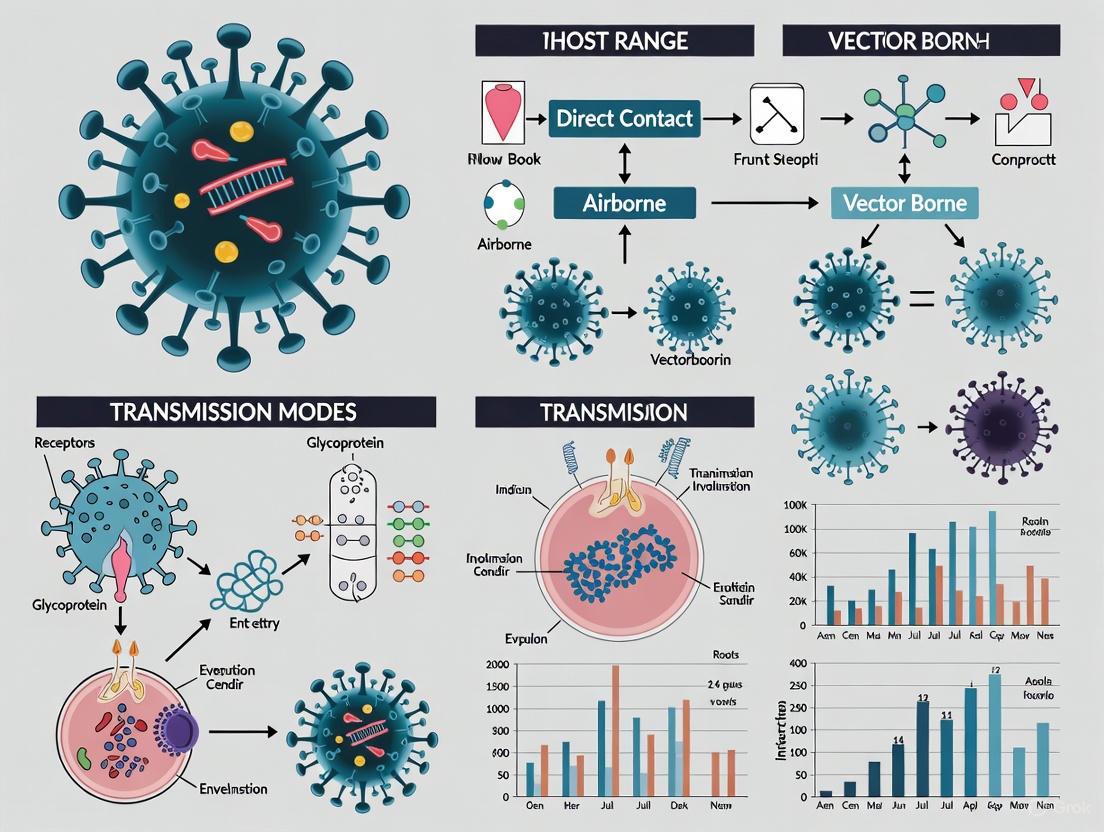
This article provides a comprehensive analysis of the principles governing viral host range and transmission modes, critical factors in understanding viral epidemiology and pathogenesis.
Viral Host Range and Transmission Modes: Mechanisms, Prediction, and Clinical Impact
Abstract
This article provides a comprehensive analysis of the principles governing viral host range and transmission modes, critical factors in understanding viral epidemiology and pathogenesis. Tailored for researchers, scientists, and drug development professionals, it explores the foundational biological mechanisms—from molecular tropism to ecological dynamics—that determine how viruses infect and spread. The scope extends to cutting-edge methodological advances, including machine learning for predicting transmission routes and computational host prediction tools. It further addresses challenges in managing viral spillover and optimizing intervention strategies, while evaluating and comparing different predictive models and their validation. This synthesis aims to equip professionals with the knowledge to anticipate viral spread, design targeted therapeutics, and develop effective public health measures.
The Fundamentals of Viral Host Range and Transmission Mechanisms
The host range of a virus is a fundamental biological property defined as the number of host species that a virus can infect and within which it can successfully replicate [1]. This spectrum of viral strategies exists on a continuum, with specialist viruses infecting one or a few closely related species at one extreme, and generalist viruses capable of infecting several different species, sometimes across different taxonomic families, at the other [2]. Understanding the evolutionary mechanisms and ecological implications underlying these strategies is critical for managing viral diseases, predicting emergence events, and developing effective therapeutic interventions.
The intrinsic evolvability of viruses, afforded by their large population sizes, short generation times, and high mutation rates, facilitates host range changes that can eventually lead to epidemics caused by emergent new viruses [3]. This review synthesizes current knowledge on the factors driving the evolution of specialist and generalist viral strategies, the molecular constraints governing these adaptations, and the experimental approaches used to investigate them, providing a framework for ongoing research in viral host range and transmission.
Evolutionary Mechanisms and Trade-offs
Selective Pressures Driving Specialization
In stable, homogeneous environments, natural selection typically favors the evolution of specialist viruses. Empirical evidence from numerous in vitro evolution experiments demonstrates that viral adaptation to a specific host is often coupled with fitness losses in alternative hosts [3]. A foundational study on Bacteriophage ØX174, which naturally infects Escherichia coli, undertook experimental evolution in Salmonella enterica. After just 11 days of selection, the phage showed an almost 700-fold fitness increase in the new host. However, this adaptation came at a substantial cost: its replicative fitness in the original E. coli host was almost completely eliminated [3].
Similar patterns have been observed across diverse virus families. RNA arboviruses like Vesicular stomatitis virus (VSV) and Eastern equine encephalitis virus (EEEV), when evolved in a single cell type, consistently become specialists, increasing their replicative fitness in the new host while paying fitness costs in alternative host cell types, including their original one [3]. Plant viruses exhibit parallel trends; for instance, Turnip mosaic virus (TuMV) genotypes that expanded their host range to plants bearing the TuRB01 resistance gene showed replicative fitness penalties ranging from approximately 32% to 100% in wildtype turnips [3].
The primary genetic mechanisms generating these fitness trade-offs are antagonistic pleiotropy and mutation accumulation [3]. Antagonistic pleiotropy occurs when mutations that are beneficial for infection in one host are directly detrimental in another. Mutation accumulation, in contrast, involves neutral mutations drifting to fixation in genes non-essential for the current host but potentially critical for infection of an alternative host. While both mechanisms result in differential fitness effects across hosts, the former is driven by natural selection, and the latter by genetic drift [3].
Conditions Favoring Generalist Viruses
Despite the advantages of specialization, generalist viruses persist successfully in nature, particularly under conditions of environmental heterogeneity. When hosts fluctuate in time or space, selective pressures differ, creating opportunities for generalist viruses to evolve [3]. Experiments with VSV and EEEV populations that alternated between two different cell types demonstrated that viruses could achieve replicative fitness values in each host similar to those reached by lineages evolved exclusively on each single host, effectively becoming generalists without apparent fitness trade-offs [3].
The rate of migration or alternation between hosts appears crucial. Research has shown that increasing the migration rate among heterogeneous cell types selects for generalist viruses with improved replicative fitness across all alternative environments [3]. This spatial heterogeneity mimics conditions within complex host organisms, where a virus encounters different tissues, cell types, and physiological barriers.
Genome architecture may also correlate with host range breadth. A 2025 analysis suggests that multipartite and segmented viruses (which package their genomes into multiple particles) have broader host ranges than monopartite viruses (with single genome segments) [4] [5]. This organization may facilitate adaptation to diverse hosts by allowing for rapid reassortment of genome segments or changes in their relative frequencies (the "genome formula"), potentially tuning gene expression for different host environments [5].
Table 1: Comparative Analysis of Specialist and Generalist Viral Strategies
| Feature | Specialist Viruses | Generalist Viruses |
|---|---|---|
| Definition | Infect one or few closely related host species [2] | Infect several different species, possibly from different families [2] |
| Evolutionary Context | Stable, homogeneous host environments [3] | Fluctuating, heterogeneous host environments [3] |
| Fitness Trade-off | Often high (antagonistic pleiotropy) [3] | Potentially low under certain conditions [3] |
| Genetic Mechanisms | Mutation accumulation, antagonistic pleiotropy [3] | Reassortment (for segmented/multipartite), genome formula tuning [5] |
| Examples | Dengue virus, Mumps virus [3] | Cucumber mosaic virus, Influenza A virus [3] |
Quantitative Data and Experimental Evidence
Research across viral systems has yielded quantitative insights into the costs of host-range expansion and the dynamics of adaptation. The following table summarizes key experimental findings:
Table 2: Quantitative Evidence of Fitness Trade-offs in Virus Evolution
| Virus | Experimental System | Fitness Gain in New Host | Fitness Cost in Ancestral Host | Reference |
|---|---|---|---|---|
| Bacteriophage ØX174 | Adaptation from E. coli to S. enterica | ~700-fold increase | Nearly complete loss (fitness ~0) | [3] |
| Turnip Mosaic Virus (TuMV) | Adaptation to resistant plants (TuRB01) | Successful host range expansion | 32% to 100% fitness reduction in wildtype host | [3] |
| Plum Pox Virus (PPV) | Serial passage in Pisum sativum (herbaceous host) | Increased infectivity, viral load & virulence | Reduced transmission efficiency in original peach tree host | [3] |
| Tobacco Etch Virus (TEV) | Serial passage in pepper | Increased viral load & virulence | No replicative fitness increase in ancestral tobacco host | [3] |
These quantitative findings consistently demonstrate that host-range expansion is often a costly trait, supporting the jack-of-all-trades paradigm wherein generalists may be masters of none [3]. However, exceptions exist, as seen with Foot-and-mouth disease virus, where adaptation to hamster kidney fibroblasts serendipitously expanded its host range to include cells from monkeys and humans [3].
Methodologies for Studying Host Range
Experimental Evolution Protocols
Directed in vitro evolution is a powerful approach for investigating viral host range dynamics. The Appelmans protocol, for instance, is a method used to expand the host range of bacteriophages through serial passage and recombination [6]. In this protocol, a phage cocktail is cyclically exposed to a panel of bacterial hosts. Phages that successfully infect new hosts are isolated and propagated, effectively "training" the phages to broaden their infectivity. A recent application of this protocol to generate phages targeting carbapenem-resistant Acinetobacter baumannii (CRAB) successfully created output phages with expanded host ranges. These were identified as recombinant derivatives originating from prophages induced from the encountered bacterial strains [6]. However, a significant caveat was that the expanded host range phages exhibited limited stability, raising questions about their therapeutic suitability [6].
Another common approach involves serial passage experiments in a single novel host. Viruses are serially passaged in a new host cell type or organism, and their evolving fitness is tracked in both the new and ancestral environments. This method has been extensively used with viruses like VSV, EEEV, and plant viruses to quantify the tempo and strength of adaptation and the associated trade-offs [3].
Computational Prediction of Host-Virus Interactions
Modern research increasingly leverages machine learning (ML) to predict virus-host interactions, including host range. One ML approach for predicting strain-specific phage-host interactions uses protein-protein interactions (PPI) as key features [7]. In this method:
- Genomic Sequencing: Phage and bacterial genomes are sequenced and assembled.
- Gene Annotation: Open reading frames are predicted and annotated.
- Protein Domain Identification: Protein domains are identified using tools like HMMER against databases such as PFAM.
- PPI Prediction: Interactions between phage and bacterial proteins are predicted by comparing them to reference PPI databases (e.g., PPIDM), assigning a reliability score to each domain-domain interaction.
- Model Training and Prediction: The PPI data, combined with experimental host-range data, are used to train ML models (e.g., LightGBM ensembles) capable of predicting infection outcomes for novel phage-bacteria pairs [7].
Another computational framework analyzes viral evolutionary signatures to predict transmission routes, which are intrinsically linked to host range [8]. This method engineers hundreds of features from viral genomes, including genomic composition, codon usage bias, and structural properties, and integrates them with virus-host association data to train predictive models. Such models can achieve high accuracy (ROC-AUC = 0.991) in classifying transmission routes, providing early insights during outbreaks [8].
Diagram 1: ML Host Range Prediction Workflow.
The Scientist's Toolkit: Research Reagent Solutions
Table 3: Essential Reagents and Resources for Viral Host Range Research
| Research Tool | Specific Examples / Formats | Primary Function in Host Range Studies |
|---|---|---|
| Cell Culture Lines | BHK (Baby Hamster Kidney) cells, Mosquito cells (e.g., C6/36), various mammalian and insect cell lines [3] | Provide in vitro host systems for serial passage experiments and replicative fitness assays. |
| Bacterial Host Panels | Historic collections of target bacteria (e.g., Salmonella enterica, Escherichia coli strains) [7] | Used in quantitative host range assays to determine phage infectivity spectrum. |
| Plant Host Variants | Wildtype and resistant genotype plants (e.g., turnips with TuRB01 gene) [3] | Enable quantification of fitness trade-offs associated with host-range expansion in complex organisms. |
| Sequencing Kits | Illumina Nextera XT DNA library prep kit, Phage DNA isolation kits (e.g., Norgen) [7] | Facilitate genomic sequencing of viral and host genomes for mutation tracking and ML feature generation. |
| Bioinformatics Software | HMMER, PFAM database, PPIDM, Fastp, Unicycler, CheckV [7] | Enable genome assembly, annotation, and prediction of protein-protein interactions for computational models. |
| Machine Learning Frameworks | LightGBM [8] [7] | Power predictive models for classifying host-range and transmission routes based on genomic features. |
The dichotomy between specialist and generalist viral strategies is governed by a complex interplay of evolutionary genetics, ecological context, and molecular constraints. While specialization is favored in stable environments due to fitness trade-offs like antagonistic pleiotropy, generalists can evolve and persist in heterogeneous landscapes through mechanisms that mitigate these costs, potentially including genomic architectures like multipartitism.
Future research will be increasingly propelled by computational approaches that integrate viral genomic features with protein interaction data to predict host range and transmission potential in silico [8] [7]. Furthermore, advanced experimental evolution protocols continue to provide mechanistic insights into the genetic basis of host switching and adaptation [6]. Understanding these dynamics is not merely an academic pursuit but is critical for public health, as the majority of emerging viral diseases result from host shift events [2]. By defining the principles governing viral host range, researchers can better anticipate and mitigate the threats posed by emerging viral pathogens.
Viral tropism, defined as the specificity of a virus for infecting a particular host, cell type, or tissue, is a fundamental determinant of disease pathogenesis, transmission dynamics, and clinical outcomes [9] [10]. This selective infection is governed by molecular interactions between viral proteins and host-cell factors, which ultimately regulate host range, tissue targeting, and viral pathogenesis [11]. At the core of these interactions are host receptors, co-receptors, and a suite of host proteins that facilitate viral entry and establish productive infection [12] [13]. Understanding these molecular determinants is crucial for defining disease mechanisms, predicting spillover risk, and developing targeted therapeutic strategies across a One Health framework [13].
The initial interaction between a virus and its host cell can be viewed as a "lock-and-key" system, where viral attachment proteins serve as the "key" that unlocks cells by interacting with receptor "locks" on the host-cell surface [11]. These interactions represent critical regulatory steps in the viral life cycle, influencing not only attachment but also entry, intracellular trafficking, and activation of signaling events necessary for successful infection [12] [11]. This review provides an in-depth examination of the molecular mechanisms governing viral tropism, with particular emphasis on receptor usage, co-factor dependencies, and experimental approaches for studying these interactions within the broader context of viral host range and transmission modes.
Fundamental Mechanisms of Viral Entry
Viral Entry Pathways
Viruses employ distinct strategies to enter host cells, with the specific pathway determined by viral structure, receptor interactions, and host cell type [12]. The major entry mechanisms include:
Endocytosis: The predominant entry mechanism for many viruses, involving cellular internalization through membrane invagination [12]. This process can be further categorized into:
- Clathrin-mediated endocytosis: Characterized by clathrin-coated pits that internalize to form vesicles destined for early endosomes with an acidic environment (pH 6.5-5.5) [12].
- Caveolin-mediated endocytosis: Occurs via caveolae, membrane invaginations associated with caveolin and lipid rafts, though the nature of "caveosomes" remains controversial [12].
- Non-clathrin non-caveolin-mediated endocytosis: Less characterized pathways that may require receptor-mediated conformational transitions for cargo internalization [12].
Membrane Fusion: Specific to enveloped viruses, involving direct fusion of the viral envelope with the host cell membrane, often facilitated by viral glycoproteins [12] [14].
Direct Penetration: Utilized by non-enveloped viruses, where the viral capsid interacts directly with host membranes to deliver genetic material [12].
These entry pathways are not mutually exclusive, and viruses may employ different mechanisms depending on cell type, receptor availability, and environmental conditions [12].
Structural Determinants: Enveloped vs. Non-enveloped Viruses
Virus structure fundamentally influences entry mechanisms and tropism determinants. Enveloped viruses possess an outer lipid bilayer derived from host cell membranes, studded with viral glycoproteins that facilitate attachment and entry [9]. Examples include HIV, Influenza virus, Herpesviruses, and coronaviruses like SARS-CoV-2 [9]. Their envelopes make them relatively sensitive to environmental stressors but allow for flexible entry mechanisms and rapid antigenic variation [9].
Non-enveloped viruses lack this lipid membrane and rely on capsid proteins for protection and host-cell attachment [9]. They are generally more resistant to environmental stressors and exhibit more stable antigenic properties [9]. Examples include adenoviruses, poliovirus, and adeno-associated viruses (AAVs) [9].
Table 1: Structural and Functional Comparison of Enveloped and Non-enveloped Viruses
| Characteristic | Enveloped Viruses | Non-enveloped Viruses |
|---|---|---|
| Outer Structure | Lipid bilayer envelope | Protein capsid |
| Stability | Sensitive to heat, desiccation, detergents | Resistant to environmental stressors |
| Transmission | Close contact, bodily fluids, protected aerosols | Fomites, fecal-oral route, contaminated water |
| Antigenic Variation | High (e.g., HIV, Influenza) | Generally more stable |
| Entry Mechanisms | Endocytosis, fusion | Endocytosis, direct penetration |
| Examples | HIV, Influenza, SARS-CoV-2, Herpesvirus | Adenovirus, Poliovirus, Norovirus, AAV |
Molecular Determinants of Tropism
Primary Receptors and Attachment Factors
Viral receptors function as key regulators of host range, tissue tropism, and viral pathogenesis [11]. These molecules can be categorized into several classes based on their structure and function:
Sialylated Glycans: Many viruses utilize sialic acid (SA) derivatives as initial attachment points, particularly respiratory viruses like Influenza A virus (IAV) which recognizes 5-N-acetyl neuraminic acid (Neu5Ac) [11]. These interactions often represent low-affinity, high-avidity initial contacts that precede higher-affinity interactions with specific protein receptors [11].
Immunoglobulin Superfamily (IgSF) Members: These cell adhesion molecules (CAMs) are frequently exploited by viruses for attachment and entry [11]. Examples include:
Integrins: Heterodimeric transmembrane receptors that mediate cell-extracellular matrix adhesion, utilized by viruses such as foot-and-mouth disease virus (FMDV) and coxsackievirus B (CVB) [11].
Phosphatidylserine (PtdSer) Receptors: Recently recognized family of receptors that recognize phosphatidylserine on apoptotic cells, which some viruses exploit for entry [11].
Table 2: Characterized Viral Receptors and Their Virus Interactions
| Virus | Primary Receptor | Receptor Class | Key Viral Protein | Tropism Implications |
|---|---|---|---|---|
| SARS-CoV-2 | ACE2 | IgSF | Spike (S) protein RBD | Broad tissue tropism (lung, intestine, heart, kidney) [14] |
| HIV-1 | CD4 | IgSF | gp120 | Targeting of CD4+ T cells, macrophages, dendritic cells [10] |
| Influenza A | Sialic acid | Carbohydrate | Hemagglutinin (HA) | Respiratory epithelial targeting [9] [11] |
| Rabies | Various neuronal receptors | Multiple | Glycoprotein G | Strong neuronal tropism, retrograde transport [9] |
| Hepatitis B | NTCP (sodium taurocholate cotransporting polypeptide) | Transporter protein | PreS1 domain | Hepatocyte specificity [9] |
Co-receptors and Entry-Activating Proteases
Beyond primary receptors, viruses often require additional host factors for efficient entry. These include:
Chemokine Co-receptors: HIV-1 utilizes CCR5 or CXCR4 as essential co-receptors following CD4 binding [15] [10]. Co-receptor choice has significant implications for disease progression, with CCR5-tropic (R5) viruses predominating in early infection and CXCR4-tropic (X4) viruses emerging later and associated with accelerated CD4+ T-cell decline [15] [10].
Protease Systems: Many viruses require proteolytic activation of their entry proteins. SARS-CoV-2 utilizes multiple proteases including TMPRSS2, furin, and cathepsins for S protein priming and activation [16] [14]. The specific protease repertoire of host cells significantly influences tissue tropism and pathogenicity [16].
The requirement for specific co-receptor and protease combinations creates additional barriers for viral host range and contributes to tissue and species specificity [13].
Post-receptor Intracellular Factors
Even successful receptor engagement does not guarantee productive infection, as intracellular factors play crucial roles in tropism determination:
- Transcriptional Regulation: Cell-type specific transcription factors may be required for viral gene expression.
- Restriction Factors: Host proteins like APOBEC3G, TRIM5α, and tetherin can block viral replication in a cell-type specific manner [12].
- Host Machinery Compatibility: The availability of specific host factors for viral replication, protein synthesis, and virion assembly varies between cell types [9].
These post-entry factors explain why mere receptor expression does not always correlate with permissiveness to infection, as demonstrated by the resistance of macrophages to X4 HIV-1 variants despite expressing both CD4 and CXCR4 [10].
Experimental Methodologies for Tropism Determination
Coreceptor Tropism Assays for HIV-1
Determining HIV-1 co-receptor usage is clinically essential for assessing eligibility for CCR5 antagonist therapy [15]. Standardized protocols include:
Geno2pheno Algorithm: A bioinformatics approach that predicts co-receptor usage based on V3 loop sequence characteristics [15].
- Procedure: HIV-1 RNA is extracted from patient plasma, the envelope (env) gene is amplified by nested PCR, and the V3 region is sequenced [15].
- Analysis: Sequences are analyzed using the Geno2pheno algorithm with a false-positive rate (FPR) of 10% (current European guidelines) [15]. FPR >10% indicates CCR5-tropic virus; FPR ≤10% indicates CXCR4-tropic virus [15].
- Parameters: V3 loop net charge calculation [(R+K)-(D+E)] and N-linked glycosylation site analysis between amino acids 6-8 provide additional tropism indicators [15].
Cell-Based Fusion Assays: Functional tests using cell lines engineered to express CD4 and specific co-receptors (CCR5, CXCR4) to monitor viral entry and fusion events [10].
Primary Cell Validation: Confirmation using primary cells, including:
- CCR5 Δ32 PBMCs: Absent viral replication in PBMCs from CCR5 Δ32 homozygous individuals indicates CCR5 dependence [10].
- Receptor Antagonists: Specific coreceptor antagonists (e.g., AMD3100 for CXCR4) inhibit entry via cognate receptors [10].
Receptor Identification and Validation
Comprehensive receptor identification involves multiple complementary approaches:
CRISPR Screening: Genome-wide knockout screens identify essential receptors and host factors through negative selection [13].
Glycan Array Screening: High-throughput profiling of viral binding to diverse carbohydrate structures reveals SA receptor specificity and preferences [11].
Structural-Functional Analyses:
- X-ray Crystallography/Cryo-EM: Determine atomic-level virus-receptor interaction interfaces [14] [11].
- Surface Plasmon Resonance: Quantifies binding affinity and kinetics of virus-receptor interactions [11].
Pseudotyping Studies: Replacing viral envelope proteins with those from other viruses (e.g., VSV-G) to test receptor specificity and entry requirements [9] [11].
The Scientist's Toolkit: Essential Research Reagents
Table 3: Key Research Reagents for Tropism Studies
| Reagent/Cell Line | Application | Key Features | Example Uses |
|---|---|---|---|
| Geno2pheno Algorithm | Bioinformatics prediction of co-receptor usage | Web-based, uses V3 sequence with adjustable FPR | HIV-1 tropism determination for clinical assessment [15] |
| Vero Cells | Viral culture and vaccine production | Highly susceptible to multiple viruses, continuous cell line | Production of vaccines for polio, rabies, Japanese encephalitis [12] |
| MDCK Cells | Influenza virus propagation | canine kidney cells with appropriate sialic acid receptors | Influenza vaccine production, virus isolation [12] |
| CCR5 Δ32 PBMCs | Validation of CCR5 dependence | Cells from CCR5 Δ32 homozygous individuals | Confirm R5 HIV-1 tropism [10] |
| Receptor Antagonists (AMD3100, Maraviroc) | Functional tropism determination | Specific blockade of CXCR4 or CCR5 | Inhibit entry via specific co-receptors [10] |
| Pseudotyped Viruses | Safe study of entry mechanisms | VSV-G pseudotyped particles with target envelopes | Study entry of highly pathogenic viruses (Ebola, SARS-CoV-2) [11] |
| CRISPR Libraries | Genome-wide receptor screening | Identify essential host factors through negative selection | Discovery of novel receptors and restriction factors [13] |
Case Studies in Viral Tropism
SARS-CoV-2: Broad Tissue Tropism Through Multiple Receptors
SARS-CoV-2 demonstrates exceptionally broad tissue tropism, infecting respiratory, cardiac, renal, intestinal, and neurological tissues [16] [14]. This promiscuity stems from its ability to utilize multiple receptors and entry pathways:
ACE2 as Primary Receptor: The spike RBD binds the peptidase domain of ACE2 with high affinity, utilizing a bridge-shaped α1 helix interface with key residues (Q498, T500, N501) forming hydrogen bonds with ACE2 (Y41, Q42, K353, R357) [14].
Alternative Receptors: Neuropilin-1, AXL, and antibody-FcγR complexes provide additional entry routes, particularly in cells with low ACE2 expression [14].
Protease Activation Systems: Tissue-specific expression of TMPRSS2 (plasma membrane), furin (Golgi), and cathepsins (endosomes) enables spike protein priming in different cellular compartments [16] [14].
Receptor Polymorphisms and Variants: ACE2 polymorphisms and spike protein mutations (particularly in the RBD) influence viral affinity and tissue targeting, contributing to variant-specific pathogenicity [16].
HIV-1: Dynamic Co-receptor Usage and Disease Progression
HIV-1 tropism is primarily defined by chemokine co-receptor usage, which evolves throughout infection and significantly impacts pathogenesis:
CCR5-tropic (R5) Viruses: Predominate during early infection and establish new infections [15] [10]. Characterized by non-syncytium-inducing (NSI) phenotype in MT-2 cells and efficient infection of macrophages and CCR5+ memory T-cells [10].
CXCR4-tropic (X4) Viruses: Typically emerge during later stages in approximately 50% of infected individuals, associated with syncytium-inducing (SI) phenotype and accelerated CD4+ T-cell decline [10].
V3 Loop Determinants: The third variable region of gp120 contains critical tropism determinants:
- Net Charge: X4 viruses typically have higher V3 net charge (median 4.0 vs 3.0 for R5) [15].
- Glycosylation Patterns: Conserved N-linked glycosylation site between amino acids 6-8 in R5 viruses, often absent in X4 variants [15].
- Crown Motifs: GPGQ is the most prevalent motif in both R5 and X4 viruses across multiple genotypes [15].
Clinical Implications: CCR5 antagonists like maraviroc are only effective against R5 viruses, necessitating tropism testing before treatment [15]. The near-complete resistance to HIV-1 infection in CCR5 Δ32 homozygotes underscores the importance of CCR5 in transmission [10].
Implications for Therapeutic Development and Vaccine Design
Understanding molecular determinants of tropism enables innovative therapeutic approaches:
Receptor-Blocking Strategies: Monoclonal antibodies targeting virus-receptor interfaces (e.g., anti-ACE2 for SARS-CoV-2) [14], small molecule inhibitors (e.g., maraviroc for CCR5) [15], and decoy receptors [13].
Engineered Tropism for Gene Therapy: Viral vectors (particularly AAVs) are engineered with modified tropism for targeted gene delivery using rational design, directed evolution, and machine learning approaches [9].
Broad-Spectrum Antivirals: Targeting common viral receptors (sialic acids, integrins, IgSF members) or essential host factors (TMPRSS2, furin) offers potential for broad-spectrum activity [11].
Vaccine Development: Cell culture-based vaccine production requires adaptation of vaccine strains to cell substrates (Vero, MDCK) [12]. Understanding receptor usage enables development of broadly permissive cell lines for vaccine manufacturing against multiple viruses [12].
Molecular determinants of tropism—including primary receptors, co-receptors, and host factors—represent fundamental regulators of viral pathogenesis, host range, and transmission dynamics. The intricate interplay between viral attachment proteins and host cell molecules governs tissue specificity, disease progression, and cross-species transmission potential. Advanced methodologies for tropism determination, from bioinformatic predictions to structural analyses and functional assays, continue to reveal new insights into these critical interactions.
This understanding directly informs therapeutic development, from receptor-blocking strategies and entry inhibitors to engineered vectors for gene therapy. As viral threats continue to emerge, particularly those with zoonotic potential, comprehensive knowledge of tropism determinants will remain essential for predicting spillover risk, developing targeted interventions, and designing effective vaccines within a One Health framework. Future research should focus on integrative mapping of receptor networks, comparative analyses across viral families, and translation of these insights into broad-spectrum therapeutic strategies.
The concept of portals of entry and exit is fundamental to understanding viral epidemiology and pathogenesis. These portals represent the specific anatomical sites through which viruses enter a susceptible host and subsequently exit to enable transmission to new hosts [17] [18]. The specific portals a virus utilizes are intrinsically linked to its host range—the diversity of species and cell types it can infect—and its transmission modes, which together determine its epidemic potential and evolutionary trajectory [19] [8]. Viruses have evolved sophisticated mechanisms to exploit specific bodily surfaces, and their ability to jump between species often depends on acquiring mutations that allow them to utilize these portals in new hosts [20].
The respiratory, gastrointestinal, genital, and vector-borne routes represent four major portal systems with distinct biological characteristics. Respiratory and gastrointestinal tracts present mucosal surfaces directly exposed to the environment, while the genital tract offers a more protected environment with different immunological properties [17]. Vector-borne transmission bypasses the body's external barriers entirely, using arthropods to deliver virus directly into the skin or bloodstream [21]. Understanding the molecular and evolutionary signatures associated with each portal is crucial for predicting emerging viral threats and designing targeted interventions [8].
This technical guide examines the core principles of these four portal systems, focusing on their roles in viral host range determination and transmission dynamics. We integrate quantitative data on representative viruses, experimental methodologies for studying portal-specific mechanisms, and computational approaches for predicting transmission routes based on viral genomic features.
Respiratory Route
Anatomical and Physiological Features
The respiratory tract presents a large epithelial surface area directly exposed to the environment, making it one of the most common routes for viral entry and exit [17]. An average human adult inhales approximately 600 liters of air hourly, creating numerous opportunities for virus-laden particles to initiate infection [17]. The respiratory system is anatomically and functionally divided into the upper respiratory tract (nasal cavity, pharynx, larynx) and lower respiratory tract (trachea, bronchi, lungs), with different cell types exhibiting varying susceptibility to viral infections.
The portal of exit for respiratory viruses typically occurs through the same anatomical structures used for entry. Viruses replicate in respiratory epithelial cells and are expelled via respiratory secretions during breathing, coughing, sneezing, or talking [17]. Droplet spread occurs when larger respiratory droplets (>5 μm) are projected short distances and quickly settle, while airborne transmission involves smaller droplet nuclei (<5 μm) that remain suspended in air for extended periods and can travel considerable distances [22]. This distinction has important implications for control measures, as airborne viruses like measles require more stringent environmental controls than those primarily spread through droplets [22].
Representative Viruses and Host Range Implications
Table 1: Representative Respiratory Viruses and Their Characteristics
| Virus | Family | Primary Host(s) | Host Range | Portal of Exit |
|---|---|---|---|---|
| Influenza A virus | Orthomyxoviridae | Birds, humans, swine | Broad (generalist) | Respiratory secretions |
| Rhinoviruses | Picornaviridae | Humans | Narrow (specialist) | Respiratory secretions |
| SARS-CoV-2 | Coronaviridae | Humans, potential animal reservoirs | Broad | Respiratory secretions |
| Measles virus | Paramyxoviridae | Humans | Narrow | Respiratory secretions, urine |
Influenza A virus exemplifies a respiratory virus with a broad host range, capable of infecting birds, humans, swine, and other mammals [19]. Its ability to utilize sialic acid receptors with different linkages in various species facilitates cross-species transmission. The virus exits infected hosts through respiratory secretions and can be transmitted through both droplet and aerosol routes [17]. In contrast, measles virus represents a specialist pathogen with humans as its only known natural host, exiting through respiratory secretions and requiring close contact for transmission [22].
The host range of respiratory viruses is determined by receptor distribution across species, environmental stability of viral particles, and compatibility with host innate immune responses in the respiratory tract. Generalist respiratory viruses like Influenza A often have segmented genomes that allow reassortment, facilitating rapid adaptation to new hosts [19]. Specialist viruses typically establish long-term relationships with their primary host, often leading to lifelong immunity after infection [17].
Research Models and Methodologies
Table 2: Experimental Models for Respiratory Virus Research
| Model System | Applications | Key Readouts |
|---|---|---|
| Human airway epithelial (HAE) cultures | Study viral entry, replication kinetics, innate immune responses | Viral titer, cytokine production, transcriptomics |
| Ferret model | Influenza transmission studies | Transmission efficiency, clinical signs, shedding titers |
| Mouse models (including humanized mice) | Pathogenesis studies, therapeutic testing | Lung viral load, histopathology, immune cell infiltration |
| Organoid cultures | Cell-type specific tropism studies | Single-cell RNA sequencing, immunofluorescence |
Air-liquid interface (ALI) cultures of human airway epithelial cells represent a sophisticated in vitro model that recapitulates the pseudostratified mucociliary epithelium of the human respiratory tract. These cultures allow researchers to study the early events of respiratory viral infection, including ciliary function, mucus production, and innate immune responses. For transmission studies, the ferret model remains the gold standard for influenza research due to similar receptor distribution and clinical disease presentation as humans.
Gastrointestinal Route
Anatomical and Physiological Features
The gastrointestinal (GI) tract presents a harsh environment for viral survival, with extreme pH variations, digestive enzymes, and bile salts that inactivate many enveloped viruses [17]. Successful enteric viruses must resist these conditions to reach susceptible cells in the intestinal epithelium. The "fecal-oral" route characterizes the transmission cycle of GI viruses: they exit an infected host in feces, contaminate water or food, and enter a new host through the mouth to establish infection in the GI tract [22] [17].
The portal of entry for GI viruses is typically the oral cavity, with primary replication occurring in the intestinal epithelium. Peyer's patches in the small intestine represent important lymphoid tissues where some viruses initiate immune responses. The portal of exit is through fecal shedding, which can continue for extended periods even after symptoms resolve, facilitating silent transmission [17]. Effective transmission requires environmental stability, as viruses must persist in water, food, or on fomites until encountering a new host.
Representative Viruses and Host Range Implications
Table 3: Representative Gastrointestinal Viruses and Their Characteristics
| Virus | Family | Primary Host(s) | Host Range | Environmental Stability |
|---|---|---|---|---|
| Rotavirus | Reoviridae | Humans, animals | Moderate (species-specific strains) | High (resists degradation) |
| Norovirus | Caliciviridae | Humans | Narrow (specialist) | High |
| Hepatitis A virus | Picornaviridae | Humans | Narrow | High |
| Enteroviruses | Picornaviridae | Humans | Narrow to Moderate | Moderate |
Norovirus exemplifies a specialist GI virus with humans as the primary host, causing widespread outbreaks through fecal-oral transmission. Its environmental stability and low infectious dose contribute to its persistence in populations. In contrast, rotavirus exists in multiple species-specific strains, with some evidence of zoonotic transmission potential [17]. Hepatitis A virus demonstrates the importance of inapparent carriers in transmission, with only 10% of infected children showing jaundice despite half being contagious [18].
The host range of enteric viruses is constrained by receptor compatibility across species, resistance to host-specific digestive processes, and temperature optimization for replication. Successful GI viruses often have non-enveloped structures that confer environmental stability, allowing persistence in water and soil [17]. This stability expands their transmission potential beyond direct host-to-host contact.
Genital Route
Anatomical and Physiological Features
The genital tract represents a protected portal of entry with distinct immunological properties compared to other mucosal surfaces. Viral entry typically occurs through microtears or direct infection of mucosal epithelium during sexual contact. Unlike respiratory and GI tracts, the genital tract is not continuously exposed to environmental pathogens, which may influence local immune surveillance [17].
The portal of exit for genital viruses is primarily through genital secretions and semen, though some viruses can also be transmitted through saliva, blood, or from mother to child [17]. This route often requires intimate contact for transmission, which can limit spread compared to respiratory or fecal-oral routes but facilitates establishment of persistent infections in specific populations.
Representative Viruses and Host Range Implications
Table 4: Representative Genital Viruses and Their Characteristics
| Virus | Family | Primary Host(s) | Host Range | Additional Transmission Routes |
|---|---|---|---|---|
| Human Immunodeficiency Virus (HIV) | Retroviridae | Humans | Narrow | Blood, perinatal |
| Herpes Simplex Virus type 2 (HSV-2) | Herpesviridae | Humans | Narrow | Perinatal, oral |
| Human Papillomavirus (HPV) | Papillomaviridae | Humans | Narrow | Skin-to-skin contact |
| Hepatitis B virus | Hepadnaviridae | Humans | Narrow | Blood, perinatal |
HIV represents a classic example of a virus that primarily utilizes the genital route, though its host range is restricted to humans despite origins in non-human primates [20]. The narrow host range of most genital viruses reflects specialized adaptations to human-specific receptors and cellular factors. HPV demonstrates how genital viruses can exploit epithelial differentiation programs, with certain high-risk types causing cervical cancer through persistence and cellular transformation [17].
Genital transmission often involves complex host-virus relationships with periods of latency or persistence, as seen with HSV-2 and HIV. This persistence allows viruses to overcome the limitations of requiring intimate contact for transmission by maintaining infectious reservoirs within populations. Mother-to-child transmission represents an important secondary route for several genital viruses, including HIV and HBV, enabling vertical perpetuation in addition to horizontal spread [17].
Vector-Borne Route
Ecological and Molecular Features
Vector-borne transmission represents a complex tripartite relationship between virus, vector, and vertebrate host [21]. Unlike direct transmission routes, vector-borne viruses must overcome barriers in both vertebrate and invertebrate hosts, requiring adaptations for replication in phylogenetically distant species [20]. The portal of entry is typically the skin, where virus is deposited along with vector saliva during blood feeding [21]. The portal of exit requires viremia sufficient to infect subsequent vectors during their blood meals.
The vector-host-pathogen interface has emerged as a critical frontier in understanding mosquito-borne viral diseases [21]. Mosquito saliva contains numerous pharmacologically active compounds that modulate host immune responses, enhancing viral replication and dissemination [21]. At the bite site, an influx of immune cells occurs, many of which are permissive to infection, creating an optimal environment for initial viral amplification before systemic spread.
Representative Viruses and Host Range Implications
Table 5: Representative Vector-Borne Viruses and Their Characteristics
| Virus | Family | Primary Vector(s) | Reservoir Hosts | Human Role |
|---|---|---|---|---|
| Dengue virus | Flaviviridae | Aedes aegypti, Ae. albopictus | Humans, non-human primates | Amplifying host |
| West Nile virus | Flaviviridae | Culex species | Birds | Incidental/dead-end host |
| Zika virus | Flaviviridae | Aedes species | Humans, non-human primates | Amplifying host |
| Japanese Encephalitis virus | Flaviviridae | Culex species | Birds, pigs | Incidental host |
Dengue virus exemplifies a vector-borne virus that has adapted to use humans as its primary reservoir host, transmitted mainly by Aedes aegypti mosquitoes in urban settings [20]. This close association with human habitats has enabled its widespread distribution in tropical and subtropical regions. In contrast, West Nile virus maintains an enzootic cycle primarily between birds and Culex mosquitoes, with humans and other mammals serving as incidental "dead-end" hosts that do not contribute to transmission cycles [20].
The host range of vector-borne viruses is constrained by multiple factors, including vector feeding preferences, viral replication efficiency in both vector and host, and environmental temperature [23]. Some viruses like West Nile virus demonstrate remarkable host breadth, infecting 49 species of mosquitoes and ticks, and 225 species of birds, in addition to various mammals [20]. This generalist strategy enhances geographic spread and persistence in diverse ecosystems.
Advanced Research Methodologies
Computational Prediction of Transmission Routes
Recent advances in machine learning have enabled computational prediction of viral transmission routes based on genomic features [8]. Wardeh et al. (2024) developed a framework that integrates viral sequence features, host association data, and ecological variables to predict transmission routes with high accuracy (ROC-AUC = 0.991 across all routes) [8]. Their approach utilizes LightGBM classifier ensembles trained on 24,953 virus-host associations with 81 defined transmission routes.
Table 6: Key Feature Categories for Predicting Viral Transmission Routes
| Feature Category | Examples | Predictive Value |
|---|---|---|
| Genomic features | Codon usage bias, nucleotide composition, GC content | High for distinguishing vector-borne vs. direct transmission |
| Structural features | Capsid symmetry, envelope presence, genome organization | Moderate to high for respiratory and GI routes |
| Ecological features | Host taxonomy, climate associations, vector distributions | Critical for vector-borne and zoonotic routes |
| Evolutionary features | Evolutionary rates, recombination frequency, selection pressure | High for predicting host switching potential |
This computational approach identified specific evolutionary signatures associated with different transmission routes. For instance, vector-borne viruses show distinct codon usage adaptations reflecting their dual-host life cycle, while respiratory viruses exhibit features optimizing for environmental stability in aerosol droplets [8]. These predictive models can guide laboratory investigations by prioritizing likely transmission routes for newly discovered viruses.
The Scientist's Toolkit: Essential Research Reagents
Table 7: Key Research Reagents for Studying Viral Portals of Entry
| Reagent/Cell Line | Application | Key Utility |
|---|---|---|
| Human airway epithelial (HAE) cultures at ALI | Respiratory virus studies | Mimics human respiratory epithelium with functional cilia and mucus production |
| Caco-2 cell line | Gastrointestinal virus studies | Human colorectal adenocarcinoma line that differentiates into enterocyte-like cells |
| Huh-7 cell line | Hepatitis virus studies | Human hepatoma line permissive for multiple hepatitis viruses |
| Vero cells (African green monkey kidney) | Viral isolation and propagation | Interferon-deficient allowing wide viral tropism |
| Aedes albopictus C6/36 cells | Arbovirus propagation | Mosquito cell line supporting high-titer arbovirus replication |
| Reverse genetics systems | Viral pathogenesis studies | Enables introduction of specific mutations to study portal determinants |
| Neutralizing antibodies | Portal entry blockade studies | Maps receptor usage and tests intervention strategies |
| Organoid cultures | Cell-type specific tropism | Recapitulates tissue architecture for portal-specific studies |
Experimental Workflow for Portal Determination
The following Graphviz diagram illustrates a comprehensive experimental workflow for determining viral portals of entry and exit:
Diagram Title: Viral Portal Determination Workflow
This integrated workflow begins with viral isolation and genomic sequencing, enabling computational prediction of potential transmission routes [8]. In vitro models including cell lines and organoids help identify permissive cell types and tissue tropisms [21]. Animal models remain essential for studying pathogenesis and transmission efficiency, particularly for respiratory and vector-borne viruses [20]. Mechanistic studies focus on receptor usage, immune evasion strategies, and host adaptations [17]. Promising interventions are tested against portal-specific transmission, with data integration refining predictive models for future outbreaks.
The respiratory, gastrointestinal, genital, and vector-borne routes represent distinct ecological niches that viruses have exploited through specialized adaptations. Each portal presents unique challenges and opportunities for viral entry, replication, and exit, ultimately shaping host range and transmission dynamics. Respiratory viruses often evolve generalist strategies with broad host ranges, while genital viruses typically specialize with narrow host ranges. Gastrointestinal viruses balance environmental stability with host specificity, while vector-borne viruses master the complex tripartite relationship between vector, reservoir host, and incidental host.
Understanding the molecular signatures associated with each portal provides crucial insights for predicting emerging viral threats and designing targeted interventions. The integration of computational approaches with traditional experimental models offers a powerful framework for rapidly characterizing new pathogens and their transmission potential. As climate change, urbanization, and global travel alter the landscape of infectious diseases [24] [23], research on viral portals of entry will remain essential for pandemic preparedness and response.
Future directions include developing more sophisticated organoid models that recapitulate the complex architecture of portal tissues, advancing single-cell technologies to understand cellular tropism at unprecedented resolution, and refining machine learning algorithms to predict host switching events based on portal-specific adaptations. By focusing on the fundamental biology of viral portals of entry and exit, researchers can better anticipate and mitigate the next pandemic threat.
Viral transmission is a complex process governed by the intricate interplay between structural stability and genetic evolution. This whitepaper examines how structural constraints on viral envelopes and genomes determine transmission efficiency and host range breadth. Through detailed analysis of measles virus as a paradigm of high genetic stability and comparison with other viral families, we identify key molecular mechanisms that limit evolutionary rates while facilitating efficient spread. We present quantitative data on mutation rates, structural stabilization parameters, and experimental approaches for investigating these constraints. The findings provide a framework for understanding how structural virology principles inform transmission dynamics, with significant implications for antiviral development and pandemic preparedness.
Viral transmission between hosts represents the critical bottleneck in pathogen ecology and evolution. Successfully navigating this bottleneck requires virions to maintain structural integrity while retaining the capacity to initiate new infections. From a structural virology perspective, virions are dynamic nucleoprotein assemblies that must balance robustness for environmental stability with flexibility for host cell entry [25]. This balance is particularly governed by the structural constraints imposed by envelope proteins and genome organization.
The genetic architecture of viruses creates fundamental constraints on evolutionary potential. RNA viruses typically exhibit higher mutation rates than DNA viruses, yet notable exceptions exist that demonstrate exceptionally high genetic stability despite RNA genomes. Measles virus (MeV) represents a paradigmatic case of such constraints, with remarkably low evolutionary rates despite its RNA genome [26]. Similarly, coronaviruses employ proofreading mechanisms that reduce mutation rates, facilitating their success as cross-species pathogens.
Within the context of viral host range research, understanding these structural constraints provides critical insights into transmission barriers and spillover potential. This technical guide examines the molecular basis of these constraints, presents experimental approaches for their investigation, and discusses implications for therapeutic intervention.
Structural Constraints on Viral Envelopes
Viral envelope proteins mediate the critical initial steps of host cell recognition and entry, making their structural features fundamental to transmission efficiency. The envelope glycoproteins must maintain conserved functional domains while potentially accommodating sequence variation that enables immune evasion.
Measles Virus: A Case Study in Envelope Stability
Measles virus exhibits exceptional antigenic stability with only a single serotype identified despite genetic diversity encompassing 24 genotypes [26]. This paradox of genetic variation without antigenic drift reflects strong structural constraints on its envelope proteins, particularly the hemagglutinin (H) and fusion (F) proteins.
Molecular Basis of Envelope Constraint in MeV:
- The H protein contains five conserved neutralizing epitopes maintained across genotypes
- Antibodies targeting two specific epitopes effectively neutralize all tested genotypes
- Structural analyses indicate these epitopes are involved in critical functional interactions: one mediates binding to the host receptor SLAM, while the other interferes with H-F protein interaction
- Escape mutations against monoclonal antibodies remain susceptible to polyclonal serum neutralization, suggesting MeV must simultaneously mutate multiple epitopes to evade immunity [26]
These structural constraints appear biologically essential for maintaining receptor binding capability and membrane fusion machinery. The functional conservation of these domains limits antigenic drift despite genomic variation, creating a transmission advantage through maintained host range but potentially increasing susceptibility to population immunity.
Comparative Envelope Architectures
Table 1: Structural Features of Viral Envelope Proteins and Their Transmission Implications
| Virus Family | Envelope Protein Features | Structural Constraints | Impact on Transmission |
|---|---|---|---|
| Paramyxoviridae (e.g., Measles) | Homotetrameric fusion protein (F) and receptor-binding protein (H) | Strong functional conservation of receptor-binding and fusion domains | Single serotype; lifelong immunity; requires multiple simultaneous mutations for immune escape |
| Coronaviridae (e.g., SARS-CoV-2) | Trimeric spike glycoprotein with S1/S2 subunits | Receptor-binding domain (RBD) flexibility balanced with maintenance of ACE2 binding | Potential for recombination events; variant emergence with altered transmissibility |
| Retroviridae (e.g., HIV-1) | Heterotrimeric envelope complex (gp120/gp41) | High glycosylation masking variable loops; conformational masking of conserved domains | Extreme antigenic diversity within hosts; complex transmission dynamics |
| Orthomyxoviridae (e.g., Influenza) | Hemagglutinin (HA) and neuraminidase (NA) | Conservation of sialic acid binding site and fusion peptide in HA | Antigenic drift and shift necessitate vaccine updates; zoonotic transmission potential |
The envelope constraints directly influence transmission modes by determining environmental stability and host cell tropism. Viruses with highly constrained envelope architectures typically exhibit more stable transmission patterns but may be more vulnerable to vaccination strategies that target conserved epitopes.
Genomic Architecture and Evolutionary Constraints
Genome organization imposes fundamental constraints on evolutionary potential through mutation rates, recombination potential, and structural genomic features.
Exceptional Genetic Stability in Measles Virus
MeV demonstrates remarkably high genetic stability both in laboratory settings and natural circulation. Quantitative analyses reveal:
Table 2: Evolutionary Rate Comparison Between Measles Virus and Other RNA Viruses
| Virus | Genome Type | Substitution Rate (subs/base/year) | Genetic Stability Mechanisms |
|---|---|---|---|
| Measles virus | Negative-sense RNA | 4-5 × 10⁻⁴ | High fidelity polymerase; structural constraints on envelope proteins; limited genomic plasticity |
| HIV-1 | Positive-sense RNA | >1.6 × 10⁻³ | Error-prone reverse transcriptase; rapid turnover; immune pressure |
| Influenza A virus | Negative-sense RNA | ~2.0 × 10⁻³ | Segment reassortment; antigenic drift; animal reservoirs |
| SARS-CoV-2 | Positive-sense RNA | ~1.0 × 10⁻³ | Proofreading exonucleases; recombination potential |
| Foot-and-mouth disease | Positive-sense RNA | >1.6 × 10⁻³ | Error-prone polymerase; quasispecies dynamics |
Molecular analyses indicate the MeV genome contains surprisingly few regions tolerant of rapid mutation. The most variable region, the carboxy-terminal 450 nucleotides of the nucleocapsid gene (N-450), shows remarkable stability even during extended in vitro passaging in different cell types [26]. This stability persists despite the error-prone nature of RNA-dependent RNA polymerases generally.
Mechanisms of Genomic Constraint
Several interconnected mechanisms maintain genomic stability in constrained viruses:
Polymerase Fidelity: While paramyxoviruses encode error-prone RNA polymerases, MeV may employ additional mechanisms to enhance replication fidelity, though the exact mechanisms remain incompletely characterized.
Structural RNA Elements: Secondary and tertiary RNA structures throughout the genome may constrain evolutionary potential by creating functional demands that limit sequence variability.
Genome Packaging Requirements: The nucleocapsid protein packaging mechanism creates structural demands that limit variability. For SARS-CoV-2, the nucleocapsid protein exhibits intrinsic disorder that becomes structured upon RNA binding, creating specific constraints [27].
Protein Structural Demands: Multifunctional proteins experience stronger evolutionary constraints due to competing structural demands. In MeV, the phosphoprotein (P) encodes multiple overlapping reading frames (P, C, and V proteins), creating constraints that limit variability.
Experimental Approaches for Investigating Structural Constraints
Understanding viral structural constraints requires multidisciplinary approaches spanning structural biology, genetics, and evolutionary analysis.
Structural Stabilization Protocols
Stabilization of Intrinsically Disordered Viral Proteins: The SARS-CoV-2 nucleocapsid (N) protein represents a challenging structural target due to intrinsic disorder regions (IDRs) comprising approximately 45% of the protein sequence. Recent methodological advances enable stabilization through:
Table 3: Research Reagent Solutions for Structural Virology
| Reagent/Category | Specific Examples | Function/Application |
|---|---|---|
| Stabilization Agents | Engineered symmetric RNA sequences; viral genome-derived RNA fragments | Promote formation of structurally homogeneous complexes; stabilize intrinsically disordered regions |
| Structural Biology Tools | Domain-specific monoclonal antibodies; cross-linking mass spectrometry (XL-MS); cryo-EM grids | Validate spatial arrangements; stabilize transient conformations; high-resolution structure determination |
| Biophysical Characterization | Differential scanning calorimetry (DSC); analytical ultracentrifugation; surface plasmon resonance | Assess thermal stability; determine oligomerization states; measure binding affinities |
| Cell Culture Systems | SLAM-expressing Vero cells; primary human airway epithelial cultures | Model relevant entry pathways; study tissue-specific transmission barriers |
Protocol: RNA-Mediated Stabilization of Nucleocapsid Proteins
- RNA Identification: Screen viral genome fragments for binding affinity using EMSA or SPR
- RNA Engineering: Design symmetric RNA sequences based on natural high-affinity binding sites
- Complex Formation: Incubate nucleocapsid protein with engineered RNA at 4:1 molar ratio in low-salt buffer
- Complex Purification: Separate stabilized complexes using size exclusion chromatography
- Validation: Verify structural homogeneity via negative stain EM and cross-linking mass spectrometry [27]
This approach has successfully stabilized SARS-CoV-2 N protein dimers, enabling structural characterization of this fundamental building block of viral capsid assembly.
Genetic Stability Assessment
Protocol: Quantifying Viral Evolutionary Rates
- Long-Term Passage: Serial passage in relevant cell culture systems (>50 passages)
- Sampling Strategy: Collect viral supernatant at regular intervals (every 5-10 passages)
- Sequence Analysis: Perform whole-genome sequencing with sufficient depth (>1000x coverage)
- Variant Calling: Identify fixed mutations and quantify minority variants
- Rate Calculation: Calculate substitution rates using molecular clock models [26]
For measles virus, this approach has demonstrated near-complete sequence identity after extensive passaging, with only single nucleotide changes observed between working stocks with divergent passage histories.
Visualization of Structural Constraint Mechanisms
The diagrams below illustrate key concepts and experimental approaches for investigating structural constraints in viral transmission.
Measles Virus Envelope Protein Constraints
MeV Envelope Constraint Mechanism This diagram illustrates how functional constraints on measles virus envelope proteins maintain antigenic stability. The hemagglutinin protein contains both highly conserved epitopes essential for receptor binding and membrane fusion, alongside more variable regions. The structural demands of these essential functions prevent antigenic drift and maintain a single serotype despite genetic diversity.
Genetic Stability Research Workflow
Genetic Stability Assessment Workflow This workflow outlines the experimental approach for quantifying viral genetic stability. The process begins with virus isolation followed by systematic in vitro passaging to simulate natural evolution. Regular whole-genome sequencing enables comprehensive variant analysis, ultimately allowing calculation of evolutionary rates using molecular clock models.
Implications for Viral Host Range and Transmission Modes
Structural constraints directly influence viral emergence potential and transmission dynamics through several mechanisms:
Host Range Determinants
The strength of structural constraints on receptor-binding domains correlates with host range breadth. MeV's strong constraint on its SLAM-binding domain limits its host range to humans and non-human primates, while influenza's more flexible receptor-binding site enables zoonotic transmission across species barriers.
Coronaviruses demonstrate intermediate constraint patterns, with conserved functional domains in the receptor-binding motif allowing some variability in specific residues that modulate host specificity. This creates the potential for host switching while maintaining efficient human-to-human transmission once established.
Transmission Efficiency Trade-Offs
Structural constraints create evolutionary trade-offs between transmission efficiency and immune evasion:
Highly constrained viruses like MeV exhibit stable transmission patterns with well-defined epidemiological characteristics, including critical community sizes for persistence and predictable age distributions of infection.
Less constrained viruses like influenza show more complex transmission dynamics with frequent epidemic and pandemic spread driven by antigenic variation, but with less predictable patterns.
Intervention Implications
The nature of structural constraints informs vaccine and therapeutic design:
- Viruses with high envelope constraint are vulnerable to vaccines targeting conserved epitopes
- Viruses with low genetic stability require therapeutic approaches targeting essential enzymatic functions with high genetic barriers to resistance
- Understanding nucleocapsid stabilization mechanisms may enable broad-spectrum antiviral approaches targeting genome packaging across virus families
Structural constraints on viral envelopes and genomes represent fundamental determinants of transmission efficiency and host range. The exceptional stability of measles virus demonstrates how strong functional constraints can maintain transmission efficiency despite limited evolutionary potential. Conversely, viruses with greater structural flexibility may achieve broader host ranges at the cost of transmission stability.
Experimental approaches combining structural biology, evolutionary analysis, and biophysical characterization provide powerful tools for investigating these constraints. The resulting insights create opportunities for novel intervention strategies that exploit structural vulnerabilities in viral transmission machinery.
Future research should focus on comparative analyses across virus families to identify general principles of structural constraint and their relationship to emergence potential. Such efforts will enhance pandemic preparedness by enabling prediction of transmission dynamics for novel pathogens based on structural features.
The classical paradigm of viruses as purely parasitic entities is being fundamentally redefined by emerging research that reveals a complex spectrum of interactions, including commensal and mutualistic relationships. This whitepaper synthesizes current evidence from eukaryotic and prokaryotic systems demonstrating that viral persistence involves sophisticated co-evolutionary adaptations benefiting both virus and host. We examine the L-A virus in Saccharomyces cerevisiae providing host stress resilience, the temporal mutualism of varicella-zoster virus in humans, and metabolic dependency in bacteriophage infections. Through integrated analysis of genomic screens, evolutionary modeling, and molecular mechanisms, we establish a new framework for understanding virus-host relationships with significant implications for antiviral therapeutic development and viral ecology research.
The conceptualization of viruses has traditionally been dominated by the parasite model, focusing on pathogenicity and host damage. However, growing evidence from diverse biological systems indicates this view is incomplete. The virus-host interaction spectrum encompasses relationships ranging from parasitism to commensalism and mutualism, often dynamically shifting across time and context. This paradigm shift recognizes that viral persistence—a fundamental aspect of virology—frequently involves sophisticated co-evolutionary adaptations that can provide selective advantages to host organisms [28] [29] [30].
The emerging framework has profound implications for understanding viral ecology, evolution, and therapeutic interventions. Rather than representing biological accidents or pure conflicts, many persistent viral infections reflect finely balanced relationships shaped by millions of years of co-evolution. This whitepaper examines the mechanistic bases and evolutionary drivers across the virus-host interaction spectrum, with particular focus on newly characterized mutualistic relationships and their relevance to viral host range and transmission mode research.
Mutualism in Eukaryotic Systems: From Yeast to Humans
The L-A Virus in Saccharomyces cerevisiae: A Case of Functional Mutualism
Recent genome-wide screening of Saccharomyces cerevisiae has revealed a striking mutualistic relationship with the L-A double-stranded RNA virus. An unbiased screen covering approximately 93% of annotated yeast genes identified 96 host factors required for efficient L-A maintenance, spanning diverse biological processes far beyond previously known factors [28].
Key Experimental Findings:
- Genomic Screening Protocol: Systematic analysis of yeast deletion and temperature-sensitive mutant collections using a standardized hot phenol/chloroform RNA extraction protocol followed by agarose gel electrophoresis detection of L-A dsRNA. Candidates underwent five rigorous screening rounds to eliminate false positives [28].
- Transcriptomic Profiling: RNA sequencing revealed that L-A presence significantly alters host stress-response gene expression patterns, priming the yeast for environmental challenges [28].
- Competitive Fitness Assays: Flow-cytometry-based competitions between isogenic L-A-free (L-A-), L-A-containing (L-A+), and L-A-overexpressing (L-A++) strains against a reference strain expressing fluorescent markers (TDH2::GFP and ADK1::mCherry) demonstrated that L-A enhances host resilience under multiple stress conditions [28].
Table 1: Quantitative Analysis of L-A Virus Effect on Yeast Host Fitness
| Stress Condition | Competitive Index (L-A+ vs L-A-) | P-value | Effect Size |
|---|---|---|---|
| Oxidative stress | 1.47 | <0.01 | Large |
| Thermal stress | 1.32 | <0.05 | Medium |
| Osmotic stress | 1.28 | <0.05 | Medium |
| Nutrient limitation | 1.41 | <0.01 | Large |
This research demonstrates that the L-A virus, traditionally considered a persistent parasite, actually provides tangible benefits to its host under suboptimal conditions, explaining its widespread persistence in laboratory yeast strains without apparent cost [28].
Temporal Mutualism in Varicella-Zoster Virus: A Game-Theoretical Framework
The varicella-zoster virus (VZV) exemplifies how viral strategies can shift across the host lifespan in a temporally partitioned evolutionarily stable strategy (TP-ESS). Research proposes an "immunosensor hypothesis" where VZV latency within sensory ganglia contributes to host immune surveillance while ensuring viral persistence [29].
Three-Phase Model of VZV-Host Interaction:
- Childhood Replication Phase: Aggressive replication and transmission optimized for spread in immunologically naive populations.
- Immunomodulatory Latency Phase: Active maintenance through continuous immune engagement rather than quiescence, characterized by VLT transcripts and immune cell infiltration in sensory ganglia.
- Late-Life Reactivation Phase: Strategic reactivation during immunosenescence enabling intergenerational transmission [29].
Table 2: Temporal Characteristics of VZV-Host Relationship
| Interaction Phase | Host Age/Status | Viral Strategy | Host Outcome | Population Effect |
|---|---|---|---|---|
| Primary infection | Childhood | Lytic replication | Varicella | Herd immunity |
| Latency maintenance | Immune competence | Immunomodulation | Continuous surveillance | Niche persistence |
| Reactivation | Immunosenescence | Controlled reactivation | Herpes zoster | Intergenerational spread |
This triphasic relationship represents a sophisticated co-evolutionary adaptation where both host and virus derive benefits: the host maintains activated immune surveillance, while the virus achieves long-term persistence and periodic transmission opportunities [29].
Prokaryotic Systems: Metabolic Dependencies and Infection Commitments
Host Metabolic State Determines Viral Infection Outcomes
Groundbreaking research in bacteriophage systems reveals that viral commitment to infection depends critically on host metabolic state, not merely structural compatibility between viral ligands and host receptors. A systematic study of five Escherichia coli phages representing diverse life cycles and entry pathways demonstrated that four showed significantly reduced adsorption under energy-limited conditions [31].
Key Experimental Protocol:
- Phage Selection: Five E. coli phages with different entry mechanisms (LamB and FhuA receptors, bacterial pilus, Tsx porin).
- Metabolic Manipulation: Comparison of energy-competent (glucose-supplemented) versus energy-depleted conditions.
- Adsorption Quantification: Measurement of adsorption rate constant (η) under standardized conditions using titering of free viral particles in post-cellular supernatant compared to resistant hosts and buffer controls [31].
Findings and Implications: The correlation between baseline adsorption rates and metabolic sensitivity suggests a viral strategy to avoid non-productive infections under unfavorable host conditions. Phages with stronger binding affinity were less sensitive to host metabolic state, indicating an evolutionary trade-off between infection commitment and metabolic opportunism [31].
Diagram 1: Two-Step Phage Adsorption Model. This diagram illustrates the metabolic dependence of viral commitment to infection, where reversible attachment precedes irreversible binding only under favorable host conditions.
Evolutionary Frameworks and Theoretical Models
Game-Theoretical Analysis of Virus-Host Coevolution
The application of game theory to virus-host interactions provides a mathematical framework for understanding the evolutionary stability of seemingly paradoxical relationships. The VZV-human system has been modeled as a temporally partitioned evolutionarily stable strategy (TP-ESS) with distinct phases representing different strategic equilibria [29].
Strategic Options and Payoff Matrix:
- Host Strategies: Maintain Immune Surveillance (S) versus Reduce Immune Investment (¬S)
- Viral Strategies: Maintain Latency (L) versus Reactivate (¬L)
The equilibrium emerges from fitness payoffs that vary across host lifespan stages, creating a dynamic where neither player benefits from unilateral deviation from the strategy. This framework explains why high virulence during primary infection can coexist with long periods of asymptomatic latency and controlled reactivation [29].
Ecological Analogies and Their Limitations
Traditional ecological classifications of symbiotic relationships require modification when applied to viruses:
- Commensalism: Explains silent persistence but cannot account for reactivation pathology.
- Parasitism: Explains host damage but is inconsistent with low mutation rates and rare reactivation.
- Temporal Mutualism: Resolves these contradictions by recognizing time-partitioned benefits [29].
Methodologies for Studying Virus-Host Interactions
Genomic Screening Approaches
The identification of host factors involved in viral persistence has been revolutionized by systematic genetic approaches. The L-A virus screen employed both non-essential gene knockout (YKO) strains and temperature-sensitive (ts) mutant collections, with rigorous validation through multiple rounds of screening [28].
Essential Experimental Protocols:
Genome-wide Yeast Screening Protocol:
- Culture YKO and ts strains in 96-deep-well plates for 72 hours at 28°C
- Extract total RNA using standardized hot phenol/chloroform procedure
- Separate L-A dsRNA via 0.8% agarose gel electrophoresis
- Quantify band intensities using ImageJ normalized to 18S rRNA
- Validate candidates through five sequential screening rounds
- Confirm via RT-qPCR with ACT1 normalization and Western blot using anti-Gag antibodies [28]
Temperature-Sensitive Mutant Screening:
- Grow ts mutants to saturation at permissive temperature (22°C)
- Seed equal cell numbers into fresh cultures and grow to mid-log phase
- Shift one culture to restrictive temperature (37°C) for 10 hours
- Maintain control at 22°C for same duration
- Harvest equal cell numbers for RNA isolation and analysis [28]
Competitive Fitness Assays
Quantifying the fitness consequences of viral persistence requires carefully controlled competition experiments:
Flow-Cytometry-Based Fitness Protocol:
- Engineer reference strain expressing constitutive fluorescent markers (TDH2::GFP, ADK1::mCherry)
- Compete tester strains (L-A-, L-A+, L-A++) against reference under stress conditions
- Monitor population ratios over time using flow cytometry
- Calculate competitive indices based on differential growth rates [28]
Diagram 2: Genome-wide Screening Workflow. This diagram outlines the systematic approach for identifying host factors required for viral maintenance, from initial screening through rigorous validation.
The Scientist's Toolkit: Essential Research Reagents
Table 3: Key Research Reagents for Studying Virus-Host Interactions
| Reagent/Resource | Application | Function/Utility | Example Use |
|---|---|---|---|
| Yeast KO Collection | Genomic screening | Identification of non-essential host factors | L-A virus host factor discovery [28] |
| Temperature-sensitive mutants | Essential gene analysis | Assessment of essential host genes under permissive/restrictive conditions | Validation of MAK genes in L-A maintenance [28] |
| TDH2::GFP ADK1::mCherry reference | Competitive fitness assays | Flow cytometry-based quantification of relative fitness | Stress resilience comparison in L-A+ vs L-A- strains [28] |
| Anti-Gag antibodies | Viral protein detection | Western blot confirmation of viral protein expression | Verification of L-A virus presence and load [28] |
| Human dorsal root ganglia | Latency studies | Ex vivo analysis of viral persistence mechanisms | Characterization of VLT transcripts in VZV latency [29] |
| SCID-hu mouse models | In vivo latency studies | Humanized model for viral latency and reactivation | VZV latency and immune infiltration studies [29] |
Implications for Therapeutic Development and Future Research
The spectrum of virus-host interactions, particularly the recognition of mutualistic relationships, has profound implications for antiviral drug development. Host-directed antiviral agents (HDAs) represent a promising approach that leverages understanding of host factors required for viral persistence [32].
Advantages of Host-Directed Approaches:
- Broad-spectrum applicability: Targeting host factors can effectiveness against multiple viruses
- Reduced resistance emergence: Host factors evolve slower than viral genomes
- Therapeutic synergy: Potential for combination with direct-acting antivirals [32]
Future research priorities should include systematic characterization of host dependency factors across diverse viral systems, temporal analysis of interaction dynamics, and development of sophisticated evolutionary models that account for the full spectrum of parasitic to mutualistic relationships.
The virus-host interaction spectrum encompasses far more complexity than traditional parasitic models acknowledge. From the functional mutualism of the L-A virus in yeast to the temporal mutualism of VZV in humans and the metabolic dependencies of bacteriophages, diverse systems reveal sophisticated co-evolutionary adaptations that benefit both partners under specific conditions. These relationships reflect evolutionarily stable strategies that have emerged through millions of years of co-adaptation. Understanding this spectrum provides not only fundamental insights into viral ecology and evolution but also novel approaches for therapeutic intervention that leverage the delicate balance of these relationships. As research in this field advances, the continuing redefinition of virus-host interactions promises to reshape virology and infectious disease treatment.
Advanced Methodologies for Predicting Transmission and Host Association
Machine Learning and Genomic Feature Analysis for Transmission Route Prediction
Understanding the routes by which viruses transmit between hosts is a cornerstone of public health and epidemiology. The physical pathway a virus uses to move from an infected to an uninfected host—whether respiratory, vector-borne, faecal-oral, or other—fundamentally shapes its outbreak potential, speed of spread, and appropriate mitigation strategies [33]. Historically, determining these specific transmission routes has been a slow process, often taking months to years of laborious field and laboratory investigation, thereby delaying critical interventions during outbreaks [33].
The field of viral ecology has increasingly recognized that a virus's transmission route is not merely an ecological accident but is deeply intertwined with its genomic makeup and evolutionary history. The burgeoning availability of viral genomic sequences, coupled with advanced computational methods, now presents an unprecedented opportunity to predict transmission routes directly from genetic data. This technical guide explores the integration of machine learning (ML) and genomic feature analysis to create predictive models for viral transmission routes. Framed within the broader context of viral host range and transmission mode research, this approach aims to provide rapid, in-silico insights to triage and guide traditional epidemiological efforts, potentially shaving crucial time off the response to emerging threats [33].
The Genomic and Evolutionary Basis of Transmission Routes
Viral transmission routes leave imprints on viral genomes through the relentless pressure of natural selection. A virus must be structurally stable enough to survive in the environment of its transmission pathway (e.g., respiratory aerosols, faecal-contaminated water, or the hemolymph of an insect vector), efficiently enter new host cells via receptors accessible in that pathway, and replicate rapidly enough to ensure successful onward transmission. These constraints shape genomic composition, codon usage, and the evolution of structural and accessory proteins [33].
Large-scale genomic analyses have revealed that viruses undertaking host jumps, a process intrinsically linked to transmission, show measurable signs of heightened evolution and adaptation [34]. The genomic targets of this selection pressure vary significantly across viral families; for some, structural genes are the primary focus of adaptation, while for others, auxiliary genes that modulate host interactions are the key [34]. Furthermore, a virus's transmission route is not always a fixed species-level trait. A single virus species or strain can employ different transmission routes in different hosts, as seen with Influenza A, which is transmitted faecal-orally in waterfowl but via the respiratory route in humans [33]. This underscores the importance of analyzing transmission at the level of virus-host associations, rather than per virus, to capture this critical ecological complexity [33].
A Framework for Predicting Transmission Routes
Core Concepts and Hierarchy
A foundational step in computationally predicting transmission routes is the creation of a standardized, hierarchical classification system. One proposed framework encompasses 81 distinct transmission routes, which are grouped into 42 higher-order modes [33]. This hierarchy unifies terminology across human, animal, and plant viruses. Key distinctions include:
- Respiratory (Individual-to-Individual) vs. Environmental Airborne: The former involves direct transmission via droplets/aerosols (e.g., influenza), while the latter involves inhalation of virions from the environment (e.g., hantaviruses from rodent urine) [33].
- Vector-Borne Transmission: This is complex and requires specifying the route from host to vector (e.g., via arthropod feeding) and from vector to host, as well as the "vectoring mechanism" (e.g., propagative vs. circulative) [33].
- Plant Virus Transmission: Dominated by insect vectors (e.g., aphids) with dynamics (non-persistent, semi-persistent, persistent) affecting transmission windows, and also includes vertical transmission via seeds [33].
Data Compilation and Feature Engineering
The predictive model is built upon a comprehensive dataset of known virus-host associations. One such effort compiled 24,953 virus-host associations spanning 4,446 viruses and 5,317 animal and plant species, each annotated with one or more of the 81 defined transmission routes [33].
From this data, a broad set of 446 predictive features is engineered from three complementary perspectives to capture the multifaceted nature of viral transmission [33]:
- Virus-Host Integrated Neighbourhoods: This feature set captures the similarity between virus-host pairs, acknowledging that closely related viruses or viruses infecting related hosts may share transmission routes.
- Host Similarity: Features that parameterize the taxonomic and biological similarity between hosts, which is crucial for differentiating routes that are categorically limited to certain host types (e.g., seed-borne transmission is exclusive to plants).
- Viral Genomic and Structural Features: Derived from the full genome sequences of viruses, these features capture biases in genome composition (e.g., codon usage, nucleotide bias), genome stability, and structural properties of viral particles that may constrain or enable different transmission mechanisms [33].
Table 1: Categories of Predictive Features for Viral Transmission Routes
| Feature Category | Description | Example Features | Rationale |
|---|---|---|---|
| Virus-Host Integrated Neighbourhoods | Captures similarity between virus-host pairs | Pairwise association-level similarities | Accounts for shared routes among related viruses and hosts |
| Host Similarity | Parameterizes taxonomic/biological relatedness of hosts | Host taxonomy, ecological traits | Differentiates routes limited to specific host types (e.g., plants) |
| Viral Genomic & Structural | Derived from full genome sequences | Genome composition, codon usage bias, structural constraints | Encodes adaptations to environmental stability and entry mechanisms |
Machine Learning Model Training and Performance
The prediction task is framed as a multi-label classification problem, where each virus-host association can be associated with multiple transmission routes. To handle this complexity, 98 independent ensembles of LightGBM classifiers are trained [33]. LightGBM is a gradient-boosting framework that is highly efficient and often delivers state-of-the-art performance on structured data.
This modeling framework has demonstrated exceptionally high predictive performance across all included transmission routes and modes, achieving a ROC-AUC of 0.991 and an F1-score of 0.855 [33]. It performs particularly well for high-consequence routes like:
- Respiratory transmission: ROC-AUC = 0.990, F1-score = 0.864 [33]
- Vector-borne transmission: ROC-AUC = 0.997, F1-score = 0.921 [33]
A critical advantage of tree-based models like LightGBM is their interpretability. The framework can rank viral features by their contribution to the prediction for each transmission route, thereby identifying the genomic evolutionary signatures associated with each route [33].
Experimental Protocols and Methodologies
Workflow for Model Development and Application
The following diagram outlines the end-to-end workflow for building and applying the ML-based transmission route prediction framework.
Detailed Methodologies for Key Steps
1. Data Curation and Hierarchy Construction
- Literature Searches: Perform systematic and complementary literature reviews to populate a database of virus-host associations with observed transmission routes. Sources include scientific publications, databases like VIRION and CLOVER, and specialized compendiums [33] [34].
- Hierarchy Standardization: Define a unified vocabulary and hierarchical structure (e.g., 81 routes -> 42 modes) to facilitate comparison across diverse viruses (human, animal, plant) and enable computational modeling [33].
2. Genomic Feature Extraction Protocol
- Sequence Acquisition: Download all available full-genome sequences for the viruses in the dataset from public repositories like NCBI Virus.
- Genome Composition Analysis: Calculate features such as:
- GC Content: The percentage of Guanine and Cytosine nucleotides.
- Codon Adaptation Index (CAI): Measures the similarity of codon usage bias between a virus and its host.
- Dinucleotide Frequencies: Relative abundances of dinucleotide pairs (e.g., CpG, UpA), which can be influenced by host immunity and impact genome stability.
- k-mer Analysis: Count the frequency of all possible subsequences of length k (e.g., 3-mers, 4-mers) to capture broader sequence composition patterns without relying on gene annotations.
3. Model Training and Validation Protocol
- Data Partitioning: Split the dataset of virus-host associations into training (~70%), validation (~15%), and hold-out test (~15%) sets, ensuring that all associations for a given virus are contained within a single split to prevent data leakage.
- Model Training: For each of the 98 transmission routes/modes, train an independent LightGBM classifier using the following typical hyperparameters (subject to tuning):
objective = "binary"metric = "binary_logloss"boosting_type = "gbdt"num_leaves = 31learning_rate = 0.05
- Ensemble Construction: For robust predictions, create an ensemble for each route by training multiple models with different random seeds and averaging their predictions.
- Performance Evaluation: Evaluate models on the held-out test set using metrics including Area Under the Receiver Operating Characteristic Curve (ROC-AUC), F1-score, precision, and recall.
Key Findings and Data Presentation
Model Performance Across Transmission Routes
The machine learning framework achieves high predictive accuracy across a wide spectrum of transmission routes. The table below summarizes the performance for a selection of key routes.
Table 2: Predictive Performance for Select Viral Transmission Routes
| Transmission Route / Mode | ROC-AUC | F1-Score | Key Predictive Features |
|---|---|---|---|
| All Routes (Overall) | 0.991 | 0.855 | All 446 feature types contributed to at least one route prediction [33] |
| Respiratory | 0.990 | 0.864 | Viral structural stability features, host similarity (mammals) [33] |
| Vector-Borne | 0.997 | 0.921 | Genome composition bias, specific vector-host similarity features [33] |
| Faecal-Oral | High (Specific metrics N/A) | High (Specific metrics N/A) | Genome stability features (acid/bile resistance), host taxonomy [33] |
| Vertical Transmission | High (Specific metrics N/A) | High (Specific metrics N/A) | Host taxonomy (animal/plant), viral latency-associated genes [33] |
Evolutionary Signatures of Host Jumps
Recent research leveraging millions of viral sequences has provided critical context for understanding transmission evolution. A landmark study analyzing ~59,000 vertebrate viral genomes revealed that humans are as much a source as a sink for viral spillover, with more inferred viral host jumps from humans to other animals (anthroponosis) than from animals to humans (zoonosis) [34]. This finding upends the traditional zoonosis-centric view and highlights the bidirectional nature of transmission networks.
Furthermore, this study demonstrated that:
- Viral lineages involved in putative host jumps show heightened evolutionary rates, indicative of active adaptation to new hosts [34].
- The extent of adaptation required for a successful host jump is lower for generalist viruses (those with broader existing host ranges) than for specialist viruses [34].
- The genomic targets of selection during a host jump vary by viral family, with either structural genes (e.g., capsid, envelope) or auxiliary genes (e.g., those involved in host immune modulation) being the prime targets, depending on the virus [34].
The Scientist's Toolkit: Research Reagent Solutions
Table 3: Essential Resources for ML-Based Transmission Route Research
| Resource Type | Specific Tool / Database | Function and Application |
|---|---|---|
| Public Data Repositories | NCBI Virus [34] | Primary source for millions of viral genome sequences and associated metadata. |
| VIRION, CLOVER [34] | Curated databases of virus-host associations and transmission evidence. | |
| Machine Learning Frameworks | LightGBM [33] | Gradient boosting framework used for high-performance classification on structured features. |
| Enformer [35] | Deep learning model for predicting gene expression from DNA sequence; useful for interpreting regulatory impacts of genomic variation. | |
| Feature Selection Methods | Pearson-Collinearity Selection (PCS) [36] | A novel feature extraction technique that combines Pearson correlation with collinearity removal to reduce data redundancy. |
| Analytical & Visualization Tools | Graphviz (DOT language) | Used for generating clear, standardized diagrams of experimental workflows and model architectures. |
| Python (Pandas, Scikit-learn, Biopython) | Core programming language and libraries for data manipulation, model building, and genomic analysis. |
Applications and Future Directions
The primary application of this predictive framework is in outbreak preparedness and rapid response. When a novel virus is sequenced, its genomic data can be fed into the model to generate immediate, in-silico hypotheses about its potential transmission routes. This can guide public health authorities to implement preliminary, route-specific control measures (e.g., mosquito control for a predicted vector-borne virus, or mask mandates for a predicted respiratory virus) while confirmatory field studies are underway, thereby saving crucial time [33].
Future advancements in this field will likely stem from:
- Integration with Multi-Omics Data: Combining genomic data with transcriptomic, proteomic, and epigenomic data could provide a more holistic view of viral adaptation and host-response mechanisms, further refining predictions [37] [38].
- Improved Feature Extraction: Techniques like the Pearson-Collinearity Selection (PCS) method, which improves prediction accuracy by selecting features highly correlated with the target trait while removing multicollinear redundancy, show great promise for enhancing genomic selection models [36].
- Deep Learning Architectures: For tasks like predicting the functional impact of genomic variation, deep learning models such as Enformer, which can integrate long-range genomic interactions (up to 100 kb), have demonstrated superior performance in predicting gene expression from sequence alone [35]. Applying similar architectures to transmission prediction could capture more complex genomic determinants.
- Bridging Surveillance Gaps: As noted in large-scale genomic studies, current viral surveillance is heavily biased towards humans and domestic animals, with significant geographical gaps in Africa, South America, and Central Asia [34]. Filling these data gaps will be essential for creating truly robust and globally representative predictive models.
The rapid expansion of viral sequence data, fueled by metagenomic studies, has uncovered millions of previously unknown viruses, most without any host information [39] [40]. This knowledge gap critically impedes our understanding of viral ecology, evolution, and its application to areas like phage therapy. Computational host prediction has thus become an indispensable field, with alignment-free methods and k-mer frequency analysis emerging as powerful tools to decipher virus-host interactions directly from genomic sequences, bypassing the limitations of traditional alignment-based approaches [41] [42].
This technical guide explores the core principles and applications of k-mer-based, alignment-free methods for predicting viral hosts. Framed within the broader context of viral host range and transmission research, we detail the underlying methodologies, present a structured overview of current tools and their performance, and provide practical experimental protocols. The aim is to equip researchers and drug development professionals with the knowledge to effectively apply and interpret these computational techniques.
Core Concepts: K-mers and Alignment-Free Analysis
The Fundamentals of K-mers
A k-mer is a contiguous subsequence of length k derived from a longer biological sequence (DNA, RNA, or protein) [43]. The process of k-mer generation involves sliding a window of a fixed size k across a sequence, extracting each overlapping fragment. For example, the sequence ATGCT would yield the following 3-mers: ATG, TGC, GCT.
The value of k is a critical parameter. Shorter k-mers are more numerous and provide higher sequence coverage but may lack specificity. Longer k-mers are more unique and specific but lead to a sparser representation and increased computational complexity, as the possible k-mer space grows exponentially with k (e.g., 4^k for DNA) [43]. The selection of k involves a trade-off, as longer k-mers can lead to overfitting due to sparse counts, a limitation sometimes addressed by using gapped k-mers [43].
The Alignment-Free Paradigm
Alignment-free methods abandon the traditional approach of finding base-to-base correspondences between sequences. Instead, they represent entire sequences as numerical vectors based on their k-mer composition, often using k-mer frequency or presence/absence profiles [41]. This approach offers several key advantages:
- Computational Efficiency: Avoids the quadratic time complexity of alignment algorithms, making it feasible to analyze large-scale genomic datasets [41].
- Handling of Divergent Sequences: Does not assume sequence collinearity, making it ideal for analyzing viruses with high mutation rates, frequent recombination, and horizontal gene transfer [41].
- Sensitivity to Global Patterns: Captures sequence-wide compositional biases, such as codon usage and GC content, which are signals of co-evolution between viruses and their hosts [39] [40].
Current Tools and Methodological Approaches
The landscape of computational host prediction tools is diverse, with methods leveraging different k-mer-based strategies and machine learning models. These can be broadly categorized, as outlined in Table 1.
Table 1: Categories and Examples of Alignment-Free Host Prediction Tools
| Category | Representative Tools | Core Methodology | Key Application/Strength |
|---|---|---|---|
| K-mer & Genomic Feature-Based ML | VHIP [40], CHERRY, iPHoP, RaFAH, PHIST [39] | Uses k-mer frequencies and other genomic features (e.g., codon usage) as input for machine learning models to predict infection/non-infection. | Predicts virus-host interaction networks; robust, broad applicability or excels in specific contexts [39] [40]. |
| Protein Language Models (PLMs) | EvoMIL [44] | Employs a pre-trained protein language model to generate embeddings from viral protein sequences, followed by multiple instance learning for host prediction. | Identifies key viral proteins involved in host specificity; high accuracy for prokaryotic and eukaryotic hosts [44]. |
| K-mer Based Phylogenetic Placement | kf2vec [45] | Uses a deep neural network to learn a distance metric from k-mer frequency vectors that correlates with phylogenetic distance. | Accurate phylogenetic placement and taxonomic identification of long sequences without alignment [45]. |
| Informative K-mer Selection | GRAMEP [41], KANALYZER [41] | Applies the principle of maximum entropy or genetic algorithms to identify the most informative k-mers for classification and SNP detection. | Identifies variant-specific mutations and classifies sequences without organism-specific information [41]. |
A rigorous benchmark of 27 virus-host prediction tools reveals that performance is highly context-dependent, with a critical trade-off between predictive accuracy, prediction rate, and computational cost [39]. Tools like CHERRY and iPHoP demonstrate robust, broad applicability, while others, such as RaFAH and PHIST, excel in specific contexts [39]. No single tool is universally optimal.
The machine learning model VHIP (Virus-Host Interaction Predictor) is a notable example of a tool trained on a high-value, manually curated set of 8,849 lab-verified virus-host pairs (VHRnet database) [40]. It computes signals of viral adaptation from genomic sequences to predict infection/non-infection for virus-host pairs with an accuracy of 87.8% at the species level, enabling the inference of complete virus-host interaction networks [40].
Another advanced approach, EvoMIL, combines protein language models (ESM-1b) with multiple instance learning [44]. This method treats a virus as a "bag" of its protein sequences, using the protein language model to generate feature embeddings. It then uses an attention mechanism to weight the importance of each protein for host prediction, achieving high accuracy and simultaneously identifying key proteins involved in virus-host specificity [44].
Experimental Protocols and Workflows
General Workflow for K-mer-Based Host Prediction
The following diagram illustrates a generalized workflow for predicting viral hosts using k-mer-based, alignment-free methods. This workflow forms the backbone for many of the tools discussed.
Diagram 1: K-mer-Based Host Prediction Workflow
Protocol 1: K-mer Frequency Analysis for Host Prediction
This protocol details the steps for a standard k-mer frequency-based analysis, applicable to tools like VHIP and others in the genomic feature-based category [43] [40].
Step 1: Data Preparation and Curation
- Input: Collect viral genome sequences in FASTA format.
- Reference Database: Use a curated database of known virus-host associations for model training or comparison. The VHRnet database, with its 8,849 lab-tested pairs, is a gold-standard example [40].
- Quality Control: Filter sequences for minimum length and quality; correct sequencing errors if possible.
Step 2: K-merization and Feature Extraction
- K-mer Generation: Process all viral sequences (both query and reference) using a sliding window to fragment them into k-mers of a predetermined length k (e.g., k=7 to k=15 for DNA). Tools like Jellyfish2, KMC3, or Meryl are designed for efficient k-mer counting [43].
- Feature Vector Construction: For each genome, create a numerical feature vector representing the normalized frequency (or presence/absence) of each possible k-mer. This results in a high-dimensional matrix where each row is a virus and each column is a k-mer.
Step 3: Model Training and Prediction
- Model Training (Training Phase): For machine learning approaches, train a classifier (e.g., Random Forest, Gradient Boosting) using the feature matrix from the reference database. The model learns to associate specific k-mer patterns with specific hosts [40].
- Host Prediction (Application Phase): Apply the trained model to the feature vector of the query virus. The output is either a predicted host taxon or a probability score for potential hosts.
Protocol 2: Protein Language Model-Based Prediction with EvoMIL
This protocol outlines the workflow for methods like EvoMIL, which leverage deep learning on protein sequences [44].
Step 1: Protein Sequence Extraction and Dataset Creation
- Input: Extract all predicted protein sequences from the viral genome(s) of interest.
- Bag Creation: For each virus, create a "bag" containing all its protein sequences. The entire bag is assigned a single host label (positive or negative for a specific host).
Step 2: Protein Embedding Generation
- Embedding: Process each protein sequence through a pre-trained protein language model (e.g., ESM-1b). This model converts each amino acid sequence into a fixed-dimensional numerical vector (an "embedding") that encapsulates structural and functional information [44].
Step 3: Multiple Instance Learning and Host Assignment
- MIL Model: Feed the set of protein embeddings (the bag) for a virus into an attention-based multiple instance learning model.
- Attention Weighting: The model learns to assign an "importance" weight to each protein in the bag. Proteins with higher weights are more influential in the final host prediction.
- Prediction and Interpretation: The model aggregates the weighted embeddings to predict the host. Researchers can then examine the attention weights to identify which viral proteins are likely key determinants of host specificity [44].
Implementation Guide and Best Practices
The Scientist's Toolkit
Table 2: Essential Research Reagents and Computational Tools
| Item / Resource | Type | Function / Application | Example Tools / Databases |
|---|---|---|---|
| Curated Virus-Host Database | Dataset | Provides labeled data for model training and benchmarking; essential for supervised learning. | VHRnet [40], Virus-Host DB (VHDB) [44], RefSeq [39] |
| K-mer Counting Software | Computational Tool | Efficiently fragments sequences and counts k-mer occurrences from large sequencing datasets. | Jellyfish2 [43], KMC3 [43], Meryl [43] |
| Host Prediction Tools | Computational Tool | Executes the core prediction algorithms based on various methodologies (see Table 1). | VHIP [40], EvoMIL [44], CHERRY, iPHoP [39] |
| Protein Language Model | Pre-trained Model | Generates informative feature embeddings from raw protein sequences. | ESM-1b [44] |
| Machine Learning Framework | Software Library | Provides the environment for developing, training, and deploying custom or pre-built models. | Python Scikit-learn, PyTorch, TensorFlow |
Addressing Challenges and Future Directions
Despite their power, alignment-free methods face challenges. A major issue is data bias, as existing databases are skewed toward well-studied model organisms (e.g., E. coli), causing models to perform poorly on rare or novel hosts from the "long tail" of diversity [39] [40]. Furthermore, database annotations often oversimplify the biological reality of host range, which can span multiple species, by assigning a single host label [39].
Future innovation will likely focus on integrative approaches that combine multiple prediction signals (e.g., k-mers, CRISPR spacers, prophages) into a single, more robust framework [39] [42]. There is also a growing emphasis on building more balanced benchmarks and developing models that can explicitly predict multi-host interactions, better reflecting the complex networks present in natural environments [39] [40]. As these tools evolve, they will increasingly enable researchers to move from asking "who is there?" to "who infects whom?", fundamentally advancing our understanding of viral ecology and its applications.
Analyzing Viral Evolutionary Signatures Linked to Specific Transmission Modes
Understanding the mechanisms of viral transmission is a cornerstone of infectious disease control and pandemic preparedness. The specific routes a virus uses to move between hosts—whether respiratory, vector-borne, or other modes—fundamentally shape its epidemiology, outbreak potential, and required mitigation strategies [33]. Traditionally, identifying these transmission routes has required months to years of painstaking ecological and clinical investigation, often causing critical delays in outbreak response.
The emerging field of viral genomic signatures offers a transformative approach: predicting transmission routes directly from viral genome sequences. This technical guide synthesizes recent advances in decoding the evolutionary signatures associated with specific transmission modes, providing researchers and drug development professionals with methodologies to rapidly characterize current and emerging viral threats. Framed within the broader context of viral host range research, these genomic tools enable a more predictive understanding of how viruses spread across species and populations.
Quantitative Foundations of Transmission-Linked Evolution
Large-scale comparative genomic analyses have revealed that viruses evolving under different transmission constraints exhibit distinct evolutionary patterns. These patterns can be quantified through several key parameters that reflect the selective pressures unique to each transmission route.
Table 1: Evolutionary Metrics Across Viral Transmission Modes
| Transmission Mode | Basic Reproductive Number (R0) Range | Antigenic Diversity Pattern | Key Evolutionary Constraints |
|---|---|---|---|
| Respiratory (e.g., Measles) | 12-18 [46] | Stable, single serotype [46] | Structural stability for environmental persistence [33] |
| Respiratory (e.g., Influenza) | 1.3-1.7 [46] | High diversity, antigenic drift [46] | Immune evasion balanced with receptor binding affinity [46] |
| Vector-borne (e.g., Mosquito-borne viruses) | Variable (temperature-dependent) [33] | Ranges from stable to diverse [33] | Dual-host adaptation (vector and vertebrate) [33] |
| Vertical (e.g., Plant seed-borne) | Not quantified | Generally stable | Long-term persistence strategies [33] |
The fundamental reproductive number (R0) varies dramatically between transmission modes, with directly transmitted respiratory viruses exhibiting the highest documented R0 values [46]. This variation in transmission efficiency correlates strongly with observed patterns of antigenic diversity. Viruses with high R0, such as measles, typically maintain antigenic stability with single serotypes, while those with lower R0, like influenza, exhibit substantial antigenic drift and diversity [46].
Table 2: Genomic Signature Specificity by Virus Genome Characteristics
| Virus Characteristic | Species-Specific Genomic Signature Prevalence | Genus/Family-Level Signature Prevalence | No Family-Level Signature Detected |
|---|---|---|---|
| Genome Size ≥50,000 nt | 78% [47] | 16% [47] | 6% [47] |
| Genome Size 20,000-49,999 nt | 45% [47] | 42% [47] | 13% [47] |
| Genome Size 10,000-19,999 nt | 22% [47] | 43% [47] | 34% [47] |
| Genome Size 5,000-9,999 nt | 16% [47] | 43% [47] | 41% [47] |
| Genome Size ≤5,000 nt | 9% [47] | 28% [47] | 62% [47] |
Genomic signature specificity shows a strong correlation with genome size, with larger viral genomes exhibiting more distinctive oligonucleotide patterns [47]. This relationship has important methodological implications for prediction efforts, suggesting that models for viruses with smaller genomes may require incorporating additional features beyond core genomic signatures.
Experimental Frameworks for Signature Identification
Machine Learning Prediction Framework
The prediction of viral transmission routes from genomic data employs a comprehensive machine learning framework that integrates multiple feature classes to achieve high predictive accuracy.
Figure 1: Workflow for machine learning-based prediction of viral transmission routes from genomic data.
Experimental Protocol: Training Transmission Route Predictors
Data Curation and Hierarchy Construction
- Compile virus-host associations with known transmission routes (e.g., 24,953 associations across 81 routes) [33]
- Construct a transmission hierarchy organizing specific routes into 42 higher-order modes
- Resolve complex transmission scenarios where viruses use different routes for different hosts
Multi-Perspective Feature Engineering
- Extract 446 predictive features from three complementary perspectives:
- Viral Genomic Features: k-mer frequencies, GC content, codon usage biases, dinucleotide composition [33] [47]
- Host Integration Features: Host taxonomy similarity, virus-host association networks ('MN4D' and 'MN3H' features) [33]
- Structured Transmission Data: Position within transmission hierarchy, route co-occurrence patterns
- Extract 446 predictive features from three complementary perspectives:
Model Training and Validation
- Train 98 independent ensembles of LightGBM classifiers, one for each transmission route/mode [33]
- Validate using cross-validation, achieving ROC-AUC = 0.991 and F1-score = 0.855 across all routes [33]
- Route-specific performance: Respiratory (ROC-AUC = 0.990, F1-score = 0.864), Vector-borne (ROC-AUC = 0.997, F1-score = 0.921) [33]
Feature Importance Analysis
- Rank viral features by contribution to prediction for each transmission route
- Identify genomic evolutionary signatures statistically associated with specific routes
Genomic Signature Conservation Analysis
Understanding the conservation of genomic signatures across viral diversity is essential for assessing prediction generalizability.
Experimental Protocol: Signature Specificity Assessment
Sequence Dataset Preparation
- Collect complete genome sequences from diverse viral families (e.g., 2,768 species from 105 families) [47]
- Trim low-complexity regions using DustMasker to minimize bias
- For segmented viruses, analyze each segment separately (total 4,273 sequences)
Signature Identification Procedure
- Divide each sequence: 30% (query) and 70% (profile)
- Apply Variable-Length Markov Chain (VLMC) models to capture k-mer frequency patterns [47]
- Compare query signature to all profile signatures
- Classify matches as: species-specific, genus-specific, family-specific, or no family-level match
Statistical Validation
- Apply simulation approach with random query-profile pairing
- Use Bonferroni-corrected two-tailed t-test to validate significance (p < 3.6 × 10⁻¹² for all size groups) [47]
- Test for methodological bias by analyzing subsequences from large genomes
Within-Host vs Between-Host Evolutionary Dynamics
Viruses face potentially conflicting selective pressures within hosts versus during transmission, creating evolutionary tradeoffs that shape their genetic signatures.
Figure 2: Conflicting selection pressures throughout the viral lifecycle shape transmission-linked signatures.
Experimental Protocol: Tracking Within-Host Evolution
Longitudinal Sampling and Sequencing
- Collect serial samples from infected hosts (human or animal models) with known transmission chains
- For SARS-CoV-2, analyze ~2 million sequences from global databases (GISAID) [48]
- For intra-host variation, use high-throughput sequencing data from NCBI SRA
Variant Calling and Frequency Analysis
- Map reads to reference genome (e.g., Wuhan-Hu-1 for SARS-CoV-2)
- Identify single nucleotide polymorphisms (SNPs) with frequency ≥ 0.03 as intra-host variation [48]
- Discard fixed polymorphisms (frequency ≥ 0.95)
- Calculate Watterson estimator of genetic diversity (θ) to quantify population variation [48]
Pleiotropic Mutation Analysis
- Identify nonsynonymous changes with frequencies significantly higher than neutral expectation (four-fold degenerate sites)
- Test for antagonistic pleiotropy through functional assays
- Example: Spike protein M1237I mutation analysis:
- Construct mutant spike expression plasmids via site-directed mutagenesis
- Measure viral assembly efficiency through plaque forming assays
- Assess transmission efficiency in vitro using pseudotyped virus systems [48]
The Scientist's Toolkit: Essential Research Reagents and Materials
Table 3: Essential Research Reagents for Viral Transmission Signature Studies
| Reagent/Material | Primary Function | Application Examples |
|---|---|---|
| Vero E6 Cells | Permissive cell line for viral propagation | SARS-CoV-2 isolation and plaque assays [48] |
| Variable-Length Markov Chain (VLMC) Models | Capture k-mer frequency patterns | Genomic signature identification and comparison [47] |
| LightGBM Classifier Ensembles | Machine learning for route prediction | Training 98 independent predictors for transmission routes [33] |
| Site-Directed Mutagenesis Kits | Introduce specific mutations | Testing pleiotropic effects (e.g., spike M1237I) [48] |
| Pseudotyped Virus Systems | Safe measurement of transmission traits | Assessing entry efficiency of spike variants [48] |
| Virus-Host Association Databases | Structured training data | 24,953 associations with transmission routes [33] |
Discussion and Research Implications
The identification of evolutionary signatures linked to transmission modes represents a significant advancement in predictive virology. Machine learning frameworks achieving ROC-AUC values exceeding 0.99 for major transmission routes demonstrate the robust signal present in viral genomes [33]. This capability could dramatically accelerate outbreak response by providing early insights into transmission potential during emerging viral threats.
The conservation of genomic signatures across viral taxa, particularly in larger genomes [47], suggests strong evolutionary constraints on transmission-optimized traits. Meanwhile, the observed tradeoffs between within-host proliferation and between-host transmission [48] reveal why some high-frequency within-host variants rarely achieve epidemic spread. This tension represents a fundamental constraint on viral adaptation.
For drug development professionals, these evolutionary signatures offer new targets for intervention. Strategies that exploit transmission-specific vulnerabilities—such as environmental stability requirements for respiratory viruses or dual-host adaptation challenges for vector-borne viruses—could yield novel antiviral approaches with high evolutionary barriers to resistance.
Future research directions should focus on expanding datasets for under-represented transmission routes, integrating structural biology insights to understand molecular mechanisms behind genomic signatures, and developing real-time prediction platforms for emerging outbreak viruses. As genomic surveillance expands globally, these transmission-linked signatures will become increasingly valuable for preempting pandemics and protecting human and animal health.
Integrating Host Taxonomy and Ecological Data into Predictive Models
The emergence of viral infectious diseases, predominantly resulting from cross-species transmission events (zoonoses), presents a continuous threat to global health, food security, and biodiversity. Predicting these events requires a multidisciplinary approach that integrates viral genomics, host taxonomy, and ecological dynamics. This whitepaper provides an in-depth technical guide on the construction of predictive models for viral host range and transmission, contextualized within a broader research framework on viral emergence. We detail methodologies that leverage large-scale genomic surveillance data, machine learning on multi-level genomic features, and phylogenetic analysis to quantify the evolutionary drivers of host jumps. The guide is structured to equip researchers and drug development professionals with the experimental protocols and computational tools necessary to build, validate, and interpret predictive models of viral host shifts, thereby informing surveillance priorities and therapeutic discovery.
Global genomic surveillance is the cornerstone of preempting emerging viral threats. An analysis of the ~12 million viral sequences in public databases like NCBI Virus reveals significant surveillance biases that directly impact predictive model training. An overwhelming 93% of vertebrate-associated viral sequences are human-derived, with domestic animals (Sus, Gallus, Bos, Anas) accounting for 15% of the remaining sequences, and all other vertebrate genera representing a mere 9% [34]. This human-centric surveillance has created massive gaps in our knowledge of global viral diversity. Furthermore, geographic sampling is heavily skewed toward the United States and China, leaving regions like Africa, Central Asia, South America, and Eastern Europe critically underrepresented [34]. Compounding these issues, sample metadata—especially host genus and collection year—is missing for a large proportion (37-45%) of non-human viral sequences, impeding robust ecological analysis [34].
Beyond surveillance gaps, recent evolutionary studies challenge the traditional unidirectional view of zoonosis. A comprehensive analysis of recent viral host jumps surprisingly found that humans are as much a source as a sink for viral spillover. The number of inferred viral host jumps from humans to other animals (anthroponotic transmission) exceeds that from animals to humans [34]. This finding illuminates a complex network of viral exchange with critical implications for model design: predictive frameworks must account for bidirectional transmission to accurately assess reservoir potential and emergence risks. These models are further informed by the observation that viral lineages involved in host jumps demonstrate heightened evolutionary rates and that the genomic targets of natural selection (e.g., structural vs. auxiliary genes) vary significantly across different viral families [34].
Data Acquisition and Preprocessing for Host Prediction
Defining Operational Taxonomic Units
A primary challenge in large-scale comparative genomic studies is the inconsistent application of viral species taxonomy. To circumvent this, a species-agnostic "viral clique" approach, based on network theory, is recommended for defining discrete, monophyletic taxonomic units [34]. This method involves:
- Sequence Similarity Calculation: Compute pairwise genetic distances between all viral genomes within a given family.
- Network Construction: Represent each genome as a node in a network, connecting nodes with edges if their similarity exceeds a defined threshold.
- Clique Identification: Identify "cliques"—subsets of the network where every node is connected to every other node. These cliques function as operational taxonomic units (OTUs) with consistent genetic diversity.
This method has demonstrated high concordance with ICTV-defined species (median adjusted Rand index = 83%) while effectively aggregating mislabeled species or splitting overly broad ones into biologically relevant units [34].
Curating Host and Ecological Metadata
Integrating high-quality ecological data is essential for contextualizing genomic predictions. Key steps include:
- Host Taxon Standardization: Map all host names from metadata to a standardized taxonomy (e.g., NCBI Taxonomy Database) to resolve synonyms and ensure consistency.
- Geospatial Linking: Geotag sequences with latitude and longitude coordinates to enable linkage with ecological databases on land use, climate, and human population density.
- Trait Integration: Compile data on host life history (e.g., lifespan, migratory behavior) and ecological traits from databases like PanTHERIA for mammals or BirdLife for avians.
Table 1: Key Data Sources for Predictive Modeling of Viral Host Range
| Data Category | Source | Description | Use Case in Modeling |
|---|---|---|---|
| Viral Genomic Sequences | NCBI Virus [34] | Repository of ~12 million viral sequences with metadata. | Core data for feature generation and phylogenetic analysis. |
| Virus-Host Associations | VIRION [34], CLOVER [49] | Curated databases of known virus-host interactions. | Ground truth data for model training and validation. |
| Host Taxonomy | NCBI Taxonomy Database | Standardized hierarchical classification of organisms. | Standardizing host labels and defining phylogenetic distances. |
| Ecological & Land Use Data | IUCN, EarthStat | Data on species distributions, human land use, and climate. | Identifying ecological correlates of spillover risk. |
Predictive Modeling Frameworks and Feature Engineering
Machine learning models for virus-host prediction rely on feature sets that encapsulate the biological signals imprinted on viral genomes through co-evolution and host adaptation.
Multi-Level Genomic Feature Extraction
Moving beyond simple nucleotide composition, models should incorporate features from multiple biological representations of the viral genome to capture complementary signals [50]. The workflow for this approach is detailed in Figure 1.
Figure 1. Workflow for multi-level genomic feature extraction and model training.
Table 2: Feature Sets for Virus-Host Prediction Models
| Feature Level | Description | Biological Signal Captured | Example Features |
|---|---|---|---|
| Nucleotide | Composition and bias of k-mers of varying lengths. | Mutational bias, codon usage, regulatory motifs. | GC content, CpG dinucleotide suppression, all 4-mer frequencies. |
| Amino Acid | k-mer composition from translated protein-coding sequences. | Protein sequence constraints, host-mimicry. | Frequencies of all 3-mer amino acid sequences. |
| Amino Acid Properties | Physico-chemical properties of amino acid residues. | Conservative substitutions, structural & functional constraints. | Hydrophobicity, polarity, charge indices per protein segment. |
| Protein Domains | Presence/absence of protein domains from databases like Pfam. | Functional capacity, protein-protein interaction potential. | Binary vector of ~10,000 known protein domains. |
Model Training and Phylogenetically-Aware Validation
Dataset Construction: For a given host taxon (e.g., a genus), create a balanced binary dataset where the positive class comprises viruses known to infect that host, and the negative class is drawn from viruses that infect other hosts within the same parent taxon (e.g., family) [50].
Model Training: Support Vector Machines (SVMs) with linear or radial basis function (RBF) kernels have been successfully applied to these high-dimensional feature sets. The choice of kernel and hyperparameters should be optimized via cross-validation.
Critical Validation: The Phylogenetic Holdout: Standard random train-test splits can lead to inflated performance estimates due to evolutionary relatedness. A phylogenetically-aware holdout is essential:
- Virus Phylogeny Reconstruction: Infer a phylogenetic tree for all viruses in the dataset.
- Stratified Splitting: Partition the tree into clades, placing entire monophyletic clades into either training or test sets. This ensures that the model is tested on its ability to generalize to evolutionarily distinct viruses, not just closely related ones [50].
This method helps disentangle the signal arising from shared evolutionary history (phylogeny) from that of convergent adaptation (host-mimicry).
Experimental Protocols for Characterizing Host Jumps
Identifying Putative Host Jumps from Genomic Data
Objective: To infer historical host jump events within a viral clique and quantify the associated adaptive evolution.
Materials:
- Computational Hardware: High-performance computing cluster.
- Software: Multiple sequence alignment tool (e.g., MAFFT), phylogenetic inference software (e.g., IQ-TREE), phylogenetic analysis library (e.g.,
apein R).
Methodology:
- Sequence Alignment and Tree Building: For a defined viral clique, produce a curated whole-genome alignment. For segmented viruses, use single-gene alignments to avoid confounding effects from reassortment [34]. Reconstruct a maximum-likelihood phylogenetic tree, rooting it with a suitable outgroup identified using alignment-free distance metrics.
- Ancestral State Reconstruction: Map host taxa (e.g., Human, Avian, Rodent) onto the tips of the phylogeny. Use probabilistic methods (e.g., maximum parsimony or Bayesian inference) to reconstruct the most likely host state at each internal node of the tree.
- Jump Inference: A host jump is inferred along a branch where the reconstructed host state of a child node differs from that of its parent node.
- Quantifying Adaptation: Test for elevated rates of molecular evolution on branches with inferred host jumps compared to stationary branches within the same tree using branch-site models in tools like HyPhy [34].
Quantifying Correlates of Host Range
Objective: To test the hypothesis that generalist viruses (broad host range) exhibit different evolutionary patterns during a host jump compared to specialist viruses (narrow host range).
Materials:
- Curated dataset of viral cliques with annotated host ranges.
- Statistical computing environment (e.g., R).
Methodology:
- Define Host Range Breadth: For each viral clique, calculate the number of distinct host orders it infects.
- Measure Adaptive Evolution: For each inferred host jump, calculate the number of amino acid substitutions per site (dN/dS or similar metric) along that specific branch.
- Statistical Testing: Perform a phylogenetic generalized least squares (PGLS) regression to model the extent of adaptation (dependent variable) as a function of host range breadth, controlling for the non-independence of data points due to shared evolutionary history.
A key finding from this analysis is that the extent of adaptation associated with a host jump is lower for viruses with broader host ranges, suggesting pre-adaptation reduces the fitness barrier to invading a new host [34].
The Scientist's Toolkit: Research Reagent Solutions
Table 3: Essential Resources for Viral Host Range and Transmission Research
| Reagent / Resource | Type | Function and Application |
|---|---|---|
| NCBI Virus Database | Data Repository | Primary source for obtaining viral genomic sequences and associated (though often incomplete) host metadata for analysis [34]. |
| VIRION / CLOVER | Curated Database | Provides manually verified virus-host association data, serving as the ground truth for training and validating predictive models [34]. |
| MAFFT | Software Tool | Performs multiple sequence alignment of nucleotide or amino acid sequences, a critical first step in phylogenetic analysis. |
| IQ-TREE | Software Tool | Infers maximum-likelihood phylogenetic trees from molecular sequences with sophisticated model selection, essential for reconstructing evolutionary relationships. |
| HyPhy | Software Tool | A platform for molecular evolutionary analysis, used to test for positive selection and measure rates of evolution across phylogenetic branches. |
| Pfam Database | Functional Database | A large collection of protein families, each represented by multiple sequence alignments and hidden Markov models (HMMs), used to annotate domains in viral proteins [50]. |
| SVM Classifiers | Computational Model | A class of machine learning models particularly effective for high-dimensional biological data, used to predict host taxonomy from genomic features [50]. |
Visualization and Data Interpretation
Effective visualization is key to interpreting the complex outputs of host prediction and evolutionary analysis. The following diagram outlines the logical flow from data integration to model interpretation, adhering to the specified color and contrast guidelines.
Figure 2. Integrated data analysis workflow for model interpretation.
When creating custom visualizations, ensure that all elements, especially text within nodes, have sufficient color contrast. For example, use dark text (#202124) on light backgrounds (#F1F3F4, #FFFFFF) and light text (#FFFFFF) on dark, vibrant backgrounds (#4285F4, #34A853, #EA4335) [51]. This ensures accessibility and readability for all audiences.
In silico triage represents a transformative approach in outbreak response, enabling rapid risk assessment and resource prioritization for emerging pathogens through computational means. Framed within the broader context of viral host range and transmission modes research, this methodology leverages genomic and structural data to predict key epidemiological parameters before extensive laboratory characterization can be completed. The unprecedented pace of emerging viral threats demands sophisticated computational frameworks that can translate pathogen genetic information into actionable intelligence for public health decision-making [33]. By integrating machine learning with virological data, in silico triage systems provide the foundational intelligence for mounting effective countermeasures against novel pathogens, potentially reducing the critical window between pathogen emergence and implemented response from months to days [33] [52].
The convergence of artificial intelligence (AI) with infectious disease epidemiology has created new paradigms for outbreak management. Where traditional approaches relied heavily on reactive measures and empirical data collection, in silico methods enable proactive threat assessment and strategic resource allocation [53]. This technical guide examines the core principles, methodologies, and implementation frameworks for deploying in silico triage systems in outbreak settings, with particular emphasis on their integration with viral host range and transmission mode research—critical determinants of epidemic potential [33].
Predictive Frameworks for Transmission Route Identification
Computational Prediction of Viral Transmission Routes
A cornerstone of in silico triage is predicting how emerging viruses transmit between hosts, which directly informs containment strategy selection. A comprehensive machine learning framework has demonstrated that viral evolutionary signatures embedded within genomic sequences are highly predictive of transmission routes [33]. This approach achieved exceptional performance in classifying high-consequence transmission routes, with ROC-AUC values of 0.990 for respiratory transmission and 0.997 for vector-borne transmission [33].
The predictive framework was constructed by first compiling a dataset of 24,953 virus-host associations with 81 defined transmission routes, then engineering 446 predictive features from multiple perspectives [33]. The system utilizes LightGBM classifier ensembles to analyze these features and predict transmission routes for novel viruses based solely on genomic information [33]. This capability is particularly valuable during early outbreak stages when empirical transmission data is unavailable but genomic sequences are rapidly generated.
Table 1: Key Predictive Features for Viral Transmission Routes
| Feature Category | Description | Example Features | Predictive Utility |
|---|---|---|---|
| Genomic Composition | Virus genome characteristics | GC content, codon usage bias, genome size | Correlates with environmental stability and host range [33] |
| Structural Properties | Viral particle architecture | Capsid symmetry, envelope presence, nucleocapsid organization | Constrains transmission mechanisms [33] |
| Host Range Similarity | Taxonomic relationships among hosts | Host phylogenetic distance, ecological overlap | Informs route-specific predictions [33] |
| Integrated Neighborhood | Virus-host association patterns | Network metrics of host-virus interactions | Captures complex transmission ecology [33] |
Experimental Protocol for Transmission Route Prediction
Objective: To computationally predict transmission routes for a novel viral pathogen using genomic data alone.
Input Requirements:
- Complete viral genome sequence(s)
- Putative host information (if available)
Methodology:
- Feature Extraction: Compute the 446 feature set encompassing genomic, structural, and host-associated variables [33].
- Data Preprocessing: Normalize features using pre-established parameters from the training dataset.
- Model Application: Process features through the pre-trained LightGBM classifier ensembles for each transmission route [33].
- Result Interpretation: Generate prediction probabilities for each of the 81 transmission routes and 42 higher-order modes organized in the transmission hierarchy [33].
Validation Framework:
- Perform cross-validation using holdout datasets with known transmission routes
- Calculate ROC-AUC and F1-scores for each route classification
- Compare feature importance rankings to established virological principles [33]
Output: Ranked list of probable transmission routes with confidence metrics, enabling targeted investigation of the most likely transmission mechanisms [33].
Diagnostic Integration and Multi-Class Pathogen Discrimination
Host Transcriptomic Signatures for Pathogen Classification
Host response profiling provides a complementary approach to direct pathogen detection for outbreak triage. Whole blood transcript signatures can differentiate multiple infectious etiologies simultaneously, enabling multiclass diagnosis of febrile illnesses [54]. This methodology has been successfully implemented using targeted RNA quantification platforms like NanoString nCounter to validate multiple diagnostic signatures in parallel [54].
A recent study demonstrated the validation of five distinct transcript signatures for pediatric infectious diseases using a single experimental platform, achieving area under ROC curve (AUC) values ranging from 0.825 to 0.910 for differentiating bacterial, viral, tuberculosis, and Kawasaki disease presentations [54]. The research further explored two novel multiclass signature frameworks: a mixed One-vs-All model (MOVA) running multiple binomial models in parallel, and a full-multiclass model that considers all diagnostic categories simultaneously [54]. The in-sample error rates for these models were 13.3% for the MOVA model and 0.0% for the full-multiclass model, demonstrating the potential accuracy of multiclass prediction across distinct diagnostic groups [54].
Table 2: Performance Metrics for Validated Transcript Signatures
| Signature Name | Target Diagnosis | Comparator Group | AUC [95% CI] | Key Transcripts |
|---|---|---|---|---|
| Wright13 | Kawasaki Disease | Other febrile illnesses | 0.897 [0.822-0.972] | 13-transcript panel [54] |
| Herberg2 | Bacterial Infection | Viral infection | 0.825 [0.691-0.959] | IFI44L, FAM89A [54] |
| Pennisi2 | Bacterial Infection | Viral infection | 0.867 [0.753-0.982] | IFI44L, EMR1-ADGRE1 [54] |
| BATF2 | Tuberculosis | Healthy children | 0.910 [0.808-1.000] | BATF2 [54] |
| TB3 | Tuberculosis | Other diseases | 0.882 [0.787-0.977] | 3-transcript signature [54] |
Experimental Protocol for Host Transcriptomic Profiling
Objective: To implement a multiclass diagnostic system for febrile illness using host transcriptomic signatures.
Sample Collection:
- Collect whole blood in PAXgene tubes for RNA stabilization
- Process samples within recommended timeframes for optimal RNA preservation [54]
RNA Extraction and Quantification:
- Extract total RNA using PAXgene Blood miRNA kits (PreAnalytiX)
- Quantify RNA concentration and quality using spectrophotometric methods
- Design a custom NanoString nCounter panel incorporating signature transcripts and housekeeping genes [54]
Data Processing and Analysis:
- Normalize raw counts using included housekeeping genes
- Apply pre-defined algorithm thresholds for signature classification
- Implement multiclass models (MOVA or full-multiclass) for simultaneous diagnosis [54]
Validation Framework:
- Establish clinical reference standards for each disease category
- Calculate performance metrics (sensitivity, specificity, AUC) for each signature
- Assess cross-platform reproducibility between measurement technologies [54]
Implementation Workflows and Integration Pathways
Integrated In Silico Triage Pipeline
The effective implementation of in silico triage requires a structured workflow that integrates genomic analysis, host response profiling, and epidemiological data. The following Graphviz diagram illustrates the complete operational pipeline for in silico triage of emerging pathogens:
Outbreak Response Phase Alignment
In silico triage methods provide distinct advantages across different outbreak response phases. The application of these computational approaches must be aligned with operational needs and data availability throughout the outbreak lifecycle [52].
Table 3: Phase-Specific Application of In Silico Triage Methods
| Response Phase | Timeframe | Key In Silico Applications | Decision Support Outputs |
|---|---|---|---|
| Investigation Phase | Days to weeks | Transmission route prediction, Host range assessment, Preliminary virulence estimation | Initial containment strategy, Diagnostic targeting, Resource mobilization guidance [52] |
| Scale-Up Phase | Weeks | Pathogen classification, Antimicrobial resistance prediction, Intervention modeling | Refined response strategies, Therapeutic guidance, Surveillance system design [52] |
| Control Phase | Weeks to months | Transmission chain reconstruction, Variant monitoring, Intervention optimization | Targeted control measures, Resource allocation adjustments, Exit strategy planning [55] |
Successful implementation of in silico triage systems requires both wet-lab reagents for data generation and computational resources for analysis. The following table details essential components for establishing an in silico triage workflow.
Table 4: Essential Research Reagents and Computational Resources
| Category | Specific Resource | Function/Application | Implementation Notes |
|---|---|---|---|
| Wet-Lab Reagents | PAXgene Blood RNA tubes | Stabilization of RNA transcripts in whole blood samples | Enables host transcriptomic profiling from clinical samples [54] |
| NanoString nCounter panels | Multiplex quantification of diagnostic transcript signatures | Validated for parallel validation of multiple signatures [54] | |
| High-throughput sequencing kits | Pathogen genome sequencing for genomic analysis | Enables real-time genomic surveillance [55] | |
| Computational Resources | LightGBM classifier ensembles | Prediction of viral transmission routes from genomic features | Pre-trained models available for implementation [33] |
| Antimicrobial resistance prediction algorithms | Culture-independent prediction of phenotypic resistance | Utilizes probabilistic inference for resistance gene mapping [55] | |
| Virus-host integrated neighborhood frameworks | Contextual analysis of transmission patterns | Incorporates association-level similarities [33] | |
| Data Resources | Public genomic databases | Reference sequences for comparative analysis | NCBI, GISAID, and other pathogen genomic repositories [55] |
| Transmission route hierarchies | Structured classification of virus transmission mechanisms | 81 defined routes organized in predictive hierarchy [33] |
In silico triage represents a paradigm shift in outbreak response, moving the field from reactive containment to proactive risk assessment and resource prioritization. By integrating genomic surveillance with machine learning prediction frameworks, public health officials can now generate critical epidemiological parameters for novel pathogens within days of initial detection. The methodologies outlined in this technical guide—from transmission route prediction to host response profiling—provide a comprehensive framework for implementing these advanced computational approaches across the outbreak response continuum.
As these technologies continue to evolve, the integration of real-world evidence and hospital surveillance data will further refine predictive models, creating a dynamic learning system that becomes increasingly accurate with each deployment [53]. The future of outbreak response lies in this synergistic combination of computational prediction and empirical validation, enabling more targeted, efficient, and effective countermeasures against emerging infectious threats.
Challenges and Optimization in Managing Viral Spillover and Spread
Overcoming Barriers to Cross-Species Transmission and Host Shifting
Cross-species transmission (CST), also referred to as host jumping or spillover, is the process by which an infectious pathogen is transmitted from a donor host species to a recipient host species [56]. This phenomenon represents a critical link in the emergence of zoonotic pandemics and is a cornerstone of viral host range and transmission modes research [57] [58]. For a virus to successfully establish itself in a new host population, it must overcome a series of complex barriers, including initial exposure, successful infection of an individual, and ultimately, efficient spread within the new host population [57]. The evolutionary mechanisms that enable viruses to breach these host-range barriers are diverse, involving viral genetic adaptability, virus-host molecular interactions, and ecological drivers that facilitate inter-species contact [58]. This technical guide synthesizes current research on the molecular determinants, experimental models, and therapeutic strategies relevant to understanding and overcoming barriers to cross-species transmission, providing a framework for researchers and drug development professionals working in viral pathogenesis and emerging infectious diseases.
Molecular Determinants of Host Range
Viral host range is defined by the spectrum of host species that a virus can infect, either as part of a principal transmission cycle or through spillover infections [57]. The molecular basis for host switching involves intricate interactions between viral proteins and host cellular factors, which can either restrict or permit infection.
Viral Protein Adaptation
Viral surface proteins and replication machinery must adapt to function efficiently in new cellular environments. Specific mutations in these proteins are often critical for overcoming host-specific barriers.
Hemagglutinin (HA) and Receptor Binding: For influenza A viruses (IAVs), the primary determinant of host range is the viral HA protein's ability to bind to sialic acid receptors on host respiratory epithelial cells. Avian IAVs preferentially bind to α2,3-linked sialic acids, while human-adapted viruses show affinity for α2,6-linked receptors [58]. Mutations in the HA receptor-binding domain (e.g., Q226L, G228S in H3N2) enable a switch from avian to human receptor specificity, facilitating cross-species transmission [58].
Polymerase Complex and Host Adaptation: The viral RNA-dependent RNA polymerase complex (comprising PB2, PB1, and PA subunits in IAV) must function effectively in the cytoplasm of new host cells. A key adaptation in IAV is the E627K mutation in the PB2 subunit, which enhances viral replication in the cooler temperatures of the human upper respiratory tract and helps the polymerase complex function despite host restriction factors [58].
Table 1: Key Viral Protein Mutations Facilitating Cross-Species Transmission
| Virus | Protein | Mutation(s) | Functional Consequence |
|---|---|---|---|
| Influenza A (H5N1) | PB2 | E627K | Enhanced polymerase activity in mammalian cells [58] |
| Influenza A (H3N2) | HA | Q226L, G228S | Shift from avian (α2,3) to human (α2,6) receptor binding [58] |
| Canine Parvovirus (CPV) | Capsid | Multiple (e.g., K93N) | Gained ability to bind canine transferrin receptor [57] |
| SARS-CoV-2 | Spike | D614G, various | Enhanced ACE2 binding affinity, transmissibility [32] |
Host Cellular Factors and Restriction Mechanisms
Host cells express dependency factors that viruses exploit for entry and replication, as well as restriction factors that inhibit viral life cycles. The balance between these factors determines susceptibility to infection.
Cellular Receptors: The distribution and conservation of viral receptors across species constitute a primary barrier to cross-species transmission. For example, the expression pattern of ACE2, the receptor for SARS-CoV-2, varies across species and influences susceptibility [57] [32].
Innate Immune Evasion: Successful host shifting requires viruses to evade or counteract the new host's innate immune defenses, particularly type I interferon (IFN) responses. Many viruses encode proteins that inhibit IFN signaling pathways (e.g., influenza NS1 protein, SARS-CoV-2 ORF proteins) [58] [59]. The ability to overcome species-specific IFN responses is a critical adaptation for establishing infection in a new host.
Cellular Machinery Hijacking: Viruses co-opt host cellular pathways for various replication steps, including entry, transcription, translation, and egress. The compatibility between viral proteins and these host systems determines replication efficiency. For instance, the host ubiquitin-proteasome system, heat shock proteins (Hsps), and various metabolic pathways are commonly targeted by viruses [59] [60].
Figure 1: Molecular Interactions Between Viral and Host Factors in Cross-Species Transmission. Solid arrows indicate viral adaptation strategies, while dashed arrows represent host barriers.
Stages of Viral Emergence and Experimental Models
Understanding the multi-stage process of viral emergence is crucial for developing targeted interventions at each potential failure point in the host-jumping cascade.
Three-Stage Emergence Model
Successful cross-species transmission leading to epidemic spread occurs through a defined sequence of stages [57]:
Initial Spillover Infection: Single infection of a new host with no onward transmission (dead-end hosts). This stage requires sufficient exposure and cellular compatibility for initial replication.
Outbreak and Local Transmission: Spillovers that cause local chains of transmission in the new host population before epidemic fade-out. This stage requires the virus to overcome population-level barriers.
Sustained Epidemic/Endemic Transmission: Efficient host-to-host transmission in the new host population, potentially leading to sustained circulation. This stage often requires further viral adaptation to optimize transmission dynamics.
Table 2: Stages of Viral Emergence and Key Determining Factors
| Stage | Key Determinants | Experimental Approaches |
|---|---|---|
| 1. Spillover Infection | Virus-receptor compatibility, cellular permissiveness, initial exposure dose | In vitro infection models using cells from different species, receptor binding assays [57] |
| 2. Localized Outbreak | Basic reproduction number (R0), population density, host behavior | Transmission studies in animal models (e.g., ferrets for influenza), contact network analysis [57] [58] |
| 3. Sustained Transmission | Viral adaptation for efficient spread, evolutionary rate, host immunity | Experimental evolution, deep sequencing of transmission chains, phylogenetic analysis [57] [61] |
Experimental Evolution to Study Host Adaptation
Experimental evolution provides a powerful approach to study how viruses overcome host barriers in controlled laboratory settings. This methodology has been successfully applied to both mammalian viruses and bacteriophages to understand host range expansion mechanisms.
Protocol: Experimental Phage Evolution for Host Range Expansion [61]
Background: This protocol demonstrates how bacteriophages can be evolved to expand their host range against clinical isolates of antibiotic-resistant Klebsiella pneumoniae, serving as a model for understanding host adaptation mechanisms.
Materials:
- Naïve bacteriophages with limited host ranges (e.g., phages Ace and APV against K. pneumoniae)
- Bacterial host strains (including multi-drug resistant and extensively drug-resistant clinical isolates)
- Liquid broth media (e.g., LB) and solid agar plates
- Incubator shaker
- Phage buffer and dilution tubes
Procedure:
- Initial Co-culture: Combine naïve phages and the bacterial host strain in liquid media at a pre-optimized multiplicity of infection (MOI).
- Serial Passage: Transfer the phage-bacteria co-culture into fresh media daily to prevent nutrient depletion. Continue this process for 30 days to allow for multiple generations of phage evolution.
- Monitoring: Titer phage populations every 3 days to assess viability and population dynamics.
- Isolation and Characterization: After 30 days, isolate evolved phages and evaluate their host range expansion using spot titer tests against a panel of clinical isolates.
- Growth Inhibition Assessment: Compare the ability of ancestral versus evolved phages to suppress bacterial growth in liquid medium over 72 hours.
Key Findings: After 30 days of experimental evolution, phages APV and Ace showed significant host range expansion, with lytic capacity increasing from 27.12% to up to 61.02% and from 42.37% to 59.32% of tested isolates, respectively. The evolved phages also demonstrated superior longitudinal suppression of bacterial growth compared to ancestral phages [61].
Figure 2: Experimental Evolution Workflow for Phage Host Range Expansion
The Scientist's Toolkit: Research Reagent Solutions
Table 3: Essential Research Reagents for Studying Cross-Species Transmission
| Reagent/Category | Specific Examples | Research Application | Key Considerations |
|---|---|---|---|
| Cell Culture Models | Primary cells from different species; Air-liquid interface (ALI) cultures; Organoids | Assess cellular permissiveness, receptor usage, and tissue tropism | Species-specific growth requirements; Physiological relevance [57] |
| Gene Editing Tools | CRISPR/Cas9 libraries; RNAi (siRNA/shRNA); Haploid cell screens (HAP1) | Identify host dependency and restriction factors | Off-target effects; Screening validation; Model suitability [60] |
| Animal Models | Ferrets (influenza); Humanized mice; Non-human primates | Study transmission dynamics, pathogenesis, and immune responses | Species-specific receptor distribution; Ethical considerations [58] |
| Antiviral Compounds | Direct-acting antivirals (DAAs); Host-targeted agents (HTAs) | Probe essential viral and host pathways; Therapeutic development | Genetic barrier to resistance; Host toxicity [62] [60] |
| Sequencing Technologies | Whole-genome sequencing; Single-cell RNA-seq; Long-read sequencing | Track viral evolution; Identify host transcriptional responses | Coverage depth; Variant calling accuracy [61] [56] |
Therapeutic Strategies to Prevent and Counteract Host Shifting
The high mutation rate of viral genomes and their capacity for host jumping necessitate innovative therapeutic approaches that are less susceptible to the emergence of resistance.
Host-Directed Antiviral Therapies
Host-directed antivirals (HDAs) target cellular factors or pathways that viruses exploit for replication, offering potential advantages over direct-acting antivirals (DAAs), including broader spectrum activity and a higher genetic barrier to resistance [32] [59] [62].
Immunomodulatory Approaches: Enhancing innate immune responses, particularly type I interferon (IFN) signaling, represents a promising broad-spectrum strategy. IRFs (interferon regulatory factors) are key transcription factors that regulate IFN production and can be targeted for therapeutic enhancement [59] [60].
Metabolic Pathway Modulation: Viruses commonly hijack host metabolic pathways, including lipid synthesis, glucose metabolism, and polyamine biosynthesis. Inhibitors targeting these pathways (e.g., DFMO targeting polyamine synthesis) show broad-spectrum antiviral potential [59].
Protein Processing and Quality Control: Targeting the ubiquitin-proteasome system (UPS) or endoplasmic reticulum (ER) protein processing can disrupt viral replication for many RNA viruses. Drugs like Bortezomib (proteasome inhibitor) have demonstrated antiviral activity against multiple viruses [59].
Table 4: Representative Host-Directed Antiviral Agents and Their Targets
| Host Target | Therapeutic Agent | Viral Pathogens | Stage of Development |
|---|---|---|---|
| IMPDH (inosine-5'-monophosphate dehydrogenase) | Mycophenolic acid, Ribavirin, Merimepodib | ZIKV, HCV, SARS-CoV-2 | Approved (Ribavirin); Clinical trials (Merimepodib) [59] |
| Cyclophilin A | Alisporivir | HCV, Coronaviruses | Phase III clinical trials [59] [60] |
| Polyamine Synthesis | DFMO, Diethylnorspermine | ZIKV, DENV | Preclinical development [59] |
| ER Glycosylation | UV-4B | DENV, Influenza | Phase III clinical trials for DENV [62] |
| AXL Kinase | Cabozantinib, R428 | ZIKV | Preclinical development [59] |
| CCR5 Receptor | Maraviroc | HIV | FDA-approved [60] |
Advantages and Challenges of Host-Targeting Approaches
Host-directed therapeutic strategies offer several advantages in preventing and counteracting cross-species transmission events:
Higher Genetic Barrier to Resistance: Since host proteins evolve more slowly than viral proteins, resistance development requires simultaneous mutations in multiple viral proteins that interact with the same host factor [62] [60].
Broad-Spectrum Potential: Host pathways are often exploited by multiple viruses within the same family, enabling single therapeutics to target multiple pathogens [59].
Complementarity with DAAs: HDAs can be combined with direct-acting antivirals to enhance potency and reduce resistance emergence, as mutants resistant to DAAs typically remain susceptible to HDAs [62].
However, significant challenges remain, particularly the risk of mechanism-based toxicity from interfering with essential host cellular functions. Careful risk-benefit evaluation and therapeutic window determination are essential for clinical development [59] [60].
Overcoming barriers to cross-species transmission involves complex interactions between viral evolutionary adaptations and host cellular factors. The molecular strategies viruses employ—including receptor-binding specificity shifts, polymerase adaptations, and immune evasion mechanisms—enable host jumping and subsequent spread. Experimental models, particularly experimental evolution and functional genomics screens, provide powerful tools to decipher these mechanisms and identify key host dependency factors. The growing understanding of virus-host interactions has catalyzed the development of host-directed antiviral therapies that target these essential host factors, offering promising alternatives to conventional direct-acting antivirals with potential for broader spectrum activity and higher genetic barriers to resistance. Future research integrating multidisciplinary approaches—including advanced structural biology, real-time surveillance, artificial intelligence prediction models, and One Health frameworks—will be essential for building effective defenses against the ongoing threat of viral cross-species transmission and emergence.
Addressing Viral Immune Evasion and Immunomodulation Strategies
Viral immune evasion represents a critical determinant of a virus's capacity to establish infection, disseminate within host populations, and cross species barriers. Within the broader context of viral host range and transmission modes research, understanding these evasion mechanisms is paramount for predicting epidemic potential and developing effective countermeasures [8]. Viruses have evolved sophisticated strategies to circumvent both innate and adaptive immune responses, directly influencing their ability to infect diverse hosts and employ varied transmission routes [19] [63]. This whitepaper provides a technical examination of viral immune evasion mechanisms, with particular emphasis on MHC-I pathway disruption, and outlines advanced experimental and computational methodologies for identifying immunomodulatory interventions. The insights herein aim to equip researchers and drug development professionals with frameworks for addressing the persistent challenge of viral adaptation and immune escape.
Viral Interference with Host Immune Sensing
The innate immune system serves as the first line of defense against viral pathogens through pattern recognition receptors (PRRs) that detect pathogen-associated molecular patterns (PAMPs). Coronaviruses, including SARS-CoV-2, exemplify sophisticated evasion of these systems by employing multiple proteins to inhibit interferon (IFN) production and signaling [63]. Their replication organelles—double-membrane vesicles (DMVs), convoluted membranes (CMs), and double-membrane spherules (DMSs)—sequester viral RNA, physically hiding PAMPs from cellular sensors like RIG-I and MDA5 [63]. Additionally, coronaviruses encode various antagonist proteins; for instance, the SARS-CoV-2 ORF6 protein inhibits IFN signaling by blocking STAT nuclear import, while Nsp3 (papain-like protease) and Nsp5 (3C-like protease) cleave key signaling adaptors, effectively shutting down the host's initial antiviral state induction [63]. Similar evasion strategies are employed by other positive-sense single-stranded RNA (+ssRNA) viruses such as dengue virus (DENV), chikungunya virus (CHIKV), and Zika virus (ZIKV), which actively target PRRs, downstream signaling molecules, transcription factors of the IFN pathway, and interferon-stimulated genes (ISGs) [64].
Table 1: Viral Evasion Proteins and Their Targets in Innate Immune Signaling
| Virus | Viral Protein | Molecular Target | Effect on Immune Signaling |
|---|---|---|---|
| SARS-CoV-2 | ORF6 | STAT nuclear import | Inhibits IFN signaling [63] |
| SARS-CoV-2 | Nsp3 | Signaling adaptors | Cleaves key innate immune signaling proteins [63] |
| SARS-CoV-2 | Nsp5 | Signaling adaptors | Cleaves key innate immune signaling proteins [63] |
| Human cytomegalovirus (HCMV) | RNA4.9 | Nuclear cGAS | Prevents IFN expression [65] |
| Multiple +ssRNA viruses | Various | RIG-I/MDA5 pathways | Suppresses IFN induction and signaling [64] |
Mechanisms of MHC-I Pathway Disruption
The Major Histocompatibility Complex class I (MHC-I) pathway is essential for antiviral adaptive immunity, presenting viral peptides to CD8+ T-cells to initiate clearance of infected cells. Consequently, viruses have evolved multiple strategies to inhibit every step of this pathway, from peptide generation to surface expression of MHC-I molecules [66].
Synthesis and Degradation Interference
Viruses target MHC-I biosynthesis through host shutoff mechanisms, wherein viral proteins like the bovine herpesvirus 1 (BHV1) virion host shut-off (vhs) protein globally suppress host protein synthesis, dramatically reducing MHC-I surface expression within hours of infection [66]. At the transcriptional level, viruses disrupt MHC-I gene expression by targeting transactivators like NLRC5; SARS-CoV-2 ORF6 protein directly suppresses NLRC5 function by preventing its nuclear import, thereby reducing MHC-I transcription [66]. Post-translational modifications offer another control point, with SARS-CoV-2 infection inducing allele-specific changes in HLA class I glycosylation patterns that promote endoplasmic reticulum (ER) retention through increased mono-glucosylated glycans on proteins like HLA-C*15:02 [66].
Disruption of Peptide Loading and Transport
Viruses strategically interfere with peptide loading and complex assembly within the ER. Herpesviruses express proteins that specifically inhibit the transporter associated with antigen processing (TAP), preventing viral peptide translocation into the ER lumen [66]. Pseudorabies virus (PRV), bovine herpesvirus 1 (BHV1), cowpox virus (CPXV), and Marek's disease virus (MDV) all inhibit TAP function to block peptide transport [66]. Additionally, viruses manipulate MHC-I trafficking; CPXV causes ER retention of MHC-I molecules, while bovine papillomavirus (BPV) and orf virus (ORFV) trap MHC-I in the Golgi apparatus, preventing surface expression [66]. African swine fever virus (ASFV) uniquely impairs MHC-I exocytosis, while porcine deltacoronavirus (PDCoV) upregulates MHC-I surface expression via NLRC5 upregulation—a potential immune hyperactivation strategy [66].
The following diagram illustrates key stages of the MHC-I pathway targeted by viral immune evasion mechanisms:
Diagram 1: Viral evasion of the MHC-I pathway. Each red intervention point indicates a documented viral inhibition mechanism.
Experimental and Computational Methodologies
High-Throughput Screening and Machine Learning
Advanced screening platforms integrating machine learning with experimental immunology have accelerated immunomodulator discovery. A recent innovative pipeline employed active learning to traverse a library of 139,998 small molecules, screening only ∼2% while discovering potent immunomodulators [67]. The methodology interleaved successive rounds of model training and in vitro high-throughput screening (HTS), using Gaussian process regression and Bayesian optimization to guide molecular selection. This approach identified molecules capable of suppressing NF-κB activity by up to 15-fold, elevating NF-κB activity by up to 5-fold, and elevating IRF activity by up to 6-fold—unprecedented potency compared to previous screens [67]. The workflow demonstrates how data-driven discovery can efficiently navigate vast molecular spaces to identify specialized immunomodulators with specific activity profiles and generalists with broad-spectrum compatibility across multiple PRR agonists.
Table 2: Key Research Reagents for Immune Signaling Research
| Research Reagent | Target/Pathway | Experimental Function |
|---|---|---|
| Poly(I:C) | TLR3/RIG-I/MDA5 | Synthetic dsRNA analog inducing IFN responses [67] |
| CpG-ODN | TLR9 | Unmethylated cytosine-phosphate-guanine motifs stimulating NF-κB/IRF [67] |
| cGAMP | STING | Cyclic dinucleotide activating interferon signaling [67] |
| R848 | TLR7/8 | Imidazoquinoline small molecule agonist [67] |
| LPS/MPLA | TLR4 | Bacterial membrane components inducing inflammatory signaling [67] |
| SN50 | NF-κB | Cell-permeable peptide inhibiting nuclear import [67] |
| Honokiol | NF-κB | Small molecule inhibitor with immunomodulatory capacity [67] |
The following diagram illustrates the integrated machine learning and experimental screening workflow:
Diagram 2: Active learning pipeline for immunomodulator discovery.
Immune Cell Signaling Profiling Technologies
Quantitative characterization of immune cell functional states is possible through technologies like Simultaneous Transcriptome-based Activity Profiling of Signal Transduction Pathways (STAP-STP). This method calculates Pathway Activity Scores (PAS) for nine key STPs—including androgen and estrogen receptor, PI3K, MAPK, TGFβ, Notch, NFκB, JAK-STAT1/2, and JAK-STAT3—from mRNA levels of target genes, generating an STP activity profile (SAP) that reflects both cell type and activation state [68]. Applied to various immune cells, this technology has revealed distinctive SAPs for naive/resting versus activated CD4+ and CD8+ T cells, T helper cells, B cells, NK cells, monocytes, macrophages, and dendritic cells [68]. In clinical applications, analysis of rheumatoid arthritis (RA) samples showed increased TGFβ STP activity in whole blood, demonstrating the technology's utility for uncovering immune dysregulation in human diseases [68].
Viral Culture and Visualization Techniques
Basic virological methods remain foundational to immune evasion research. Cell culture systems require carefully selected cell lines supporting viral replication, with primary cells, immortalized lines, and tumor-derived cells each offering distinct advantages [69]. Virus purification typically employs differential centrifugation, with low-speed spins (∼5,000×g) removing cell debris followed by high-speed centrifugation (∼30,000-100,000×g) to pellet virions; further purification through sucrose or glycerol density gradients enables separation by buoyant density [69]. Visualization techniques have advanced significantly, with standard light microscopy identifying virally induced cytopathic effects, fluorescence microscopy using fluorochromes like DAPI and Alexa dyes to track viral proteins, and confocal microscopy providing enhanced resolution for protein colocalization studies [69]. Immunofluorescence assays (IFA) using tagged antibodies remain workhorse methods for detecting viral proteins in infected cells [69].
Integration with Host Range and Transmission Research
Understanding immune evasion mechanisms provides critical insights into viral host range and transmission dynamics. Machine learning frameworks analyzing evolutionary signatures can predict viral transmission routes—such as respiratory, vector-borne, or vertical transmission—directly from genomic sequences [8]. These models achieve remarkable predictive performance (ROC-AUC = 0.991 across routes) by identifying genomic features correlated with transmission mechanisms, enabling rapid assessment of outbreak potential during emerging viral threats [8]. The host range—the diversity of species a virus can naturally infect—is intimately connected to its immune evasion capabilities, as successful infection requires overcoming each host's unique immune defenses [19]. Research indicates that viruses span a specialist-generalist continuum, with generalist viruses like Influenza A and Cucumber mosaic virus capable of infecting multiple species, while specialist viruses like dengue and mumps viruses exhibit narrow host ranges [19]. Crucially, a virus may employ different transmission routes in different hosts, as exemplified by Influenza A, which transmits faecal-orally in waterfowl but respiratorily in humans [8]. This ecological flexibility underscores why immune evasion research must consider both host and viral factors.
Viral immune evasion represents a sophisticated arsenal of mechanisms targeting multiple layers of host immunity, from initial sensing to adaptive clearance. The intricate interplay between these evasion strategies and viral host range underscores why emerging pathogens with broad host compatibility often pose the greatest pandemic threats. Moving forward, research must leverage integrated computational and experimental approaches to unravel the complex relationship between immune evasion capacity and transmission ecology. The methodologies outlined herein—from machine learning-guided immunomodulator discovery to quantitative immune signaling profiling—provide powerful tools for this endeavor. By deepening our understanding of how viruses circumvent host immunity, we can develop more effective vaccines and therapeutics that anticipate viral evolution and preemptively counter immune evasion strategies. This proactive approach is essential for mitigating the impact of emerging viral threats on global health.
Optimizing Intervention Strategies Based on Transmission Route Stability
Understanding viral transmission routes is not merely an ecological footnote but a cornerstone of effective epidemic preparedness and response. The physical pathway a virus uses to move between hosts—be it respiratory, vector-borne, or other modes—fundamentally shapes its outbreak dynamics, ecological niche, and the stability of its transmission chains [33]. This guide frames the optimization of intervention strategies within the broader context of viral host range and transmission modes research. It posits that by quantitatively analyzing the evolutionary signatures and epidemiological parameters associated with different transmission routes, researchers and public health professionals can design more robust, predictive, and stable interventions. The stability of a transmission route, influenced by factors from environmental persistence to vector availability, directly determines the efficacy and strategic prioritization of control measures, a principle evident in diseases ranging from COVID-19 to tonsillitis [33] [70].
Quantitative Analysis of Transmission Routes & Stability
Different transmission routes impose distinct selective pressures and result in characteristic epidemiological patterns. A quantitative understanding of these differences is crucial for modeling interventions.
Table 1: Quantitative Features of Major Viral Transmission Routes
| Transmission Route | Epidemiological Stability & Speed | Key Quantitative Features for Modeling | Associated Evolutionary Signatures |
|---|---|---|---|
| Respiratory | High stability in dense populations; rapid outbreak speed [33]. | High transmission rate; short generation time; density-dependent spread [33]. | Genomic features related to environmental stability (e.g., aerosol persistence) and binding to respiratory tract receptors [33]. |
| Vector-Borne | Variable stability; closely linked to environmental temperature and vector population dynamics [33]. | Vector competence; extrinsic incubation period; vector lifespan and biting rate [33]. | Features associated with replication in both vertebrate and arthropod cells; codon usage biases adapted to vector hosts [33] [70]. |
| Faecal-Oral | Moderate stability; slower, more sustained spread dependent on sanitation [33]. | High environmental persistence; slow decay rate in water/soil [33]. | Genomic and structural features conferring acid and bile salt resistance for gut infectivity [33]. |
| Vertical / Sexual | High stability within a host lineage; slow, limited spread [33]. | Low transmission rate; long duration of infection; direct host-to-host contact required [33]. | Features enabling immune evasion for persistent infection within a single host [33]. |
The stability of a transmission route is a key determinant in the success of an intervention. For example, a highly stable and rapid route like respiratory transmission requires interventions that act quickly and break chains of transmission efficiently. In contrast, vector-borne routes, with their stability tied to environmental factors, may be more effectively controlled by targeting the vector population or the environmental drivers themselves [33]. Compartmental models used for diseases like tonsillitis incorporate these stability concepts by tracking the flow of individuals through states like Susceptible ((S)), Acutely Infected ((A)), Chronically Infected ((C)), Treated ((T)), and Recovered ((R)). The force of infection ((\lambda)) in such a model is calculated as: [ \lambda = \frac{\beta (A + \eta C)}{N} ] where (\beta) is the transmission rate, (\eta) is the relative infectiousness of chronic cases, and (N) is the total population [70]. This formula quantitatively integrates the contribution of different infectious compartments to transmission stability.
Experimental & Methodological Framework
Predicting Transmission Routes from Genomic Data
Objective: To computationally predict the potential transmission routes of a novel or poorly characterized virus using its genome sequence and other features, providing an early insight for intervention planning.
Protocol:
Feature Engineering (446 Features): For a given virus-host association, engineer features from three complementary perspectives [33]:
- Virus-Host Integrated Neighbourhoods: Calculate association-level similarities based on known transmission routes of related viruses and hosts.
- Host Similarity: Incorporate taxonomic and ecological similarity between hosts to differentiate routes limited to specific host types (e.g., plant vs. animal).
- Viral Genomic & Structural Features: Extract data from the full genome sequence, including genome composition biases (e.g., codon usage, GC content), and structural information (e.g., virion stability parameters) that may correlate with transmission mechanisms.
Model Training: Train independent ensembles of LightGBM (Gradient Boosting Machine) classifiers. Each ensemble is trained to predict a specific transmission route or a higher-order transmission mode from the hierarchy of 81 routes and 42 modes [33].
Prediction & Validation:
- Input the feature set for a virus with an unknown transmission route into the trained model ensembles.
- The framework outputs a prediction of the most probable routes, achieving high performance (e.g., ROC-AUC = 0.997 for vector-borne routes) [33].
- The model also ranks the viral features by their contribution to the prediction, revealing the genomic evolutionary signatures most associated with each route.
<100 chars: Genomic Route Prediction Workflow
Modeling Intervention Strategies with Optimal Control Theory
Objective: To determine the most effective and cost-efficient combination of public health interventions to reduce disease prevalence, using a compartmental model as a base.
Protocol (as applied to tonsillitis):
Model Formulation: Develop a well-posed compartmental model (e.g., an SAACTR model: Susceptible-Acute-Chronic-Treated-Recovered) using a system of ordinary differential equations to capture the transmission dynamics [70].
- Define a force of infection that accounts for different infectious compartments.
- Establish that the model's solutions are positive and bounded, and derive the basic reproduction number ((R_0)).
Stability and Sensitivity Analysis:
- Prove the local and global stability of the disease-free equilibrium.
- Perform a sensitivity analysis (e.g., using the Latin Hypercube Sampling-Partial Rank Correlation Coefficient method) to identify the model parameters (e.g., transmission rate, chronic treatment rate) to which (R_0) is most sensitive. These are the prime targets for intervention [70].
Optimal Control Problem Formulation: Introduce time-dependent control variables into the model [70]:
- (u_1(t)): Preventative measures (e.g., masks, hygiene campaigns) to reduce transmission.
- (u_2(t)): Effort to enhance treatment rates for acutely infected individuals.
- (u_3(t)): Effort to enhance treatment rates for chronically infected individuals.
Application of Pontryagin's Maximum Principle:
- Define an objective function ((J)) that aims to minimize both the number of infected individuals and the cost of implementing the controls over a fixed time period.
- Formulate the Hamiltonian ((H)) for the system.
- Derive the adjoint system of equations and the optimality conditions.
- Characterize the optimal controls in terms of the state and adjoint variables.
Numerical Simulation and Strategy Evaluation: Solve the optimality system numerically (e.g., using the forward-backward sweep method and the fourth-order Runge-Kutta method) to simulate the following scenarios [70]:
- Strategy A: Prevention only ((u_1))
- Strategy B: Acute treatment only ((u_2))
- Strategy C: Chronic treatment only ((u_3))
- Strategy D: Combined prevention and chronic treatment ((u1), (u3))
- Strategy E: Combined acute and chronic treatment ((u2), (u3))
- Strategy F: Full combined strategy ((u1), (u2), (u_3)) Compare the effectiveness of these strategies in reducing the total number of infected individuals over time.
<100 chars: Optimal Control Analysis Workflow
Table 2: Key Reagents and Computational Tools for Transmission Research
| Item / Tool Name | Function / Application | Relevance to Transmission & Stability |
|---|---|---|
| LightGBM Classifier | A machine learning framework for large-scale data classification [33]. | Used to predict viral transmission routes from genomic and ecological features, enabling early assessment of transmission stability [33]. |
| Compartmental Model (ODE System) | A mathematical framework describing the flow of individuals between disease states [70]. | The core structure for simulating disease dynamics, testing interventions, and quantifying transmission stability. |
| Optimal Control Theory Software | Computational tools for solving optimal control problems (e.g., forward-backward sweep algorithms) [70]. | Essential for numerically determining the most cost-effective intervention strategy over time, given model constraints. |
| Sensitivity Analysis Libraries | Software packages (e.g., in R or Python) for performing global sensitivity analyses like LHS-PRCC [70]. | Identifies the model parameters that most influence (R_0) and outbreak stability, highlighting the most critical intervention targets. |
Discussion & Integration
The integration of machine learning-based route prediction with mathematical modeling and optimal control theory creates a powerful, iterative framework for optimizing interventions. The prediction of a virus's transmission route provides the initial, critical parameters for building a dynamical model [33]. This model then becomes the testing ground for various intervention strategies, with optimal control theory identifying the most efficient path to destabilize the transmission cycle. A recurring and critical finding from this quantitative approach is the unequivocal superiority of multi-faceted, integrated strategies over single-intervention approaches [70]. For instance, combining preventative measures ((u1)) that reduce transmission with enhanced treatment protocols ((u2), (u_3)) that clear persistent infectious reservoirs has been shown to be the most effective and robust method for reducing disease prevalence, as demonstrated in models of tonsillitis and other infectious diseases [70]. This synergy is key to managing the stability inherent in different transmission routes. Future directions in this field will involve refining predictive features for viral transmission, incorporating network theory to model contact heterogeneity, and adapting frameworks to account for the significant impact of climate change on the stability of vector-borne transmission routes.
Navigating Complex Virus-Vector-Host Interactions in Epidemic Control
Understanding the intricate relationships between viruses, their arthropod vectors, and vertebrate hosts is fundamental to controlling epidemics of vector-borne diseases. These tripartite interactions dictate viral maintenance, amplification, and spillover into human populations. The field is evolving from viewing vectors as passive syringes to recognizing them as active participants in viral transmission cycles, where viral infection can alter vector biology, including feeding behavior, fecundity, and longevity [71]. Furthermore, vectors often carry diverse viral communities, and virus-virus interactions within the vector can significantly influence viral epidemiology and evolution [71]. This guide synthesizes current methodologies and findings to provide researchers and public health professionals with a comprehensive framework for investigating these complex systems, with an emphasis on integrating empirical field data with advanced computational predictions.
Quantitative Analysis of Vector-Host Feeding Patterns
Detailed knowledge of the host-feeding patterns of mosquito populations in nature is an essential component for evaluating their vectorial capacity and for assessing the role of various vertebrates as reservoir hosts [72]. Molecular analyses of blood-engorged mosquitoes provide critical data on these preferences.
Table 1: Host-Feeding Patterns of Culex Mosquito Vectors in Southern California
| Mosquito Species | Number of Blood Meals Analyzed | Avian Hosts (%) | Mammalian Hosts (%) | Principal Hosts Identified |
|---|---|---|---|---|
| Culex quinquefasciatus | 531 | 88.4% | 11.6% | House Finches, other passeriform birds, humans |
| Culex tarsalis | 531 | 82.0% | 18.0% | Passeriform birds |
| Culex erythrothorax | 531 | 59.0% | 41.0% | Not Specified |
| Culex stigmatosoma | 531 | 100.0% | 0.0% | Avian hosts |
Source: Data compiled from a study of 531 blood-engorged mosquitoes in Southern California (2006-2008) [72].
The data reveals distinct ecological roles for different vector species. Cx. quinquefasciatus and Cx. tarsalis are strongly ornithophilic, while Cx. erythrothorax exhibits a more generalist feeding strategy. Cx. stigmatosoma appears to be a strict avian feeder. The study identified house finches and several other passeriform birds as the main blood-meal sources, positioning them as key amplification hosts in the WNV transmission cycle [72]. Consequently, Cx. quinquefasciatus was identified as the principal enzootic and "bridge vector" responsible for spillover to humans in this region.
Experimental Protocols for Field Surveillance and Vector Competence
Protocol for Vector Collection and Blood Meal Analysis
Objective: To determine host-feeding patterns and identify reservoir hosts of mosquito-borne viruses [72].
Mosquito Collection:
- Tools: CDC-style encephalitis vector survey (EVS) traps baited with dry ice, gravid traps baited with hay infusion, and handheld mechanical aspirators.
- Procedure: Collect mosquitoes weekly from permanent sites across urban/suburban, riparian, and wetland habitats. Set traps in the afternoon and collect mosquitoes the following morning.
- Specimen Processing: Transport mosquitoes alive to the laboratory on ice packs. Anesthetize with triethylamine or dry ice, and identify species using morphological keys. Separate blood-fed females and store at -70°C.
Blood Meal Identification:
- DNA Isolation: Under a dissecting microscope, dissect the abdomen of engorged mosquitoes. Isolate DNA from the abdominal content using DNA-zol BD or similar reagents.
- PCR Amplification and Sequencing: Amplify a fragment of the mitochondrial cytochrome b gene using PCR. Sequence the PCR products and compare the sequences to the GenBank DNA sequence database to identify the vertebrate host species.
- Validation: Validate the molecular assay performance using DNA isolated from the blood of known vertebrate species.
Virus Detection:
- Screening: Test blood-fed mosquitoes, non-blooded female pools, and vertebrate tissues for virus using cell culture, real-time reverse transcriptase-PCR (RT-PCR), and immunoassays.
- Serosurveys: Estimate virus antibody prevalence in wild birds using a blocking enzyme-linked immunosorbent assay (ELISA).
Protocol for Investigating Vector-Virus Molecular Interactions
Objective: To analyze how viral infection and abundance affect the vector's transcriptional network and how this interaction influences viral epidemiology [71].
Meta-transcriptomic Sequencing:
- Sample Preparation: Process vector samples (e.g., varroa mites) for total RNA extraction and prepare RNAseq libraries.
- Sequencing and Assembly: Sequence the libraries and perform de novo transcriptome assembly to create a reference for the vector's genes.
Viral Load Quantification and Co-occurrence:
- Bioinformatic Analysis: Map RNAseq reads to viral genomes to calculate viral abundance (e.g., in Transcripts Per Million - TPM).
- Correlation Analysis: Perform correlation analysis (e.g., Pearson correlation with FDR correction) between the loads of different viruses to identify potential competition or cooperation.
Gene Co-expression Network Analysis:
- Network Construction: Use weighted gene co-expression network analysis (WGCNA) to cluster thousands of vector genes into a smaller number of co-expression modules.
- Module-Virus Interaction: Correlate the "eigengene" (a representative expression profile) of each module with the load of each virus to identify significant vector module-virus interactions.
Functional Analysis and Experimental Validation:
- Gene Ontology (GO) Enrichment: Perform GO term enrichment analysis on genes within significantly interacting modules to identify affected biological processes (e.g., immune response, regulation of gene expression).
- RNAi Silencing: Select candidate genes from key modules (e.g., immune-related or RNAi pathway genes) for functional validation. Silence these genes in the vector via RNAi and measure the subsequent change in viral load to confirm the interaction.
Computational Prediction of Viral Transmission Routes
The traditional process for determining viral transmission routes can take months to years. Recent advances in machine learning now allow for the rapid in silico prediction of these routes, which can significantly accelerate outbreak response [33].
A comprehensive predictive framework was developed by compiling a dataset of 24,953 virus-host associations with 81 defined transmission routes. The model was engineered with 446 features from multiple perspectives, including viral genomic sequence composition, morphological information, and virus-host integrated neighbourhoods [33]. The framework achieved an ROC-AUC of 0.991 and an F1-score of 0.855 across all transmission routes, with particularly high performance for high-consequence routes like respiratory (ROC-AUC = 0.990) and vector-borne transmission (ROC-AUC = 0.997) [33]. This approach can rank viral features by their predictive importance, revealing genomic evolutionary signatures associated with each transmission route and identifying potential gaps in our knowledge of known viruses.
Computational Prediction of Virus Transmission
Multi-Virus Dynamics Within Vectors
Vectors are frequently infected by multiple viruses, which can interact in ways that shape disease epidemiology. Research on the varroa mite, which carries over 20 honey bee viruses, shows no evidence of competition between viruses. Instead, significant positive correlations were found between the loads of specific viruses, such as VDV2 and VDV4, and ARV-2 and ARV-1 [71].
Crucially, viruses that co-occur tend to interact with the vector's gene co-expression modules in similar ways. For instance, VDV2 and VDV4 abundances both positively correlated with the same vector gene modules, while the deformed wing virus variants DWVa and DWVc both showed negative interactions with another set of modules [71]. This suggests that the interplay between the vector's transcriptional response and viral communities is a key determinant of viral epidemiology. Experimental silencing of candidate vector genes confirmed that changes in vector gene expression directly lead to changes in viral load, validating the biological significance of these correlations [71].
Multi-Virus Interactions in a Vector
The Scientist's Toolkit: Essential Research Reagents
Table 2: Key Research Reagents for Virus-Vector-Host Interaction Studies
| Reagent / Material | Function / Application | Example Use Case |
|---|---|---|
| CDC-style EVS Trap | Collects host-seeking mosquitoes using CO₂ (dry ice) as an attractant. | Field surveillance of vector populations and collection of blood-fed specimens for analysis [72]. |
| DNA-zol BD | Reagent for rapid isolation of genomic DNA from biological samples. | DNA extraction from mosquito abdominal content for PCR-based blood meal identification [72]. |
| Mitochondrial Cytochrome b Primers | PCR primers that amplify a conserved region of the vertebrate mitochondrial genome. | Identification of vertebrate host species from mosquito blood meals via DNA sequencing [72]. |
| RNAi Reagents | Double-stranded RNA (dsRNA) or reagents for its production and introduction into the vector. | Functional validation of candidate vector genes by silencing their expression and observing changes in viral load [71]. |
| Blocking ELISA Kit | Immunoassay for detecting virus-specific antibodies in serum. | Sero-surveillance to estimate past exposure and infection rates in wild bird populations [72]. |
| RNAseq Library Prep Kit | Prepares RNA samples for high-throughput sequencing on platforms like Illumina. | Meta-transcriptomic analysis of vector gene expression and viral abundance in infected vectors [71]. |
Limitations of Predictive Models and Strategies for Data Gap Mitigation
Predictive models have become indispensable tools in viral research, particularly for forecasting host range and transmission modes of novel and emerging viruses. These models inform critical public health decisions, from surveillance priorities to outbreak containment strategies [73]. However, their performance is fundamentally constrained by specific limitations, not least of which are significant gaps in the data used to build and validate them. This technical guide examines the core limitations of predictive models in viral host and transmission research and outlines robust, actionable strategies for mitigating the impact of data gaps. By addressing these challenges, researchers can enhance model reliability and accelerate scientific discovery in virology and drug development.
Core Limitations of Predictive Models in Virology
The application of predictive models to virology faces several interconnected challenges that can compromise their accuracy and generalizability. Understanding these limitations is the first step toward developing more resilient modeling frameworks.
A primary limitation is the data quality and availability itself. Many novel viruses are detected in only one host species during initial discovery, which does not reflect their true host range but rather a sampling artifact [73]. This can lead to a systematic underestimation of host plasticity. Furthermore, virus-host association databases are often compiled from the scientific literature, which introduces reporting and sampling biases. Viruses that cause severe human disease or are associated with high-profile outbreaks are studied more extensively, creating an overrepresentation of certain virus families in models [73]. One study noted that after adjusting for search effort (e.g., PubMed hits), the observed network centrality of well-known viruses was significantly affected, indicating that our understanding of host-virus networks is skewed by research attention rather than true biological patterns [73].
Another critical limitation is the misapplication of evaluation metrics. The Pearson product-moment correlation coefficient (r) and the coefficient of determination (r²) are widely used to assess model performance. However, these are measures of correlation, not accuracy. A model can have a high r value while its predictions systematically deviate from the line of perfect agreement (where predicted values equal observed values). These metrics do not quantify the difference between predicted and observed values, making them insufficient and potentially misleading for assessing predictive accuracy [74]. Variance explained based on cross-validation (VEcv) and Legates and McCabe’s efficiency (E1) are more appropriate accuracy measures [74].
Finally, model transparency and bias present significant hurdles. Complex machine learning models, especially deep learning ones, can function as "black boxes," making it difficult to interpret the underlying reasoning for a prediction. This lack of explainability is a major concern for stakeholders and regulators. Moreover, if models are trained on biased data, they can perpetuate or even amplify existing disparities. For instance, predictive models in other fields have been shown to wrongly forecast failure for minority groups who subsequently succeed, while overestimating success for majority groups [75].
Table 1: Key Limitations of Predictive Models in Virology
| Limitation Category | Specific Challenge | Impact on Model Performance |
|---|---|---|
| Data Quality & Availability | Sparse data on novel viruses (mean host species = 1.32) [73] | Underestimation of host range and plasticity |
| Reporting & Sampling Bias | Over-representation of well-studied viruses (e.g., Flaviviridae, Filoviridae) [73] | Skewed virus-host networks; poor generalizability to under-studied viruses |
| Incorrect Metric Use | Use of correlation (e.g., r, r²) instead of accuracy metrics [74] | Misleading assessment of model performance; inability to detect systematic errors |
| Model Transparency & Bias | "Black box" deep learning models; historical data biases [75] | Reduced trust and adoption; amplification of existing biases in predictions |
Proven Strategies for Mitigating Data Gaps
Addressing the inherent data gaps in virology requires a multi-faceted strategy that leverages novel computational approaches, robust validation, and intentional data curation.
Advanced Modeling Techniques
Integrated Multi-Perspective Feature Engineering: To compensate for missing direct data, models can integrate a wide array of engineered features. One successful framework for predicting viral transmission routes synthesized 446 predictive features from three perspectives: virus-host integrated neighbourhoods, host similarity, and viral genomic features. This approach allowed the model to achieve high performance (ROC-AUC > 0.99) for routes like respiratory and vector-borne transmission, even for viruses with unobserved routes [33].
Foundation Models and In-Context Learning: Traditional models are trained on a single dataset. An emerging alternative is the use of tabular foundation models like Tabular Prior-data Fitted Network (TabPFN). This transformer-based model is pre-trained on millions of synthetic datasets generated from a defined prior distribution of causal models. It can then be applied to a new, small-sized dataset (up to 10,000 samples) to perform predictions in a single forward pass, essentially learning a general-purpose algorithm for tabular data. This in-context learning method is substantially faster and has shown to outperform gradient-boosted decision trees on small datasets, making it highly suitable for novel virus problems where data is scarce [76].
Predictive Network Analysis: When direct host associations are unknown for a novel virus, its potential hosts can be inferred from a network of known virus-host interactions. Gradient boosting decision tree models can be trained on this network to predict missing links. The model uses network topological characteristics (e.g., Jaccard coefficient) to predict whether two viruses share a host and the taxonomic order of that host. This method can generate a predicted host-virus network, estimating the zoonotic potential of newly discovered viruses based on their proximity to known viruses in the network [73].
Robust Validation and Governance
Adopting Appropriate Accuracy Metrics: Researchers must move beyond r and r² for model validation. VEcv is a recommended measure as it quantifies the proportion of variance explained by the model when predictions are made for validation samples, providing a more realistic assessment of predictive accuracy [74]. E1, which is based on absolute errors, is another robust alternative [74].
Implementing Bias Mitigation and Governance: Proactive steps must be taken to identify and mitigate bias. This includes:
- Auditing Variables: Ensuring models rely on institution-specific, real-time behavioral data rather than static or demographic proxies that can encode bias [75].
- Granular Analysis: Disaggregating performance data to identify if model accuracy varies across specific host or virus groups [75].
- Establishing Ethical Frameworks: Developing clear guidelines for data usage and privacy to build trust and ensure responsible model deployment [77].
Table 2: Strategies for Mitigating Data Gaps and Their Applications
| Mitigation Strategy | Methodology | Application in Viral Research |
|---|---|---|
| Multi-Perspective Feature Engineering | Integrating features from virus-host neighborhoods, host taxonomy, and genomic sequences [33] | Predicting transmission routes (e.g., respiratory, vector-borne) for viruses with missing data |
| Tabular Foundation Models (TabPFN) | Using a transformer model pre-trained on millions of synthetic datasets for in-context learning on small real-world datasets [76] | Rapid prediction of host range for a novel virus with limited surveillance data |
| Predictive Network Analysis | Using gradient boosting models on virus-host networks to predict missing links [73] | Inferring potential human infectivity for a newly discovered wildlife virus |
| Variance Explained (VEcv) | Using cross-validation to measure the proportion of variance explained in validation samples [74] | Providing a true measure of a model's predictive accuracy for host species |
Experimental Protocols for Predictive Modeling
Adherence to rigorous experimental protocols is critical for generating reliable and reproducible predictive models. The following workflow outlines key stages from data preparation to model deployment, highlighting best practices at each step.
Protocol for Data Compilation and Curation
Objective: To assemble a comprehensive and high-quality dataset of virus-host associations and viral features for model training.
- Literature & Database Mining: Systematically compile data from sources like GenBank and published literature. The dataset should include virus species, host species, and documented transmission routes [33] [73].
- Address Sampling Bias: Account for variable research effort across viruses. This can be done by incorporating a proxy for search effort (e.g., number of PubMed hits for a virus) into the model to adjust for over-representation of well-studied viruses [73].
- Feature Synthesis: Engineer a broad set of predictive features from multiple perspectives:
- Viral Genomic Features: Derived from full genome sequences (e.g., genome composition, codon usage bias, stability) [33].
- Host Similarity Features: Incorporate taxonomic and ecological similarities between hosts to differentiate routes [33].
- Integrated Neighbourhoods: Create features that capture pair-wise association-level similarities within the virus-host network [33].
Protocol for Model Training and Validation
Objective: To train a predictive model using a robust validation framework that provides a true estimate of its generalizability.
- Model Selection: Choose a model architecture suited to the data structure and volume. For small datasets (<10,000 samples), a foundation model like TabPFN is highly effective [76]. For larger datasets or network-based prediction, gradient boosting decision trees (GBDT) are a strong baseline [73].
- Hierarchical Framework Construction: For transmission route prediction, structure the different routes into a hierarchy (e.g., from 81 specific routes to 42 higher-order modes) to improve prediction of under-represented routes [33].
- Validation and Accuracy Assessment: Crucially, avoid using r or r². Instead, use a proper validation method like cross-validation and report accuracy using VEcv or E1 [74]. The performance of a binary prediction model, for instance, should be reported using metrics like positive predictive value, sensitivity, and F-score [73].
The Scientist's Toolkit: Research Reagent Solutions
This section details key resources and computational tools essential for conducting predictive modeling research in viral host range and transmission.
Table 3: Essential Research Reagents and Computational Tools
| Tool/Reagent | Function/Description | Application Example |
|---|---|---|
| Virus-Host Association Database | A curated database of known virus-host interactions, often compiled from literature and GenBank [73]. | Serves as the foundational training data for predictive network and host-range models. |
| Gradient Boosting Framework (e.g., XGBoost, LightGBM) | A powerful machine learning algorithm based on an ensemble of decision trees, which has dominated tabular data prediction [76]. | Used to train models for predicting missing links in virus-host networks [73] or viral transmission routes [33]. |
| Tabular Foundation Model (TabPFN) | A transformer-based model pre-trained on synthetic data for fast, accurate prediction on small tabular datasets [76]. | Rapid in-context prediction of host range for a novel virus from a small sample set. |
| Variance Explained (VEcv) Metric | An accuracy measure that quantifies the proportion of variance explained by the model on validation data [74]. | Provides a reliable assessment of a model's predictive power, replacing flawed metrics like r². |
| Virus Transmission Hierarchy | A unified framework categorizing 81+ transmission routes into a logical hierarchy for multi-level prediction [33]. | Enables structured prediction of transmission modes for animal and plant viruses. |
Validation and Comparative Analysis of Predictive Models and Frameworks
In the field of virology, accurately predicting viral host range and transmission modes is fundamental to mitigating emerging infectious diseases. The development of computational models to forecast virus-host associations and transmission routes has accelerated dramatically, creating an urgent need for robust performance benchmarking. Within this context, two metrics have emerged as particularly valuable for evaluating predictive models: the Receiver Operating Characteristic Area Under the Curve (ROC-AUC) and the F1 score. These metrics provide complementary insights into model performance, especially when dealing with the imbalanced datasets and high-stakes predictions characteristic of virological research. For instance, a recent framework predicting viral transmission routes achieved impressive performance across 81 defined routes, with ROC-AUC = 0.991 and F1-score = 0.855, demonstrating the potential of machine learning in this domain [33]. Such models rely on evolutionary signatures extracted from viral genomes to predict how viruses spread between hosts, enabling earlier insights into transmission patterns before lengthy laboratory investigations can be completed.
This technical guide examines the theoretical foundations, practical applications, and methodological protocols for implementing ROC-AUC and F1-score metrics specifically within viral host range and transmission mode research. By providing structured comparisons, experimental protocols, and visualization tools, we aim to equip researchers with the necessary framework to rigorously evaluate predictive models that stand to revolutionize our response to emerging viral threats.
Theoretical Foundations: ROC-AUC and F1-Score Explained
ROC-AUC: Comprehensive Discrimination Assessment
The Receiver Operating Characteristic (ROC) curve is a fundamental tool for visualizing and evaluating the performance of binary classification models. It plots the True Positive Rate (TPR or recall) against the False Positive Rate (FPR) across all possible classification thresholds [78] [79]. The Area Under this Curve (AUC) provides a single numerical value that summarizes the model's ability to distinguish between classes, with interpretations ranging from random (0.5) to perfect discrimination (1.0) [78].
True Positive Rate (TPR/Recall/Sensitivity) is calculated as TP/(TP+FN), representing the proportion of actual positives correctly identified. False Positive Rate (FPR) is calculated as FP/(FP+TN), representing the proportion of actual negatives incorrectly classified as positive [80] [81]. A key advantage of ROC-AUC is its threshold invariance, providing an aggregate performance measure across all possible classification thresholds [82] [80]. This metric is particularly valuable in virology research because it evaluates performance across the entire spectrum of decision boundaries, which is crucial when the optimal threshold may not be known in advance.
ROC-AUC values are typically interpreted using standardized guidelines, though domain-specific considerations often apply in virological applications:
| AUC Value | General Interpretation | Virological Application Context |
|---|---|---|
| 0.9 - 1.0 | Excellent discrimination | High-confidence host range predictions |
| 0.8 - 0.9 | Good discrimination | Reliable transmission route classification |
| 0.7 - 0.8 | Fair discrimination | Moderate-performance screening tools |
| 0.6 - 0.7 | Poor discrimination | Limited utility for predictive tasks |
| 0.5 - 0.6 | Fail (no better than random) | Unacceptable for research applications |
Table 1: Interpretation guidelines for ROC-AUC values in virological research contexts [78] [79].
F1-Score: Balanced Assessment of Positive Class Performance
The F1-score provides a balanced evaluation of a model's performance on the positive class by calculating the harmonic mean of precision and recall [82] [79]. This metric is particularly valuable when dealing with imbalanced datasets, where accuracy can be misleading due to class distribution skew [80] [83].
Precision (Positive Predictive Value) is calculated as TP/(TP+FP), measuring the accuracy of positive predictions. Recall (Sensitivity) is calculated as TP/(TP+FN), measuring the completeness of positive identification [79] [80]. The F1-score formula is:
F1 = 2 × (Precision × Recall) / (Precision + Recall)
Unlike the arithmetic mean, the harmonic mean used in the F1-score penalizes extreme values, resulting in a high score only when both precision and recall are strong [79] [83]. This property makes it particularly useful for virological applications where both false positives and false negatives carry significant consequences, such as in predicting host range expansion or identifying novel transmission routes.
Metric Selection for Virological Research Applications
Comparative Analysis of Strengths and Limitations
The choice between ROC-AUC and F1-score depends on research objectives, dataset characteristics, and the specific implications of different types of classification errors in virological contexts.
| Characteristic | ROC-AUC | F1-Score |
|---|---|---|
| Class Imbalance Sensitivity | Robust to imbalance [81] | Highly sensitive to imbalance [82] |
| Threshold Dependence | Threshold-independent [82] [80] | Threshold-dependent [82] |
| Focus Area | Overall performance across classes [82] | Performance on positive class [79] |
| Interpretation | Probability that random positive ranks higher than random negative [82] | Harmonic mean of precision and recall [79] |
| Random Baseline | 0.5 (universal) [81] | Proportion of positive class (varies with imbalance) [81] |
| Primary Virological Use Cases | Host range prediction, model selection [84] [44] | Transmission route classification, outbreak risk assessment [33] |
Table 2: Comparative analysis of ROC-AUC and F1-score for virological research applications.
Application Contexts in Viral Host Range and Transmission Research
ROC-AUC is preferable when evaluating models for viral host range prediction where both true positives and true negatives are valuable, and the class distribution may be imbalanced. For example, in predicting host range expansion in parasitic mites (a comparable system to viral host jumping), models achieved ROC-AUC values of approximately 0.799, indicating good discrimination capability [84]. Similarly, virus-host association predictors like EvoMIL have demonstrated impressive ROC-AUC scores exceeding 0.95 for prokaryotic hosts and 0.8-0.9 for eukaryotic hosts [44].
F1-score is optimal for evaluating predictions of specific transmission routes where the positive class is of primary interest and often represents the minority class. For instance, in predicting high-consequence transmission routes like respiratory (F1-score = 0.864) and vector-borne (F1-score = 0.921) spread, the F1-score provides a balanced view of performance that accounts for both false alarms and missed detections [33]. This is particularly important when the costs of false positives (unnecessary containment measures) and false negatives (missed outbreaks) must be carefully balanced.
Experimental Protocols and Methodologies
Benchmarking Framework for Viral Transmission Prediction
The following workflow illustrates the experimental protocol for benchmarking predictive models of viral transmission routes, adapted from methodologies that have successfully predicted 81 defined transmission routes using evolutionary signatures [33]:
Diagram 1: Viral transmission prediction workflow.
Dataset Compilation and Curation: The foundation of any robust predictive model in virology is a comprehensive, well-curated dataset. The protocol begins with assembling virus-host associations with documented transmission routes, ideally encompassing diverse viral families and host species. For example, one established framework incorporated 24,953 virus-host associations spanning 4,446 viruses and 5,317 animal and plant species, with 81 defined transmission routes [33]. Each association should be meticulously annotated with metadata including host taxonomy, viral genomics, and experimentally verified transmission mechanisms.
Feature Engineering and Selection: Following data collection, the next critical phase involves engineering predictive features from multiple complementary perspectives. Genomic features may include nucleotide composition, codon usage bias, and evolutionary signatures extracted from protein sequences. Ecological and epidemiological features should encompass host range, geographic distribution, and environmental factors. One successful implementation engineered 446 predictive features, with virus-host integrated neighborhoods and host similarity features contributing most significantly to prediction accuracy [33]. Dimensionality reduction techniques may be applied to mitigate overfitting while retaining biologically meaningful predictors.
Model Training and Evaluation Methodology
Model Training with Cross-Validation: Implement multiple classifier types (e.g., LightGBM, Random Forest, SVM) using stratified k-fold cross-validation to account for class imbalance. For viral transmission prediction, the use of 98 independent ensembles of LightGBM classifiers has demonstrated high performance [33]. Hyperparameter optimization should be conducted separately for each fold to prevent data leakage. When possible, incorporate positive-unlabeled learning approaches to account for potentially unobserved virus-host links, as this has been shown to improve sensitivity in predicting multi-host parasites [84].
Performance Benchmarking Protocol: Evaluate all models using both ROC-AUC and F1-score metrics, with careful consideration of class-specific performance. Compute confidence intervals for all metrics through bootstrapping (e.g., 1,000 iterations) to assess stability. For viral transmission route prediction, the evaluation should include both overall performance and route-specific analysis, particularly for high-consequence routes like respiratory and vector-borne transmission. Comparative analysis should employ statistical tests such as DeLong's test for ROC-AUC comparisons to determine significant differences between model performances [78].
Implementation Guide: Calculation and Interpretation
Computational Implementation
Practical implementation of these metrics requires appropriate computational tools and libraries. The following code examples demonstrate calculation using Python's scikit-learn library, widely used in bioinformatics and computational biology research:
For comprehensive evaluation, researchers should generate both ROC and precision-recall curves to visualize performance across thresholds:
Interpretation Framework for Virological Applications
Interpreting metric performance requires context-specific considerations. For ROC-AUC, values above 0.9 are generally considered excellent in virological applications, as demonstrated by a viral transmission route prediction framework achieving 0.991 [33]. However, the clinical utility threshold may be higher for diagnostic applications. For F1-score, interpretation depends on class balance and application requirements, with values above 0.8 indicating strong performance for binary classification of transmission routes [33].
When evaluating models for viral host range prediction, consider both metric types: ROC-AUC for overall discriminative ability and F1-score for performance on the positive class (successful infection). This dual evaluation is particularly important given the frequent class imbalance in host-pathogen datasets, where most virus-host pairs do not result in productive infection [44] [40].
Essential Research Reagents and Computational Tools
Successful implementation of predictive models in virology requires both computational tools and carefully curated biological data. The following table outlines key resources referenced in recent literature:
| Resource Type | Example | Application in Virology |
|---|---|---|
| Curated Datasets | VHRnet (8,849 lab-tested virus-host pairs) [40] | Training and benchmarking host prediction models |
| Protein Language Models | ESM (Evolutionary Scale Modeling) [44] | Generating protein embeddings for host prediction |
| Machine Learning Frameworks | LightGBM [33] | Training ensembles for transmission route prediction |
| Multiple Instance Learning | Attention-based MIL [44] | Host prediction from viral protein sequences |
| Benchmarking Tools | Scikit-learn metrics [80] | Standardized evaluation of model performance |
| Virus-Host Databases | Virus-Host Database (VHDB) [44] | Source of known virus-host associations |
Table 3: Essential research reagents and computational tools for viral host range and transmission prediction research.
The rigorous benchmarking of predictive models using ROC-AUC and F1-score metrics is essential for advancing computational virology, particularly in the critical domains of host range prediction and transmission mode classification. These complementary metrics provide distinct insights into model performance—ROC-AUC offers a threshold-independent assessment of overall discriminative ability, while F1-score delivers a balanced evaluation of positive class prediction crucial for imbalanced datasets common in virological research.
As the field progresses toward more sophisticated models leveraging protein language models and multiple instance learning [44], appropriate metric selection becomes increasingly important. By implementing the protocols, visualizations, and interpretation frameworks outlined in this guide, researchers can ensure robust model evaluation, enabling more accurate predictions of viral emergence and spread. This approach will ultimately enhance our preparedness for and response to emerging viral threats through more reliable computational risk assessment.
The accurate prediction of viral host range and transmission modes is a cornerstone of modern infectious disease research and pandemic preparedness. For decades, sequence-based homology searches have been the fundamental methodology for inferring protein function and evolutionary relationships, forming the backbone of viral characterization [85]. However, the explosion of genomic data and the complexity of viral evolution have exposed limitations in these traditional approaches, particularly for detecting distant evolutionary relationships. The emergence of High-Throughput Prediction (HTP) tools—powered by machine learning and protein language models—represents a paradigm shift, offering unprecedented sensitivity in identifying remote homologs and predicting phenotypic characteristics from sequence data alone [86] [33]. This technical analysis provides a comprehensive comparison of these methodologies, framed within the critical context of viral host range and transmission mode research, to guide researchers in selecting optimal tools for their investigative workflows.
Core Principles and Technological Evolution
Traditional Sequence-Based Homology Searches
Traditional homology search tools operate on the principle that evolutionary relationships can be inferred from sequence similarity. These methods typically employ a seed-and-extend approach, where short exact matches (seeds) are first identified between a query and database sequences, followed by more computationally intensive gapped alignments to confirm homology [87]. The most established tools in this category include BLASTp, which uses dynamic programming for alignment but accelerates searches via k-mer prefiltering [85]. A critical development was the introduction of profile-based methods such as PSI-BLAST and HHblits, which iteratively build position-specific scoring matrices or hidden Markov models from multiple sequence alignments to detect more distant relationships [85] [88]. These tools remain widely used due to their interpretability, well-understood statistical frameworks, and extensive database support.
Next-Generation High-Throughput Prediction Tools
The new generation of HTP tools leverages machine learning architectures and protein language models (PLMs) to move beyond direct sequence comparison. These models are pre-trained on millions of protein sequences using self-supervised objectives, learning fundamental principles of protein structure and function [86]. Methods like PLMSearch utilize deep representations from these models to predict structural similarity, enabling them to identify homologous relationships even when sequence similarity has decayed to undetectable levels [86]. Another emerging approach integrates diverse feature sets—including genomic composition biases, codon usage patterns, and morphological characteristics—with ensemble machine learning classifiers to predict complex phenotypic traits such as viral transmission routes directly from sequence data [33].
Table 1: Fundamental Differences Between Traditional and HTP Approaches
| Characteristic | Traditional Sequence-Based Tools | High-Throughput Prediction Tools |
|---|---|---|
| Core Principle | Sequence similarity via alignment | Pattern recognition in embedded representations |
| Underlying Model | Substitution matrices, HMMs | Protein language models, neural networks |
| Primary Output | Alignment scores, E-values | Predicted similarity scores, classification probabilities |
| Key Advantage | Interpretability, established statistics | Sensitivity for remote homology, speed for large datasets |
| Typical Workflow | Seed-and-extend, profile construction | Feature extraction, similarity prediction |
Performance Benchmarking and Quantitative Comparison
Sensitivity for Remote Homology Detection
The critical advantage of HTP tools emerges when detecting remote homologous relationships where sequence identity is low. In comprehensive benchmarks, PLMSearch demonstrated a threefold increase in sensitivity compared to MMseqs2 at the family level, with dramatically greater improvements at superfamily-level (16x) and fold-level (219x) comparisons [86]. This performance advantage is quantified by the Area Under the Receiver Operating Characteristic curve (AUROC), where PLMSearch achieved 0.928 at the family level compared to 0.318 for MMseqs2, highlighting its superior ability to distinguish true homologs from non-homologs in challenging low-similarity scenarios [86].
Profile-based traditional tools like CS-BLAST and PHMMER show intermediate performance, generally outperforming non-profile methods but still falling short of PLM-based approaches [88]. For viral research, this enhanced sensitivity is particularly valuable when investigating evolutionary relationships across large taxonomic divides or when analyzing viruses with high mutation rates that rapidly obscure sequence similarity.
Computational Efficiency and Scalability
Despite their increased complexity, HTP tools demonstrate remarkable efficiency. PLMSearch can search millions of query-target protein pairs in seconds, matching the speed of optimized traditional tools like MMseqs2 while delivering significantly higher sensitivity [86]. This combination of speed and accuracy makes such tools particularly suitable for rapid analysis during emerging outbreaks, when timely characterization of novel viruses is critical.
Among traditional tools, significant speed variations exist. DIAMOND achieves approximately 100-fold speed acceleration compared to BLASTp through reduction of the amino acid alphabet, though with a slight compromise in sensitivity [85]. MMseqs2 further optimizes this approach through inexact k-mer matching and vectorized dynamic programming, making it one of the fastest traditional options [85].
Table 2: Performance Comparison of Representative Tools
| Tool | Type | AUROC (Family Level) | Search Speed (M pairs/sec) | Key Application in Viral Research |
|---|---|---|---|---|
| BLASTp | Traditional | 0.855 [88] | ~0.1x [85] | Initial function annotation, high-identity homology |
| MMseqs2 | Traditional | 0.318 [86] | ~100x [85] | Large-scale metagenomic screening |
| DIAMOND | Traditional | 0.820-0.850 [85] | ~100x [85] | Fast database searching with good sensitivity |
| CS-BLAST | Traditional (Profile) | 0.880 [88] | ~10x [88] | Remote homology detection |
| PLMSearch | HTP (PLM) | 0.928 [86] | ~100x [86] | Remote homology, structural similarity prediction |
| Transmission Route Predictor | HTP (ML Ensemble) | 0.991 [33] | N/A | Viral transmission route prediction from genome |
Application to Viral Host Range and Transmission Research
Predicting Viral Host Range
Determining the potential host range of a virus is fundamental to assessing spillover risk. Traditional approaches rely on identifying homologous host-pathogen interaction factors or receptor-binding domains in viral proteins. For example, BLASTp and PSI-BLAST can identify conserved domains associated with specific host tropisms, such as the receptor-binding domains of coronaviruses [85]. However, these methods struggle when relevant similarities occur at the structural rather than sequence level.
HTP tools significantly advance host range prediction through integrative feature analysis. By training on diverse viral genomes with known host associations, machine learning models can identify subtle genomic signatures correlated with host specificity [33]. These models incorporate features such as codon usage bias, dinucleotide frequencies, and compositional properties that reflect adaptation to specific cellular environments [33]. For novel viruses, these approaches can rapidly generate testable hypotheses about potential host ranges, guiding subsequent experimental validation.
Predicting Viral Transmission Routes
A groundbreaking application of HTP tools is the direct prediction of viral transmission routes from genomic sequences. Recent research has demonstrated that machine learning classifiers can achieve exceptional performance (ROC-AUC = 0.991) in predicting transmission routes by analyzing evolutionary signatures in viral genomes [33]. This framework successfully identified high-consequence transmission routes, including respiratory (ROC-AUC = 0.990) and vector-borne transmission (ROC-AUC = 0.997), using a hierarchical classification system that incorporates 446 complementary features from multiple biological perspectives [33].
The predictive features contributing to route classification include genome composition biases, structural protein properties, and host association patterns. For example, envelope glycoprotein characteristics correlated with environmental stability were predictive of respiratory transmission, while specific genomic signatures in arthropod-borne viruses reflected their adaptation to replication in both vertebrate and invertebrate hosts [33]. This approach demonstrates how HTP tools can extract biologically meaningful predictions directly from sequence data, providing early insights during outbreaks of novel pathogens.
Experimental Protocols for Tool Evaluation
Benchmarking Homology Search Tools
Robust evaluation of homology inference tools requires carefully constructed benchmark datasets with verified homologous and non-homologous pairs. The following protocol, adapted from community standards, provides a framework for comparative tool assessment [89] [88]:
- Dataset Construction: Select protein sequences with definitive homology relationships from curated databases (e.g., SwissProt, Pfam, SCOP). Include multi-domain proteins to create realistic test cases, ensuring positive pairs share identical domain architectures at the superfamily level and negative pairs share no homologous domains [88].
- Tool Configuration: Execute each tool with optimized parameters. For BLASTp and DIAMOND, enable composition-based statistics. For MMseqs2, adjust sensitivity settings based on need. For PLM-based tools, use pre-trained models without modification [85] [86].
- Performance Quantification: Calculate standard metrics including sensitivity, precision, and AUROC at different evolutionary depths (family, superfamily, fold levels). Measure computational requirements including search time and memory usage [89] [86].
- Statistical Analysis: Compare performance across tools using appropriate statistical tests, accounting for multiple comparisons. Evaluate if performance differences are statistically significant and biologically relevant [89].
Workflow for Viral Transmission Route Prediction
The prediction of viral transmission routes from genomic sequences involves a sophisticated machine learning pipeline [33]:
- Feature Engineering: Extract 446 features from three complementary perspectives: (a) virus-host integrated neighborhoods capturing association-level similarities; (b) host taxonomic similarities accounting for route-specific constraints; (c) viral genomic features including genome composition, codon usage, and amino acid biases [33].
- Model Training: Implement ensemble classifiers (e.g., LightGBM) for each transmission route in the hierarchy. Use stratified cross-validation to address class imbalance and prevent overfitting [33].
- Model Interpretation: Employ feature importance analysis to identify genomic evolutionary signatures most predictive of each transmission route. This step provides biological insights beyond simple prediction [33].
- Validation: Perform temporal validation on recently discovered viruses and experimental follow-up on high-priority predictions to confirm biological relevance [33].
Diagram Title: Viral Transmission Route Prediction Workflow
Table 3: Essential Resources for Viral Prediction Research
| Resource Category | Specific Tools/Databases | Function in Research | Example Applications |
|---|---|---|---|
| Sequence Search Tools | BLASTp, MMseqs2, DIAMOND [85] | Initial homology identification, function annotation | Identifying conserved viral proteins, functional domain discovery |
| Profile-Based Search Tools | PSI-BLAST, HHblits, PHMMER [85] [88] | Remote homology detection, sensitive domain finding | Detecting divergent viral polymerases, structural protein homologs |
| HTP Prediction Tools | PLMSearch [86], Transmission Route Predictor [33] | Remote homology beyond sequence similarity, phenotypic prediction | Identifying host adaptation signatures, predicting transmission potential |
| Reference Databases | Swiss-Prot, Pfam, SCOP, CATH [89] [88] | Gold-standard benchmarks, domain definitions | Curating training data, validating predictions, functional classification |
| Benchmarking Platforms | AFproject [89], Homology Benchmark [88] | Standardized tool evaluation, performance comparison | Objective tool selection for specific research questions |
| Visualization & Analysis | R/Python ecosystems [90], Phylogenetic tools | Results interpretation, statistical analysis, visualization | Creating comparative visualizations, statistical validation of results |
Integrated Workflow for Viral Characterization
The complementary strengths of traditional and HTP tools suggest an integrated workflow for comprehensive viral characterization. A recommended approach begins with traditional tools (BLASTp, MMseqs2) for initial annotation and high-confidence homology identification, leveraging their speed and interpretability for established relationships [85]. For proteins with no clear homologs or when investigating distant evolutionary relationships, HTP tools (PLMSearch) should be employed to detect remote homologies based on structural similarities captured by protein language models [86]. Finally, for phenotypic prediction including host range and transmission routes, specialized machine learning classifiers trained on relevant feature sets provide actionable hypotheses for experimental validation [33].
This integrated approach balances efficiency with sensitivity, ensuring that researchers can maximize insights from viral genomic data while understanding the limitations and appropriate applications of each tool class.
Diagram Title: Integrated Viral Characterization Pipeline
Validating Predictions with Laboratory and Epidemiological Field Data
In the rapidly evolving field of virology, the ability to accurately predict viral behavior—including host range, transmission dynamics, and evolutionary trajectories—has profound implications for public health responses, therapeutic development, and pandemic preparedness. However, predictions alone remain speculative until they undergo rigorous validation through integrated laboratory and epidemiological investigations. This validation process transforms theoretical models into actionable scientific knowledge, creating a critical bridge between computational forecasting and real-world viral behavior.
The context of viral host range and transmission modes research presents unique challenges for prediction validation. Viruses operate within a complex biological continuum, from specialist pathogens with narrow host preferences to generalist viruses capable of infecting multiple species, with Influenza A virus serving as a prime example of the latter due to its ability to infect both birds and various mammalian species [19]. The validation framework must therefore account for this biological diversity, ensuring that predictive models accurately reflect the intricate relationships between viral pathogens and their hosts. Furthermore, the high mutation rates characteristic of RNA viruses, particularly the lack of proofreading activity in many viral polymerases, generates remarkable genetic diversity that complicates but also underscores the necessity of robust validation methodologies [91].
This technical guide provides a comprehensive framework for virologists, epidemiologists, and drug development professionals seeking to establish rigorous validation protocols for predictions related to viral host range and transmission modes. By integrating state-of-the-art computational approaches with advanced laboratory techniques and epidemiological field studies, researchers can create a virtuous cycle of prediction and validation that accelerates our understanding of viral dynamics and enhances our capacity to respond to emerging threats.
Framework for Integrated Validation
The validation of predictions in virology requires a systematic, multi-disciplinary approach that connects computational modeling with empirical verification. This integrated framework ensures that predictions generated through in silico methods are rigorously tested against biological reality, creating a feedback loop that continuously refines both predictive models and experimental designs.
Computational Prediction Phase
The validation pipeline begins with the generation of testable predictions through computational means. Recent advances have demonstrated the power of combining biophysical principles with artificial intelligence to forecast viral evolution and transmission potential. For instance, researchers have developed models that quantitatively link biophysical features—such as spike protein binding affinity to human receptors and antibody evasion capabilities—to a variant's likelihood of surging in global populations [92]. These models incorporate complex factors like epistasis, where the effect of one mutation depends on the presence of others, to overcome limitations of earlier approaches that struggled with accurate prediction [92].
The VIRAL framework (Viral Identification via Rapid Active Learning) exemplifies this approach by combining biophysical modeling with machine learning to accelerate detection of high-risk SARS-CoV-2 variants. This system analyzes potential spike protein mutations to identify those most likely to enhance transmissibility and immune escape, dramatically accelerating the identification of variants that could drive future outbreak waves [92]. Simulations demonstrate that this framework can identify high-risk SARS-CoV-2 variants up to five times faster than conventional approaches while requiring less than 1% of experimental screening effort [92].
Laboratory Verification Stage
Once computational predictions are generated, they must undergo rigorous laboratory testing using standardized protocols. This stage moves from in silico predictions to in vitro and in vivo validation, employing a suite of laboratory techniques to assess the biological validity of the predictions. Cell culture systems remain fundamental for initial validation, allowing researchers to examine viral replication kinetics, host range limitations, and cellular tropism under controlled conditions [91]. For respiratory viruses like influenza, human airway epithelial cell cultures provide particularly relevant models as they recapitulate the cellular complexity of the human respiratory tract.
Advanced molecular methods form the technical core of the laboratory verification stage. Next-generation sequencing (NGS) technologies enable comprehensive characterization of viral populations, including the detection of minor variants within quasispecies distributions [91]. These techniques are complemented by targeted amplification approaches using PCR with specific or degenerate primers, which remain valuable for focused investigations of known viral targets [91]. For predictions related to host-virus interactions, CRISPR screening technologies have emerged as powerful tools for identifying host dependency factors through systematic genetic manipulation [60].
Epidemiological Confirmation Phase
The final validation stage moves from controlled laboratory settings to real-world populations through epidemiological studies. This phase confirms whether predictions validated in the laboratory translate to actual transmission dynamics in human populations. Surveillance systems established by public health agencies provide the foundational data for these confirmation studies, generating laboratory-confirmed case data that can be linked to meteorological, demographic, and behavioral variables [93].
Sophisticated statistical approaches like distributed lag non-linear models (DLNMs) enable researchers to capture the complex, non-linear relationships between environmental factors and viral transmission while accounting for delayed effects [93]. These models can incorporate cross-basis functions that simultaneously represent the exposure-response and lag-response dimensions of relationships between predictors and outcomes, providing a more accurate picture of how predictive variables influence real-world transmission dynamics [93].
Quantitative Validation Metrics and Performance Standards
The validation of predictions requires standardized metrics to assess performance across different models and viral systems. The table below summarizes key quantitative metrics derived from recent studies, providing benchmarks for evaluating prediction accuracy.
Table 1: Performance Metrics for Predictive Models in Virology
| Model/Technique | Application Context | Key Performance Metrics | Reference |
|---|---|---|---|
| Ensemble ML (ADB-XGB) | Influenza A/B detection from CBC parameters | AUROC: 0.810 (external validation) | [94] |
| Biophysics-AI Framework | SARS-CoV-2 variant prediction | 5x faster variant identification; <1% of experimental screening effort | [92] |
| Two-stage Time Series Analysis | Meteorological factors and laboratory-confirmed influenza | Temperature-LCI association (p=0.0001) across genders and ages | [93] |
| DLNM Models | Meteorological effects on influenza transmission | Relative Risk (RR) calculations for temperature, humidity, wind speed | [93] |
These quantitative benchmarks provide essential reference points for evaluating new predictive models. The area under the receiver operating characteristics curve (AUROC) value of 0.810 achieved by machine learning models for influenza detection from complete blood count parameters demonstrates the potential for predictive models to achieve clinically relevant performance [94]. Similarly, the dramatic efficiency gains in variant identification through combined biophysics-AI approaches highlight how computational methods can optimize resource allocation in laboratory validation efforts [92].
Beyond these specific metrics, validation should assess sensitivity and specificity in predicting host range expansions, temporal accuracy in forecasting transmission dynamics, and geographic precision in identifying spatial spread patterns. For models predicting evolutionary trajectories, the correlation between predicted and observed mutation frequencies provides a crucial measure of performance, particularly for amino acid substitutions that alter host range or transmission efficiency.
Experimental Protocols for Validation
Laboratory Protocols for Host Range Validation
Validating predictions about viral host range requires experimental approaches that test the capacity of viruses to infect and replicate in novel cell types or host species. The following protocol provides a standardized methodology for this validation:
Cell Culture and Infection Assays
- Cell Line Selection: Based on predictive models of host range, select relevant cell lines representing potential new host species. Include positive control cell lines known to be permissive and negative controls known to be non-permissive.
- Virus Inoculation: Infect cell monolayers at a standardized multiplicity of infection (MOI; typically 0.01-0.1). Include appropriate negative controls (mock infection with culture medium only).
- Replication Kinetics Assessment: Collect supernatant samples at 0, 12, 24, 48, and 72 hours post-infection. Quantify viral titers using plaque assays or TCID50 methods.
- Immunofluorescence Staining: Fix infected cells at 24 hours post-infection. Permeabilize cells and stain with virus-specific antibodies followed by fluorophore-conjugated secondary antibodies. Visualize using fluorescence microscopy to confirm intracellular viral protein expression.
Molecular Validation of Host Factors
- CRISPR/Cas9 Screening: Generate knockout cell lines for predicted host dependency factors using CRISPR/Cas9 gene editing. Validate knockout efficiency through Western blotting and sequencing.
- Infection of Knockout Cells: Challenge knockout cell lines with the virus of interest. Compare replication efficiency to wild-type cells using viral titer measurements and quantitative PCR at 24-hour intervals.
- Rescue Experiments: Re-express the host factor in knockout cells using lentiviral transduction. Confirm that restored expression rescues viral replication capacity.
This protocol enables systematic testing of predictions about host range expansion and identification of host factors critical for viral replication. The integration of classical virological methods with modern genetic approaches provides multiple layers of validation evidence.
Field Study Protocols for Transmission Validation
Validating predictions about transmission modes requires well-designed epidemiological studies that collect appropriate field data. The following protocol outlines a standardized approach:
Study Design and Data Collection
- Case Definition: Establish clear case definitions using laboratory confirmation criteria, such as the Chinese Diagnostic Criteria for Influenza (WS285-2008), which requires influenza-like symptoms plus laboratory confirmation via RT-PCR, viral culture, or serological testing [93].
- Surveillance System Integration: Utilize established surveillance systems like the China Influenza Surveillance Information System (CISIS) to collect data on onset date, collection date, diagnosis date, spatial attributes, virus type, gender, and age [93].
- Environmental Data Collection: Collect daily meteorological data including ambient mean temperature, relative humidity, and wind speed from national meteorological services [93].
- Temporal Alignment: Align and merge meteorological and case datasets using crosswalking techniques to ensure date consistency [93].
Statistical Analysis Framework
- Two-Stage Time Series Analysis: Implement distributed lag nonlinear models (DLNMs) to capture non-linear and delayed effects of predictive factors on transmission.
- First-Stage Analysis: For each geographical unit, fit a quasi-Poisson regression model incorporating cross-basis functions for meteorological variables, smooth functions of time to control for seasonality and long-term trends, and adjustment for confounding factors.
- Second-Stage Analysis: Combine city-specific estimates using random-effects meta-analysis to generate overall effect estimates.
- Subgroup Analysis: Stratify analyses by age, gender, and other demographic factors to identify vulnerable subpopulations.
- Model Validation: Use cross-validation techniques to assess model performance and test sensitivity to model specification.
This protocol enables rigorous testing of predictions about environmental drivers of transmission, host susceptibility patterns, and spatial spread dynamics. The two-stage analytical approach properly accounts for both city-level heterogeneity and delayed effects of predictive factors.
Data Integration and Synthesis Techniques
The validation of predictions requires sophisticated data integration approaches that synthesize information from multiple sources and scales. Digital epidemiology exemplifies this integrated approach, leveraging diverse digital data sources—including search engine queries, social media trends, and digital health records—to detect and monitor outbreaks in real-time [95]. This methodology complements traditional surveillance systems, providing additional validation pathways for predictive models.
The integration of epidemiological and laboratory data creates particularly powerful validation frameworks. As noted by the CDC Field Epidemiology Manual, collaboration between epidemiologists and laboratory scientists has a synergistic effect, yielding public health data that are stronger than either discipline can provide alone [96]. This integration enables critical investigation goals including etiologic agent identification, case detection, point-source identification, and chain of infection definition [96].
Effective data integration requires standardized protocols for data generation, sharing, and analysis. The use of comparable case definitions for both infection and outcome is crucial for cross-study comparisons and conclusions about causality [97]. Similarly, high standards of specificity, sensitivity, and reproducibility in laboratory assays applied to appropriate specimens and controls provide the foundation for valid inferences [97]. Minimum performance criteria should be established even when investigator creativity enters uncharted territory, with peer review journals reinforcing these standards by requiring sound epidemiologic design and laboratory assays capable of supporting the conclusions [97].
The Scientist's Toolkit: Research Reagent Solutions
The validation of predictions in virology research relies on a sophisticated toolkit of reagents and methodologies. The table below summarizes essential research reagents and their applications in validation studies.
Table 2: Essential Research Reagents for Prediction Validation Studies
| Reagent/Methodology | Primary Function | Application in Validation | Technical Considerations |
|---|---|---|---|
| CRISPR/Cas9 Systems | Gene editing to knockout host dependency factors | Functional validation of predicted host-virus interactions | Requires careful controls for off-target effects; use multiple guide RNAs per gene |
| Next-Generation Sequencing | Comprehensive viral genome characterization | Validation of predicted evolutionary trajectories; quasispecies analysis | Can detect minor variants present at frequencies as low as 1% in viral populations |
| Domain-Specific Antibodies | Detection of viral proteins in novel host systems | Confirmation of viral replication in predicted new host cells | Requires validation for cross-reactivity in new host species |
| Pseudovirus Systems | Safe study of envelope glycoprotein function | Testing predictions about cell tropism and entry requirements | Enables study of high-consequence pathogens without BSL-4 containment |
| siRNA/shRNA Libraries | Transient gene silencing | High-throughput screening of predicted host factors | Potential for off-target effects; requires multiple independent reagents for validation |
| Viral Antigens | Serological assays | Detection of immune responses in predicted new hosts | Enables confirmation of infections in serosurveillance studies |
This toolkit enables researchers to move from computational predictions to empirical validation across multiple biological scales. The selection of appropriate reagents depends on the specific prediction being tested, with CRISPR/Cas9 systems particularly valuable for validating host dependency factors and pseudovirus systems enabling safe investigation of tropism predictions for dangerous pathogens.
Visualization of Research Workflows
The complex process of predictive validation benefits greatly from visual representation of key workflows. The diagrams below illustrate critical pathways and methodologies in the validation pipeline.
Predictive Validation Workflow
Visualization of the end-to-end predictive validation workflow, illustrating the parallel laboratory and epidemiological verification pathways that converge through data integration.
Laboratory Methods for Viral Characterization
Classification of laboratory methodologies for viral detection and characterization, showing the pathway from sample collection to validated prediction.
The validation of predictions through integrated laboratory and epidemiological approaches represents a cornerstone of modern virology research, particularly in the critical domains of host range and transmission dynamics. This technical guide has outlined a comprehensive framework for establishing robust validation protocols that bridge computational forecasting and empirical verification. By implementing these standardized methodologies—ranging from CRISPR-based functional validation of host factors to distributed lag nonlinear modeling of transmission dynamics—researchers can significantly enhance the reliability and utility of predictive models in virology.
The accelerating pace of both viral evolution and technological innovation necessitates continued refinement of these validation approaches. Emerging methodologies in digital epidemiology, single-cell genomics, and spatial pathogen detection will undoubtedly expand the validation toolkit in coming years. However, the fundamental principle articulated in this guide will remain constant: predictions about viral behavior must undergo rigorous, multi-dimensional validation before informing public health decisions or therapeutic development. By maintaining this rigorous standard while embracing technological innovation, the virology research community can enhance our collective ability to anticipate and respond to the perpetual challenge of viral diseases.
Contrasting Predictive Features for Different Transmission Modes (e.g., Fecal-Oral vs. Respiratory)
Understanding the factors that predict how a virus transmits is a cornerstone of public health preparedness and outbreak control. While much research focuses on a virus's potential to infect new hosts (host range), the specific routes it uses to spread—such as fecal-oral versus respiratory pathways—are equally critical and are governed by distinct viral and host characteristics. The transmission route dictates the pattern of a virus's spread, the severity of outbreaks it may cause, and the non-pharmaceutical interventions required for its containment [98]. For instance, respiratory viruses can spark rapid, widespread epidemics, whereas vector-borne and fecal-orally transmitted viruses may exhibit more protracted and geographically variable outbreak patterns [33].
Despite their importance, the specific routes of transmission for many viruses remain unconfirmed for long periods, sometimes only being elucidated during major outbreaks [33]. This gap highlights the urgent need for frameworks that can predict transmission modes from available data, such as viral genomic sequences. Mounting evidence suggests that viral transmission routes are not random but are imprinted in evolutionary signatures within the viral genome [33]. This technical guide synthesizes current research to contrast the predictive features for fecal-oral and respiratory transmission modes, providing a structured resource for researchers and drug development professionals working within the broader context of viral host range and transmission dynamics.
Fundamental Definitions and Biological Underpinnings
Hierarchy of Virus Transmission
To systematically analyze transmission, it is useful to conceptualize a hierarchy of transmission mechanisms. One comprehensive study defined 81 specific transmission routes, which can be grouped into broader 42 higher-order modes [33]. Within this hierarchy, two critical high-level modes are:
- Respiratory Transmission: Involves the inhalation of viruses suspended in droplets or aerosols from the respiratory tract of an infected host [98] [33]. This is often termed "airborne" or "droplet" transmission in a individual-to-individual context.
- Fecal-Oral Transmission: Describes the process where pathogens in fecal particles pass from one host to the mouth of another [99]. This is typically an indirect transmission route involving contaminated food, water, hands, or fomites, though it can also occur via direct contact or aerosolized toilet plumes [100] [99].
A critical concept in transmission prediction is that routes are defined per virus-host association, not per virus. A single virus species may utilize different transmission routes in different hosts. A prime example is Influenza A, which is transmitted via the respiratory pathway in humans but can be transmitted via the fecal-oral route in waterfowl [33] [34]. This underscores the importance of considering both viral and host-specific factors in any predictive model.
Key Biological and Epidemiological Correlates
The biological and epidemiological outcomes of these transmission modes differ substantially, influencing their predictive features.
- Respiratory viruses, such as Influenza A and many coronaviruses, benefit from rapid individual-to-individual transmission, often leading to swift, global outbreaks [33]. Their spread is driven by the physics of respiratory particles and the biology of respiratory tract receptors.
- Fecal-oral viruses must be stable enough to survive the harsh, acidic environment of the stomach and the digestive enzymes of the gut, and they often possess a capsid structure that provides environmental robustness to persist in water and on surfaces [101]. The transmission pathway often follows the "F-diagram," involving fluids, fingers, flies, food, fields, and fomites [99].
Predictive Features for Transmission Modes
Predictive frameworks for virus transmission routes leverage a multi-perspective approach, integrating features from the virus genome, its structure, and the context of its host. A leading machine learning framework achieved high predictive performance (ROC-AUC = 0.991) by engineering 446 features spanning three complementary perspectives [33].
Comparative Table of Predictive Features
The table below summarizes and contrasts the key predictive features for respiratory versus fecal-oral transmission routes.
Table 1: Contrasting Predictive Features for Respiratory and Fecal-Oral Transmission Modes
| Feature Category | Predictive of Respiratory Transmission | Predictive of Fecal-Oral Transmission | Key References |
|---|---|---|---|
| Genomic & Evolutionary | Distinct codon usage bias and GC content; specific evolutionary signatures linked to rapid inter-host transmission. | Distinct evolutionary signatures associated with environmental persistence and enteric infection; different genomic compositional biases. | [33] |
| Structural & Virion | Envelope commonly present, facilitating entry and exit in respiratory mucosa. | Capsid structure conferring high environmental stability and acid resistance is a strong indicator. | [33] [101] |
| Receptor & Tropism | Binding affinity to receptors highly expressed in the respiratory tract (e.g., ACE2 for SARS-CoV-2). | Binding affinity to receptors expressed in the gastrointestinal tract (e.g., ACE2 in enterocytes). | [102] |
| Host Range & Epidemiology | A broader predicted host range is often correlated with zoonotic potential and respiratory spread. | Association with known enteric viruses in integrated neighborhood models; evidence of enteric infection in hosts. | [33] [34] |
| Experimental Evidence | Successful infection of respiratory cell lines, organoids, or animal models via intranasal inoculation. | Successful infection of intestinal organoids or cell lines; virus isolation from fecal samples in animal models. | [103] [102] |
Case Study: Predictive Analysis of SARS-CoV-2
The SARS-CoV-2 pandemic provides a salient case study for the application of these predictive features, as the virus demonstrates a primary transmission mode with evidence of a potential secondary route.
Table 2: Transmission Mode Evidence for SARS-CoV-2
| Transmission Mode | Supporting Evidence | Contradictory or Limiting Evidence |
|---|---|---|
| Respiratory (Primary) | High viral loads in respiratory tract; dominance of droplet/aerosol transmission; stability in aerosols for hours [98] [100]. | N/A (Widely accepted as primary mode) |
| Fecal-Oral (Potential) | Detection of viral RNA in feces of ~48% of patients [103] [102]; evidence of GI infection via ACE2-positive enterocytes [102] [100]; successful experimental infection of intestinal organoids [103]. | No strong epidemiological evidence for human fecal-oral transmission; limited success in culturing infectious virus from stool [103]. |
This case illustrates that while genomic and experimental data (e.g., receptor tropism, organoid infection) can suggest a potential for a secondary transmission route, confirming its epidemiological significance requires direct population-level studies.
Experimental Protocols for Characterizing Transmission
Protocol 1: Assessing Fecal-Oral Transmission Potential
Objective: To determine if a virus shed in feces is experimentally infectious and can initiate infection via the gastrointestinal route.
Methodology:
- Sample Collection & Preparation: Collect fecal samples, rectal/anal swabs, or sewage concentrate from infected hosts. Process samples to create inoculum for cell culture, with appropriate filtration and dilution to remove bacteria [103].
- In Vitro Infection Models:
- Cell Lines: Inoculate human colon cell lines (e.g., Caco-2) and assess infection via cytopathic effect, immunofluorescence, or increase in viral titer over time [103] [102].
- Organoids: Utilize human small intestinal or colonic organoids to model the complex, differentiated epithelium of the GI tract. Infection is confirmed via electron microscopy, viral RNA quantification, or immunostaining for viral proteins [103] [102].
- In Vivo Animal Models: Inoculate suitable animal models (e.g., non-human primates, mice) intragastrically. Monitor for fecal viral shedding and evidence of intestinal infection post-mortem via histology and viral load measurement in intestinal tissues [103].
- Controls: Include appropriate negative controls (e.g., mock-infected cells/animals, samples from uninfected hosts) and positive controls (known infectious virus) [103].
Interpretation: Successful infection in cell lines, organoids, or animals via fecal-derived virus provides direct evidence of potential fecal-oral transmission. Failure to culture infectious virus from RNA-positive samples suggests the detected RNA may be from non-infectious particles or fragments.
Protocol 2: A Machine Learning Workflow for Route Prediction
Objective: To computationally predict the most likely transmission routes for a novel virus from its genome sequence and associated metadata.
Methodology: The following workflow is adapted from a large-scale machine learning framework that successfully predicted transmission routes [33].
- Feature Engineering (446 Features):
- Virus-Host Integrated Neighbourhoods: Calculate features based on the transmission routes of viruses that are phylogenetically similar and that infect taxonomically similar hosts.
- Host Similarity: Incorporate the taxonomic relatedness of hosts to differentiate between routes that are categorically host-specific (e.g., seed-borne in plants).
- Genomic Features: Extract features from the full genome sequence, including genome composition (e.g., GC content, codon usage bias), and inferred structural properties [33].
- Model Training & Prediction: Train ensembles of machine learning classifiers (e.g., LightGBM) on a curated dataset of virus-host associations with known transmission routes. Use the trained model to rank the predicted routes for a novel virus-host association [33].
- Signature Identification: The model ranks viral features by their contribution to the prediction for each route, thereby identifying the evolutionary signatures associated with each transmission mode [33].
Interpretation: The framework outputs a ranked list of probable transmission routes, providing early, data-driven hypotheses for virologists and epidemiologists to test in the lab and field.
Research Toolkit and Visualization
The Scientist's Toolkit: Essential Research Reagents
Table 3: Key Reagent Solutions for Investigating Viral Transmission Modes
| Research Reagent / Material | Function in Transmission Research |
|---|---|
| Human Intestinal Organoids | A physiologically relevant in vitro model to study viral tropism for and replication in the gastrointestinal epithelium, key for assessing fecal-oral potential [102]. |
| Polarized Air-Liquid Interface (ALI) Cultures | Differentiated respiratory epithelial cultures that mimic the human airway, used to study respiratory virus infection, replication, and release [98]. |
| Angiotensin-Converting Enzyme 2 (ACE2) Expressing Cell Lines | Engineered cell lines used to confirm receptor usage and tropism for viruses like SARS-CoV-2, which is relevant for both respiratory and enteric infection [102]. |
| Volumetric Capnography Systems | Devices that measure CO2 concentration and flow volume to assess pulmonary function parameters; can be used in studies of respiratory virus impact on lung physiology [104]. |
| Animal Models (e.g., Ferrets, NHPs) | In vivo models used to study pathogenesis, transmission dynamics, and host response for both respiratory and enteric viruses under controlled conditions [103] [98]. |
Visualization of the Transmission Prediction Workflow
The following diagram illustrates the integrated, multi-perspective workflow for predicting viral transmission routes, from data compilation to model interpretation.
Diagram 1: Transmission Route Prediction Workflow. This diagram outlines the machine learning framework for predicting virus transmission routes, highlighting the three complementary perspectives used in feature engineering [33].
Visualization of Fecal-Oral Transmission Experimental Protocol
The diagram below details the key experimental steps for assessing the potential for fecal-oral transmission of a virus.
Diagram 2: Assessing Fecal-Oral Transmission Potential. This workflow shows the parallel in vitro and in vivo approaches used to determine if a virus found in feces is infectious and can initiate enteric infection [103] [102] [100].
The accurate and timely prediction of viral transmission routes is a cornerstone of effective pandemic preparedness and response. This capability enables targeted public health interventions, rational resource allocation, and the development of effective medical countermeasures. The process is fundamentally rooted in the complex interplay between a pathogen's host range—the spectrum of species it can infect—and its specific modes of transmission between hosts. Recent advances in genomic surveillance, bioinformatics, and machine learning have significantly enhanced our ability to decipher these relationships, offering powerful new tools for outbreak management. This whitepaper presents technical case studies from contemporary outbreaks to illustrate the methodologies, data, and computational frameworks that are successfully predicting transmission routes and shaping global health security. The insights gained are critical for researchers, scientists, and drug development professionals working to mitigate the threats posed by emerging and re-emerging infectious diseases.
Integrative Methodology for Transmission Route Prediction
Predicting how a virus will spread requires a multi-faceted approach that synthesizes data from disparate sources. The following workflow illustrates the core components of a modern prediction framework, from initial data collection to final public health guidance.
Figure 1: An integrated workflow for predicting viral transmission routes, combining genomic, epidemiological, and clinical data to inform public health action.
Case Study 1: Mpox Virus (2022-2025) – Predicting International Spread and Sexual Transmission
The global Mpox outbreak that began in 2022 represents a paradigm shift in the epidemiology of a known pathogen, demonstrating how genomic surveillance can track and predict changes in transmission dynamics.
Genomic Predictors of Enhanced Human-to-Human Transmission
The emergence of the Mpox clade 1b variant in the Democratic Republic of Congo (DRC) in 2024 was characterized by genetic mutations that served as key predictors for its increased transmissibility. Genetic investigation revealed numerous mutations in genes associated with the host enzyme apolipoprotein B mRNA editing catalytic polypeptide-like 3 (APOBEC3) cytosine deaminase. The presence of APOBEC3-related mutations is a recognized genomic signature of sustained human-to-human transmission, as these edits occur during viral replication in human hosts [105]. This genetic evidence provided an early warning that the new clade had potential for more efficient spread through close physical contact, including sexual contact, distinguishing it from traditionally circulating variants and prompting enhanced global surveillance [105].
Quantitative Analysis of Global Mpox Spread (2022-2025)
Table 1: Comparative Analysis of Mpox Outbreak Scale and Mortality (2022-2025)
| Outbreak Period | Primary Clade | Confirmed Global Cases | Global Deaths | Number of Affected Countries | Primary Predicted Transmission Routes |
|---|---|---|---|---|---|
| 2022-2023 | IIb | 97,281 [105] | ~200 [105] | 118 [105] | Sexual contact, close physical contact |
| 2024-2025 | Ib | >55,000 (suspected & reported) [105] | ~1,000 [105] | >10 (including DRC, Rwanda, Uganda, USA, Thailand) [105] | Close physical contact, sexual contact, potential for household transmission |
Experimental Protocol for Outbreak Strain Surveillance
Title: Genomic Surveillance and Phylogenetic Analysis of Emerging Mpox Variants
Objective: To identify genetic mutations associated with enhanced transmissibility and altered tropism in circulating Mpox strains.
Methodology:
- Sample Collection: Obtain clinical specimens (lesion swabs, blood, semen) from confirmed Mpox patients with appropriate ethical approvals [105].
- Viral Genome Sequencing: Extract viral DNA and perform whole-genome sequencing using next-generation sequencing platforms (e.g., Illumina NextSeq 550) [7].
- Genome Assembly & Annotation: Process raw reads through a quality control pipeline (Fastp v0.23.2), perform de novo genome assembly (Unicycler v0.5.0), and annotate genomes using specialized tools (Pharokka v1.7.0 for viral genomes) [7].
- Variant Calling & Phylogenetics: Identify single-nucleotide polymorphisms (SNPs) and insertions/deletions (indels) relative to reference genomes. Construct phylogenetic trees to track emergence and spread of novel variants.
- APOBEC3 Mutation Analysis: Specifically scan for mutations in the context of APOBEC3 preference (e.g., GA-to-AA changes) as evidence of human adaptation [105].
- Correlation with Epidemiology: Integrate genomic findings with epidemiological data to confirm predicted transmission routes.
Case Study 2: Avian Influenza A(H5N1) – Predicting Zoonotic Spillover and Mammalian Adaptation
While the Mpox outbreak demonstrated human-to-human transmission, the ongoing global spread of highly pathogenic avian influenza (H5N1) represents a critical case study in predicting cross-species transmission and spillover risk.
Genomic Surveillance of Mammalian Adaptation Markers
The prediction of avian influenza transmission risk to humans relies on the identification of specific molecular markers associated with mammalian adaptation in viral genomes. Key surveillance targets include:
- Receptor Binding Domain (RBD) Mutations: Changes in the hemagglutinin (HA) gene (e.g., Q226L, G228S) that alter binding affinity from avian-type (α2,3-linked sialic acid) to human-type (α2,6-linked sialic acid) receptors [106].
- Polymerase Complex Mutations: Adaptations in the PB2 protein (e.g., E627K, D701N) that enhance viral replication at lower temperatures found in the human upper respiratory tract.
- HA Cleavage Site Motifs: Assessment of multi-basic cleavage sites that correlate with high pathogenicity in poultry and potential for severe human disease.
The technical protocol for such analysis employs a combination of next-generation sequencing and structural biology approaches, including negative-stain transmission electron microscopy (EM) to characterize antigenic domains and receptor binding structures, as demonstrated in studies of influenza hemagglutinin bound to monoclonal antibodies [106].
Table 2: Documented Human H5N1 Cases and Genomic Predictors (2025)
| Country | Confirmed Cases | Deaths | Genomic Adaptation Markers Identified | Predicted Transmission Route |
|---|---|---|---|---|
| Cambodia | 11 | 6 [107] | Under investigation | Direct contact with infected poultry |
| Mexico | 1 | 1 [107] | Under investigation | Zoonotic spillover, likely avian source |
Computational Prediction of Host Range and Transmission Potential
The prediction of transmission routes is fundamentally connected to understanding viral host range. Recent advances in computational biology provide powerful tools for predicting these interactions from genomic data alone.
Machine Learning Frameworks for Host Range Prediction
Title: Strain-Specific Phage-Host Interaction Prediction Using Protein-Protein Interactions
Objective: To predict host range and specificity using machine learning models trained on protein-protein interaction (PPI) data.
Methodology:
- Feature Extraction:
Model Training:
- Train machine learning classifiers (e.g., random forest, gradient boosting) using PPI features and experimental host-range data.
- For Salmonella and Escherichia phages, this approach achieved prediction accuracies of 78-92% and 84-94%, respectively [7].
Validation:
This methodology demonstrates how protein interaction data can be leveraged to predict host-pathogen interactions, a approach that can be adapted to viral host range prediction.
Bioinformatic Tools for Host Prediction
Table 3: Computational Tools for Predicting Virus-Host Interactions
| Tool Name | Computational Approach | Underlying Principle | Application Context |
|---|---|---|---|
| Phirbo [108] | Alignment-based | Compares BLAST search results of virus and host against a reference database | Improved precision for related hosts |
| VirHostMatcher [108] | Alignment-free | Compares oligonucleotide frequencies between viral and host sequences | Host prediction when sequence homology is low |
| WIsH [108] | Alignment-free | Calculates virus-host similarity using k-mer frequencies | Identifying hosts from metagenomic data |
| HostPhinder [108] | Alignment-free | Uses virus-virus similarity based on oligonucleotide usage | Predicting hosts for novel viruses based on similarity to known viruses |
| BacteriophageHostPrediction [108] | Machine Learning | Uses >200 features (genomic, protein, physicochemical properties) | High-accuracy host prediction using comprehensive feature sets |
Table 4: Key Research Reagents and Computational Tools for Transmission Route Prediction
| Tool/Reagent | Function/Application | Specifications/Examples |
|---|---|---|
| Next-Generation Sequencers | Viral genome sequencing for identification of transmission markers | Illumina NextSeq 550 [7] |
| Transmission Electron Microscopy | Structural characterization of viral proteins and antigenic sites | FEI Tecnai 12 electron microscope (80-120 kV) [106] |
| Bioinformatic Pipelines | Genome assembly, annotation, and variant calling | Custom workflows incorporating Fastp, Unicycler, CheckM, CheckV [7] |
| Protein Interaction Databases | Feature generation for host range prediction models | PFAM database, PPIDM (Protein-Protein Interactions Domain Miner) [7] |
| Host Range Prediction Tools | Computational prediction of pathogen host specificity | VirHostMatcher, WIsH, HostPhinder, PHP [108] |
| Codon Usage Analysis Tools | Assessment of viral adaptation to host translational machinery | COUSIN (Codon Usage Similarity Index) [108] |
The case studies presented herein demonstrate that predicting viral transmission routes is an increasingly achievable goal through the integration of genomic surveillance, computational biology, and traditional epidemiology. The Mpox outbreak highlighted how genetic markers (APOBEC3 mutations) could predict enhanced human-to-human transmission, while the ongoing avian influenza surveillance exemplifies the critical importance of identifying species adaptation markers. The experimental protocols and computational tools detailed in this whitepaper provide a roadmap for researchers and public health professionals to anticipate and respond to emerging threats. As these technologies continue to evolve, the scientific community's ability to predict, prepare for, and potentially prevent future outbreaks will be substantially strengthened, ultimately enhancing global health security in an era of emerging infectious diseases.
Conclusion
The intricate interplay between viral host range and transmission modes is a cornerstone of virology with direct implications for outbreak preparedness and therapeutic development. Foundational knowledge of viral tropism and structural constraints provides the basis for understanding spread, while advanced computational methodologies now offer powerful tools for rapid, accurate prediction of transmission routes directly from genomic sequences. Overcoming challenges related to spillover and immune evasion requires optimized, route-specific intervention strategies. The successful validation of these predictive models against real-world data marks a significant advance, enabling a more proactive stance against emerging viral threats. Future directions should focus on refining multi-omics integration into predictive frameworks, developing broad-spectrum antivirals that target transmission bottlenecks, and applying these insights to design next-generation vaccines and public health policies that effectively disrupt the chain of viral infection.
References
- 1. of Host | SpringerLink Range Viruses [https://link.springer.com/protocol/10.1007/978-1-0716-0334-5_4]
- 2. The Evolutionary Significance of Generalist Viruses with ... [https://benthamopenarchives.com/abstract.php?ArticleCode=TOVJ-14-22]
- 3. The Evolution of Viruses in Multi-Host Fitness Landscapes [https://pmc.ncbi.nlm.nih.gov/articles/PMC2703199/]
- 4. Quantitative Perspectives on the Costs and Benefits of a ... [https://pubmed.ncbi.nlm.nih.gov/41012703/]
- 5. Living Together Apart: Quantitative Perspectives on the ... [https://www.mdpi.com/1999-4915/17/9/1275]
- 6. Appelmans protocol – A directed in vitro evolution enables... | CoLab [https://colab.ws/articles/10.1016%2Fj.virusres.2023.199272]
- 7. A machine learning approach to predict strain-specific ... [https://www.nature.com/articles/s41598-025-22075-2]
- 8. Evolutionary signatures can predict viral transmission routes [https://journals.plos.org/plospathogens/article?id=10.1371/journal.ppat.1012629]
- 9. Molecular Engineering of Virus Tropism [https://www.mdpi.com/1422-0067/25/20/11094]
- 10. Biological and Molecular Aspects of HIV-1 Coreceptor Usage [https://www.hiv.lanl.gov/content/sequence/HIV/REVIEWS/SCHUITEMAKER2002/Schuitemaker.html]
- 11. Virus–Receptor Interactions: The Key to Cellular Invasion - PMC [https://pmc.ncbi.nlm.nih.gov/articles/PMC6083867/]
- 12. Host receptors: the key to establishing cells with broad viral ... [https://pmc.ncbi.nlm.nih.gov/articles/PMC7113910/]
- 13. The Role of Host Receptors and associated Co-factors in ... [https://www.frontiersin.org/research-topics/73547/the-role-of-host-receptors-and-associated-co-factors-in-viral-tropism-and-pathogenesis]
- 14. Molecular mechanism of interaction between SARS-CoV-2 ... [https://www.nature.com/articles/s41392-021-00653-w]
- 15. Co-receptor tropism and genetic characteristics of the V3 ... [https://pmc.ncbi.nlm.nih.gov/articles/PMC6518647/]
- 16. SARS-CoV-2 mechanisms of cell tropism in various organs ... [https://www.sciencedirect.com/science/article/pii/S2405844024026082]
- 17. Medical Microbiology - Epidemiology and Evolution - NCBI - NIH [https://www.ncbi.nlm.nih.gov/books/NBK7872/]
- 18. The Infectious Disease Process [https://basicmedicalkey.com/the-infectious-disease-process/]
- 19. Host Range, Host–Virus Interactions, and Virus Transmission [https://pmc.ncbi.nlm.nih.gov/articles/PMC7173471/]
- 20. Transmission cycles, host range, evolution and emergence of ... [https://pmc.ncbi.nlm.nih.gov/articles/PMC7097645/]
- 21. The Vector - Host - Pathogen Interface: The Next Frontier in ... [https://www.frontiersin.org/journals/cellular-and-infection-microbiology/articles/10.3389/fcimb.2020.564518/full]
- 22. Principles of Epidemiology | Lesson 1 - Section 10 [https://archive.cdc.gov/www_cdc_gov/csels/dsepd/ss1978/lesson1/section10.html]
- 23. Vector-Borne Diseases | Climate and Health [https://www.cdc.gov/climate-health/php/effects/vectors.html]
- 24. Vector-borne diseases [https://www.who.int/news-room/fact-sheets/detail/vector-borne-diseases]
- 25. Introduction: The Structural Basis of Virus Function - PMC [https://pmc.ncbi.nlm.nih.gov/articles/PMC7120296/]
- 26. Constraints on the Genetic and Antigenic Variability of Measles Virus [https://www.mdpi.com/1999-4915/8/4/109]
- 27. Structural stabilization of the intrinsically disordered SARS ... [https://www.nature.com/articles/s41467-025-61861-4]
- 28. Genome-wide screen uncovers novel host factors for L-A virus ... [https://bmcmicrobiol.biomedcentral.com/articles/10.1186/s12866-025-04491-6]
- 29. Strategic latency with temporal mutualism: a coevolutionary ... [https://www.frontiersin.org/journals/immunology/articles/10.3389/fimmu.2025.1682707/full]
- 30. The four Ws of viruses: Where, Which, What and Why [https://www.sciencedirect.com/science/article/pii/S0042682225000881]
- 31. Viral commitment to infection depends on host metabolism [https://elifesciences.org/reviewed-preprints/107825]
- 32. Overview of host-directed antiviral targets for future ... [https://www.sciencedirect.com/science/article/pii/S2211383525001431]
- 33. Evolutionary signatures can predict viral transmission routes [https://pmc.ncbi.nlm.nih.gov/articles/PMC11527288/]
- 34. The evolutionary drivers and correlates of viral host jumps [https://www.nature.com/articles/s41559-024-02353-4]
- 35. Effective gene expression prediction from sequence by ... [https://www.nature.com/articles/s41592-021-01252-x]
- 36. Genomic prediction with NetGP based on gene network ... [https://pmc.ncbi.nlm.nih.gov/articles/PMC11933868/]
- 37. 2025 and Beyond: The Future of Genomic Data Analysis ... [https://blog.crownbio.com/2025-and-beyond-the-future-of-genomic-data-analysis-and-innovations-in-genomics-services]
- 38. Increasing use of artificial intelligence in genomic medicine ... [https://www.nature.com/articles/s44276-025-00135-4]
- 39. Computational approaches for virus host prediction [https://arxiv.org/html/2509.00349v1]
- 40. Virus-host interactions predictor (VHIP) - PubMed Central - NIH [https://pmc.ncbi.nlm.nih.gov/articles/PMC11441702/]
- 41. GRAMEP: an alignment-free method based on the maximum ... [https://bmcbioinformatics.biomedcentral.com/articles/10.1186/s12859-025-06037-z]
- 42. Global overview and major challenges of host prediction ... [https://www.sciencedirect.com/science/article/pii/S1879625721000572]
- 43. A survey of k-mer methods and applications in bioinformatics [https://pmc.ncbi.nlm.nih.gov/articles/PMC11152613/]
- 44. Prediction of virus-host associations using protein language ... [https://journals.plos.org/ploscompbiol/article?id=10.1371/journal.pcbi.1012597]
- 45. Machine Learning Enables Alignment-Free Distance ... [https://pubmed.ncbi.nlm.nih.gov/41077897/]
- 46. Viral evolution and transmission effectiveness - PMC [https://pmc.ncbi.nlm.nih.gov/articles/PMC3782273/]
- 47. Evolution shapes and conserves genomic signatures in ... [https://www.nature.com/articles/s42003-024-07098-1]
- 48. Tradeoffs between proliferation and transmission in virus ... [https://virologyj.biomedcentral.com/articles/10.1186/s12985-025-02727-5]
- 49. Understanding the anatomy and proper construction of tables [https://www.decisionfoundry.com/misc/articles/understanding-the-anatomy-and-proper-construction-of-tables/]
- 50. Predicting host taxonomic information from viral genomes [https://pmc.ncbi.nlm.nih.gov/articles/PMC7307784/]
- 51. has enhanced Text | ACT contrast | WAI | W3C Rule [https://www.w3.org/WAI/standards-guidelines/act/rules/09o5cg/]
- 52. How decision makers can use quantitative approaches to ... [https://pmc.ncbi.nlm.nih.gov/articles/PMC6558558/]
- 53. Key Takeaways from IDWeek 2025: AI, AMR Strategies, ... [https://www.medpace.com/blog/key-takeaways-from-idweek-2025-ai-amr-strategies-next-generation-anti-viral-development-converging/]
- 54. Integration and validation of host transcript signatures ... [https://translational-medicine.biomedcentral.com/articles/10.1186/s12967-024-05241-4]
- 55. Artificial Intelligence in Infectious Disease Diagnostic ... [https://pmc.ncbi.nlm.nih.gov/articles/PMC12562594/]
- 56. Cross-species transmission [https://en.wikipedia.org/wiki/Cross-species_transmission]
- 57. Cross-Species Virus Transmission and the Emergence of New ... [https://pmc.ncbi.nlm.nih.gov/articles/PMC2546865/]
- 58. A Review of Cross-Species Transmission Mechanisms ... [https://www.mdpi.com/2306-7381/12/5/447]
- 59. Antiviral strategies targeting host factors and mechanisms ... [https://pmc.ncbi.nlm.nih.gov/articles/PMC8349405/]
- 60. Viral-Host Dependency Factors as Therapeutic Targets to ... [https://www.frontiersin.org/journals/virology/articles/10.3389/fviro.2022.935933/full]
- 61. Experimental phage evolution results in expanded host ... [https://www.nature.com/articles/s41467-025-66062-7]
- 62. Strategies and efforts in circumventing the emergence of ... [https://www.nature.com/articles/s44259-025-00125-z]
- 63. Innate immune sensing of coronavirus and viral evasion ... [https://www.nature.com/articles/s12276-021-00602-1]
- 64. Viral Innate Immune Evasion and the Pathogenesis of ... [https://pmc.ncbi.nlm.nih.gov/articles/PMC6832425/]
- 65. Viral immune evasion - Latest research and news [https://www.nature.com/subjects/viral-immune-evasion]
- 66. MHC-I pathway disruption by viruses: insights into immune ... [https://www.frontiersin.org/journals/immunology/articles/10.3389/fimmu.2025.1540159/full]
- 67. Data-driven discovery of innate immunomodulators via ... [https://pmc.ncbi.nlm.nih.gov/articles/PMC10646978/]
- 68. Quantitative characterization of immune cells by measuring ... [https://www.nature.com/articles/s41598-024-75666-w]
- 69. Methods to Study Viruses - PMC - PubMed Central [https://pmc.ncbi.nlm.nih.gov/articles/PMC7149989/]
- 70. Optimal intervention design for tonsillitis transmission via ... [https://pmc.ncbi.nlm.nih.gov/articles/PMC12307684/]
- 71. Vector-virus interaction affects viral loads and co-occurrence [https://bmcbiol.biomedcentral.com/articles/10.1186/s12915-022-01463-4]
- 72. Vector-Host Interactions Governing Epidemiology of West ... [https://pmc.ncbi.nlm.nih.gov/articles/PMC2990044/]
- 73. Predicting the potential for zoonotic transmission and host ... [https://www.nature.com/articles/s42003-022-03797-9]
- 74. Assessing the accuracy of predictive models for numerical ... [https://pmc.ncbi.nlm.nih.gov/articles/PMC5570302/]
- 75. 3 Questions to Ask to Mitigate Bias in Predictive Modeling [https://www.civitaslearning.com/blog/3-essential-questions-for-mitigating-bias-in-predictive-modeling/]
- 76. Accurate predictions on small data with a tabular ... [https://www.nature.com/articles/s41586-024-08328-6]
- 77. Predictive Risk Modeling | Proactive Risk Management ... [https://www.theirmindia.org/blog/from-reactive-to-proactive-how-predictive-risk-modeling-is-transforming-risk-management/]
- 78. A guide to interpreting the area under the curve value [https://pmc.ncbi.nlm.nih.gov/articles/PMC10664195/]
- 79. Understanding the F1 Score and AUC-ROC Curve [https://keylabs.ai/blog/understanding-the-f1-score-and-auc-roc-curve/]
- 80. Understanding F1 Score, Accuracy, ROC-AUC & PR- ... [https://www.deepchecks.com/f1-score-accuracy-roc-auc-and-pr-auc-metrics-for-models/]
- 81. The receiver operating characteristic curve accurately ... [https://pmc.ncbi.nlm.nih.gov/articles/PMC11240176/]
- 82. F1 Score vs ROC AUC vs Accuracy vs PR AUC [https://neptune.ai/blog/f1-score-accuracy-roc-auc-pr-auc]
- 83. Why F1-score and ROC-AUC outperform accuracy in ... [https://www.linkedin.com/posts/ashish-sinha-83892a3_datascience-machinelearning-ai-activity-7377775883962654720-FhJp]
- 84. Predicting host range expansion in parasitic mites using a ... [https://www.nature.com/articles/s41467-024-49515-3]
- 85. A large-scale assessment of sequence database search tools ... [https://pmc.ncbi.nlm.nih.gov/articles/PMC11262835/]
- 86. PLMSearch: Protein language model powers accurate and ... [https://www.nature.com/articles/s41467-024-46808-5]
- 87. Faster sequence homology searches by clustering ... [https://pmc.ncbi.nlm.nih.gov/articles/PMC4393512/]
- 88. Benchmarking the next generation of homology inference ... [https://pmc.ncbi.nlm.nih.gov/articles/PMC5013910/]
- 89. Benchmarking of alignment-free sequence comparison methods [https://genomebiology.biomedcentral.com/articles/10.1186/s13059-019-1755-7]
- 90. Quantitative Data Analysis. A Complete Guide [2025] [https://www.6sigma.us/six-sigma-in-focus/quantitative-data-analysis/]
- 91. Laboratory Methods in Molecular Epidemiology: Viral Infections [https://pmc.ncbi.nlm.nih.gov/articles/PMC11633636/]
- 92. Forecasting the next variant [https://news.harvard.edu/gazette/story/2025/07/forecasting-the-next-variant/]
- 93. Epidemiological trends of laboratory-confirmed influenza ... [https://bmcpublichealth.biomedcentral.com/articles/10.1186/s12889-025-24182-1]
- 94. Development of an early prediction model for risk of influenza ... [https://pmc.ncbi.nlm.nih.gov/articles/PMC12403889/]
- 95. harnessing big data for early detection and monitoring of ... [https://www.sciencedirect.com/science/article/pii/S2590088924000465]
- 96. Optimizing Epidemiology–Laboratory Collaborations [https://www.cdc.gov/field-epi-manual/php/chapters/epi-lab-collaboration.html]
- 97. INTEGRATING EPIDEMIOLOGY, LABORATORY RESEARCH ... [https://www.ncbi.nlm.nih.gov/books/NBK83711/]
- 98. Transmissibility and transmission of respiratory viruses [https://www.nature.com/articles/s41579-021-00535-6]
- 99. Fecal–oral route [https://en.wikipedia.org/wiki/Fecal%E2%80%93oral_route]
- 100. Transmission of SARS-CoV-2 via fecal-oral and aerosols ... [https://pmc.ncbi.nlm.nih.gov/articles/PMC7332911/]
- 101. Predicting and preventing the next viral disease transmitted ... [https://www.sciencedirect.com/science/article/pii/S0740002025000620]
- 102. Potential intestinal infection and faecal–oral transmission ... [https://www.nature.com/articles/s41575-021-00416-6]
- 103. Fecal-oral transmission of SARS-CoV-2: A systematic review ... [https://pmc.ncbi.nlm.nih.gov/articles/PMC10141930/]
- 104. Prediction of Pulmonary Function Parameters Based on a ... [https://pmc.ncbi.nlm.nih.gov/articles/PMC9032560/]
- 105. Mpox 2022 to 2025 Update: A Comprehensive Review on Its ... [https://pmc.ncbi.nlm.nih.gov/articles/PMC12197743/]
- 106. Negative‐Stain Transmission Electron Microscopy of ... [https://pmc.ncbi.nlm.nih.gov/articles/PMC6746251/]
- 107. Global Disease Outbreaks: A 2025 Snapshot and ... [https://www.kff.org/global-health-policy/global-disease-outbreaks-a-2025-snapshot-and-implications-for-the-u-s/]
- 108. Computational Prediction of Bacteriophage Host Ranges [https://pmc.ncbi.nlm.nih.gov/articles/PMC8778386/]